


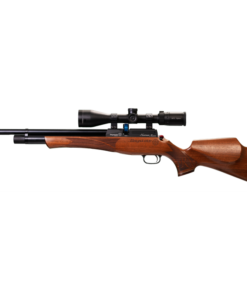
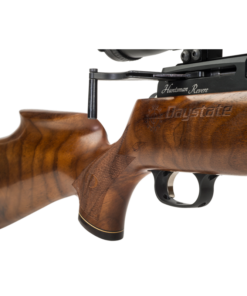
Daystate Huntsman Revere Regulated

$1,300.00
The new Huntsman Revere incorporates the same side lever system also used in their flagship Wolverine R line of rifles. This superior cocking action is smooth and almost effortless. When the cocking lever reaches the rearward position, the magazine rotates a pellet into the bore line. On the forward closing stroke, the pellet is inserted into the bore and the lever is magnetically assisted to close, a delightful experience.
The German made, Competition grade A.R.T approved barrel and match grade fully adjustable trigger provide long range accuracy for target and hunting use. Other user inspired features include: Individual pressure gauges for both air cylinder and regulator, an 11mm scope rail, shrouded barrel with capped ½ UNF threads, and industry exclusive 5-year warranty for the USA.
Daystate Huntsman Revere Regulated PCP Air Rifle
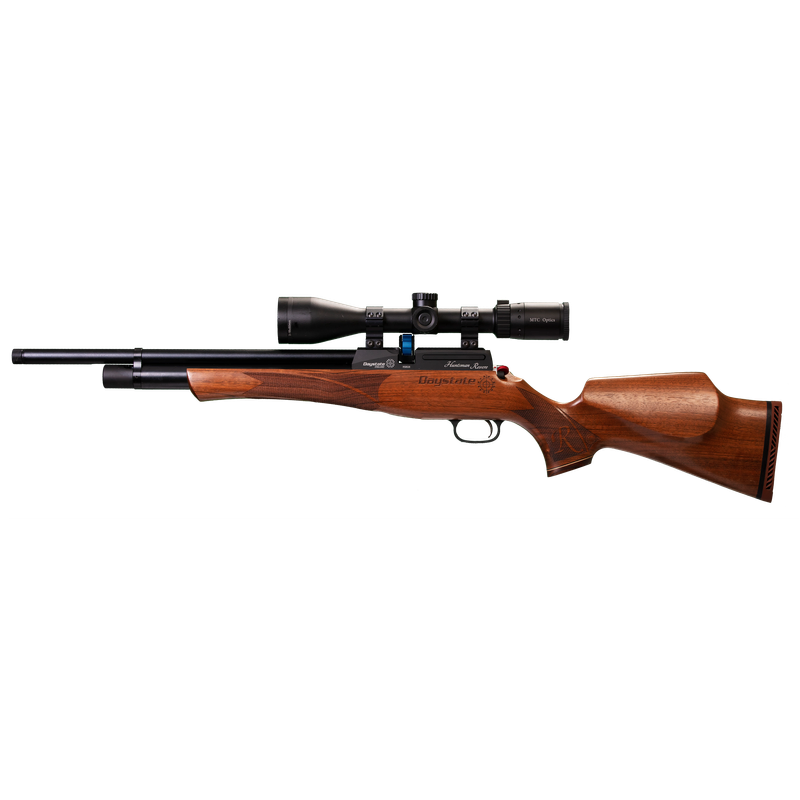
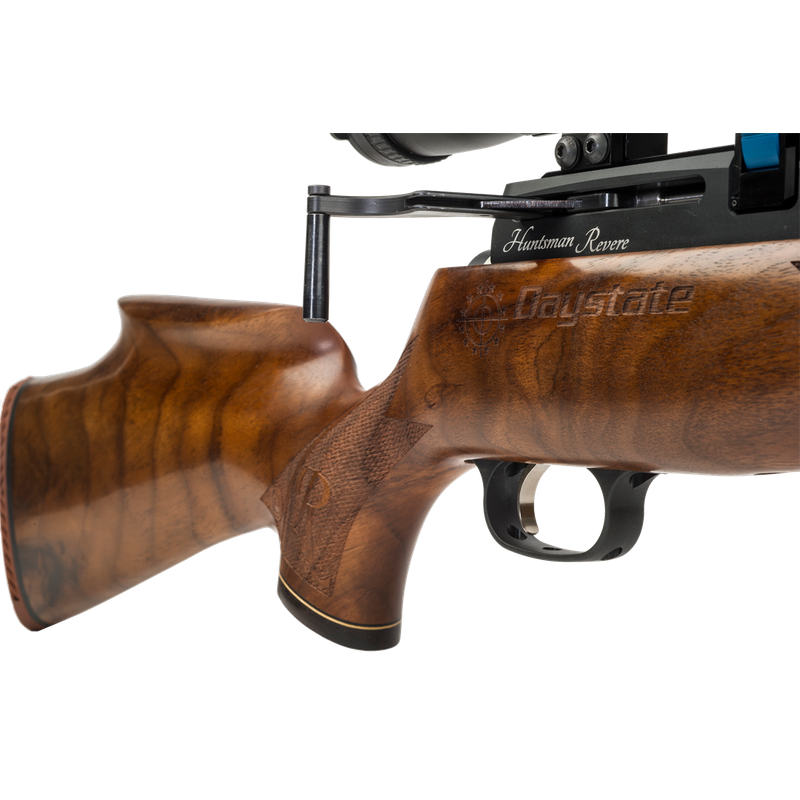
The Daystate Huntsman Revere Regulated has been created for shooters who appreciate traditional sporting-rifle elegance but expect the consistency, convenience, and accuracy delivered by a modern pre-charged pneumatic platform. A beautifully proportioned profile is combined with a refined sidelever action, an efficient regulated firing system, a shrouded match-grade barrel, and a carefully shaped sporting stock. Consequently, classic appearance does not have to be sacrificed to obtain dependable contemporary performance.
Every element of the rifle has been arranged around balance and practical usability. Instead of being burdened by an oversized tactical chassis or unnecessarily complicated electronic controls, the Huntsman Revere is presented as a streamlined mechanical PCP rifle. Its action is seated low in the stock, its controls are positioned within comfortable reach, and its overall shape is kept slim enough for convenient carrying. Therefore, the rifle can be enjoyed by experienced enthusiasts as well as shooters who are entering the premium PCP category for the first time.
A HUMA-Air regulator has been incorporated so that more consistent pressure can be supplied to the firing valve. As a result, dependable shot-to-shot performance can be maintained across the rifle’s useful pressure range. The firing cycle is also kept controlled and predictable, which allows attention to be placed on sight alignment, trigger control, and responsible shot placement.
Moreover, a sidelever mechanism has been fitted to reduce the effort required to cock and reload the rifle. The lever can be cycled smoothly without the shooting position being disturbed unnecessarily. A revised self-indexing magazine system is supported, while a single-shot loading tray is normally included for deliberate target work. Accordingly, the platform can be configured for either convenient follow-up loading or a slower, highly focused shooting routine.
Whether the rifle is being selected for precision target shooting, regulated pest-management duties where legally permitted, small-game applications under applicable regulations, or general airgun enjoyment, a versatile and sophisticated experience is provided. Above all, the Huntsman name is respected because understated design, practical engineering, and field-ready accuracy have been brought together without excess weight or complexity.
Daystate Huntsman Revere Regulated Highlights
- Regulated PCP action: A HUMA-Air regulator is incorporated to support consistent velocity, predictable performance, and efficient use of the available air supply.
- Smooth sidelever operation: Cocking and loading are made easier through a refined mechanical sidelever system.
- Multiple calibre choices: Configurations may be offered in .177, .20, .22, and .25, although regional availability can vary.
- Several power configurations: Sub-12 ft-lb and higher-power FAC versions may be offered according to calibre, market, and local regulations.
- Up to 40 ft-lb in selected versions: High-power .25-calibre configurations may be rated up to approximately 40 ft-lb by the manufacturer.
- Shrouded match-grade barrel: Accuracy, stability, and a moderated firing report are supported by the precision barrel assembly.
- Self-indexing magazine: Convenient multi-shot loading is provided through Daystate’s revised gate-loading magazine design.
- Single-shot loading option: A dedicated tray can be used when individual pellet loading is preferred.
- Adjustable two-stage trigger: Trigger characteristics can be tailored within the manufacturer’s recommended adjustment range.
- Low-seated action: A natural head position and balanced handling are encouraged by the action’s placement within the stock.
- Premium stock choices: Traditional walnut and textured Safari-style configurations may be available.
- Right- and left-handed options: Selected walnut configurations can be ordered for the shooter’s preferred orientation.
- Ambidextrous Safari Edition: An alternative textured stock can be selected by shooters who want adaptable handling.
- Accessory mounting provision: Depending on the stock version, attachment points may be provided for a sling, bipod, or compatible shooting support.
- Mechanical simplicity: Reliable operation is achieved without electronic firing controls or batteries.
A Modern Interpretation of a Historic Sporting Rifle
Few PCP platforms have been allowed to retain such a recognizable identity across multiple generations. The Huntsman name has been represented in the Daystate range for more than four decades, and its underlying sporter character has been preserved while successive mechanical improvements have been introduced. With the Revere generation, one of the platform’s most significant upgrades has been provided: a dedicated sidelever action.
Previously, a more traditional bolt-style arrangement was associated with the series. However, higher-powered PCP rifles are frequently benefited by a well-designed sidelever because less effort can be required during cocking. Therefore, the Daystate Huntsman Revere Regulated can be cycled in a controlled, fluid manner while the rifle remains supported.
Although the mechanism has been modernized, the external character has not been abandoned. A conventional rifle profile is still presented. Sweeping stock lines, a restrained receiver, and a slim air cylinder are integrated rather than being visually separated. Consequently, the rifle appears cohesive and mature instead of overly mechanical.
This design direction will be especially appreciated by shooters who want PCP performance without the military-inspired appearance found on many contemporary air rifles. Furthermore, the platform can be mounted naturally and carried comfortably because its proportions have been kept close to those of a classic sporting arm.
Regulated Performance and Consistent Air Delivery
Consistency is one of the most important qualities that can be built into a precision PCP rifle. As the reservoir pressure falls, an unregulated system may deliver air to the valve at gradually changing pressures. When those variations become significant, muzzle velocity and pellet impact can be affected. By contrast, a regulator is used to isolate the firing valve from the changing pressure held in the main reservoir.
A HUMA-Air regulator has been installed in the Daystate Huntsman Revere Regulated. Consequently, air can be supplied to the firing system at a more controlled pressure throughout the rifle’s regulated operating range. More uniform velocity can therefore be encouraged, and vertical variation on the target may be reduced when a suitable pellet, stable support, and sound shooting technique are used.
Naturally, accuracy cannot be guaranteed solely by the presence of a regulator. Pellet quality, barrel condition, atmospheric conditions, scope setup, shooter technique, and the selected power configuration must also be considered. Nevertheless, a properly functioning regulated system provides a dependable foundation on which accurate performance can be developed.
The regulator also supports more predictable shot management. Once the preferred fill pressure and refill point have been understood, shooting sessions can be planned with greater confidence. Instead of wondering how rapidly the point of impact may change as pressure declines, the shooter can concentrate on the pressure gauge and remain within the recommended operating range.
Moreover, efficient air usage can be encouraged because a controlled volume of air is released for each shot. The exact shot count will vary according to calibre, legal power level, pellet weight, reservoir pressure, temperature, and rifle setup. Therefore, one universal shot-count figure should not be assumed for every version.
Refined Sidelever Action
The sidelever represents one of the defining features of the Revere generation. It has been designed so that the firing mechanism can be cocked and the magazine advanced with a smooth rearward and forward movement. Because the lever is positioned conveniently beside the receiver, it can be reached without excessive hand movement.
During supported target shooting, the rifle can remain settled on a rest while the action is cycled. Likewise, when a responsible follow-up shot is legally and ethically required in the field, unnecessary disruption to the shooting position can be minimized.
A lighter and smoother cocking stroke is particularly useful in higher-power configurations, where greater spring and hammer forces may otherwise have to be managed. Daystate specifically identifies reduced cocking effort as one of the reasons the sidelever arrangement is suited to higher-output PCP rifles.
In addition, the mechanism contributes to the rifle’s premium character. Movement is intended to feel deliberate rather than loose or abrupt. However, the lever should always be operated fully and without being forced. Correct cycling allows the magazine to index properly and helps prevent pellet-loading errors.
The trigger should not be touched while the action is being loaded. Furthermore, the muzzle must always be kept pointed in a safe direction, and the rifle should be treated as loaded until its condition has been personally verified.
Revised Self-Indexing Magazine System
A practical multi-shot magazine has been developed for the Huntsman Revere. The breech and action have been optimized to work with Daystate’s revised gate-loading, self-indexing magazine design. Accordingly, each pellet can be presented in sequence as the sidelever is cycled.
Magazine capacity depends on calibre and the magazine supplied for the selected market. Smaller-calibre versions generally allow more pellets to be carried, while larger projectiles naturally occupy more space. Therefore, the specification shown for the exact product variation should be checked before an order is completed.
A self-indexing magazine offers several advantages during a normal shooting session. Pellets can be loaded before the firing line is entered, repeated handling can be reduced, and the next shot can be prepared with a simple lever movement. This arrangement can be particularly welcome during outdoor shooting, where small loose pellets might otherwise be difficult to handle while gloves are being worn.
Nevertheless, the magazine should never be relied upon as an indicator that the rifle is unloaded. Once it has been removed, the breech and barrel must still be checked according to the manufacturer’s procedure. An additional pellet may remain chambered even when the magazine appears empty.
For best results, the magazine should be kept clean and protected from dirt, grit, and damaged pellets. Projectiles should be inspected before loading, and heavily deformed examples should be discarded safely. By maintaining the magazine and using consistent ammunition, smoother feeding can be supported.
Single-Shot Loading for Deliberate Precision
Not every shooting session requires rapid reloading. For careful pellet testing, formal target practice, or deliberate bench shooting, a single-shot loading tray may be preferred. Daystate includes its current tray system with the Revere package, although package contents should always be confirmed for the exact listing and destination.
When the tray is installed, each pellet can be handled and inspected individually. Consequently, damaged skirts, inconsistent shapes, or visibly contaminated pellets can be identified before they enter the barrel. A more deliberate rhythm is also created, which may help the shooter maintain concentration.
Single loading can be useful when several pellet designs are being compared. Each group can be completed with a clearly identified pellet type, and accidental mixing inside a magazine can be avoided. Furthermore, pellet orientation can be observed directly as the projectile is introduced into the breech.
Although the process is slower, speed is rarely required during accuracy evaluation. Consistency of setup, breathing, support, trigger release, and follow-through should be prioritized. Therefore, the included tray adds genuine versatility rather than merely serving as a spare accessory.
Match-Grade Barrel and Shrouded Construction
A match-grade barrel is fitted so that the rifle’s regulated air delivery can be translated into reliable downrange precision. Barrel quality remains essential because the pellet must be stabilized and guided consistently before it leaves the muzzle.
The barrel is surrounded by a shroud, through which the report produced by the firing cycle can be reduced. However, perceived sound varies according to power level, calibre, pellet choice, surroundings, and local configuration. A rifle that appears quiet in an open field may sound noticeably louder beside walls or beneath a covered firing point because sound is reflected.
The shroud also contributes to the Huntsman’s clean appearance. Rather than leaving an exceptionally thin barrel exposed, a visually balanced assembly is created above the air cylinder. As a result, the rifle retains a graceful sporter profile while modern sound-management features are incorporated.
Where a separate moderator is considered, local laws must be checked first. Compatibility should also be confirmed with the retailer or manufacturer because thread types and regional specifications can differ. An unsuitable accessory should never be forced onto the barrel assembly.
Routine bore maintenance should be conservative. Excessive cleaning can cause more problems than it solves, particularly when unsuitable rods, aggressive solvents, or abrasive materials are used. Therefore, the guidance supplied by Daystate should be followed, and only airgun-safe products should be selected.
Adjustable Two-Stage Trigger
Precise shooting is supported by a two-stage adjustable trigger. The first stage allows pressure to be taken up in a controlled manner, while the second stage provides a defined release point. When it has been set correctly, the trigger can help the shot be released without unnecessary disturbance to sight alignment.
Adjustability does not mean that every internal setting should be altered without care. Trigger mechanisms are safety-critical assemblies. Therefore, adjustments must remain within the manufacturer’s recommended limits, and the rifle must pass all prescribed safety checks after any change has been made.
Many shooters may find the factory configuration suitable from the beginning. Familiarity should first be developed through safe dry-handling procedures where permitted and through controlled range use. Only after the original feel has been understood should minor changes be considered.
A trigger should never be made dangerously light for the sake of perceived precision. Instead, a predictable release, secure sear engagement, and clear distinction between the stages should be maintained. If professional inspection is required, the work should be entrusted to a qualified airgun technician.
Traditional Walnut Stock Options
The walnut-stocked Daystate Huntsman Revere Regulated is shaped for shooters who prefer natural material and traditional craftsmanship. Because walnut grain varies from one stock blank to another, each rifle can display an individual pattern, tone, and figure. Product photographs should therefore be treated as representative unless the exact rifle has been pictured.
The action is seated low within the stock, which has long been a defining characteristic of the Huntsman design. As a result, the scope does not need to be positioned unnecessarily high, and a more natural relationship between the cheek, eye, and optic can be achieved when suitable mounts are selected.
Checkering or textured gripping areas are provided so that control can be maintained around the grip and forend. Meanwhile, the forend is kept sleek enough to be carried comfortably or supported across a shooting bag.
Depending on availability, right-handed and left-handed walnut versions may be offered. The correct configuration should be selected rather than assuming that every listing is ambidextrous. For a left-handed shooter, the appropriate stock orientation can materially improve cheek placement, grip comfort, and access to the controls.
Walnut should be cared for with products intended specifically for finished gunstocks. The rifle must not be left wet, stored inside a damp case, or exposed to prolonged heat. After outdoor use, moisture should be removed with a soft cloth, and the rifle should be allowed to reach room temperature before secure storage.
Huntsman Revere Safari Edition
A more adaptable stock is offered through the Huntsman Revere Safari Edition. Raised-grain wood is used to provide a tactile surface, while a natural camouflage appearance is created by the stock’s distinctive finish. Stippled panels are added around the grip and forend so that secure contact can be maintained.
Unlike handed walnut configurations, the Safari stock has been designed to be genuinely ambidextrous. Therefore, it may be preferred by households in which the rifle will be used by more than one authorized shooter or by individuals who occasionally change shooting sides.
An adjustable rise-and-fall cheekpiece is incorporated. Eye alignment can consequently be adapted for different optic dimensions and mount heights. A soft-feel rubber surface is also applied to the comb so that comfortable cheek contact can be maintained during longer sessions.
The forend is made broader and flatter than that of the traditional sporter stock. Because of this geometry, a stable interface can be formed on a benchrest or shooting bag. At the same time, material has been relieved to prevent the stock from becoming unnecessarily heavy.
Attachment points are incorporated for shooters who wish to add a sling, bipod, or another compatible support. Every accessory must be installed correctly, and the attachment hardware must not interfere with the air cylinder, stock, or internal components.
Finally, a scalloped butt profile is used to promote stable shoulder placement. The same shape can also be positioned effectively against a rear bag during supported target shooting. Thus, field practicality and bench-oriented adjustment are combined within one distinctive stock.
Balanced Sporter Handling
A premium air rifle should not be judged only by the numbers shown on a specification sheet. Balance, reach, grip angle, cheek position, and ease of mounting can be equally important. These qualities have traditionally been emphasized in the Huntsman platform.
Because the air reservoir is housed beneath the barrel and the action is positioned low in the stock, the rifle’s mass is distributed along a familiar sporting profile. It can therefore be brought into the shoulder naturally without the top-heavy sensation sometimes produced by large scopes and tall receiver assemblies.
Balance will, of course, be changed by the chosen optic. A compact hunting-style scope can preserve the rifle’s agile feel, whereas a large target optic with an oversized objective lens and heavy mounts will add noticeable weight. Consequently, optics should be chosen according to the rifle’s intended role rather than magnification alone.
A lightweight sling may be fitted where compatible mounting points are provided. However, the sling must never be used as a substitute for secure muzzle control. Likewise, a bipod may improve supported stability, but care must be taken to prevent the rifle from being left unattended or pointed in an unsafe direction.
Calibre and Power Choices
The Daystate Huntsman Revere has been produced in several calibre and power configurations. Daystate lists .177, .20, .22, and .25 options, although not every variation will necessarily be stocked or permitted in every country.
In manufacturer-listed high-power configurations, output may be offered up to approximately:
- .177 calibre: Up to 18 ft-lb in selected versions
- .22 calibre: Up to 30 ft-lb in selected versions
- .25 calibre: Up to 40 ft-lb in selected versions
Lower-powered configurations, including versions intended to comply with UK non-FAC limits, may also be available. Actual energy can vary with the selected pellet and individual rifle setup. Therefore, the legal classification of the exact version must be confirmed before purchase, possession, transport, or use.
.177-Calibre Configuration
A flatter trajectory is often associated with .177 pellets at appropriate velocities. For that reason, this calibre is widely selected for paper-target shooting and precision practice. Pellet availability is generally broad, while each projectile’s smaller dimensions may allow greater magazine capacity.
Nevertheless, the lightest pellet should not automatically be selected. Stability, consistency, and suitability for the barrel must be evaluated. In higher-power .177 configurations, particularly careful pellet matching may be required so that excessive velocity is avoided and accuracy is preserved.
.20-Calibre Configuration
The .20 calibre occupies a less common position between .177 and .22. It can offer a useful balance of pellet weight and trajectory, although ammunition selection may be more limited in some regions. Shooters considering this version should check that suitable quality pellets can be obtained consistently before selecting the rifle.
Because .20 is comparatively specialized, availability of magazines and replacement accessories should also be confirmed. For enthusiasts who already understand the calibre, however, it can provide a distinctive and rewarding setup.
.22-Calibre Configuration
The .22 version is often chosen as a versatile all-around option. A broad selection of pellets is available in many markets, and useful downrange energy can be retained without the projectile dimensions of .25 calibre.
For target shooting, stable performance may be achieved with well-matched domed pellets. Where lawful pest control or small-game hunting is undertaken, an appropriate pellet must be selected and sufficient accuracy must first be demonstrated on targets. Ethical range limitations must always be respected.
.25-Calibre Configuration
The .25 version is intended for shooters who require a heavier projectile and greater potential energy. Up to approximately 40 ft-lb may be produced in certain manufacturer-listed configurations. Consequently, this model is likely to be regulated or licensed in many jurisdictions.
A more curved trajectory may be experienced compared with lighter calibres, especially as distance increases. Accurate range estimation and a properly verified trajectory profile are therefore essential. Higher air consumption may also be expected, so fewer regulated shots can generally be obtained per fill than from lower-powered configurations.
Pellet Selection and Accuracy Testing
No single pellet can be guaranteed to perform best in every barrel. Even rifles of the same model and calibre may show individual preferences. Consequently, a selection of reputable pellets should be tested before a large quantity is purchased.
Testing should be conducted from a stable, safe position with a suitable backstop. Groups should be fired at consistent distances, and the same aiming technique should be maintained. Wind conditions should also be noted because lightweight pellets can be affected significantly by changing air movement.
At least several groups should be completed with each pellet type. A single unusually small group may have been produced by chance, while one poor group may have resulted from shooter error. Therefore, repeatability should be valued more highly than one exceptional result.
Pellets should also be examined for damaged skirts, inconsistent heads, or contamination. They must be stored in a dry container and protected from impact. Lubrication should not be applied unless it is specifically recommended and understood, because excessive oil can enter the barrel and alter performance.
Once a preferred pellet has been identified, the rifle’s point of impact should be verified throughout the expected distance range. This information can be recorded in a simple trajectory chart. However, such testing should be completed only on an approved range or another lawful shooting area with a reliable backstop.
Optics and Scope Setup
No open sights are typically relied upon for a precision PCP rifle of this type; therefore, a compatible scope and mounting system will normally be required. The optic should be selected according to the rifle’s intended use, expected distance, available light, and desired overall weight.
A compact variable-power scope can complement the Huntsman’s streamlined handling. For bench shooting, a larger objective lens and increased magnification may be preferred. Nevertheless, excessive scope size can raise the centre of gravity and reduce the rifle’s portability.
Mount height deserves particular attention. The objective bell must clear the barrel and receiver, but the optic should not be mounted higher than necessary. A lower, secure installation can support a more natural cheek weld and reduce the difference between the optical axis and the bore axis.
Ring compatibility must be verified with the rail specification of the exact rifle. The mounts should be tightened evenly to the manufacturer’s recommended torque. Over-tightening can damage the scope tube or mounting hardware, while insufficient tension can allow the optic to shift.
After installation, eye relief should be checked from the normal shooting position. The reticle should appear level when the rifle is held naturally, and the full field of view should be visible without the head being stretched forward or pulled backward.
Zeroing must be completed in a controlled environment. Initial alignment can be performed at close range before the final zero distance is used. Each adjustment should be recorded, and the pellet’s actual point of impact should be confirmed rather than being estimated.
Filling and Pressure Management
The Huntsman Revere is powered by compressed air and must be filled only through suitable PCP-rated equipment. A compatible hand pump, high-pressure compressor, or certified charging cylinder may be used, provided that clean, dry air is supplied.
The maximum fill pressure specified for the exact rifle must never be exceeded. Information should be taken from the rifle’s manual, markings, and current manufacturer guidance rather than copied from another model. Furthermore, the pressure gauge should be observed during filling, and the process should be stopped immediately if abnormal heat, leakage, or resistance is detected.
When a charging cylinder is used, its valve should be opened slowly. Rapid filling can generate heat and may make the pressure reading less representative once the air cools. A controlled fill is therefore safer and may provide a more accurate final pressure.
After filling has been completed, the charging line must be bled before the connector is removed. The exact procedure will depend on the equipment being used. Eye protection should be worn, and hands should be kept clear of pressurized fittings.
Only components rated for the required working pressure should be selected. Automotive compressors, workshop air hoses, and low-pressure fittings must never be substituted for certified PCP equipment.
Mechanical Simplicity Without Batteries
The Daystate Huntsman Revere Regulated is operated mechanically. No battery is required for the firing cycle, and no electronic programming menu has to be navigated before the rifle can be used.
For many shooters, this simplicity will be considered one of the model’s strongest qualities. The rifle can be filled, loaded, made ready, and used through familiar physical controls. In addition, concerns about battery charge, electronic display visibility, or software configuration are removed.
Mechanical operation should not be mistaken for basic construction. A regulator, precision valve, refined sidelever, self-indexing magazine, and adjustable trigger are all integrated. Therefore, advanced performance is delivered through carefully developed mechanical engineering.
This balance makes the rifle especially appealing to those who admire Daystate craftsmanship but do not require the extensive electronic adjustment offered by some of the brand’s flagship platforms.
Designed for Responsible Target Shooting
On a formal range, the rifle can be configured for precise paper-target or reactive-target shooting where those targets are permitted. Its regulator supports consistent strings, while the single-shot tray allows a deliberate routine to be followed.
A suitable pellet trap or backstop must always be installed. Hard surfaces, water, glass, and unsuitable metal objects should never be used as improvised targets because ricochets may be produced. Eye protection should be worn, and all range commands must be followed.
Before each session, the rifle’s pressure, mounts, fasteners, and barrel condition should be checked. The magazine should be inspected, and the selected pellets should be confirmed. Afterward, the rifle must be unloaded and secured before leaving the firing line.
Responsible Field Applications
Where lawful, properly licensed, and appropriate, selected versions may be used for pest-management or small-game applications. However, ownership of a powerful PCP rifle does not by itself establish that the rifle is suitable for every quarry or situation.
Local law, landowner authorization, safe backstops, calibre suitability, and humane capability must all be established beforehand. Furthermore, reliable accuracy should be demonstrated on targets from realistic field positions before any live quarry is considered.
The shooter must understand the pellet’s trajectory and retain a strict personal distance limit. Shots should be declined whenever the target cannot be positively identified, a safe background is absent, or humane placement cannot be assured.
Why Choose the Daystate Huntsman Revere Regulated?
The rifle occupies a distinctive position within the premium PCP market. It is neither presented as an entry-level utility gun nor overloaded with adjustments that may never be used. Instead, a sophisticated mechanical action is housed inside an elegant sporting format.
Its strongest advantages include:
- A proven Huntsman design heritage
- A consistent HUMA-Air regulated action
- Smooth sidelever cocking
- Classic walnut and adaptable Safari stock options
- Multi-shot and single-shot loading
- A shrouded match-grade barrel
- An adjustable two-stage trigger
- Multiple calibre and power choices
- Balanced handling without excessive bulk
- Battery-free mechanical operation
For the buyer who wants a refined PCP rifle with traditional visual appeal, the combination is difficult to overlook. Moreover, it can be adapted to different shooting roles through the choice of calibre, stock, optic, and legal power level.
Important Purchase and Compliance Notice
Airgun laws differ substantially between countries, states, provinces, and local jurisdictions. Some versions of this rifle may require a firearms certificate, permit, registration, secure-storage arrangement, age verification, dealer transfer, or another form of authorization.
Consequently, eligibility must be confirmed before an order is placed. The buyer is responsible for understanding the laws that apply to possession, shipment, transport, storage, and use. High-power or FAC-rated models should never be ordered on the assumption that air rifles are unregulated everywhere.
Product specifications, stock appearance, magazine capacity, power output, accessories, and package contents may vary by region or production batch. Therefore, the exact configuration should be confirmed before checkout.
Frequently Asked Questions
What type of air rifle is this model?
It is a premium pre-charged pneumatic air rifle that uses compressed air stored inside an onboard cylinder. Before shooting begins, the cylinder must be filled with clean, dry air through compatible high-pressure filling equipment. Once it has been charged correctly, multiple shots can be taken before another refill is required.
Unlike a spring-powered rifle, very little movement is produced during the firing cycle. Consequently, a smooth and controlled shooting experience can be enjoyed. No battery is required because the firing system is mechanically operated.
What is the purpose of the regulator?
A HUMA-Air regulator is incorporated to control the pressure delivered from the main air cylinder to the firing valve. Although pressure inside the cylinder gradually falls as shots are taken, a more consistent operating pressure can be maintained within the regulated range.
As a result, shot-to-shot velocity variation can be reduced. A more predictable point of impact may therefore be achieved when quality pellets, a properly mounted scope, and consistent shooting techniques are used. Nevertheless, accuracy will also be influenced by pellet selection, environmental conditions, maintenance, and individual skill.
Which calibres are available?
Depending on the market and current inventory, the rifle may be offered in .177, .20, .22, and .25 calibre. However, every calibre may not be available in every country.
The .177 version is commonly preferred for precision target shooting and a relatively flat trajectory. Meanwhile, .22 is often selected as a versatile general-purpose calibre. The less common .20 option provides characteristics between .177 and .22, while .25 is intended for shooters who require a heavier projectile and greater potential energy.
Before purchasing, the availability and legal classification of the selected calibre should be confirmed.
How much power can be produced?
Power varies according to calibre, regional configuration, and applicable legislation. Lower-powered versions may be supplied for markets where unrestricted air-rifle energy is limited. Meanwhile, selected higher-power versions may produce up to approximately 18 ft-lb in .177, 30 ft-lb in .22, and 40 ft-lb in .25.
Those figures should not be treated as guaranteed output for every rifle. Actual muzzle energy will be affected by the specific configuration and pellet being used. Furthermore, higher-power versions may require a firearms certificate, permit, dealer transfer, registration, or another authorization.
Is a firearms licence required?
That depends entirely on the purchaser’s location and the rifle’s power configuration. In certain countries, a lower-powered version may be owned without a firearms certificate by an adult who satisfies the relevant conditions. In other jurisdictions, most PCP air rifles are regulated regardless of power.
Local laws governing purchase, possession, delivery, transport, storage, and use must therefore be checked before an order is submitted. The buyer should never assume that a configuration advertised in another country can be legally purchased or shipped to their location.
Is the rifle suitable for beginners?
It can be used by a responsible beginner who has received suitable instruction and understands PCP filling procedures, safe handling, and local regulations. The sidelever is operated smoothly, the trigger is refined, and the regulated action makes performance more predictable.
However, this is a premium rifle rather than a basic introductory package. A compatible scope, secure storage equipment, a safe pellet trap, and suitable charging equipment will usually be required. New shooters should also be supervised by an experienced and legally authorized adult whenever applicable.
How is the rifle cocked and loaded?
A sidelever is used to cock the action and chamber a pellet. When the lever is drawn fully rearward, the firing mechanism is prepared and the magazine is indexed. The lever is then returned forward to introduce the pellet into the breech.
The movement should be completed smoothly without being forced. Additionally, the muzzle must remain pointed in a safe direction, the safety instructions must be followed, and the trigger must not be touched during loading.
Does it include a magazine?
A self-indexing multi-shot magazine is normally supplied, although the exact package contents should be confirmed before purchase. Magazine capacity will depend on calibre because larger pellets occupy more space.
A single-shot loading tray may also be included. This tray is particularly useful during careful accuracy testing, pellet comparison, or deliberate target shooting. Because regional packages can vary, the included magazine quantity and loading accessories should be shown clearly on the final invoice.
Can left-handed shooters use it?
Selected stock configurations are suitable for left-handed use. Traditional walnut stocks may be produced in dedicated right- or or left-handed versions. Therefore, the correct orientation should be selected when ordering.
The Safari-style stock is designed to be ambidextrous and may provide greater flexibility when the rifle will be used by authorized shooters with different preferences. Nevertheless, the exact stock supplied should be verified from the product variation rather than assumed from a general photograph.
What is special about the Safari stock?
A tactile raised-grain finish is applied to the Safari stock, while stippled gripping areas are provided around the forend and pistol grip. Consequently, dependable contact can be maintained during changing outdoor conditions.
An adjustable cheekpiece is also included so that eye alignment can be improved for different scopes and mount heights. Moreover, the wider, flatter forend can be supported effectively on a shooting bag or benchrest. Because the design is ambidextrous, it can accommodate a wider range of shooters.
Is the trigger adjustable?
Yes. An adjustable two-stage trigger is fitted. The first stage allows controlled take-up to be felt, while the second stage provides a more clearly defined release point.
Although adjustments can be made, the mechanism should not be altered beyond the manufacturer’s recommended limits. An excessively light or incorrectly adjusted trigger may become unsafe. Therefore, unfamiliar users should leave the factory settings unchanged or have adjustments completed by a qualified airgun technician.
Does the rifle come with a scope?
A scope is not always included. Product photographs may show an optic for demonstration purposes even when the rifle is sold without one. The package description should therefore be checked carefully.
When an optic is selected, the mounting rail, ring size, objective clearance, eye relief, and overall weight should be considered. A compact variable-power scope can preserve the rifle’s balanced handling, whereas a larger target scope may be preferred for supported precision shooting.
Does it have open sights?
The platform is primarily intended to be used with a telescopic sight, so conventional open sights are generally not supplied. A compatible scope and mounting system should be budgeted for unless they are explicitly included in the advertised package.
After installation, the optic must be securely mounted and zeroed on an approved range or another lawful shooting area with a reliable backstop.
How many shots are available from one fill?
The number of usable shots depends on calibre, power level, pellet weight, fill pressure, temperature, and the regulator’s configuration. Lower-powered versions will generally provide more shots from one fill than high-energy versions.
Rather than relying on one universal figure, the specification for the exact variation should be requested. During use, the pressure gauge should be monitored, and the cylinder should be refilled before pressure falls below the recommended regulated range.
What equipment is required for filling?
A PCP-rated hand pump, high-pressure compressor, or certified charging cylinder can be used. All hoses, fittings, gauges, and connectors must be rated for the required working pressure.
Only clean, dry compressed air should be introduced. Oxygen, carbon dioxide, welding gases, or improvised workshop compressors must never be used. The maximum fill pressure specified by the manufacturer must also never be exceeded.
Can it be filled with an ordinary air compressor?
No. A conventional garage, tyre, or household compressor does not normally produce the pressure or air quality required by a PCP air rifle. Attempting to adapt unsuitable equipment can cause equipment failure, moisture contamination, serious injury, or property damage.
A purpose-built PCP compressor or another approved high-pressure air source should be used. Filling should be performed slowly, and the charging line should be depressurized before the connector is removed.
Is the barrel moderated?
A shrouded barrel is fitted, which helps manage the sound produced during firing. However, noise level will vary according to calibre, power configuration, pellet choice, and surroundings.
A separate moderator may be compatible with certain regional versions, but the correct thread and legal status must be confirmed. Sound moderators are restricted or prohibited in some places. Therefore, one should not be purchased, fitted, or used without checking applicable laws.
Which pellets should be used?
High-quality lead pellets of the correct calibre should be selected. Domed designs are commonly tested first because they often provide stable performance across a variety of distances. Nevertheless, each barrel can show an individual preference.
Several reputable pellet types and weights should be compared from a supported position. Repeatable group size should be prioritized rather than choosing pellets solely according to advertised speed or energy. Damaged, dirty, or incorrectly sized ammunition must not be loaded.
Can airgun slugs be used?
Slug suitability will depend on the barrel, calibre, power level, and individual projectile design. A slug should not automatically be considered superior to a conventional pellet. Some configurations may perform well with selected slugs, while others may deliver better accuracy with quality diabolo pellets.
Manufacturer or qualified retailer guidance should be requested before extensive slug testing is conducted. Chronograph results, stability, safe range conditions, and legal energy limits must also be considered.
Is the rifle suitable for target shooting?
Yes. Its regulated action, refined trigger, smooth sidelever, and single-shot loading option make it well suited to precision practice. Supported bench shooting, informal paper-target sessions, and responsible recreational use can all be enjoyed where legally permitted.
For the best results, a correctly fitted scope and carefully selected pellet should be used. A safe pellet trap and dependable backstop must always be installed, while hard surfaces that could cause ricochets should be avoided.
Can it be used for pest control or hunting?
Selected power and calibre versions may be suitable for lawful pest control or small-game hunting. However, suitability must be determined by local law, quarry type, pellet performance, safe shooting distance, and the shooter’s demonstrated ability.
Landowner permission and any required licence must be obtained. Moreover, a safe background must be identified before every shot, and uncertain opportunities must be declined. Humane shot placement should always be prioritized over maximum distance.
What routine maintenance is required?
The rifle should be kept clean, dry, and securely stored. Exterior metal surfaces can be wiped with a soft cloth after handling, while the stock can be maintained with a product appropriate for its finish.
The filling connector and magazine should be protected from dust and grit. Petroleum-based oils must not be placed inside high-pressure air systems. Internal servicing, regulator work, and trigger repairs should be completed only by a qualified technician.
How should it be stored?
The rifle should be unloaded, uncocked where instructed, separated from ammunition, and secured against unauthorized access. Local storage laws must be followed, especially where a certified cabinet or locking device is required.
Before storage, moisture should be removed. A wet rifle should not be sealed immediately inside a foam-lined case because corrosion or stock damage may develop. The air-cylinder storage pressure recommended by the manufacturer should also be maintained.
What should be inspected when the rifle arrives?
Before use, the model, calibre, serial information, stock orientation, included accessories, and general condition should be checked. The barrel should be unobstructed, the pressure gauge should be examined, and the packaging should be retained until the order has been fully verified.
If shipping damage, missing components, or an incorrect variation is discovered, the rifle should not be fired. Instead, the retailer should be contacted promptly and clear photographs should be provided.
Why is this model considered a premium PCP rifle?
Premium status is supported by the combination of a regulated mechanical action, precision barrel, refined sidelever, adjustable trigger, carefully designed stock, and long-established British sporting-rifle heritage.
More importantly, these features have been integrated into a balanced platform rather than added simply to increase the specification list. Therefore, an elegant appearance, predictable operation, and practical versatility can be enjoyed in one carefully developed package.
Who is this rifle best suited for?
It is particularly well suited to shooters who prefer traditional styling but still want modern regulated PCP performance. It may also appeal to anyone who values mechanical simplicity, smooth loading, quality stockwork, and a balanced sporter profile.
Meanwhile, buyers who require extensive electronic programming or a highly tactical chassis may prefer another platform. For those who appreciate understated engineering and adaptable performance, however, a compelling long-term airgun can be obtained.
Premium Air Rifles and PCP Airguns for Precision Shooting
Choosing the right air rifle becomes easier when performance, intended use, handling, calibre, and local regulations are considered together. Today’s air rifles range from accessible recreational models to sophisticated regulated PCP platforms designed for experienced shooters. Whether an air gun is being selected for controlled target practice, sporting competition, or lawful field use, dependable construction and predictable operation should always be prioritized.
Modern airguns are available in numerous configurations, including traditional sporting rifles, compact carbines, tactical platforms, bullpups, and large-calibre models. Because every airgun is designed for a particular performance range, the most expensive option will not automatically be the most suitable one. Instead, the best air rifle should be matched to the shooter’s experience, preferred calibre, permitted power level, and intended shooting environment.
At Elite Air Gun Store, a carefully selected collection is presented for enthusiasts searching for the best airguns from respected manufacturers. Anyone comparing an air rifle for sale can review available configurations, specifications, and compatible equipment before making a decision. Likewise, customers exploring airguns for sale are encouraged to confirm age restrictions, licensing requirements, transfer rules, and local ownership laws before ordering.
Shop Air Rifles with Greater Confidence
When customers want to buy air rifle equipment, more than muzzle energy should be evaluated. Stock dimensions, trigger design, total weight, action type, magazine capacity, filling requirements, and after-sales support can all affect the ownership experience. Those planning to buy airguns online should also confirm what is included in the advertised package because scopes, moderators, filling connectors, magazines, and cases may be sold separately.
A dependable air rifle shop should provide clear descriptions and distinguish manufacturer specifications from optional equipment. Similarly, a responsible airgun store should avoid promising identical performance from every calibre or pellet. As an experienced airgun dealer, we recommend that product availability and regional compliance be verified before checkout.
Our online airgun store brings together sporting rifles, PCP platforms, optics, pellets, filling solutions, and maintenance products in one accessible catalogue. Independent air rifle reviews can also be consulted when several models appear suitable. However, published airgun reviews should be treated as guidance because results are affected by pellet selection, scope setup, weather conditions, and shooter technique.
Performance for Different Experience Levels
Our collection of premium air rifles has been selected for shooters who value quality engineering, dependable materials, and refined handling. Advanced professional air rifles may include regulated actions, adjustable triggers, match-grade barrels, and configurable stocks. Nevertheless, premium performance should always be supported by safe handling and regular practice.
Most full-powered models are classified as adult air rifles and should be secured against unauthorized access. The phrase air rifles for adults does not remove the need for training, careful storage, or legal compliance. Regardless of experience, the muzzle must always be controlled, the rifle must be treated as loaded, and a safe backstop must be used.
A powerful air rifle may offer useful retained energy, but power alone does not guarantee accuracy. Before a high power air rifle is selected, the owner should understand its air consumption, trajectory, sound level, and legal classification. In many jurisdictions, higher-output versions require licensing, registration, secure storage, or dealer-managed transfer.
For controlled grouping and predictable pellet placement, a precision air rifle should be paired with consistent ammunition and a properly mounted optic. An accurate air rifle is created through the combined performance of the barrel, valve, regulator, trigger, pellet, and shooter. Therefore, realistic range testing should be completed before field performance is evaluated.
Target, Sporting and Field Applications
A dedicated target air rifle can be selected for paper targets, approved reactive targets, and structured training. Where competition is intended, a sport air rifle may provide the balance and adjustability required for repeated positional shooting. A specialist competition air rifle can offer more extensive ergonomic adjustment, while a match air rifle is generally configured around consistency and disciplined shot execution.
For outdoor courses, a field target air rifle is usually combined with a suitable variable-power scope and carefully mapped trajectory information. Responsible air rifle shooting should always be conducted on an approved range or lawful private property with permission. Equally, safe airgun shooting requires eye protection, secure target placement, positive identification of the shooting area, and a backstop capable of containing every pellet.
A hunting air rifle should only be considered where airgun hunting is lawful and the selected calibre is appropriate for the intended quarry. Ethical air rifle hunting depends on demonstrated accuracy, sound judgement, and strict personal range limits. Responsible airgun hunting also requires landowner permission and any applicable licence.
Not every model marketed as air rifles for hunting will be suitable for every species or distance. A small game air rifle must therefore be assessed according to legal energy requirements, pellet performance, and humane capability. Uncertain shots must always be declined.
Accessories, Replacement Components and Equipment
A complete setup may require carefully selected airgun accessories, such as optics, mounts, magazines, slings, bipods, cases, and certified filling equipment. Compatible air rifle accessories should be chosen according to the precise model rather than external appearance alone.
Replacement airgun parts must match the manufacturer’s specifications. Likewise, safety-critical air rifle parts, including trigger components, valves, pressure-bearing fittings, and regulator components, should be installed by a qualified technician.
Our available airgun supplies may include pellets, targets, cleaning materials, charging connectors, hoses, and storage products. Appropriate airgun equipment should always be pressure-rated where compressed air is involved. Additional airgun gear, such as eye protection, shooting bags, chronographs, and secure transport cases, can support a safer and more organized experience.
PCP Air Rifle Technology
A PCP air rifle is powered by high-pressure air stored inside an onboard cylinder or removable bottle. Modern PCP air rifles are valued because minimal recoil is produced and repeated shots can be taken from one fill. Compared with many spring-powered designs, a PCP airgun can provide a smoother firing cycle and greater power flexibility.
The abbreviation PCP means pre-charged pneumatic. Although the phrase pcp airguns covers many designs, every system requires compatible charging equipment and careful pressure management. A conventional PCP rifle may use a traditional sporter layout, while modern PCP rifles can also be built as carbines, bullpups, tactical platforms, or large-calibre systems.
The best PCP air rifle should be chosen according to intended use rather than headline velocity alone. When evaluating a PCP air rifle for sale, buyers should check the maximum filling pressure, regulated shot count, magazine capacity, stock orientation, calibre, and package contents. Anyone preparing to buy PCP air rifle equipment must also budget for a suitable charging source and secure storage.
A listed PCP airgun for sale may be supplied as the rifle alone or as part of a larger kit. Consequently, customers should confirm whether a fill probe, magazine, single-shot tray, scope, mounts, moderator, or case has been included.
Regulated and High-Power PCP Options
A regulated PCP air rifle uses a regulator to deliver air to the firing valve at a controlled pressure. As cylinder pressure falls, a more uniform firing pressure can therefore be maintained across the useful shot string. Velocity variation may consequently be reduced, although pellet quality and shooter technique will still affect results.
A high power PCP air rifle can produce considerably greater energy than a low-powered target model. Because additional air is generally consumed, fewer shots may be obtained per fill. Furthermore, possession restrictions are likely to be stricter in many locations.
For convenient handling, a compact PCP air rifle may be preferred when overall length and transportability matter. However, reduced size should not be confused with reduced capability. The exact balance, barrel length, cylinder capacity, and sound-management system should still be evaluated.
Bullpup, Tactical and Repeating Designs
A bullpup PCP air rifle positions the action farther back within the stock, allowing overall length to be reduced while useful barrel length is retained. Similarly, a PCP bullpup rifle can offer excellent manoeuvrability from a seated or supported position. Nevertheless, trigger feel, cheek placement, sidelever location, and scope height should be considered carefully.
A tactical PCP air rifle may include an adjustable stock, accessory rails, vertical grip, removable bottle, or modular mounting system. Meanwhile, a PCP tactical rifle is often chosen by shooters who want greater configuration flexibility than a traditional wooden sporter provides.
A semi automatic PCP air rifle can prepare the next shot through the energy supplied by its operating system without requiring manual cycling between shots. By contrast, a full automatic air rifle continues cycling while its trigger remains activated, where legally permitted. Such models face significant restrictions in many jurisdictions and must never be purchased or used without confirming applicable law.
Big-Bore PCP Air Rifles
A big bore PCP air rifle is designed to launch larger and heavier projectiles than common small-calibre airguns. The broader category of big bore airgun equipment may include models intended for specialized sporting or lawful field applications.
A 50 caliber air rifle or 50 cal air rifle sits at the upper end of commonly marketed big-bore PCP platforms. Likewise, a 45 caliber air rifle delivers substantially different handling, filling, trajectory, and backstop requirements from a conventional pellet rifle.
Other large-calibre choices may include a 35 caliber air rifle or 30 caliber air rifle. These models generally consume more air and require specialized projectiles. Because extreme energy may be produced, an appropriate range, certified backstop, legal authorization, and experienced supervision are essential.
Popular Small and Medium Calibres
A 25 caliber air rifle is frequently selected when heavier pellets and increased retained energy are required. Meanwhile, a 22 caliber air rifle provides a versatile balance of pellet availability, energy, and manageable air consumption. The phrase 22 PCP air rifle is commonly used for this configuration, while .22 PCP air rifle is the conventional written form.
A 177 air rifle is often preferred for paper targets and sporting disciplines because a relatively flat trajectory can be achieved. A 177 PCP air rifle combines that calibre with a smooth pneumatic action, while a 177 caliber air rifle may also be powered by a spring, gas ram, CO₂ system, or another permitted mechanism.
The less common 20 caliber air rifle occupies a position between .177 and .22. Before this calibre is chosen, local pellet availability should be checked.
Metric descriptions are also frequently used. A 6.35mm air rifle corresponds approximately to .25 calibre, a 5.5mm air rifle corresponds to .22, and a 4.5mm air rifle corresponds to .177. Customers searching for an air rifle 22 caliber should therefore recognize both imperial and metric product labels.
Additional search terms such as PCP 22 air rifle, PCP 25 caliber, PCP 30 caliber, PCP 35 caliber, and PCP 50 caliber describe increasingly varied performance classes. Each calibre should be selected only after ammunition supply, intended range, air consumption, legal status, and backstop requirements have been considered.
How Pre-Charged Pneumatic Rifles Work
A compressed air rifle stores high-pressure air before the trigger is operated. Similarly, a compressed air gun releases a measured volume of that air behind the projectile during firing. Because combustion is not required, recoil and mechanical vibration can be kept relatively low.
A pre charged pneumatic rifle must be filled with clean, dry air from compatible equipment. The broader term pre charged pneumatic airgun also includes pistol, carbine, bullpup, and big-bore formats. Oxygen, carbon dioxide, workshop compressors, and improvised fittings must never be substituted for certified PCP charging equipment.
Choosing a PCP for Its Intended Role
A PCP hunting rifle should provide dependable accuracy with the selected projectile before lawful field use is considered. In contrast, a PCP target rifle may prioritize shot count, trigger refinement, balance, and low power. A specialist PCP competition rifle may provide extensive stock and sight adjustment for structured disciplines.
For configurable handling, a PCP carbine rifle can combine reduced dimensions with familiar sporter ergonomics. Whatever format is preferred, the final choice should be based on practical fit and genuine performance requirements.
Complete Packages and Kits
A PCP air rifle kit may include the rifle, magazine, fill connector, scope, mounts, pump, and protective case. However, contents vary, so every included component should be identified before checkout.
A broader PCP air rifle package may offer better value when all accessories are correctly matched. Buyers looking for a PCP rifle with scope should still confirm optic quality, magnification range, mounting compatibility, and whether zeroing has been completed.
Ultimately, reliable equipment, lawful ownership, responsible handling, and suitable training should be prioritized. By comparing action type, calibre, dimensions, regulation, accessories, and package contents, a more confident long-term selection can be made.
| CALIBER | .177, .22, .25 |
|---|
Be the first to review “Daystate Huntsman Revere Regulated”
Related products
PCP Air Rifles
Air Rifles
Air Rifles
Air Rifles
Air Rifles
Air Rifles
Air Rifles
Reviews
There are no reviews yet.