


FX Crown MkII, Synthetic
$1,500.00
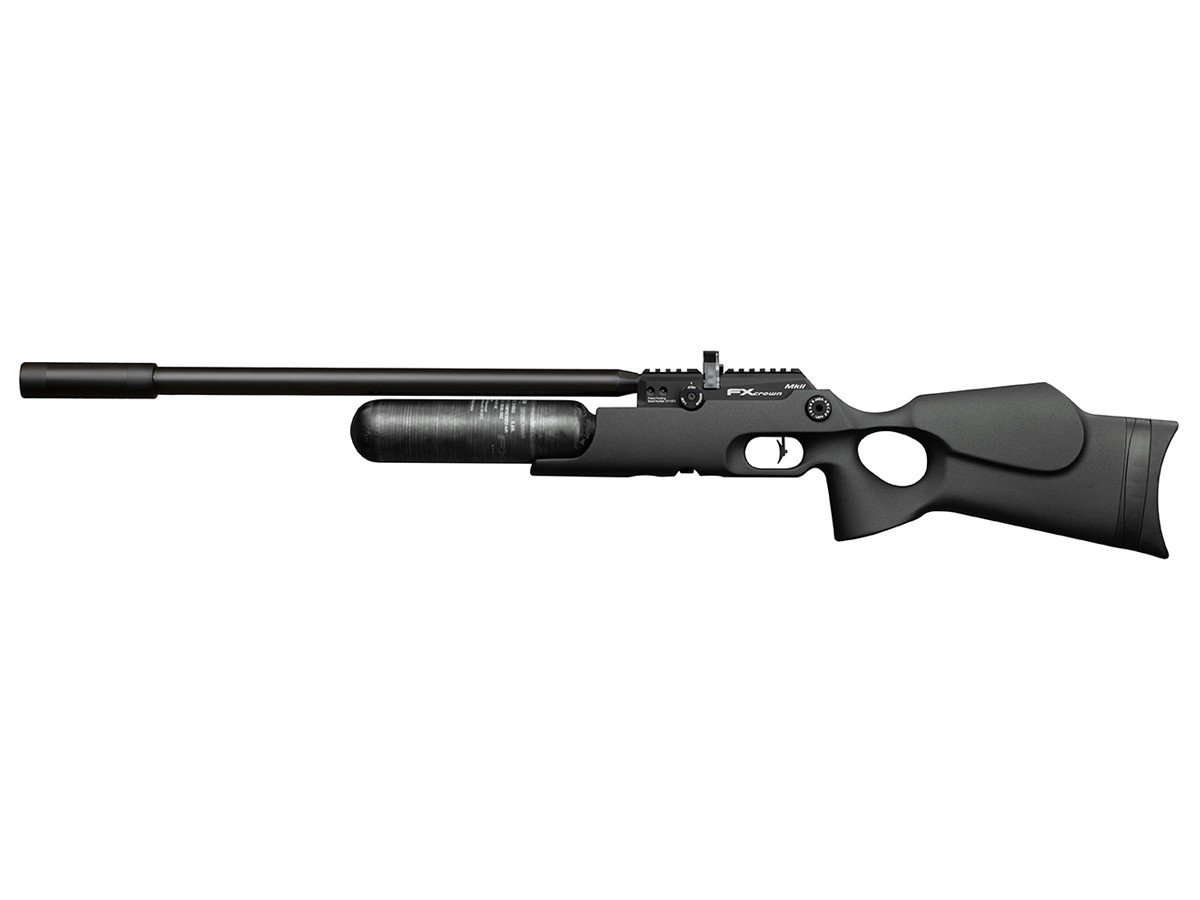
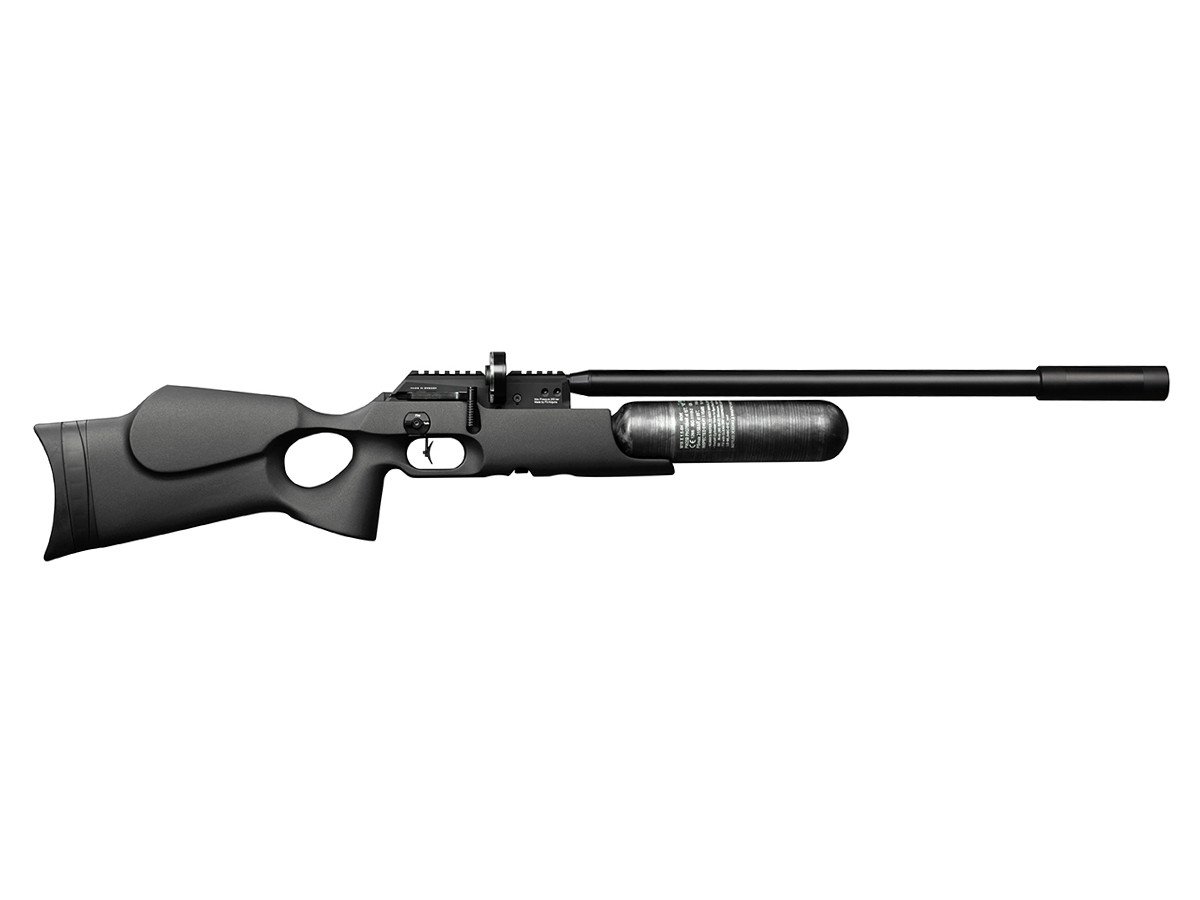
FX Crown MkII PCP Air Rifle, Synthetic Stock
- Ambidextrous thumbhole synthetic stock
- Smooth sidelever cocking system
- Magazine Capacity: 21 rds. in .177, 18 rds. in .22, 15 rds. in .25, 13 rds. in .30
- Shots per fill: 200 in .177, 145 in .22, 110 in .25, 45 in .30
- 500mm (19.685″) or 600mm (23.62″) barrel options
- 28% more plenum volume and larger valving allow for more power than ever before
- With moderator, 500mm barrel models have an overall length of 45″
- With moderator, 600mm barrel models have an overall length of 49″
- Superlight Smooth Twist X (STX) barrel offers more rigidity, yet is about ½-pound lighter than previous version
- Includes Superior liner
- Interchangeable calibers and barrel liners (additional calibers and liners sold separately)
- Fully shrouded barrel
- Updated breech block with four barrel set screws for more rigidity = better performance
- Upgraded action with integrated 20 MOA Picatinny rail
- Breech block upgrade allows for caliber changes without removing scope
- Externally adjustable AMP (Adjustable Match Precision) regulator
- Externally adjustable hammer spring tension
- 3-step transfer port adjustment
- Dual pressure gauges: one for air tube pressure, one for regulator pressure
- Removable 480cc carbon fiber air cylinder
- Max fill pressure is 250 bar (3600 psi)
- Two-stage adjustable, match trigger
- Adjustable buttpad
- Male quick-disconnect Foster fitting
- Includes one magazine and 3-year transferable warranty
- ManufacturerFX Airguns
- Caliber .30
- Velocity 955 fps
- Condition New
- Ammo Type Pellets
- Action Sidelever
- Barrel Style Rifled
- Fire Mode Repeater
- Gun Weight 6.30
- Loudness 2-Low-Medium
- Magazine Capacity 13
- Mechanism Pre-charged pneumatic
- Rail Weaver/Picatinny
- Safety Manual
- Front Sights none
- Rear Sights none
- Shots per Fill 45
- Trigger Adjustability Two-stage adjustable
- Use Small game hunting/target practice
- Warranty 3-year limited warranty
- Upgrades 600mm Barrel
FX Crown MkII Synthetic PCP Air Rifle
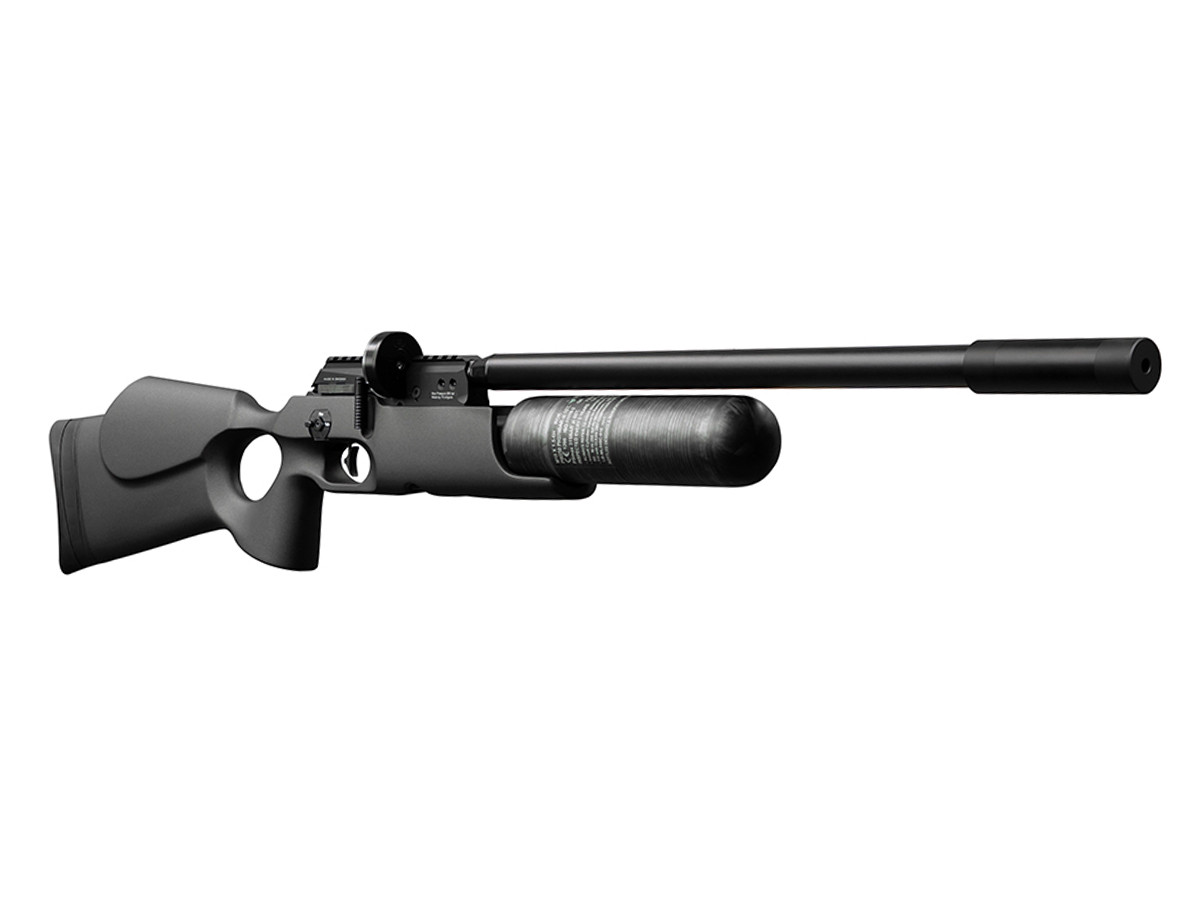

Engineered for shooters who value refined accuracy, adaptable performance, and classic sporter handling, the FX Crown MkII Synthetic is presented as a premium pre-charged pneumatic air rifle with impressive versatility. A familiar rifle profile has been retained, while the advanced adjustment systems expected from FX Airguns have been incorporated throughout the platform.
With its durable synthetic stock, large-capacity carbon-fibre air bottle, smooth sidelever action, and externally adjustable power system, the FX Crown MkII Synthetic can be configured around different shooting preferences. Whether controlled target practice, competitive shooting, or lawful field use is being considered, a balanced and highly customizable experience is provided.
Official configurations are offered in several calibres, barrel lengths, and regional power levels. Consequently, the exact specifications should always be confirmed before an order is placed. FX Airguns lists the Crown MkII in .177, .22, .25, and .30 calibre options, subject to market availability.
Why Choose the FX Crown MkII Synthetic?

A combination of traditional handling and modern airgun technology is delivered by the FX Crown MkII, Synthetic. Rather than being limited to one fixed performance arrangement, the rifle is designed so that important settings can be adapted to the selected ammunition and intended application.
Most importantly, excellent shooting stability is encouraged by the rifle’s full-length sporter layout. A comfortable shoulder position can be maintained, while the raised cheekpiece supports repeatable alignment behind a properly mounted optic. Meanwhile, the adjustable recoil pad allows the fit to be refined for different users, shooting positions, and clothing thicknesses.
Because a synthetic stock is fitted, practical durability is also increased. Moisture, changing temperatures, and routine field handling can be tolerated more easily than they may be by a finely finished wooden stock. Furthermore, less attention is generally required to preserve the exterior finish. As a result, the rifle can be confidently selected by anyone who wants premium FX engineering in a robust, low-maintenance format.
Highlighted Product Features
- Premium PCP operating system for smooth, consistent shooting performance
- Durable synthetic thumbhole stock with an ergonomic, weather-resistant finish
- FX Smooth Twist X barrel system designed around interchangeable barrel-liner technology
- Large carbon-fibre air bottle for extended shooting sessions
- Externally adjustable AMP regulator for controlled performance tuning
- Three-position transfer-port adjustment for convenient airflow selection
- Macro and micro hammer-spring controls for precise power refinement
- Smooth sidelever action for comfortable and efficient magazine cycling
- High-capacity removable magazine with capacity determined by calibre
- Fully shrouded barrel for moderated muzzle report
- Adjustable cheekpiece and recoil pad for a more personalized fit
- Integrated accessory rail for appropriate optics mounting
- Multiple calibre and barrel-length configurations, depending on the market
- Ambidextrous sporter-style design suited to a broad range of responsible adult shooters
Refined Performance Through Advanced Airflow
Greater airflow capacity was incorporated into the Crown MkII platform so that increased performance potential could be supported. The power plenum was enlarged over the original Crown design, and improved valve delivery was introduced. Consequently, heavier projectiles and broader tuning ranges can be accommodated more effectively when they are permitted by the selected configuration.
Consistency is supported by the AMP regulator. A controlled volume of air is supplied for each shot, allowing velocity variation to be minimized when the rifle has been correctly configured. In addition, regulator settings can be adjusted externally. Fine changes can therefore be completed without extensive disassembly, although adjustments should always be performed according to the manufacturer’s instructions.
Further control is offered through the three-position transfer-port selector. Different airflow levels can be selected, while hammer-spring tension can be changed through both macro and micro adjustment systems. Accordingly, the rifle can be adapted for efficiency, lower-energy practice, or higher-power applications where such use is legal.
However, random adjustment should be avoided. The regulator, hammer spring, transfer port, projectile weight, and barrel configuration are designed to function as an interconnected system. Therefore, measured tuning should be completed gradually, and local energy restrictions must always be observed.
Smooth Twist X Barrel Versatility
FX Smooth Twist X barrel technology is fitted to the Crown MkII. Through this system, the internal barrel liner can be changed without requiring an entirely new rifle. Different liners may be selected for compatible projectile types and weights, while calibre conversion may also be supported through the appropriate factory components.
Because ammunition preferences vary, this adaptability can be particularly valuable. One pellet may produce excellent results in one configuration, whereas another may be better suited to a different liner or power setting. Therefore, responsible accuracy testing can be conducted with suitable projectiles and a secure backstop before a preferred combination is chosen.
Additionally, the barrel is fully shrouded. A more controlled muzzle report is created by this design, while the streamlined appearance of the rifle is preserved. Local regulations concerning moderators and other sound-reduction accessories must nevertheless be checked before any optional equipment is installed.
Lightweight Synthetic Stock and Adjustable Ergonomics
Comfort has been prioritized through the Crown MkII Synthetic’s thumbhole stock. A secure grip can be established without excessive wrist strain, while the fore-end is shaped to provide stable support from common shooting positions. Although the rifle carries a substantial air supply, manageable handling is maintained by the lightweight stock and carbon-fibre bottle.
Moreover, the cheekpiece can be adjusted so that eye alignment with the scope is improved. The recoil pad can also be repositioned, allowing shoulder contact to be refined. Even though meaningful recoil is not produced in the same way as it is by a powder-burning rifle, a consistent head and shoulder position remains essential for repeatable accuracy.
The synthetic construction is especially useful where the rifle may be exposed to changing outdoor conditions. Expansion and contraction caused by moisture are reduced, and routine cleaning is simplified. Usually, the surface can be maintained with a soft, lightly dampened cloth, after which it should be dried before storage.
Large Air Capacity for Longer Sessions
A 480cc carbon-fibre air bottle is commonly fitted to the FX Crown MkII Synthetic, although final specifications may vary by configuration. Because a substantial air reserve is provided, longer shooting sessions can be supported between refills. Nevertheless, the actual shot count will be influenced by calibre, barrel length, regulator pressure, projectile weight, power setting, and ambient temperature.
A clearly visible pressure gauge is provided so that the remaining air supply can be monitored. Refilling should only be completed with compatible high-pressure equipment, and the manufacturer’s maximum fill-pressure instructions must never be exceeded. Furthermore, clean, dry air should be used to protect the rifle’s internal components.
Smooth Sidelever and High-Capacity Magazine
Effortless cycling is encouraged by the Crown MkII’s sidelever action. Because the lever is positioned within convenient reach, the rifle can be operated without unnecessary movement between shots. A high-capacity removable magazine is also supplied, with capacity varying according to the chosen calibre.
For careful single-projectile loading, an optional single-shot tray may be used when compatible. This arrangement can be appreciated during deliberate benchrest practice or ammunition testing. Regardless of the loading method selected, the safety procedure outlined in the FX manual should always be followed.
A Premium Platform Built Around the Shooter
Ultimately, the FX Crown MkII Synthetic is distinguished by the breadth of control that is placed at the shooter’s disposal. A weather-resistant stock is combined with sophisticated regulation, adaptable barrel technology, generous air capacity, and refined ergonomics. Consequently, one premium platform can be configured around several responsible shooting disciplines.
Before purchasing, the available calibre, power level, barrel length, magazine capacity, and legal requirements should be confirmed with the retailer. Protective eyewear, a secure backstop, responsible storage, and adult supervision where required must always be prioritized.
For buyers seeking a high-end PCP air rifle that blends classic styling with modern adjustability, the FX Crown MkII, Synthetic offers an exceptionally capable and thoughtfully engineered choice.
FX Crown MkII Synthetic Calibres, FAC Power and Accessories
The FX Crown MkII Synthetic is offered as a highly configurable PCP air rifle capable of being adapted to different shooting disciplines. Multiple calibre options, regional power configurations, adjustable performance controls, and compatible accessories are available. Consequently, the exact specification supplied should always be verified with the retailer before purchase.
Available Calibres
Four principal calibre options are officially listed for the FX Crown MkII: .177, .22, .25, and .30 calibre. Each option provides different characteristics, making calibre selection an important part of configuring the rifle.
.177 Calibre – 4.5mm
The .177-calibre FX Crown MkII Synthetic is generally selected for target shooting, economical practice, and applications where a flatter trajectory is preferred. Because relatively light pellets are used, good velocity can be produced with moderate air consumption.
Higher magazine capacity is also normally provided in .177 calibre. Therefore, fewer magazine changes may be required during extended target sessions. Nevertheless, actual velocity and shot count will depend on the projectile, barrel length, regulator setting, and permitted power level.
.22 Calibre – 5.5mm
A versatile balance is offered by the .22-calibre FX Crown MkII. Greater projectile mass is provided than with .177 ammunition, while manageable air consumption and a practical trajectory are retained.
For this reason, .22 is frequently considered an adaptable choice for target shooting and lawful field use. A broad selection of compatible pellets is also available. Furthermore, the Smooth Twist X barrel system allows suitable liners and ammunition combinations to be evaluated for the desired application.
.25 Calibre – 6.35mm
More projectile weight and energy can be delivered by the .25-calibre FX Crown MkII Synthetic, particularly when the rifle is supplied in an unrestricted or FAC-rated configuration. Wind resistance may also be improved by properly matched heavier projectiles.
However, additional compressed air is normally consumed with each shot. Therefore, the usable shot count per fill may be lower than that of comparable .177 or .22 configurations. The exact performance will be determined by the rifle’s setup, selected ammunition, and regional energy restrictions.
.30 Calibre – 7.62mm
The .30-calibre FX Crown MkII is intended for customers who require the platform’s highest energy potential where ownership and use are legally permitted. Heavy pellets or compatible airgun slugs may be supported when the correct liner and factory-approved configuration are fitted.
Increased air consumption should be expected, while projectile drop must be properly understood. A secure backstop and an appropriate shooting environment are essential because considerably more retained energy may be carried by the heavier projectile.
Sub-12 ft-lb and FAC Configurations
Both Full Power and Sub-12 ft-lb Crown MkII configurations are listed by FX Airguns. However, availability varies according to calibre, barrel length, destination, and local legislation.
For England and Wales, an air rifle that is capable of producing more than 12 foot-pounds of muzzle energy must be held on a valid Firearm Certificate. A rifle at or below the applicable limit generally does not require an FAC, although age, purchasing, possession, transportation, storage, and use restrictions still apply. Current UK government guidance should be consulted, and local police advice should be requested when uncertainty exists.
Different requirements apply in Scotland, Northern Ireland, and other countries. Consequently, “FAC” should not be treated as a universal classification. The laws of the buyer’s actual location must be checked before the rifle is purchased, transferred, adjusted, or used.
Sub-12 ft-lb Power
A factory-supplied Sub-12 model is designed around markets where an air rifle may be possessed without an FAC when its output remains within the legal threshold. Controlled target shooting, club practice, and other lawful applications can be supported by this configuration.
Even so, individual rifles and ammunition combinations can produce different readings. Energy should never be assumed from a single velocity figure. Instead, projectile weight and measured velocity must both be considered. Unauthorized adjustment that causes the rifle to exceed the legal limit may change its legal classification.
FAC and Full-Power Performance
Increased airflow is provided by the Crown MkII’s enlarged plenum, updated porting, and 6.5mm valve. According to FX Airguns, the MkII plenum was increased by 28 percent over the preceding Crown platform.
The final energy level is influenced by calibre, barrel length, projectile weight, regulator pressure, hammer-spring setting, transfer-port position, and valve configuration. Therefore, one universal FAC power figure cannot accurately describe every Crown MkII Synthetic.
External power controls are included, but they should only be used within the manufacturer’s recommendations and the owner’s legal authority. Any adjustment that could alter the rifle’s legal status should be completed by a qualified professional.
Recommended FX Crown MkII Accessories
A carefully selected accessory package can improve comfort, protection, and practical usability without compromising the rifle’s balance.
Optics and Mounting Equipment
Because conventional open sights are not normally fitted, a suitable rifle scope and compatible rings will be required. The Crown MkII features a Picatinny scope rail with a built-in 20 MOA angle, providing additional usable elevation adjustment for suitable optics. Ring height should be selected according to the scope’s objective diameter and the shooter’s preferred cheekpiece position.
Magazines and Loading Accessories
A spare FX Mega Magazine can be carried for convenient magazine changes. Magazine capacity varies by calibre, while compatible metal magazine lids may provide additional clearance for certain heavier projectiles. Compatibility should always be confirmed before accessories are ordered.
A single-shot tray may also be selected for deliberate target shooting and ammunition testing. Careful manual loading can be supported by this accessory, particularly where each projectile is being inspected before use.
Air-Filling Equipment
A compatible high-pressure hand pump, diving cylinder, or PCP compressor may be used to refill the rifle. Clean, dry, filtered air must be supplied, and the maximum permitted fill pressure must not be exceeded. FX lists compatible carbon-fibre bottle options in 300cc, 480cc, and 580cc capacities, although fitment and regional availability should be verified.
Protection and Maintenance
A padded rifle case, protective lens covers, cleaning supplies intended for airgun barrels, and an official FX service kit may be considered. Only manufacturer-approved lubricants should be used because unsuitable petroleum products can damage seals or create a safety hazard in high-pressure systems.
Ultimately, the ideal FX Crown MkII Synthetic calibre, power level, and accessory package should be selected around lawful use, preferred ammunition, handling requirements, and local licensing rules.
Frequently Asked Questions
What is the FX Crown MkII Synthetic?
The FX Crown MkII Synthetic is a premium pre-charged pneumatic air rifle created around a traditional sporter-style design. Advanced adjustment systems are combined with a lightweight, weather-resistant synthetic stock, a high-capacity magazine, a carbon-fibre air bottle, and the FX Smooth Twist X barrel system. Consequently, competition, recreational, and lawful field configurations can be supported by the same adaptable platform.
What is the difference between the original FX Crown and the Crown MkII?
Several important performance improvements were incorporated into the second-generation platform. Most notably, the power plenum was enlarged by approximately 28 percent, while improved porting and a larger 6.5mm valve were introduced. Greater airflow and increased power potential can therefore be provided.
Additionally, a 20 MOA angle was built into the Picatinny scope rail. More usable elevation adjustment can consequently be retained in a compatible scope. Nevertheless, established Crown features such as the external regulator, transfer-port selector, hammer-spring controls, and interchangeable barrel-liner system were preserved.
Which calibres are available?
The rifle is officially offered in four principal calibres:
- .177 calibre or 4.5mm
- .22 calibre or 5.5mm
- .25 calibre or 6.35mm
- .30 calibre or 7.62mm
Availability can differ between countries and retailers. Furthermore, not every barrel length, power level, or stock configuration will necessarily be supplied in every calibre. The exact model specification should therefore be confirmed before an order is completed.
Which calibre should be selected?
Calibre selection should be based on the intended lawful application, local regulations, preferred projectile, available shooting distance, and required energy level.
A relatively flat trajectory and efficient air consumption can be provided by .177 calibre. Meanwhile, a useful balance between projectile weight, trajectory, and shot count is offered by .22 calibre. Greater projectile mass and energy potential can be delivered by .25 calibre, whereas .30 calibre is generally chosen for the platform’s highest-power applications where permitted.
No calibre should automatically be described as the best for every buyer. A configuration that performs well for target practice may not provide the characteristics required for another discipline.
Is a Firearm Certificate required?
The answer depends on the rifle’s power and the laws applicable where it will be possessed. In England and Wales, an air rifle capable of producing more than 12 foot-pounds of muzzle energy must be held on a valid Firearm Certificate. Models operating within the applicable limit are generally classified differently, although purchasing, possession, transportation, and use restrictions still apply.
Separate air-weapon rules apply in Scotland, while different legislation is enforced in Northern Ireland and other countries. Therefore, current guidance should be checked with the relevant licensing authority or local police before purchasing or adjusting the rifle.
Is a Sub-12 ft-lb version available?
Yes. Sub-12 ft-lb and Full Power versions are listed for the Crown MkII platform, although availability depends on the selected market and configuration. A factory-supplied Sub-12 version may be appropriate where an air rifle must remain within the applicable non-FAC limit.
However, performance should not be assumed solely from the model name. Muzzle energy can be affected by projectile weight, velocity, adjustment settings, and individual rifle variation. Consequently, the rifle should be used in its lawful factory configuration unless the owner possesses the required authority for a different power level.
How powerful is the FAC version?
No single energy figure can accurately represent every full-power model. Output is influenced by calibre, barrel length, projectile weight, regulator pressure, hammer-spring tension, transfer-port selection, valve configuration, and regional specification.
For that reason, the manufacturer or retailer’s specification for the exact variant should be consulted. Published maximum figures should not be treated as guaranteed performance with every type of ammunition. Furthermore, adjustments capable of changing the rifle’s legal status should only be undertaken by an appropriately qualified person and within the owner’s licensing authority.
Can the power be adjusted externally?
Several external performance controls are provided. Airflow can be changed through the transfer-port selector, while hammer-spring tension can be refined through macro and micro controls. The AMP regulator can also be adjusted externally.
These controls are intended to help the platform be matched to an appropriate projectile and performance objective. Nevertheless, each control affects the wider system. Random changes may reduce efficiency, consistency, or reliability. Manufacturer instructions should therefore be followed, and legal energy limits must never be exceeded.
What is the AMP regulator?
The Adjustable Match Precision regulator controls the pressure of the air supplied to the firing valve. By creating a regulated working pressure, more consistent projectile velocities can be supported across a useful portion of the rifle’s air supply.
An external regulator adjustment is provided, allowing changes to be made without extensive disassembly. However, adjustment should be performed carefully and in the correct direction. Pressure should not be reduced against a pressurized system unless the manufacturer’s specified procedure permits it.
What is the Smooth Twist X barrel system?
The Smooth Twist X system uses a removable internal barrel liner. Different compatible liners can therefore be installed to accommodate selected projectile types, weights, calibres, or twist requirements.
This arrangement provides more adaptability than a permanently fixed conventional barrel. Even so, a liner change should not be treated as the only requirement for every calibre conversion. The correct liner, barrel components, pellet probe, and magazine may also be required. Factory compatibility must always be confirmed before conversion parts are purchased.
Can pellets and airgun slugs both be used?
Compatible pellets and purpose-designed airgun slugs may be supported when the correct barrel liner, calibre, and power configuration are fitted. However, satisfactory results cannot be guaranteed with every projectile.
Diameter, weight, length, construction, and barrel twist can all affect performance. A projectile that groups accurately in one rifle may perform differently in another example of the same model. Responsible testing should therefore be conducted in a controlled environment with a secure backstop.
What barrel lengths are available?
Different barrel lengths have been produced for the Crown MkII, with availability varying according to calibre and market. Compact, standard, and longer configurations may be encountered through authorised retailers.
A shorter barrel can provide easier handling and reduced overall length. Conversely, a longer barrel may allow compressed air to be used more efficiently in some higher-power configurations. The barrel length should therefore be chosen around balance, legal output, transport requirements, and the intended shooting discipline.
How many shots can be fired from one fill?
The shot count cannot be represented by one universal figure. Calibre, regulator pressure, hammer setting, barrel length, projectile weight, bottle capacity, and required energy will influence the number of useful regulated shots.
Generally, a lower-powered .177 or .22 configuration will produce more shots per fill than a high-powered .25 or .30 model. Environmental temperature and the pressure remaining before refilling can also affect the practical result. Accordingly, retailer figures should be treated as estimates for a specified configuration rather than guarantees for every setup.
What size air bottle is fitted?
A 480cc carbon-fibre bottle is commonly associated with the synthetic model, although the supplied capacity should be confirmed for the exact variant. Compatible carbon-fibre bottles in 300cc, 480cc, and 580cc capacities are listed by FX.
A larger bottle can provide an increased air reserve, but additional overall length or weight may be introduced. Conversely, a smaller bottle can make the rifle more compact and easier to carry while reducing the number of shots available between refills.
What pressure can the bottle accept?
FX carbon-fibre bottles associated with this platform are commonly rated for filling up to 250 bar. Nevertheless, the marking on the installed bottle and the instructions supplied with the individual rifle must take priority over a general product description.
The maximum permitted pressure must never be exceeded. Moreover, only clean, dry, filtered air should be introduced. Oxygen, carbon dioxide, welding gas, or an unsuitable industrial gas must never be used in a PCP air rifle.
How can the rifle be refilled?
An appropriate high-pressure hand pump, diving cylinder, or PCP compressor can be used with the correct filling connector. The filling equipment must be rated for the required working pressure and should include suitable moisture filtration.
Before filling begins, the rifle and connecting equipment should be inspected. The connection should then be secured, and the pressure should be increased gradually. Once the correct fill level has been reached, the line must be depressurized according to the equipment manufacturer’s procedure before it is disconnected.
What magazine capacity is provided?
Magazine capacity varies by calibre. Smaller-calibre models generally hold more projectiles than larger-calibre versions because less internal space is required for each round. The supplied magazine should therefore be verified against the rifle’s calibre and regional package.
Spare magazines may be purchased for convenient use during extended sessions. However, only a compatible magazine should be inserted. Incorrect magazine dimensions or incompatible projectile lengths may cause loading problems or damage.
Can a single-shot tray be used?
A compatible single-shot tray can be used where one is available for the selected calibre and action. This accessory may be appreciated during careful target shooting, accuracy evaluation, or projectile testing.
Each projectile can be manually inspected and loaded, allowing deliberate shooting to be encouraged. Nevertheless, the rifle must still be treated as loaded whenever a projectile has been inserted. The muzzle must remain pointed in a safe direction throughout the process.
Does the rifle include open sights?
Traditional front and rear sights are not normally fitted. A suitable optical sight will therefore be required. A Picatinny scope rail is incorporated, and a 20 MOA angle is built into the MkII rail.
Compatible rings should be selected according to the optic’s tube diameter, objective size, and required mounting height. Adequate clearance must be maintained between the scope and magazine. After installation, the adjustable cheekpiece can be positioned to support a natural and repeatable sight picture.
Is the synthetic stock adjustable?
The synthetic stock includes ergonomic features designed to improve fit and control. An adjustable cheekpiece allows the height of the shooter’s head position to be refined, while the adjustable recoil pad helps support consistent shoulder placement.
Although PCP air rifles produce minimal recoil compared with powder-powered rifles, consistent positioning remains important. A well-fitted stock can reduce strain and make repeatable alignment behind the optic easier to maintain.
Is the stock suitable for left-handed shooters?
An ambidextrous configuration is provided by the sporter-style synthetic stock, making the rifle accessible to both right- and left-handed users. The thumbhole, cheek support, and general grip design are formed to support comfortable handling from either side.
However, the sidelever’s position and the user’s preferred loading technique should still be considered. If a specific left-handed operating arrangement is required, compatibility should be confirmed with the retailer before purchase.
Is the barrel shrouded?
Yes. A full-length barrel shroud is incorporated into the design. The shroud helps manage muzzle report while preserving the streamlined appearance of the rifle.
Actual sound levels will differ according to calibre, power, barrel length, projectile, and surroundings. Where additional sound-reduction equipment is being considered, local laws must first be checked because moderators and related accessories are regulated differently across jurisdictions.
What accessories are recommended?
Useful accessories may include:
- A compatible scope and correctly sized mounting rings
- A padded or lockable rifle case
- Approved high-pressure filling equipment
- Spare calibre-correct magazines
- A compatible single-shot tray
- Protective scope covers
- A secure target holder and effective backstop
- Eye protection
- Manufacturer-approved maintenance products
- An official FX seal or service kit
- A chronograph for lawful performance monitoring
Every accessory should be selected according to the exact rifle variant. Compatibility should never be assumed solely because an item is advertised for another FX model.
How should the rifle be cleaned?
The exterior should be wiped with a soft, dry cloth after handling. If moisture or surface dirt is present, a slightly damp cloth can be used before the rifle is carefully dried. Abrasive cleaners and aggressive solvents should be avoided.
Barrel cleaning should only be completed when necessary and with products suitable for airgun barrels. Excessive cleaning may cause unnecessary wear. Additionally, petroleum-based oil must not be introduced into the high-pressure air system because unsuitable lubricants can damage seals and create a serious hazard.
How should it be stored?
The rifle should be unloaded, depressurized only as directed by the manufacturer, and stored securely away from unauthorized users. A suitable locked cabinet or other legally compliant security arrangement should be used.
Pellets, magazines, filling equipment, and keys should also be controlled responsibly. Moreover, the storage area should remain dry and protected from extreme temperatures. Local licensing conditions may impose additional security requirements, particularly when a full-power model is held on a Firearm Certificate.
Is the FX Crown MkII Synthetic suitable for beginners?
The rifle can be operated by a responsible adult beginner who has received appropriate safety instruction. Nevertheless, its adjustment range and high-pressure PCP system make proper training especially valuable.
New users may benefit from instruction at an established shooting club before settings are changed. Safe muzzle control, trigger discipline, suitable backstop selection, correct filling procedures, and knowledge of local law should all be understood before the rifle is used independently.
What should be checked before purchasing?
The selected calibre, barrel length, bottle capacity, power classification, magazine capacity, supplied accessories, warranty coverage, and legal requirements should all be confirmed. The specification shown on a retailer’s page must match the actual product being supplied.
Finally, the buyer should confirm that suitable filling equipment, a compatible optic, safe storage, and an approved place to shoot are available. When these factors are considered together, the correct configuration can be selected with greater confidence.
Practical Use Scenarios
A premium pre-charged pneumatic rifle becomes most valuable when its adjustable features are matched thoughtfully to a real shooting environment. Rather than being restricted to one discipline, this platform can be configured for controlled target practice, benchrest shooting, approved club competitions, responsible field use, equipment testing, and extended recreational sessions. In every situation, however, lawful ownership, safe handling, secure storage, and an effective backstop must be treated as essential requirements.
Precision Shooting at an Approved Outdoor Range
An outdoor range provides one of the most suitable environments in which the rifle’s accuracy and ergonomic design can be appreciated. Before a session begins, the rifle can be inspected, the bottle pressure can be checked, and the selected magazine can be loaded only after the firing point has been declared safe for shooting.
A properly mounted optic can then be adjusted to provide a clear and comfortable sight picture. Because an adjustable cheekpiece is included, the shooter’s eye can be aligned naturally with the centre of the scope. Meanwhile, the recoil pad can be repositioned so that consistent shoulder contact is supported. These adjustments are especially useful during longer sessions because unnecessary neck, shoulder, and wrist strain can be reduced.
From a supported position, groups can be fired at approved paper targets while the same aiming point is maintained. Different compatible pellets may be compared to determine which option produces the most consistent results. Only one variable should be changed at a time so that meaningful comparisons can be made. For example, one projectile type can be tested before another weight or design is introduced.
A stable bench, suitable front rest, and rear bag may be used where range rules permit them. However, the rifle should never be placed on a rest in a way that points the muzzle outside the designated safe area. The action must also be opened whenever the range is made safe, and any required chamber indicator should be fitted.
Benchrest Accuracy Evaluation
Benchrest shooting is a practical scenario in which the rifle’s regulated action, adjustable stock, and refined trigger can be used effectively. Because much of the shooter’s physical movement is reduced by a stable support system, ammunition consistency and rifle setup can be evaluated more clearly.
Before testing begins, a clean target should be placed at a known and authorized distance. Wind direction, temperature, bottle pressure, and projectile details may be recorded. Several carefully controlled groups can then be produced without rushing the firing cycle. A single-shot tray may be preferred for this process because each projectile can be inspected and manually loaded.
When results are being reviewed, one unusually wide group should not be used to judge the entire setup. Several groups should instead be compared. If a repeated pattern is observed, factors such as optic mounting, stock position, projectile compatibility, and support technique can be checked.
The rifle’s external controls should not be adjusted casually between every group. A consistent baseline should first be established. Any permitted adjustment should then be made gradually and according to the manufacturer’s instructions. Most importantly, the rifle must remain within the power level authorized for the owner and location.
Recreational Target Shooting at a Club
A supervised shooting club offers a welcoming environment for recreational practice. New users can be introduced to range commands, safe loading procedures, correct filling methods, and responsible equipment handling. Experienced members may also be available to help with basic optic setup and shooting posture.
For a relaxed club session, moderate power and a compatible pellet can be selected where the rifle’s configuration allows it. Efficient air use may be prioritized over maximum output, especially when targets are being engaged at ordinary club distances. Consequently, more shots may be obtained from each fill, while noise and equipment demands may be reduced.
The high-capacity magazine can be convenient during repeated target exercises. Nevertheless, it must never be assumed that the rifle is empty simply because the magazine has been removed. The action, loading area, and magazine must all be checked before the rifle is declared clear.
Because the synthetic stock is resistant to routine handling, the rifle can be shared more comfortably between authorized users under proper supervision. The cheekpiece and recoil pad may be adjusted for each participant. However, performance controls should not be altered by inexperienced users without qualified guidance.
Field Target and Positional Practice
Field target and positional shooting require a different approach from supported benchrest work. The rifle may be used from standing, kneeling, sitting, or supported positions according to the rules of the activity. Balance, stock fit, trigger control, and a stable sight picture consequently become particularly important.
The sporter-style layout allows the rifle to be shouldered naturally. Furthermore, the lightweight barrel system helps prevent the front end from feeling unnecessarily heavy. This can make transitions between approved targets more comfortable during an organized course.
Before participating, the competition’s power, calibre, equipment, and target rules should be reviewed. Some events operate under strict energy limits, while others may restrict supports, slings, seating aids, or optical accessories. The rifle should be configured before arrival rather than being extensively altered during the event.
A repeatable routine can be developed at each firing point. The target can first be identified, the safe shooting lane can be confirmed, and the rifle can then be loaded only when permission has been given. After the shot or sequence has been completed, the rifle should be made safe before the participant moves to another position.
Indoor Range Training
An indoor range provides a controlled environment where wind and changing weather are largely removed. Therefore, basic shooting technique, trigger control, breathing, and repeatable body position can be practiced more easily.
A lower-energy factory configuration may be appropriate where it is required by the facility. The selected ammunition must also be compatible with the range’s target system and backstop. Steel targets should never be used unless they have been specifically approved for the rifle’s calibre and energy.
Noise behaviour can differ indoors because sound is reflected by walls and ceilings. Hearing protection may therefore be appropriate even when the rifle is considered relatively quiet. Eye protection should always be worn, particularly where fragments or damaged target materials could be present.
During an indoor session, the large air supply can support an extended period of practice without frequent refilling. Even so, pressure should be monitored rather than allowed to fall unpredictably below the rifle’s useful regulated range. Refilling should only be performed in the designated area with approved equipment.
Lawful Farm and Property Management
Where local law permits air-rifle pest management, the rifle may be considered for professional or responsible property-control work. However, permission from the landowner must be obtained, the selected species must be legally controlled, and every activity must comply with wildlife, animal-welfare, firearms, and discharge regulations.
Before any use is considered, the property should be assessed carefully. Public paths, neighbouring buildings, roads, livestock areas, machinery, hard surfaces, and places where people may unexpectedly appear must be identified. If a safe direction and reliable backstop cannot be guaranteed, no shot should be taken.
The appropriate calibre and lawful power level should be selected with advice from an experienced professional. Humane standards must be prioritized, while speculative or poorly presented opportunities must be refused. Shooting at movement, noise, or an unidentified shape is never acceptable.
Property management should also involve non-shooting measures. Food sources can be secured, damaged structures can be repaired, waste can be contained, and professional pest-control services can be consulted. An air rifle should never be treated as a substitute for a broader prevention plan.
When the rifle is carried between authorized locations, it should remain unloaded and secured in a suitable case. It must not be displayed casually, left unattended, or placed where an unauthorized person can access it.
Ammunition Compatibility Testing
The interchangeable barrel-liner system makes controlled projectile testing a relevant practical scenario. However, safe and meaningful testing requires more than firing many different products without a plan.
First, only ammunition of the correct calibre and suitable design should be considered. Damaged, deformed, contaminated, or incorrectly sized projectiles should be rejected. Each product can then be recorded according to its manufacturer, weight, diameter, and type.
A consistent target distance, support position, fill pressure, and optic setting should be maintained. Several groups can be produced with each candidate, after which accuracy and functional reliability can be compared. If a chronograph is legally and safely available, velocity consistency may also be recorded without using the results to exceed an applicable power limit.
The cleanest-looking or fastest projectile should not automatically be selected. Reliable magazine feeding, group consistency, legal muzzle energy, and the intended target material must also be considered. Once a suitable option has been identified, the same production batch may be retained for important practice or competition sessions when practical.
Extended Shooting Sessions
The large carbon-fibre bottle makes the rifle suitable for longer visits to a range or club. A full session can be organized around several target exercises without repeated interruptions for refilling.
Before leaving home, the rifle, magazines, optic, fill connector, protective equipment, targets, and documentation can be checked. The air bottle’s test status and visible condition should also be inspected. Any bottle showing damage, unusual surface changes, or an expired certification status should be assessed by a qualified professional before use.
During the session, the pressure gauges can be monitored at sensible intervals. A refill should be completed slowly with clean, dry air, and the maximum pressure marked for the installed bottle must never be exceeded. Connections should be kept clean so that dust and moisture are not introduced into the filling system.
After shooting has ended, all magazines should be unloaded, the rifle should be made safe, and the equipment should be returned to its protective case. A final check of the firing point can prevent magazines, connectors, or other accessories from being left behind.
Use in Changing Weather Conditions
The synthetic stock is particularly practical where outdoor conditions are variable. Light moisture, temperature changes, and routine field contact are less likely to affect the stock than they might affect an untreated natural material. Nevertheless, weather resistance should not be confused with complete immunity from damage.
After exposure to rain or condensation, the exterior should be dried carefully. Water should be prevented from remaining around adjustment controls, scope mounts, the magazine opening, gauges, or filling connections. The rifle should not immediately be sealed inside a damp case because trapped moisture can encourage corrosion.
Temperature can also influence air pressure and projectile performance. A rifle filled in a cool environment should not be left in a hot vehicle or exposed to direct heat. Likewise, performance observed on a warm day may differ from that experienced in colder conditions.
The optic should be protected with suitable covers during transportation. If lenses become wet, they should be cleaned with products intended for optical surfaces rather than clothing or abrasive paper.
Introducing an Authorized New Shooter
A supervised introduction can be conducted at an approved club or suitable range. Before the rifle is handed over, basic safety rules should be explained clearly. The muzzle must always remain pointed in a safe direction, the trigger must not be touched until the shooter is ready, and the rifle must be treated as loaded until it has been personally checked.
A stable supported position can be used for the first session. The cheekpiece and recoil pad can be adjusted so that the shooter is not forced into an uncomfortable posture. A large, clearly visible paper target may be selected, while complicated performance adjustments should be avoided.
Only one projectile should initially be loaded at a time. This makes the sequence easier to control and allows safe habits to be reinforced. Once the new participant consistently follows instructions, magazine operation may be introduced under supervision.
The objective of the first session should be responsible handling rather than maximum accuracy. Confidence can be developed gradually, while poor habits can be corrected before they become established.
Maintenance After Practical Use
Routine care helps protect reliability and appearance. Once the rifle has been unloaded and made safe, the synthetic stock can be wiped with a soft cloth. Dust can be removed from the scope rail, bottle, shroud, and action without aggressive chemicals.
The fill probe and connection points should be kept clean and protected. Approved lubricant may be applied only where the manufacturer recommends it. General-purpose oil, petroleum products, and excessive silicone should not be introduced into the high-pressure system.
Barrel cleaning should be performed only when required. If accuracy changes unexpectedly, loose scope mounts, damaged ammunition, pressure variation, or an incorrectly seated magazine should be checked before aggressive barrel cleaning is attempted.
Finally, the rifle should be stored securely in accordance with local law. Unauthorized access must be prevented, and any certificate conditions must be followed. Through careful preparation, controlled use, and responsible maintenance, dependable performance can be preserved across a broad range of legitimate shooting scenarios.
Why This Rifle Is a Better Choice
Choosing a premium PCP air rifle should involve more than comparing maximum velocity or power. Accuracy, consistency, comfort, durability, adjustability, air capacity, maintenance needs, and long-term versatility should all be considered. This rifle is a compelling choice because these qualities have been combined in one refined platform without sacrificing the familiar handling of a traditional sporter.
Exceptional Versatility for Different Shooting Activities
One of the strongest reasons to choose this rifle is the flexibility offered by its design. Instead of being restricted to one narrow purpose, it can be configured for controlled recreational shooting, precision target practice, benchrest sessions, approved competitions, and lawful field applications.
Multiple calibres are available, allowing the platform to be matched more closely to individual requirements. A lighter calibre can be selected for economical target practice and efficient air consumption, while a larger calibre can be considered when greater projectile energy is lawfully required.
Moreover, different barrel lengths and regional power configurations may be available. Therefore, buyers are not forced into one universal specification. A configuration can be chosen according to local regulations, preferred shooting distances, handling requirements, and intended use.
Refined Accuracy and Consistent Performance
Accuracy is supported by a combination of barrel quality, regulated air delivery, a stable action, and an adjustable ergonomic stock. The Smooth Twist X barrel system is particularly important because an interchangeable internal liner is used. Compatible liners can consequently be selected for different calibres, projectile types, weights, and twist requirements.
Consistency is also encouraged by the adjustable regulator. A controlled amount of pressure is supplied to the firing system, helping velocity remain stable throughout the rifle’s useful regulated shot range. When velocity variation is reduced, vertical movement between shots can also be minimized.
However, accuracy is not created by the rifle alone. Suitable ammunition, a properly mounted optic, safe shooting conditions, and consistent technique will still be required. Nevertheless, a highly capable mechanical foundation is provided, giving the user the opportunity to achieve reliable results without immediately replacing major components.
Advanced Adjustment Without Extensive Modification
Many conventional air rifles are supplied with limited performance controls. By comparison, several adjustments are made accessible on this platform. Hammer-spring tension can be changed through macro and micro controls, while airflow can be selected through the transfer-port adjustment. The regulator can also be adjusted externally.
These features allow the rifle to be refined around an appropriate projectile and lawful energy level. For example, an efficient target configuration may be preferred during an extended club session, whereas a different factory-approved arrangement may be selected for another permitted discipline.
The controls should always be used according to the manufacturer’s instructions. Nevertheless, their availability reduces the need for unnecessary internal modifications. As experience is gained, the rifle can be adapted more precisely instead of being quickly outgrown.
Greater Power Potential Where Legally Permitted
A larger plenum, improved porting, and an upgraded valve were incorporated into the second-generation design. Consequently, greater airflow and improved full-power potential can be supported when compared with the earlier platform.
This additional capacity is particularly valuable for larger-calibre or heavier-projectile configurations. Rather than relying on excessive operating pressure alone, a more capable air-delivery system is provided. Performance can therefore be developed while consistency and efficiency are still prioritized.
However, greater power should never be treated as the only measurement of quality. An unnecessarily powerful setup may consume more air, produce fewer shots per fill, and be unsuitable for a particular range. The real advantage is that additional performance potential is available when it is lawfully needed, rather than being forced into every shooting situation.
Comfortable Traditional Rifle Handling
Although advanced technology is built into the action, a familiar sporter-style shape is retained. This makes the rifle appealing to users who appreciate traditional handling but still want the benefits of a modern regulated PCP system.
The thumbhole stock supports a natural grip, while the raised and adjustable cheekpiece helps establish proper eye alignment behind the scope. The recoil pad can also be repositioned to improve shoulder contact. As a result, different body types, shooting positions, and optic heights can be accommodated more effectively.
Good stock fit becomes especially important during long sessions. When the head, wrist, and shoulder are supported naturally, less energy is spent fighting an uncomfortable position. Improved comfort can subsequently contribute to better concentration and more consistent shooting technique.
Durable Synthetic Construction
The synthetic stock provides a practical advantage for anyone who expects the rifle to be used regularly. Unlike an ornate wooden stock, the surface does not require the same level of protection from light rain, temperature changes, scratches, or routine handling.
Maintenance is also simplified. Dust and minor marks can usually be removed with a soft cloth, while moisture can be wiped away after outdoor use. Therefore, more time can be spent enjoying the rifle and less time can be devoted to preserving a delicate exterior finish.
Furthermore, the synthetic construction helps reduce unnecessary weight. A manageable balance can consequently be maintained despite the installation of a large air bottle and full-length barrel system. This can be appreciated during standing practice, organized field courses, and transportation between approved shooting locations.
Generous Air Capacity
A large carbon-fibre bottle is commonly fitted, providing enough compressed-air capacity for extended shooting sessions. Frequent interruptions for refilling can therefore be reduced, especially when an efficient calibre and moderate power configuration are being used.
Carbon-fibre construction offers a useful balance between air capacity and weight. A comparable conventional cylinder could add more bulk to the front of the rifle, whereas the carbon-fibre bottle helps preserve practical handling.
Dual pressure gauges are also incorporated discreetly beneath the stock. Both bottle pressure and regulated pressure can be monitored without disturbing the rifle’s clean sporter appearance. Consequently, the user can identify when refilling is required and observe whether the regulated system is operating normally.
Smooth and Convenient Operation
The sidelever action is positioned for comfortable cycling. A projectile can be loaded from the removable magazine without excessive movement, helping the shooter maintain a stable position between controlled shots.
A high-capacity magazine is supplied, with capacity determined by calibre. This is convenient during club sessions and organized target exercises because repeated reloading is reduced. For more deliberate practice, a compatible single-shot tray may also be used.
Although operation is smooth, safe handling must never be relaxed. The rifle must still be treated as loaded until the chamber, magazine, and action have been personally checked.
Strong Accessory and Upgrade Potential
A broad selection of compatible accessories is another reason the rifle represents a worthwhile long-term purchase. Spare magazines, single-shot trays, alternative bottle capacities, service kits, barrel liners, calibre-conversion components, and suitable optical equipment may be added where compatible and legally permitted.
The Picatinny scope rail includes a built-in 20 MOA inclination. Additional usable elevation adjustment can therefore be retained in an appropriate optic. This makes the rifle easier to equip for different target disciplines without immediately requiring a specialized mounting base.
Because the platform can be expanded gradually, the original rifle does not need to be replaced whenever the owner’s interests develop. Appropriate accessories can instead be added as genuine needs arise.
Better Long-Term Value
The initial cost of a premium rifle may be higher than that of an entry-level model. However, long-term value should be measured through durability, adjustability, performance consistency, accessory support, and the number of disciplines that can be accommodated.
A less adaptable rifle may eventually require replacement when the owner wants a different calibre, more adjustment, improved ergonomics, or greater air capacity. In contrast, this platform is designed to evolve through compatible components and carefully controlled configuration changes.
Ultimately, this rifle is a better choice for anyone who values precision, adaptable performance, traditional ergonomics, and durable construction. It provides room for skills to develop while remaining practical enough for regular use. When the correct calibre and legal power level are selected, a dependable and rewarding ownership experience can be provided for many years.
Be the first to review “FX Crown MkII, Synthetic”
Related products
Air Rifles
Air Rifles
Air Rifles
Air Rifles
Air Rifles
Air Rifles
Reviews
There are no reviews yet.