
Weihrauch HW44 Air Pistol PCP | HW 44
Price range: $730.00 through $850.00
Weihrauch HW44 Air Pistol PCP Pre-Charged For Sale
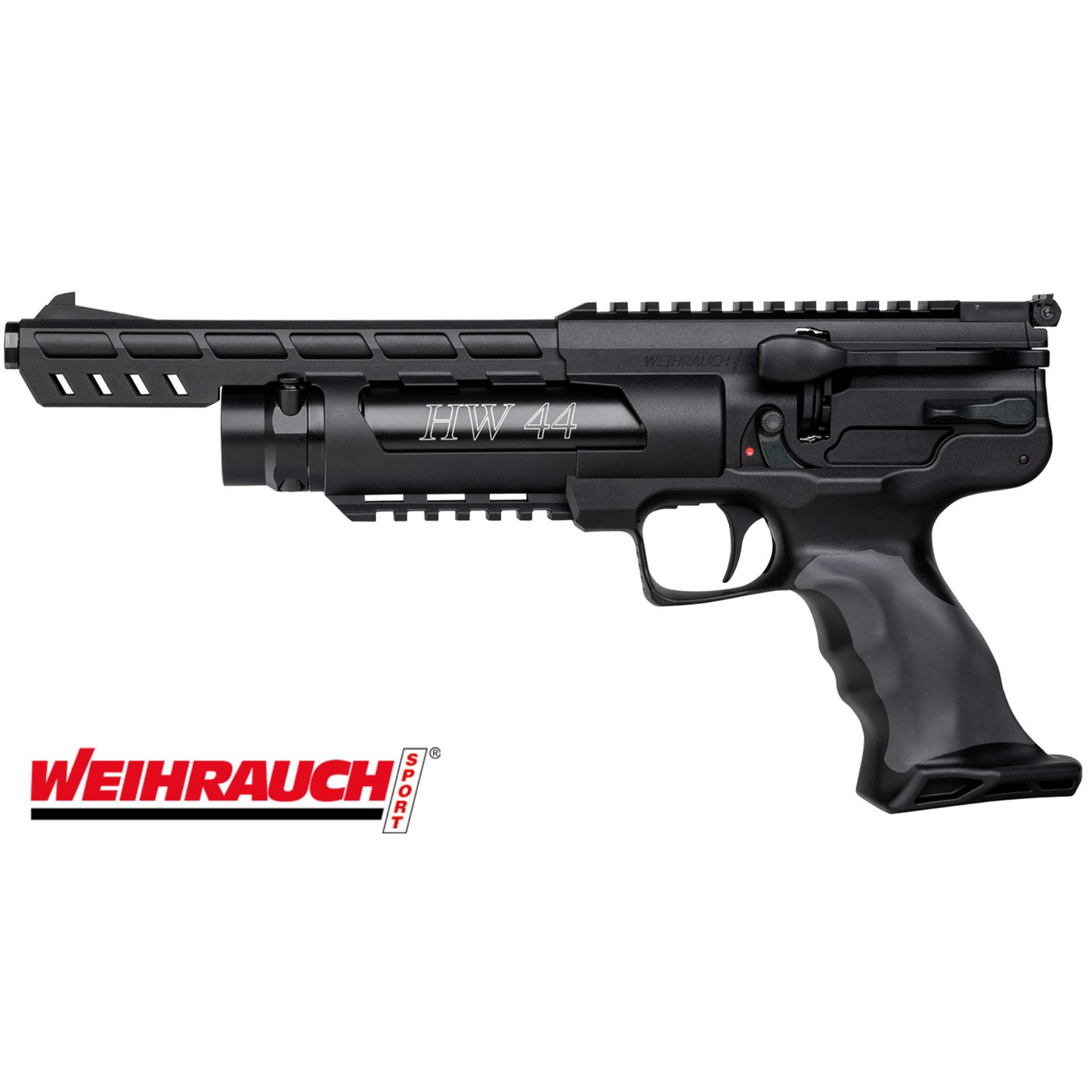
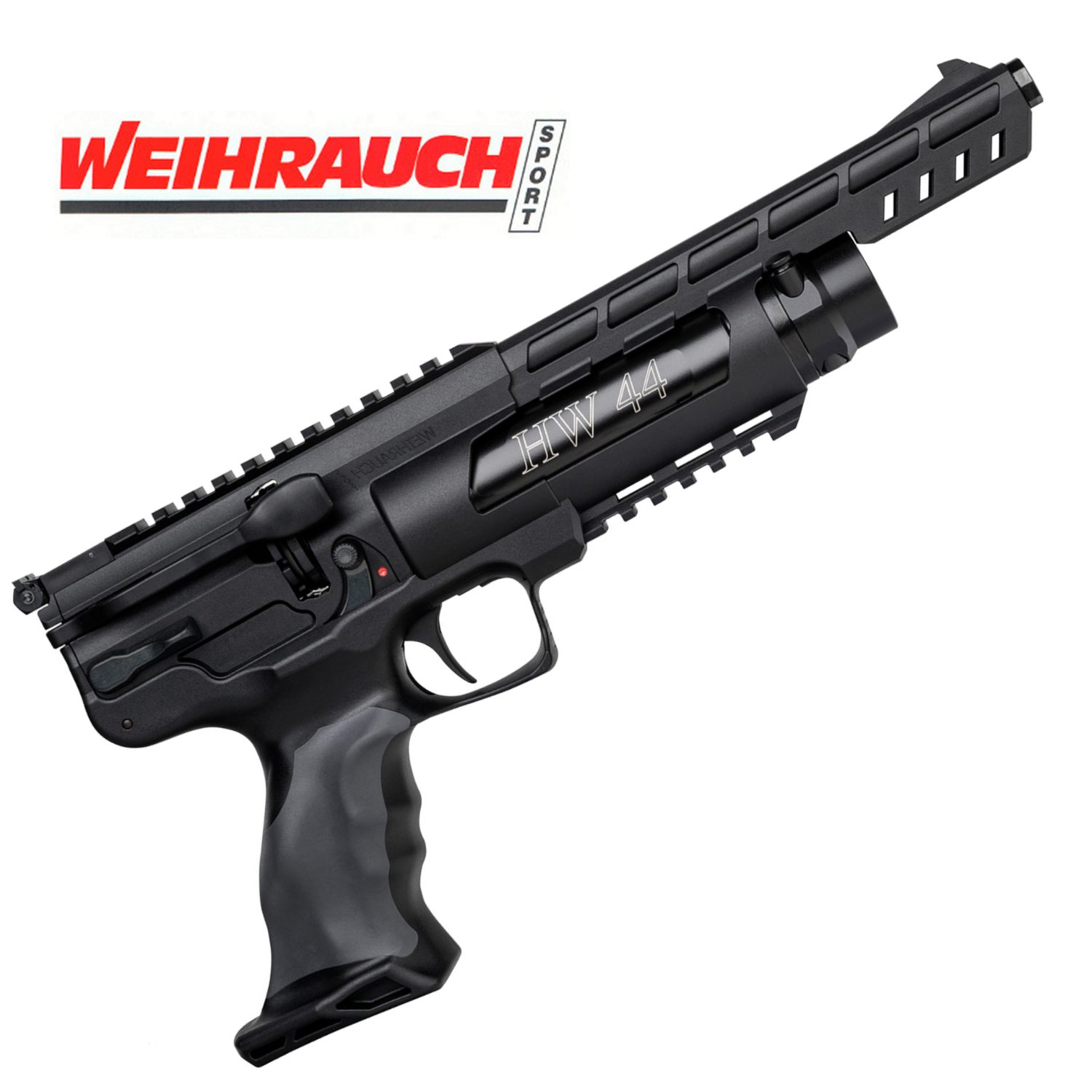
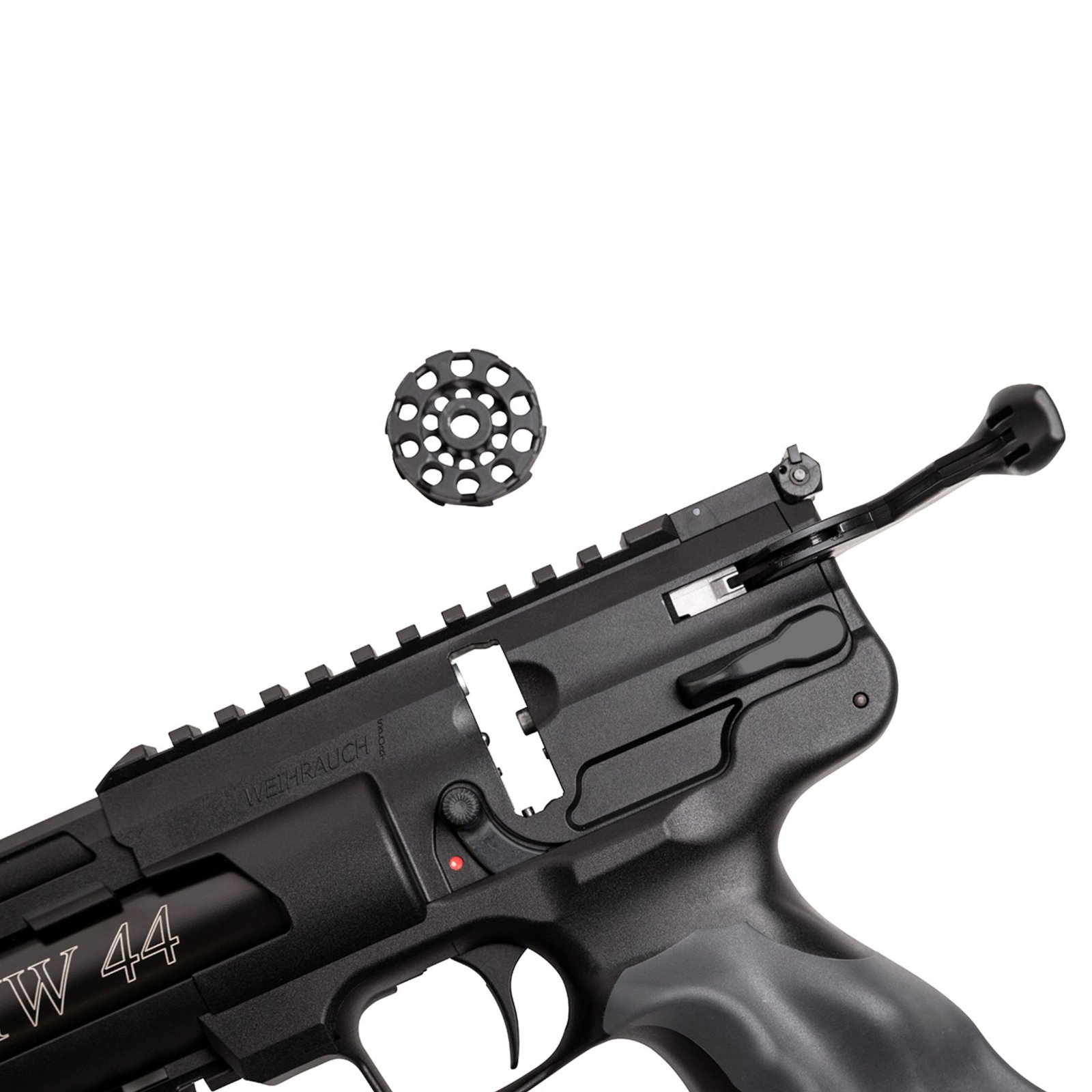
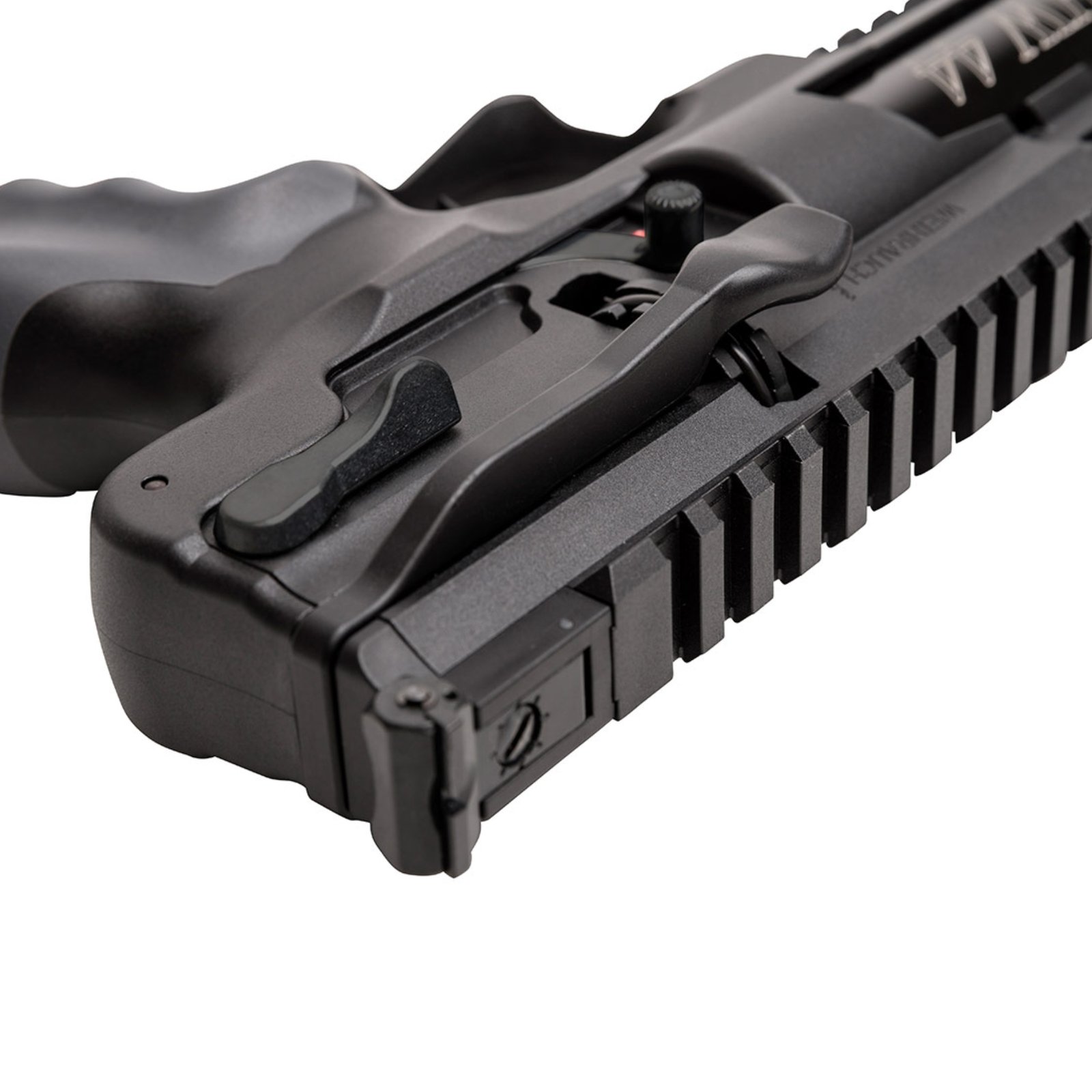
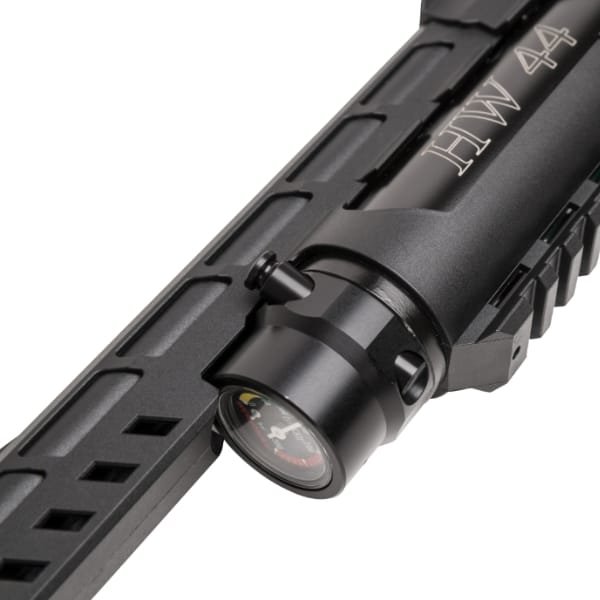
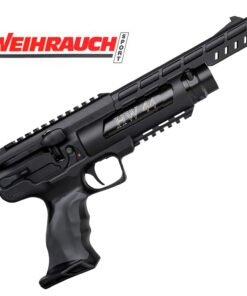
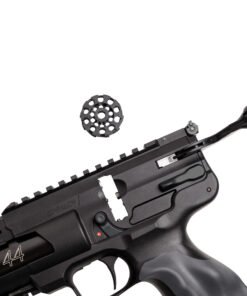
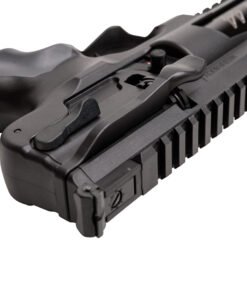
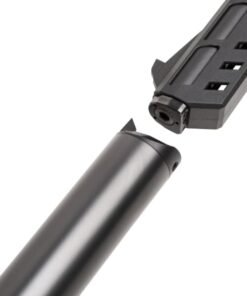
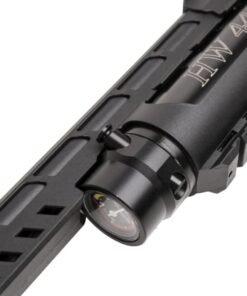
The HW 44 pre-charged air pistol from Weihrauch is a superb multi-shot PCP airgun featuring a side-lever loading system. The 10 shot magazine capacity is fast and easy repeating. The built in refillable 200 bar air cylinder features a quick fill system and integral pressure gauge. The Weihrauch HW44 also features two Picatinny / Weaver type rail mounts for optional extras.
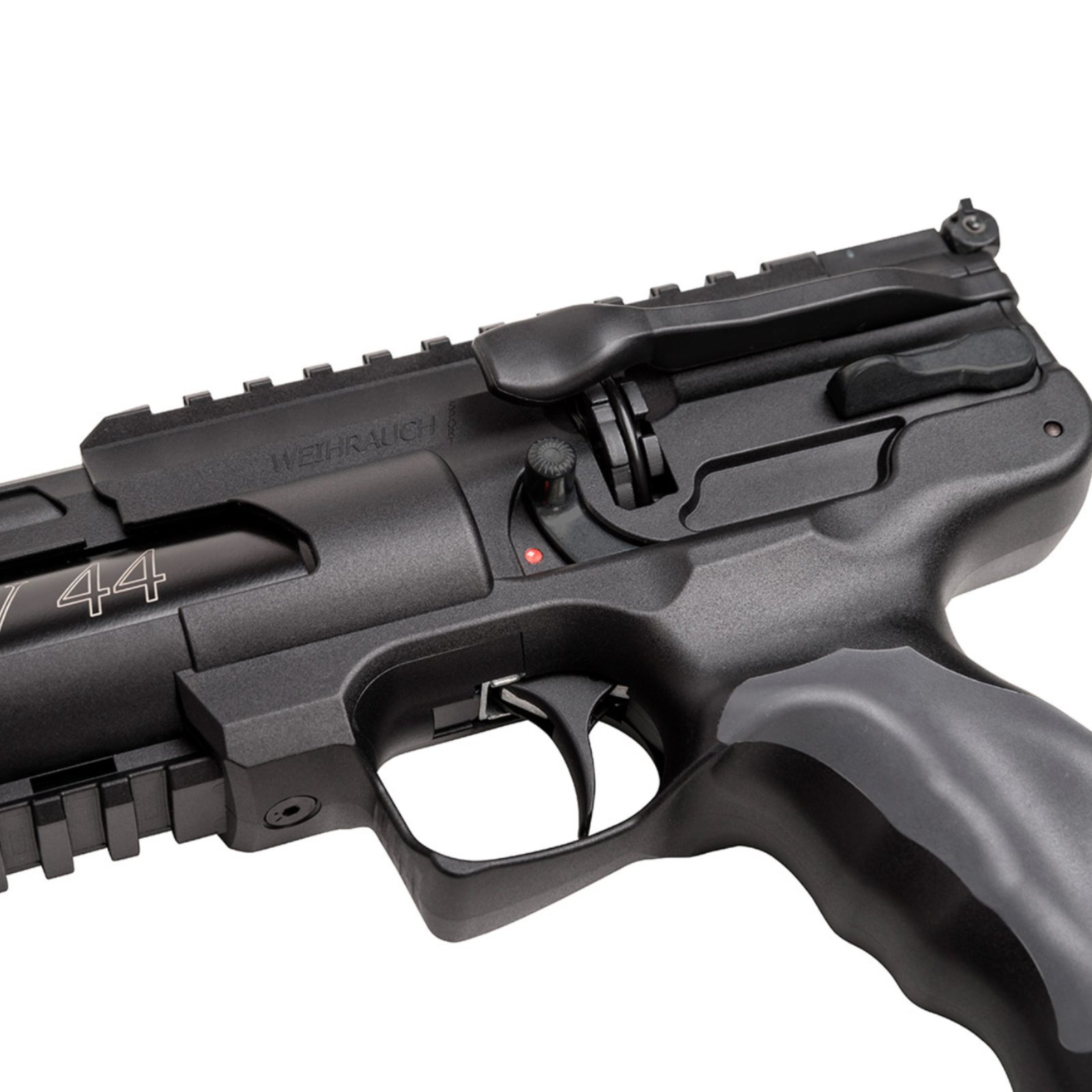
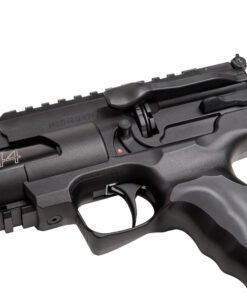
The Weihrauch HW 44 has a two stage match trigger with manual safety. The air pistol is well balanced and the pistol grip handle features a slip-resistant finish. The Weihrauch HW44 comes right handed but can be converted (at extra cost) for left handed shooters.

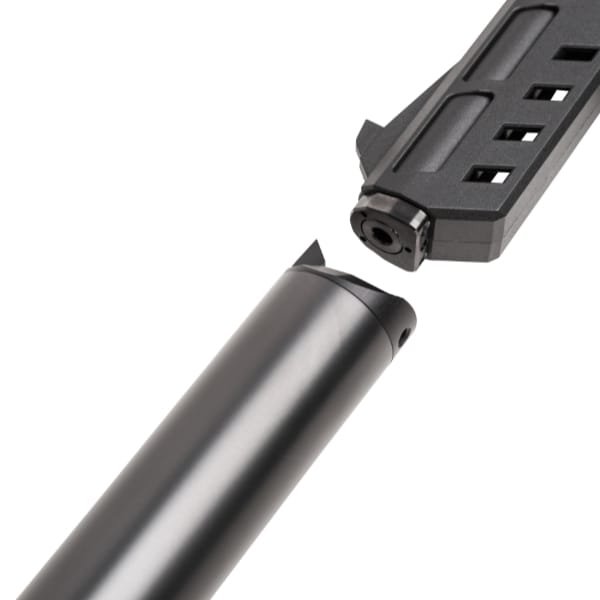
Air Pistol only accessories such as sound moderator and scope, available at extra cost. Refilling the HW44 air pistol with require an additional air bottle or hand pump designed for airguns. Hull Cartridge Company official UK import.
As standard, the Weihrauch HW44 pistol features an ambidextrous handle with a left handed side-lever for cocking.
Left handed shooters: The side-lever can be transferred across to the right hand side for an additional £30.00 (Pistol must be purchased in full before conversion is possible – 24 hrs notice required before collection).
Weihruch HW44 Air Pistol
Very popular Pre-charged multi-shot air pistol with side-lever cocking superb quality! Made in Germany
Hull Cartridge Official 12 Months Warranty
Product Features
Weihrauch HW44 Air Pistol PCP – Precision Engineering, Performance and Shooting Excellence

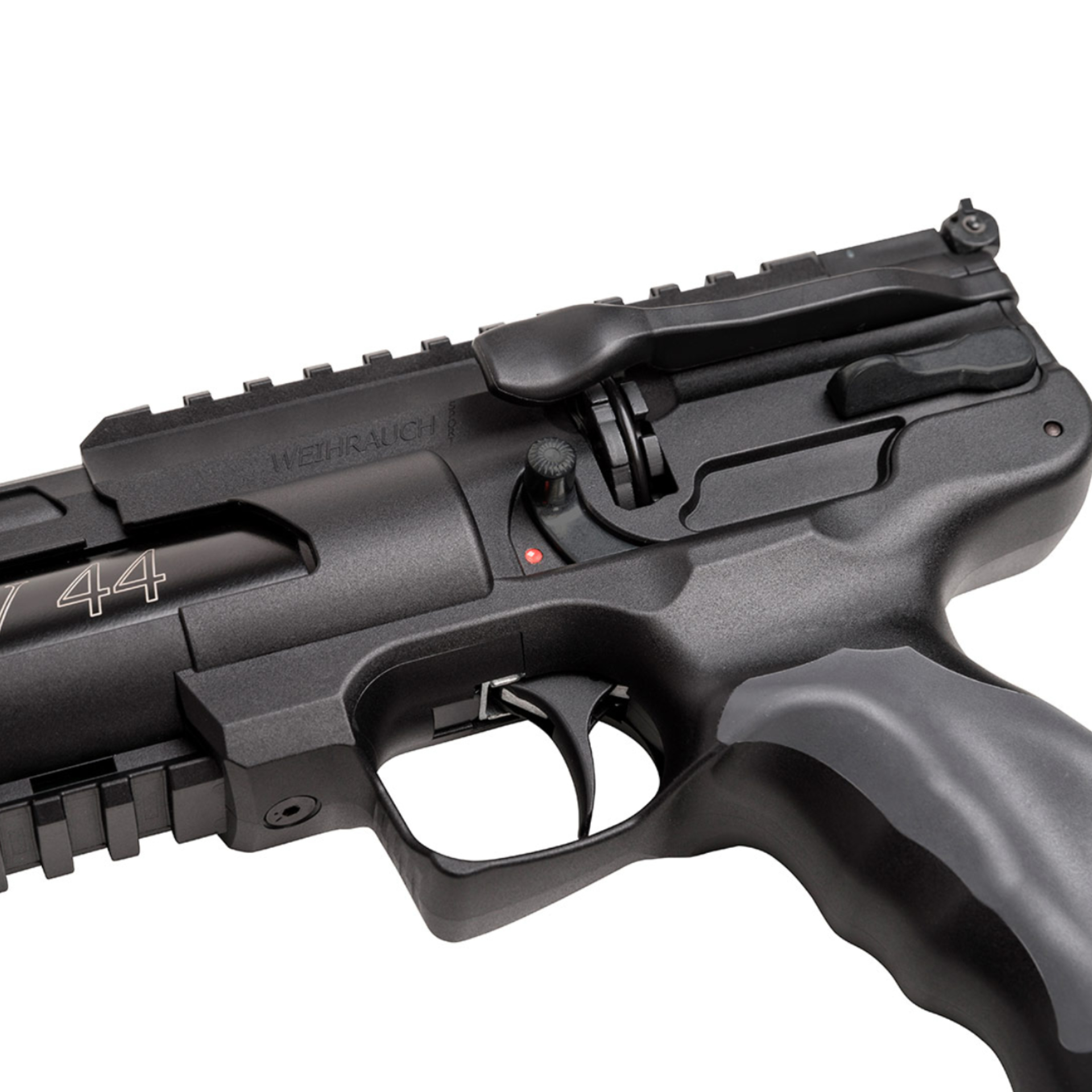
The Weihrauch HW44 Air Pistol PCP | HW 44 represents outstanding German engineering, combining precision manufacturing, exceptional handling, and advanced pre-charged pneumatic technology. Designed for serious recreational shooters and experienced enthusiasts, this innovative air pistol delivers smooth operation, dependable accuracy, and impressive shooting consistency.
Unlike a traditional spring-powered air gun, the HW44 uses compressed air to propel pellets with minimal mechanical vibration. Consequently, shooters experience a controlled firing cycle, predictable pellet delivery, and improved opportunities for consistent shot placement.
Furthermore, Weihrauch developed this sophisticated platform using engineering principles associated with its acclaimed HW110 PCP rifle. As a result, the compact pistol incorporates proven operating technology while maintaining its distinct handling characteristics.
For enthusiasts researching the best air rifle, best airguns, or premium air rifles, the HW44 offers an alternative for those specifically seeking a precision air pistol rather than a shoulder-fired rifle.
Its combination of refined German craftsmanship, dependable mechanical components, and thoughtful ergonomics makes it particularly appealing for structured target practice.
1.2 Advanced PCP Technology – How the Weihrauch HW44 Works
The HW44 operates through a pre-charged pneumatic (PCP) system that stores compressed air inside an integrated reservoir.
When the trigger releases the firing mechanism, regulated air pressure propels the pellet through the barrel. Therefore, the pistol avoids the pronounced recoil characteristics associated with many spring-piston designs.
Importantly, its internal regulator helps maintain consistent firing pressure across the usable air supply.
Essential PCP Engineering Features
- Power system: Regulated pre-charged pneumatic operation.
- Maximum filling pressure: 200 bar, approximately 2,900 PSI.
- Magazine capacity: 10 pellets.
- Loading mechanism: Manually operated sidelever.
- Trigger: Adjustable two-stage match trigger.
- Air management: Integrated pressure gauge and quick-fill system.
- Ergonomics: Slip-resistant grip suitable for right- and left-handed shooters.
- Mounting: Weaver/Picatinny-compatible accessory mounting.
- Calibres: .177, .20, and .22 in manufacturer-listed configurations, depending on market.
These engineering characteristics distinguish the HW44 from conventional compressed air rifle and compressed air gun designs while providing many of the benefits associated with a modern pcp airgun.
1.3 Accuracy and Precision – Why the Weihrauch HW44 Performs So Well
Accuracy remains one of the most important characteristics of any quality airgun.
Fortunately, the HW44 combines a precision-manufactured barrel, stable regulated air delivery, and a refined trigger mechanism.
Its 247 mm barrel provides the foundation for consistent pellet guidance, while the adjustable trigger supports deliberate, controlled shooting.
Additionally, its well-balanced construction helps users develop steadier aiming habits during regular training sessions.
Although the HW44 is not a conventional precision air rifle, accurate air rifle, target air rifle, competition air rifle, or match air rifle, it shares important design priorities with these platforms.
It is particularly suitable for recreational target shooting, accuracy development, and appropriate air-pistol disciplines.
Individual results naturally depend on pellet selection, shooting technique, distance, and environmental conditions.
1.4 Calibre Options, Power and Shooting Applications
The manufacturer lists the HW44 in .177 (4.5 mm), .20 (5.0 mm), and .22 (5.5 mm), although regional availability varies.
For example, the .177 version suits shooters who prioritize paper targets and precision-oriented practice. Meanwhile, the .22 version appeals to enthusiasts who prefer a larger pellet diameter.
Manufacturer-listed FAC configurations include muzzle energies of approximately 18 J in .177, 21 J in .20, and 25 J in .22. Lower-powered versions also exist.
Consequently, buyers should verify the exact specification and applicable local regulations before selecting a configuration.
While enthusiasts frequently research a 177 air rifle, 177 pcp air rifle, 177 caliber air rifle, 22 caliber air rifle, 22 pcp air rifle, .22 pcp air rifle, 20 caliber air rifle, 5.5mm air rifle, or 4.5mm air rifle, the HW44 delivers selected calibre options in a dedicated pistol format.
1.5 Air Rifle and Airgun Comparisons – Understanding Different PCP Categories
Consumers exploring an air rifle, air rifles, air gun, airguns, or airgun should distinguish between handgun and rifle configurations.
Popular searches include adult air rifles, air rifles for adults, professional air rifles, powerful air rifle, high power air rifle, sport air rifle, field target air rifle, and air rifle shooting.
Other common categories include pcp air rifle, pcp air rifles, pcp, pcp rifle, pcp rifles, best pcp air rifle, regulated pcp air rifle, high power pcp air rifle, compact pcp air rifle, tactical pcp air rifle, pcp hunting rifle, pcp target rifle, pcp competition rifle, pcp tactical rifle, and pcp carbine rifle.
Specialized configurations, such as a bullpup pcp air rifle, pcp bullpup rifle, semi automatic pcp air rifle, full automatic air rifle, big bore pcp air rifle, or big bore airgun, serve substantially different purposes.
Similarly, searches for a 25 caliber air rifle, 6.35mm air rifle, 30 caliber air rifle, 35 caliber air rifle, 45 caliber air rifle, 50 caliber air rifle, 50 cal air rifle, air rifle 22 caliber, pcp 22 air rifle, pcp 25 caliber, pcp 30 caliber, pcp 35 caliber, or pcp 50 caliber concern calibre classifications that should not be confused with the HW44’s actual specifications.
The HW44 is neither a large-calibre rifle nor an automatic firearm. Instead, it is a manually cycled, magazine-fed precision PCP pistol.
1.6 Practical Applications – Where and When to Use the HW44
The Weihrauch HW44 is especially appropriate for supervised shooting ranges, controlled recreational target sessions, and precision practice where air pistols are permitted.
Although buyers may also research a hunting air rifle, air rifle hunting, airgun hunting, air rifles for hunting, or small game air rifle, the HW44 should be evaluated according to its particular power configuration, intended use, and local hunting regulations.
For recreational shooters, regular airgun shooting provides opportunities to improve trigger control, concentration, and consistent technique.
1.7 Accessories, Maintenance and Responsible Product Selection
Compatible airgun accessories, air rifle accessories, airgun parts, air rifle parts, airgun supplies, airgun equipment, and airgun gear support equipment care and practical shooting enjoyment.
Recommended essentials include suitable pellet targets, approved eye protection, a compatible filling system, and secure storage equipment.
Customers researching a pcp air rifle kit, pcp air rifle package, or pcp rifle with scope should remember that the HW44 requires pistol-compatible components.
Finally, comparison searches such as air rifle reviews, airgun reviews, air rifle for sale, airguns for sale, buy air rifle, buy airguns online, air rifle shop, airgun store, airgun dealer, online airgun store, pcp air rifle for sale, buy pcp air rifle, and pcp airgun for sale can help buyers understand the wider market.
However, choosing the correct product depends on verified technical specifications, lawful ownership, and intended shooting applications.
Ultimately, the Weihrauch HW44 Air Pistol PCP stands apart through its regulated pneumatic system, smooth repeating action, adjustable match trigger, and precise German manufacturing. For enthusiasts who value controlled handling, reliable engineering, and consistent target performance, this sophisticated air pistol offers a compelling specialist shooting experience.
Weihrauch HW44 – German Engineering, Precision Performance, Ergonomic Design, and Real-World Shooting Experience
2.1 The Engineering Philosophy Behind the Weihrauch HW44
The Weihrauch HW44 represents a remarkable combination of German engineering expertise, mechanical refinement, and thoughtful design. Every major component contributes to a shooting experience that emphasizes precision, consistency, comfort, and dependable performance. Rather than relying on an unnecessarily complicated operating system, Weihrauch developed a carefully balanced platform that brings together established technology and modern manufacturing methods.
One of the most impressive characteristics of this model is its engineering relationship with the respected HW110 platform. Although the two products have different physical configurations, they share an emphasis on dependable mechanical operation, controlled compressed-air delivery, and consistent trigger performance. This connection demonstrates how the manufacturer adapts proven technology to meet different handling requirements without sacrificing fundamental quality.
German manufacturing has long maintained a reputation for close dimensional tolerances, disciplined quality control, and durable mechanical design. Weihrauch continues that tradition through precision-machined components and carefully integrated operating systems. Consequently, the HW44 offers the reassuring mechanical feel that experienced shooters frequently associate with the manufacturer’s products.
Additionally, its construction demonstrates a clear understanding of how individual components influence overall performance. The relationship between the barrel, trigger mechanism, pressure regulation system, and grip geometry creates a unified shooting platform. Therefore, precision does not depend on one isolated feature. Instead, it develops from the interaction of several carefully engineered systems.
This integrated approach is particularly important for people who appreciate equipment that delivers predictable results across repeated shooting sessions. A dependable mechanical design allows the user to concentrate on fundamental skills rather than continually adjusting to inconsistent operating characteristics.
Ultimately, the HW44 reflects an engineering philosophy built around mechanical stability, practical efficiency, and long-term usability. Its design prioritizes useful performance characteristics instead of unnecessary decorative complexity.
2.2 Precision Barrel Manufacturing and Its Importance for Accuracy
The barrel is among the most important components influencing the accuracy potential of the Weihrauch HW44. Its manufacturing quality helps determine how consistently each pellet travels along its intended path before leaving the muzzle. Weihrauch incorporates a precision-manufactured rifled barrel designed to support stable projectile movement and repeatable performance.
Rifling consists of carefully formed spiral grooves inside the barrel. These grooves impart rotational movement to the pellet as it travels forward. Consequently, the projectile gains gyroscopic stability that supports consistent flight when the pellet, velocity, and shooting conditions are suitable.
However, precision involves considerably more than the presence of rifling. The uniformity of the internal bore, consistency of the rifling dimensions, and quality of the barrel’s finishing all influence shooting results. Even relatively small differences in manufacturing quality can affect the repeatability of pellet movement.
The HW44 features a barrel approximately 247 millimeters long. This dimension suits the compact design while providing sufficient length for its intended pneumatic performance. Furthermore, the barrel works together with the controlled air-delivery system to support predictable velocity characteristics.
Because this model uses stored compressed air rather than a powerful spring-piston assembly, the firing cycle produces relatively little mechanical disturbance. As a result, the shooter can maintain a more stable sight picture during the instant of firing.
Nevertheless, actual accuracy depends on several additional factors. Pellet consistency, distance, environmental conditions, shooting technique, and equipment condition all influence results. No precision barrel can completely eliminate the effects of poor shooting fundamentals or unsuitable ammunition.
The most important advantage lies in repeatability. When a precision barrel works with a stable power system and a properly functioning trigger, shooters have a stronger foundation for evaluating their technique and improving their performance.
For this reason, the HW44 appeals to enthusiasts who appreciate the technical relationship between engineering quality and practical precision.
2.3 Advanced Pressure Regulation and Consistent Performance
A significant engineering advantage of the Weihrauch HW44 is its regulated compressed-air operating system. The purpose of this technology is to manage pressure delivery so that the firing mechanism receives a more consistent supply of air throughout the useful operating range.
Without effective pressure management, changing reservoir pressure can influence the energy delivered during successive shots. As pressure decreases, variations may appear in projectile velocity, depending on the particular design and operating conditions.
The HW44 addresses this challenge through an integrated regulator that helps control the pressure available to the firing mechanism. Consequently, the platform can maintain more predictable output than a comparable unregulated arrangement under appropriate conditions.
Consistency matters because changes in projectile velocity can produce differences in trajectory. At longer target distances, even modest variations may influence vertical point of impact. Therefore, pressure regulation contributes to the overall precision potential of the equipment.
Additionally, regulated operation supports a more uniform shooting experience. Shooters can develop familiarity with the trigger and firing characteristics without encountering the same degree of pressure-related variation associated with some simpler pneumatic systems.
However, a regulator does not guarantee identical velocity for every discharge. Differences in pellet manufacturing, temperature, mechanical condition, and other operating variables can still influence measured performance.
For this reason, serious accuracy assessment requires a realistic understanding of the entire system. The regulator supports consistency, but the barrel, ammunition, and shooter remain equally important elements.
The engineering value of this feature becomes particularly apparent during organized target sessions involving repeated shots. Instead of focusing constantly on changing operating characteristics, the user can devote greater attention to aiming consistency, body position, and trigger discipline.
Ultimately, effective pressure regulation adds practical value by making the equipment more predictable and helping users identify genuine improvements in shooting technique.
2.4 Ergonomic Grip Design and Comfortable Handling
Comfort and control play a fundamental role in the shooting experience, particularly when working with precision equipment that demands stable handling. Weihrauch designed the HW44 with an ergonomic grip that provides a secure connection between the user’s hand and the firing mechanism.
The grip incorporates textured surfaces that help maintain consistent contact. Furthermore, its configuration accommodates both right-handed and left-handed users, making the design suitable for a wider range of shooting preferences.
One important benefit of appropriate grip geometry is improved control during deliberate target practice. When the hand rests comfortably around the grip, the shooter can concentrate on sight alignment, breathing, and smooth trigger operation.
Moreover, the relationship between grip angle and trigger reach can influence how naturally the equipment points toward a target. A comfortable position minimizes unnecessary muscular tension, which can otherwise contribute to inconsistent results.
The overall dimensions also deserve attention. Although the HW44 has a compact configuration compared with shoulder-fired equipment, its approximately 337-millimeter overall length gives it a substantial presence. Consequently, users should consider their individual hand size, strength, and preferred shooting posture when evaluating comfort.
Balance represents another essential design characteristic. The distribution of weight between the barrel assembly, receiver, reservoir, and grip influences how naturally the equipment settles during aiming.
However, ergonomic suitability remains personal. A design that feels comfortable to one shooter may feel less natural to another. Therefore, evaluating grip comfort and overall balance in a controlled retail or range environment is worthwhile whenever possible.
By combining textured grip surfaces with thoughtful proportions, Weihrauch provides a practical foundation for comfortable handling and deliberate shooting.
2.5 The Adjustable Two-Stage Trigger and Its Contribution to Precision
The trigger mechanism is one of the most important interfaces between the shooter and the equipment. Even excellent mechanical accuracy can become difficult to achieve when trigger movement feels unpredictable or inconsistent.
Weihrauch equips the HW44 with an adjustable two-stage match trigger designed to offer a refined and predictable firing experience.
A two-stage arrangement provides distinct phases of trigger movement. The initial stage allows the shooter to recognize controlled movement before reaching the final release stage. This separation can improve the shooter’s awareness of the firing process.
Furthermore, a predictable release helps reduce the tendency to disturb the intended sight alignment at the moment of discharge. As a result, experienced users often value this type of design when assessing precision-oriented equipment.
The trigger’s mechanical consistency also supports the development of repeatable habits. When the operating characteristics remain familiar, the shooter can concentrate on fundamentals rather than compensating for unexpected changes in trigger behavior.
However, precision does not depend exclusively on a light trigger. Predictability, appropriate resistance, mechanical reliability, and user familiarity are equally important considerations.
Safety remains essential throughout operation. The trigger should never be modified outside the manufacturer’s approved specifications, and any suspected mechanical fault should receive attention from a qualified professional.
Ultimately, Weihrauch’s trigger design illustrates how a relatively small mechanical component can have a substantial influence on the overall quality of the shooting experience.
2.6 Sidelever Operation and the Benefits of a Repeating Mechanism
The HW44 incorporates a manually operated sidelever mechanism that allows the user to cycle its repeating system. This arrangement combines mechanical simplicity with the convenience of a multi-shot magazine.
Rather than requiring a separate manual loading process for every discharge, the repeating mechanism provides a practical operating arrangement for structured recreational sessions.
The sidelever contributes to the model’s distinctive appearance while reinforcing its relationship with Weihrauch’s established precision-engineering approach.
Importantly, the mechanism remains manually operated. It should not be confused with systems that automatically complete the cycling process after firing.
A manually operated arrangement gives the shooter a clearly defined sequence between individual shots. Additionally, it supports deliberate pacing during target sessions, encouraging attention to equipment condition and safe handling.
Mechanical quality is especially important in repeating designs because several components must function together reliably. Magazine positioning, internal engagement, and lever movement all require appropriate manufacturing tolerances.
Weihrauch’s experience with precision mechanisms provides a strong engineering foundation for this configuration.
Nevertheless, smooth operation depends on correct maintenance and the use of components approved for the specific model. Excessive force or unauthorized modifications can damage delicate internal parts.
Overall, the sidelever system contributes to the HW44’s practical appeal by combining a refined mechanical feel with the convenience of a repeating platform.
2.7 Magazine Construction and Reliable Pellet Management
The Weihrauch HW44 uses a removable magazine designed to accommodate ten pellets. This capacity provides a convenient balance between compact equipment dimensions and repeated target practice.
Magazine construction plays an important role in mechanical reliability. Each pellet must remain properly positioned until the operating mechanism advances it into the firing sequence.
Consequently, dimensional accuracy and compatible ammunition are important considerations. A poorly manufactured or unsuitable pellet may affect feeding consistency, even when the surrounding mechanism functions correctly.
The ten-shot capacity allows users to organize shooting sessions into manageable sequences. Furthermore, it offers a straightforward way to monitor the number of pellets used during controlled practice.
An additional practical benefit is the availability of compatible spare magazines through appropriate suppliers. Having an approved replacement component can support equipment ownership and routine maintenance.
However, compatibility should always be verified against the precise product designation. Similar-looking components from other Weihrauch models are not necessarily interchangeable.
Regular inspection also contributes to dependable performance. Visible damage, contamination, or unusual mechanical resistance should receive appropriate attention before further use.
Ultimately, the magazine demonstrates how practical convenience and precision engineering can complement each other in a compact mechanical design.
2.8 Construction Materials, Durability, and Long-Term Reliability
Durability represents an important consideration for anyone investing in precision-manufactured equipment. The HW44 combines metallic mechanical components with synthetic external elements to achieve a practical relationship between strength, handling, and resistance to ordinary wear.
Its receiver and internal operating components require close manufacturing tolerances because mechanical consistency directly influences function.
Meanwhile, the synthetic grip provides a durable contact surface designed for regular handling. Compared with some traditional decorative materials, modern synthetic components can offer practical resistance to moisture and routine environmental exposure.
Nevertheless, no mechanical system is completely maintenance-free. Dust, moisture, inappropriate storage conditions, and prolonged neglect can gradually affect performance.
For this reason, long-term reliability depends on both manufacturing quality and responsible ownership.
Another important consideration involves seals and pressure-bearing components. These elements are integral to the pneumatic operating system and must remain in suitable condition.
Their service requirements can vary according to age, use, environmental conditions, and the manufacturer’s recommendations.
When mechanical servicing becomes necessary, qualified technicians should handle pressure-system repairs and internal adjustments.
Proper storage is equally important. Keeping the equipment unloaded, depressurized when specifically required by the manufacturer’s storage guidance, secured against unauthorized access, and protected from damaging environmental conditions helps preserve its condition.
The HW44’s construction reflects Weihrauch’s commitment to dependable engineering, while sensible care supports its continued performance over time.
2.9 Noise Characteristics, Smooth Operation, and Shooting Comfort
The firing characteristics of the HW44 differ considerably from those of conventional spring-driven mechanisms. Because the pneumatic system does not rely on a large moving piston to generate pressure during discharge, it avoids much of the mechanical vibration commonly associated with spring-powered designs.
As a result, the firing experience can feel comparatively smooth and controlled.
Reduced mechanical movement offers practical benefits for recreational target shooting. It helps limit unnecessary disturbance during the firing cycle and contributes to the refined operating sensation expected from a precision-oriented platform.
However, sound levels depend on the exact configuration, projectile characteristics, operating pressure, and surrounding environment.
Although some versions incorporate sound-reduction features, the equipment should never be described as completely silent.
Enclosed shooting environments can also influence perceived noise because hard surfaces reflect sound differently from open spaces.
Therefore, suitable hearing protection should be considered according to range rules and actual noise conditions.
Shooting comfort also involves physical balance, grip design, and trigger predictability. Together, these characteristics help create an experience that feels controlled rather than unnecessarily harsh.
For enthusiasts who appreciate refined mechanical behavior, this combination provides an important reason to consider the HW44.
Why the Weihrauch HW44 Remains a Distinctive Precision Platform
The strongest argument for the Weihrauch HW44 lies in the way its individual engineering features work together.
Its precision-manufactured barrel supports consistent pellet guidance, while the regulated pneumatic system helps maintain predictable pressure delivery. Furthermore, the adjustable two-stage trigger contributes to controlled operation, and the ergonomic grip provides a comfortable connection between the user and the equipment.
These qualities make the HW44 attractive to people who value craftsmanship, mechanical refinement, and dependable target performance.
Importantly, its appeal does not depend solely on numerical specifications. Practical satisfaction also comes from smooth operation, balanced handling, consistent construction quality, and confidence in the manufacturer’s engineering experience.
For experienced enthusiasts, the equipment offers an opportunity to appreciate how sophisticated mechanical systems interact within a relatively compact design.
Meanwhile, responsible newcomers can benefit from its approachable operating characteristics when participating in properly supervised training.
The HW44 also demonstrates that precision equipment need not rely on unnecessary complexity to deliver a satisfying experience. Instead, disciplined engineering, carefully selected materials, and intelligent component integration can provide meaningful advantages.
Ultimately, this German-made platform embodies the qualities that have helped establish Weihrauch’s reputation: attention to detail, dependable mechanical design, thoughtful ergonomics, and a sustained emphasis on accuracy.
For those seeking a sophisticated precision shooting experience, the HW44 offers a compelling combination of performance, durability, manufacturing expertise, and practical enjoyment.
Weihrauch HW44 – Practical Shooting Applications, Consistent Accuracy, Long-Term Performance, and Ownership Experience
3.1 Understanding the Real-World Capabilities of the Weihrauch HW44
The Weihrauch HW44 demonstrates how thoughtful engineering can transform a compact shooting platform into an exceptionally refined piece of recreational equipment. Its combination of mechanical consistency, balanced construction, and sophisticated operating characteristics makes it particularly appealing to enthusiasts who appreciate precision and dependable performance.
One of its most significant advantages is the relationship between the internal operating system and the overall shooting experience. Every important component contributes to the predictable mechanical behavior that experienced users expect from a respected German manufacturer. Consequently, the equipment offers more than attractive specifications; it provides a carefully developed platform that supports consistent use.
In practical settings, performance depends on several interacting factors. The quality of the barrel, the condition of the pneumatic system, the consistency of compatible ammunition, and the user’s experience all influence the final results. Therefore, understanding these relationships is essential when evaluating the equipment objectively.
Furthermore, its compact design introduces practical benefits for transportation, organized target sessions, and secure storage. Although it has a relatively substantial construction for a handgun, its dimensions remain manageable compared with larger sporting equipment.
The quality of the manufacturing also becomes apparent through the interaction of moving components. A refined mechanical design should produce consistent resistance, predictable engagement, and smooth operation without unnecessary looseness.
Nevertheless, every mechanical product requires appropriate care and realistic expectations. Manufacturing precision can support repeatability, but it cannot eliminate environmental influences or differences in individual shooting ability.
Ultimately, the HW44 is most impressive when considered as a complete engineering system rather than a collection of isolated features. Its appeal comes from the balance between precision, usability, comfort, and mechanical dependability.
3.2 Why Consistent Performance Matters During Target Practice
Consistency provides the foundation for meaningful progress during recreational target shooting. When equipment behaves predictably, users can assess their results more effectively and identify whether differences arise from shooting technique, environmental conditions, or mechanical performance.
The HW44 incorporates several characteristics that contribute to this consistency. Its controlled pneumatic operation minimizes certain mechanical disturbances, while its carefully manufactured barrel supports repeatable projectile guidance.
Additionally, its refined trigger mechanism offers a predictable mechanical interface. Together, these features create favorable conditions for organized practice.
However, a consistent operating system should not be confused with guaranteed accuracy. Results depend on the individual shooter, appropriate ammunition, target distance, and the surrounding environment.
For example, temperature changes can influence compressed-air behavior and projectile performance. Similarly, variations in ammunition manufacturing may produce measurable differences during repeated sessions.
Recognizing these influences helps users develop realistic expectations about precision equipment.
An additional advantage of dependable operation is the ability to compare results over time. When the same equipment remains mechanically sound, changes in target performance become easier to interpret.
This is especially valuable for enthusiasts who enjoy maintaining shooting records, participating in organized recreational activities, or developing greater familiarity with their equipment.
Furthermore, predictable operation contributes to confidence. Familiarity with the mechanical characteristics reduces unnecessary uncertainty during supervised shooting sessions.
The broader lesson is that performance quality involves repeatability rather than occasional exceptional results. A well-engineered platform should support dependable behavior across ordinary operating conditions.
For this reason, consistent construction and controlled operation remain among the most meaningful qualities of the HW44.
3.3 Where the Weihrauch HW44 Delivers Its Greatest Practical Value
The HW44 is particularly suitable for properly managed shooting ranges, supervised recreational facilities, and designated target environments where its use is permitted.
These locations provide structured conditions for evaluating the equipment while supporting responsible handling and established safety procedures.
A supervised range offers several practical advantages. Clearly defined firing areas, suitable backstops, controlled access, and established operating rules help reduce unnecessary risks.
Additionally, organized facilities may provide opportunities to compare shooting results under relatively consistent conditions.
For enthusiasts interested in recreational accuracy, such environments offer a useful setting for appreciating the mechanical characteristics of the HW44.
Its compact configuration can also make transportation between authorized locations more convenient, provided owners follow applicable laws and use appropriate secure carrying equipment.
However, the HW44 should not automatically be considered suitable for every recreational environment. Local regulations, property restrictions, safety requirements, and facility policies may limit where it can be used.
Residential gardens, informal outdoor areas, and public spaces can present legal and safety concerns even when they appear physically isolated.
Therefore, designated shooting facilities generally provide a more appropriate environment for enjoying its capabilities.
Another practical consideration involves the availability of trained personnel. Experienced range supervisors can provide guidance on facility procedures, safety expectations, and responsible equipment use.
Ultimately, the greatest practical value emerges when sophisticated engineering meets a controlled environment that allows users to appreciate performance without compromising safety.
3.4 How Design Balance Influences Comfort and User Experience
Balance has a substantial influence on how shooting equipment feels during extended recreational sessions. The distribution of mass affects perceived stability, handling comfort, and the amount of physical effort required to maintain a steady position.
The HW44 combines a substantial mechanical assembly with a compact handgun configuration. Consequently, its overall feel differs from that of lightweight recreational pistols.
This weight can provide a reassuring sense of stability for some users. However, others may prefer lighter equipment depending on their physical characteristics and personal preferences.
The position of the grip relative to the barrel and receiver also influences perceived balance.
Furthermore, the shape and texture of the grip help determine how comfortably the hand maintains contact with the equipment.
An appropriate grip should feel secure without requiring excessive muscular effort. Unnecessary tension can contribute to fatigue and reduce overall comfort.
The HW44’s ambidextrous design provides additional flexibility by accommodating different dominant-hand preferences.
Nevertheless, hand size varies considerably between individuals. As a result, the same grip may feel natural to one person and less comfortable to another.
Long-term satisfaction depends on recognizing these differences before making a purchasing decision.
Comfort also extends beyond physical dimensions. Smooth mechanical operation, predictable trigger characteristics, and straightforward controls contribute to a more satisfying ownership experience.
When these characteristics work together, the equipment feels cohesive rather than mechanically awkward.
Therefore, balance should be evaluated as part of the overall design rather than treated as a minor specification.
3.5 The Importance of Manufacturing Tolerances and Mechanical Quality
Precision manufacturing involves controlling the dimensions and relationships of components so that the assembled mechanism operates consistently.
In sophisticated pneumatic equipment, manufacturing tolerances influence several important functions, including component alignment, mechanical engagement, and the interaction between moving assemblies.
Weihrauch’s reputation rests partly on its established experience producing carefully engineered sporting equipment.
The HW44 reflects this background through its integration of precisely manufactured components within a compact mechanical arrangement.
Close tolerances can contribute to predictable movement and reliable component interaction. However, appropriate tolerances must also account for normal operating clearances, temperature variation, and material behavior.
Excessively tight component relationships are not automatically superior. Effective engineering requires a suitable balance between precision, durability, and dependable operation.
Material selection also influences long-term performance. Different components must tolerate mechanical loads, environmental exposure, and ordinary wear.
Furthermore, surface finishing and manufacturing consistency can affect how parts interact throughout their service lives.
These details are not always visible during a casual inspection, yet they contribute to the overall impression of quality.
For prospective owners, examining the mechanical finish, external assembly, and general construction can provide useful insight into the manufacturer’s attention to detail.
Nevertheless, internal technical assessments should remain the responsibility of qualified professionals.
Ultimately, manufacturing excellence depends on achieving dependable operation repeatedly, not merely producing attractive external components.
Long-Term Ownership and Responsible Equipment Care
Owning precision equipment involves more than enjoying its initial performance. Long-term satisfaction also depends on appropriate storage, routine inspection, and responsible maintenance.
The HW44 contains mechanical and pressure-bearing components that require attention to the manufacturer’s service recommendations.
Because compressed air forms an essential part of the operating system, owners should respect all published pressure limits and handling instructions.
Additionally, the equipment should receive periodic visual inspection for signs of damage, unusual wear, corrosion, or deterioration.
External surfaces benefit from appropriate care, particularly after exposure to moisture or dusty environments.
However, cleaning and maintenance products should always be compatible with the manufacturer’s recommendations. Unsuitable chemicals can damage certain finishes, seals, and synthetic materials.
Secure storage represents another fundamental ownership responsibility.
When not in use, the equipment should remain unloaded and secured against access by unauthorized individuals, especially children.
A suitable lockable storage arrangement can help protect both the equipment and the surrounding household.
Furthermore, owners should maintain appropriate documentation, including purchase records, product identification information, and relevant service history.
These records may prove valuable when arranging professional maintenance or identifying compatible replacement components.
If pressure leakage, abnormal mechanical resistance, or inconsistent operation develops, the equipment should not be used until a qualified technician has assessed the problem.
Attempting unauthorized repairs to pressurized assemblies can create serious hazards.
Ultimately, responsible care preserves the value of careful engineering and contributes to a safer, more dependable ownership experience.
Why Environmental Conditions Influence Shooting Results
Environmental conditions can affect the performance of precision shooting equipment, even when its internal mechanisms function correctly.
Temperature, humidity, wind, and changes in atmospheric conditions may influence projectile behavior or the characteristics of compressed air.
For example, temperature fluctuations can change the pressure relationship inside a pneumatic reservoir.
The exact effect depends on the system’s design, regulator behavior, and operating conditions.
Similarly, wind can affect projectile movement after it leaves the barrel, particularly at greater target distances.
These factors demonstrate why identical equipment does not necessarily produce identical results in every environment.
Humidity and moisture introduce additional concerns because prolonged exposure may affect metallic surfaces and certain mechanical components.
Therefore, suitable storage conditions remain important even when the equipment has not been used recently.
Temperature also deserves attention during transportation and storage. Extreme heat can increase pressure inside sealed reservoirs and may expose equipment to conditions outside the manufacturer’s recommended limits.
For this reason, owners should avoid leaving pressurized sporting equipment in excessively hot vehicles or other unsuitable environments.
A controlled shooting facility can reduce some environmental variation, making it easier to assess mechanical consistency.
However, even indoor environments require suitable ventilation, supervision, and appropriate backstop arrangements.
Understanding environmental influences allows enthusiasts to assess performance more realistically while maintaining responsible equipment care.
Evaluating Accuracy Without Relying on Exaggerated Claims
Precision equipment frequently attracts ambitious performance claims. However, responsible product evaluation should distinguish between demonstrated engineering characteristics and results that depend on individual circumstances.
The HW44 has several design features that support accurate target shooting, including a precision barrel, regulated pneumatic operation, and a refined trigger mechanism.
Nevertheless, these features do not establish a universal group size or guarantee a particular result at every distance.
Accuracy measurements become meaningful only when the testing conditions are clearly understood.
Factors such as ammunition type, target distance, equipment condition, and environmental stability influence the outcome.
Furthermore, results achieved by experienced evaluators may differ from those obtained by recreational users.
For this reason, responsible descriptions should emphasize the equipment’s engineering potential without presenting unsupported performance statistics.
A consistent mechanical system provides an excellent foundation for recreational precision work, but meaningful results still require appropriate conditions and competent handling.
Independent testing, manufacturer documentation, and reputable technical assessments can provide valuable information.
Additionally, prospective buyers should consider the intended application rather than relying entirely on maximum performance figures.
For many enthusiasts, smooth handling, dependable operation, and repeatable recreational accuracy offer greater practical value than exceptional results achieved under highly specialized conditions.
Ultimately, the HW44 deserves recognition for its engineering quality without the need for unrealistic promises.
Understanding the Value of German Craftsmanship
German precision manufacturing has developed a strong international reputation through generations of technical specialization, disciplined production methods, and mechanical innovation.
Weihrauch contributes to this tradition through its established experience manufacturing recreational and sporting equipment.
The HW44 reflects an approach that prioritizes functional refinement rather than superficial complexity.
Its construction demonstrates how careful design can bring together multiple mechanical systems within a relatively compact assembly.
Furthermore, the manufacturer’s established technical heritage gives prospective owners an identifiable background against which to evaluate the product.
Craftsmanship, however, should not be judged exclusively by country of origin or reputation.
The most meaningful indicators include manufacturing consistency, appropriate material selection, dependable operation, and the availability of accurate technical documentation.
The HW44 brings these considerations together in a product designed for enthusiasts who appreciate mechanical quality.
Its visual appearance also reflects its functional purpose. Rather than relying heavily on decorative styling, the design communicates precision through its proportions, visible controls, and purposeful construction.
For many owners, this combination provides lasting satisfaction beyond initial performance figures.
Ultimately, well-executed craftsmanship contributes to both practical usability and long-term appreciation of the equipment.
Why the Weihrauch HW44 Offers Lasting Value to Shooting Enthusiasts
The lasting appeal of the Weihrauch HW44 comes from its balance of sophisticated engineering, practical ergonomics, and dependable operating characteristics.
Its regulated pneumatic system supports consistency, while its precision-manufactured barrel and adjustable trigger contribute to the overall quality of the shooting experience.
Additionally, its manually operated repeating mechanism provides a distinctive combination of mechanical engagement and recreational convenience.
These characteristics make the HW44 particularly interesting to enthusiasts who value precision equipment as much for its engineering as for its practical application.
Long-term ownership satisfaction also depends on appropriate expectations. The equipment offers a specialized shooting experience, and its suitability should be assessed according to the intended environment, personal comfort, and applicable regulations.
Furthermore, responsible maintenance and secure storage contribute significantly to preserving its condition.
When evaluated as a complete system, the HW44 demonstrates how careful manufacturing and intelligent design can create a refined recreational platform.
Its strongest qualities do not depend on unnecessary exaggeration. Instead, they emerge from predictable operation, thoughtful construction, recognizable manufacturing expertise, and a clear commitment to precision.
For users who appreciate these characteristics, the Weihrauch HW44 represents a distinctive example of modern German mechanical craftsmanship, delivering a rewarding combination of technical sophistication, controlled performance, and long-term ownership appeal.
Weihrauch HW44 – Advanced Design Features, Practical Benefits, Safety Considerations, Maintenance, and Long-Term Ownership Value
4.1 Understanding the Purpose Behind the Weihrauch HW44 Design
The Weihrauch HW44 represents a carefully developed approach to precision engineering, combining sophisticated mechanical technology with practical features designed to improve the overall ownership experience. Every aspect of its construction reflects the manufacturer’s commitment to dependable performance, durability, and functional refinement.
Unlike equipment that depends primarily on aggressive styling or exaggerated performance claims, this German-manufactured model emphasizes mechanical consistency and intelligent component integration. Consequently, its greatest strengths become apparent through its thoughtful construction and predictable operation.
The development philosophy behind the HW44 focuses on achieving a balanced relationship between power delivery, handling characteristics, and mechanical reliability. These considerations are particularly important because compact equipment must accommodate several sophisticated systems within relatively limited dimensions.
Furthermore, the manufacturer has incorporated engineering principles associated with its established sporting product range. This approach allows proven technological concepts to support a distinctive design without introducing unnecessary complexity.
The result is a product that feels purposeful. Its dimensions, operating controls, and internal components contribute to an integrated mechanical arrangement rather than functioning as unrelated additions.
Another important consideration is the relationship between precision and user confidence. Equipment that operates consistently allows owners to become familiar with its characteristics, which can make supervised recreational sessions more predictable and enjoyable.
However, engineering quality should never be confused with automatic performance guarantees. Actual results depend on correct operating conditions, maintenance, equipment condition, and responsible handling.
Ultimately, the HW44 demonstrates that sophisticated design does not require unnecessary complication. Instead, careful planning, appropriate materials, and disciplined manufacturing can deliver an impressive combination of comfort, consistency, and long-term practical value.
4.2 The Importance of Mechanical Stability and Structural Integrity
Mechanical stability plays a fundamental role in the performance of precision-manufactured sporting equipment. Every component must maintain its intended relationship with neighboring parts while functioning within established engineering tolerances.
The HW44 incorporates a carefully organized assembly in which the receiver, barrel, pressure reservoir, and operating mechanism work together as a unified structure.
This arrangement supports predictable mechanical behavior while helping maintain the alignment necessary for consistent operation.
Structural integrity becomes especially important in equipment containing pressurized systems. The materials and connections involved must withstand the operating conditions established by the manufacturer.
Consequently, the design requires appropriate engineering standards, material selection, and quality-control procedures.
Additionally, the external structure must provide sufficient durability for ordinary handling and transportation. Minor bumps and routine movement can occur during responsible ownership, so the construction should offer practical robustness without introducing excessive weight.
The relationship between weight and strength is particularly significant. Heavy construction does not automatically indicate greater quality, just as lighter materials do not necessarily imply weakness.
Instead, effective engineering uses materials according to their mechanical properties and intended functions.
Over time, structural condition can also influence ownership satisfaction. Equipment that retains its mechanical integrity is more likely to preserve the operating characteristics originally intended by the manufacturer.
For this reason, owners should periodically inspect accessible exterior surfaces for visible damage, corrosion, looseness, or unusual changes.
Any suspected structural defect requires professional assessment rather than continued operation.
Ultimately, mechanical stability contributes to the dependable character of the HW44 and reinforces the importance of high-quality manufacturing.
4.3 How Internal Engineering Contributes to a Refined Operating Experience
A sophisticated product is often distinguished by the interaction of its internal mechanisms rather than by any single prominent feature.
The HW44 brings several mechanical systems together to deliver controlled and predictable operation.
Its pressure-management arrangement works alongside the firing mechanism, while the barrel assembly provides the necessary guidance for compatible projectiles.
Furthermore, the manually operated repeating system adds practical convenience without relying on an automatic cycling arrangement.
Each system serves a distinct purpose, yet their performance remains interconnected.
For example, consistent pressure delivery helps support predictable firing characteristics. Similarly, a refined trigger mechanism contributes to the user’s perception of mechanical quality.
The relationship between these systems illustrates why engineering integration matters.
An impressive individual component cannot fully compensate for poor coordination elsewhere in the design. Conversely, carefully matched components can produce a more satisfying experience even without unusually complicated technology.
Another advantage involves mechanical familiarity. Predictable movement and consistent control resistance allow users to develop confidence in the equipment’s normal operating characteristics.
However, unusual resistance, unexpected changes, or inconsistent mechanical behavior may indicate a maintenance problem.
Such symptoms should receive appropriate professional attention rather than being ignored.
The manufacturer’s technical documentation remains the primary reference for understanding approved operating procedures and service requirements.
Overall, the internal design reflects an emphasis on coordinated mechanical performance, controlled operation, and dependable engineering.
4.4 Why Build Quality Matters More Than External Appearance
External appearance often influences first impressions, but lasting satisfaction depends primarily on construction quality and functional reliability.
The HW44 features distinctive styling that reflects its modern mechanical design. Nevertheless, its most meaningful qualities lie beneath the exterior.
Precision-manufactured components, carefully selected materials, and appropriate assembly tolerances contribute more to dependable operation than decorative features alone.
Moreover, high-quality construction can improve the consistency of mechanical interactions.
A properly manufactured assembly should exhibit appropriate fit, predictable movement, and a finish suitable for its intended operating environment.
Surface treatment also contributes to durability. Metallic components may require protection against moisture, handling-related wear, and environmental exposure.
Synthetic materials provide another practical advantage because they can offer resistance to ordinary wear while supporting ergonomic design.
However, external materials differ in their chemical resistance and environmental limitations. Therefore, owners should avoid assuming that every cleaning product or storage condition is suitable.
The overall quality of the product should be assessed through a combination of manufacturer documentation, visible workmanship, mechanical condition, and professional inspection when appropriate.
Additionally, long-term serviceability deserves attention. A product supported by accessible technical information and qualified servicing options can offer greater ownership confidence.
Ultimately, thoughtful engineering and dependable construction provide more enduring value than appearance alone.
4.5 Understanding the Relationship Between Comfort and Precision
Comfort is not merely a secondary benefit in precision-oriented equipment. It contributes to how naturally users interact with the mechanical controls and how consistently they maintain an appropriate position during supervised activities.
The HW44 incorporates an ergonomic grip intended to provide secure contact and practical handling.
Its textured surface helps reduce unwanted movement caused by ordinary variations in hand contact.
Furthermore, the ambidextrous configuration accommodates different dominant-hand preferences without requiring a fundamentally different design.
This versatility increases its appeal to a broader range of users.
Balance is another important consideration. The arrangement of the barrel, receiver, reservoir, and grip influences how the equipment feels when supported.
Some individuals appreciate a substantial mechanical feel because it creates a sense of stability. Others may find additional weight less comfortable during longer sessions.
Consequently, personal preference and physical characteristics remain important factors.
Trigger reach also contributes to ergonomics. The distance between the grip and the trigger influences whether the controls feel natural for different hand sizes.
Although the HW44 incorporates carefully considered proportions, no single design can guarantee an ideal fit for every person.
The most suitable choice depends on individual comfort, intended activities, and experience.
Ultimately, precision and comfort complement each other. A well-designed mechanical platform should support dependable operation while offering practical handling characteristics.
4.6 When Professional Inspection Becomes Important
Even carefully manufactured equipment can develop maintenance requirements over time.
The HW44 contains interacting mechanical and pressure-bearing components, making appropriate inspection particularly important throughout its service life.
Visible changes in condition may provide early indications that professional assessment is necessary.
Examples include unusual mechanical resistance, suspected pressure leakage, damaged external components, unexpected changes in operation, or signs of corrosion.
Such symptoms should never be treated as ordinary characteristics without further evaluation.
Furthermore, pressure-related problems require particular caution because compressed air stores considerable energy.
Owners should never attempt to dismantle pressurized components or bypass safety features.
Instead, qualified technicians with appropriate knowledge and equipment should handle internal repairs and pressure-system servicing.
Professional attention also becomes appropriate after significant accidental impact or exposure to conditions outside the manufacturer’s recommendations.
A product may appear undamaged externally while containing components that require closer examination.
For used equipment, a documented inspection can provide additional confidence about its condition.
The availability of authentic replacement components also matters. Substituting unsuitable parts may compromise reliability and create unnecessary risks.
Therefore, servicing should follow approved technical specifications.
Ultimately, professional inspection protects both the mechanical integrity of the HW44 and the safety of people using or handling it.
4.7 Proper Storage and Protection Against Environmental Damage
Long-term storage conditions can significantly influence the condition of precision-manufactured mechanical equipment.
The HW44 combines metallic, synthetic, and pressure-bearing components, each of which may respond differently to environmental exposure.
Moisture represents one of the most common concerns because prolonged contact can contribute to corrosion on susceptible metallic surfaces.
Similarly, excessive heat can create unfavorable conditions for seals, finishes, and compressed-air systems.
Therefore, storage locations should remain dry, secure, and within the manufacturer’s recommended temperature range.
A suitable protective case may help reduce exposure to dust and minor external contact during transportation.
However, a case alone does not replace secure storage.
When not in use, the equipment should remain unloaded and protected against unauthorized access.
A lockable cabinet or approved safe provides a more appropriate long-term solution than leaving the product accessible in an ordinary room.
Additionally, storage arrangements should comply with applicable legal requirements.
Owners should consult the manufacturer’s instructions regarding reservoir pressure during extended periods of inactivity. Different pneumatic systems may have particular storage recommendations.
Importantly, pressure should never be released or modified through improvised procedures.
Routine exterior inspection can help identify early deterioration before it develops into a more serious problem.
Overall, sensible environmental protection contributes to long-term reliability and preserves the quality of the equipment’s manufactured components.
4.8 Understanding the Long-Term Value of Precision Manufacturing
The initial purchase price of sophisticated sporting equipment represents only one part of its overall ownership value.
Long-term satisfaction depends on durability, dependable performance, appropriate manufacturer support, and the availability of qualified maintenance services.
The HW44 benefits from Weihrauch’s established reputation for producing mechanically refined equipment.
Its engineering approach emphasizes proven operating principles and carefully integrated components.
Consequently, prospective owners may appreciate the product for its technical heritage as well as its practical recreational capabilities.
However, reputation alone cannot guarantee future condition or resale value.
Maintenance history, visible wear, mechanical integrity, regional demand, and applicable regulations can all influence an individual unit’s value.
Furthermore, the availability of original accessories and documentation may affect the ownership experience.
A well-maintained example with accurate records can provide greater confidence than equipment with an uncertain service history.
Replacement parts also deserve consideration. Purchasing genuine components through authorized sources helps reduce compatibility concerns.
Although durable construction can contribute to a long service life, owners should still anticipate ordinary wear and periodic professional servicing.
The most meaningful measure of value is therefore the relationship between purchase cost, manufacturing quality, ongoing care, and practical enjoyment.
For enthusiasts who appreciate refined mechanical design, the HW44 offers value beyond its immediate specifications.
4.9 What Makes the Weihrauch HW44 Different from Conventional Recreational Equipment?
The HW44 stands out because it combines a sophisticated compressed-air system with a compact, precision-oriented mechanical design.
Its regulated operation supports predictable performance, while its carefully manufactured barrel and refined trigger contribute to its distinctive character.
Additionally, the manually operated repeating mechanism provides a particular type of mechanical interaction that appeals to many enthusiasts.
These features distinguish it from simpler recreational products that prioritize low manufacturing cost over technical refinement.
However, greater mechanical sophistication does not automatically make a product suitable for every individual.
Some users may prefer simpler equipment, lighter construction, or different operating characteristics.
Therefore, suitability should always be evaluated according to personal preferences, intended applications, and applicable regulations.
The HW44 is especially compelling for people who appreciate manufacturing precision and enjoy understanding how mechanical systems contribute to performance.
Its construction encourages appreciation of the relationship between material quality, pressure control, mechanical movement, and ergonomic design.
Another distinctive characteristic is the product’s balance between established engineering principles and modern styling.
Rather than introducing complexity without purpose, the manufacturer incorporates features intended to support consistency and usability.
Ultimately, the HW44 distinguishes itself through its cohesive engineering approach and its emphasis on mechanical refinement.
4.10 Final Assessment of the Weihrauch HW44’s Engineering Excellence
The Weihrauch HW44 brings together several characteristics associated with sophisticated precision-manufactured sporting equipment.
Its controlled pneumatic operation, carefully developed mechanical systems, refined trigger, and practical ergonomic design establish a strong foundation for recreational target shooting.
Furthermore, its German manufacturing heritage reinforces the product’s emphasis on engineering quality and dependable construction.
The relationship between its individual components is particularly important. Precision does not originate exclusively from the barrel, trigger, or pressure-management system.
Instead, the overall experience develops through their coordinated operation.
This integrated design approach contributes to predictable mechanical behavior and a refined feel.
Long-term satisfaction also depends on responsible ownership. Secure storage, appropriate environmental protection, routine visual inspection, and qualified professional servicing remain essential considerations.
Moreover, realistic expectations help prospective owners appreciate the equipment’s genuine strengths without relying on exaggerated claims.
The HW44 should be evaluated according to its intended purpose, physical suitability, documented specifications, and lawful use.
Its most compelling characteristics include the quality of its construction, consistency of its operating system, and attention to practical handling.
For enthusiasts who value mechanical sophistication, these qualities can provide lasting enjoyment and a deeper appreciation of precision engineering.
Ultimately, the Weihrauch HW44 represents a thoughtful combination of established manufacturing expertise and modern technical design. Its enduring appeal lies in its ability to deliver a distinctive ownership experience built around craftsmanship, dependable mechanical operation, practical ergonomics, and responsible recreational performance.
Weihrauch HW44 – Ownership Benefits, Reliability, Quality Assurance, Practical Considerations, and Long-Term Satisfaction
5.1 Why the Weihrauch HW44 Represents a Significant Achievement in German Engineering
The Weihrauch HW44 demonstrates the importance of precision manufacturing, intelligent design, and mechanical consistency in modern sporting equipment. Developed by a manufacturer with extensive experience in producing sophisticated mechanical systems, this model reflects a commitment to dependable construction and practical performance.
One of its strongest characteristics is the relationship between established engineering principles and modern technological refinement. Instead of relying on unnecessary complexity, Weihrauch has incorporated carefully developed features that contribute to a cohesive operating experience. Consequently, the equipment demonstrates how individual mechanical components can work together to provide predictable functionality.
The manufacturer’s attention to detail is particularly important. Precise dimensions, appropriate material selection, and controlled manufacturing processes contribute to the reliability expected from a premium product. Furthermore, the overall construction demonstrates a clear understanding of the relationship between structural stability and mechanical efficiency.
Another notable advantage is the balance between sophistication and usability. Although the internal operating system incorporates advanced technology, its external arrangement remains focused on practical handling and familiar mechanical controls.
This approach allows enthusiasts to appreciate the quality of the engineering without encountering unnecessary complications during ordinary ownership.
Moreover, the design reflects a philosophy in which functional requirements determine the arrangement of components. The grip, receiver, barrel assembly, and integrated pneumatic system occupy carefully considered positions within the overall structure.
Such integration contributes to a refined appearance while supporting the product’s intended recreational purpose.
Ultimately, the HW44 illustrates why thoughtful design remains fundamental to manufacturing excellence. Its strongest appeal comes from the combination of technical sophistication, dependable construction, and attention to the practical expectations of responsible owners.
5.2 How Manufacturing Quality Influences Everyday Reliability
Manufacturing quality affects how mechanical equipment performs throughout its service life. Even relatively small inconsistencies in component dimensions, assembly procedures, or material properties can influence the behavior of sophisticated operating systems.
The HW44 benefits from Weihrauch’s established experience in precision manufacturing. Its design incorporates components that must function together within appropriate engineering tolerances.
Consequently, dependable performance relies on more than the strength of individual materials. It also depends on how accurately those materials are manufactured and assembled.
For example, moving components require sufficient clearance to operate smoothly while maintaining the alignment necessary for their intended functions.
Similarly, stationary components must remain structurally stable during ordinary operation.
A carefully manufactured assembly supports predictable mechanical movement and helps reduce unwanted variation between repeated operating cycles.
Furthermore, suitable surface treatments can provide protection against normal environmental exposure and handling-related wear.
However, even high-quality manufacturing cannot eliminate every possible maintenance requirement. Mechanical equipment naturally experiences wear, and some components may require professional attention over time.
Therefore, reliability should be understood as a combination of appropriate design, manufacturing consistency, operating conditions, and responsible care.
Another important consideration is the manufacturer’s technical support structure. Access to suitable documentation and qualified servicing helps owners address maintenance concerns without relying on improvised solutions.
Ultimately, long-term dependability develops from the interaction of manufacturing quality and appropriate ownership practices.
5.3 The Importance of Balanced Construction and Practical Ergonomics
A well-balanced mechanical design provides several important benefits, including comfortable handling, predictable movement, and an improved overall user experience.
The HW44 incorporates a substantial mechanical assembly within a relatively compact configuration. Its proportions reflect the need to accommodate the operating mechanism, pressure reservoir, barrel, and external controls.
The relationship between these components influences how the equipment feels when held and supported.
Furthermore, its textured grip contributes to secure contact, while its ambidextrous arrangement provides practical flexibility for different users.
Comfort remains particularly important during extended recreational sessions. Equipment that feels awkward or excessively demanding may produce unnecessary fatigue, reducing the enjoyment of otherwise well-organized activities.
However, physical suitability varies according to hand size, individual strength, experience, and personal preference.
For this reason, prospective owners should consider the equipment’s dimensions and weight alongside its technical specifications.
Another important factor involves the positioning of mechanical controls. Their arrangement should remain understandable and accessible within the manufacturer’s intended operating procedures.
A thoughtful external layout can make routine handling feel more intuitive while reducing unnecessary confusion.
Nevertheless, ergonomic convenience should never replace proper instruction or compliance with established safety procedures.
Ultimately, successful ergonomic design balances mechanical requirements with the physical characteristics of the people who use the equipment.
5.4 Why Consistency Matters More Than Occasional Exceptional Results
Consistency represents one of the most meaningful characteristics of precision-manufactured equipment. Although an individual result may appear impressive, dependable performance across repeated sessions provides a more useful indication of overall engineering quality.
The HW44 incorporates several features intended to support predictable operation. Its controlled pressure-management system, carefully manufactured barrel, and refined mechanical components contribute to this objective.
Furthermore, the relationship between these systems helps establish a stable foundation for recreational precision activities.
However, individual results remain dependent on environmental conditions, appropriate ammunition, equipment condition, and user experience.
For example, variations in temperature can influence pneumatic behavior. Similarly, differences in projectile manufacturing may affect measured performance.
Consequently, responsible evaluation requires consideration of the entire operating environment.
A well-designed product should provide repeatable mechanical characteristics rather than relying on occasional favorable conditions.
This distinction is particularly important when comparing technical claims from different manufacturers.
Published specifications can identify operating limits and design characteristics, but they do not necessarily describe every result that an individual owner will experience.
Independent assessments may provide additional context, especially when testing conditions are documented clearly.
Ultimately, predictable operation contributes more to lasting satisfaction than unsupported claims of extraordinary performance.
5.5 Long-Term Maintenance and the Value of Professional Servicing
Appropriate maintenance is essential for preserving the condition of sophisticated mechanical equipment. The HW44 contains components that require suitable care, particularly because its operating system incorporates stored compressed air.
Over time, environmental exposure, ordinary wear, and extended periods of storage may influence the condition of individual parts.
Therefore, responsible ownership involves following the manufacturer’s inspection and maintenance recommendations.
External surfaces should remain free from excessive contamination, while accessible components should receive periodic visual examination for obvious signs of damage.
Furthermore, owners should pay attention to unexpected changes in mechanical behavior.
Unusual resistance, suspected leakage, visible corrosion, or inconsistent operation may indicate that professional inspection is necessary.
Because pressurized systems can present serious hazards, unauthorized disassembly should always be avoided.
Qualified technicians possess the appropriate training and equipment to assess internal components while following established safety requirements.
Another important consideration involves the use of authentic replacement parts. Components designed for similar products are not necessarily interchangeable.
Incorrect substitutions can compromise mechanical reliability and may create unsafe operating conditions.
Consequently, servicing should rely on verified manufacturer specifications and appropriately qualified professionals.
Documenting maintenance history can also provide practical benefits. Accurate records help establish when the equipment received professional attention and may support future service decisions.
Ultimately, responsible maintenance protects the value of precision engineering and contributes to a safer, more dependable ownership experience.
5.6 Understanding the Relationship Between Durability and Storage Conditions
Durability depends not only on manufacturing quality but also on the environment in which equipment is stored.
The HW44 combines metallic and synthetic components with a pressurized operating system. Each material has particular characteristics that influence its response to temperature, humidity, and environmental exposure.
For example, prolonged moisture exposure can contribute to corrosion on susceptible metallic surfaces.
Similarly, excessive temperatures can affect seals, finishes, and the pressure characteristics of compressed-air reservoirs.
Therefore, suitable storage conditions are important for preserving the equipment’s long-term condition.
A dry, secure environment with moderate temperatures provides a sensible foundation for responsible ownership.
Additionally, protective storage equipment can help reduce exposure to dust, accidental contact, and ordinary environmental contamination.
However, protection against physical damage should not be confused with security against unauthorized access.
When not in use, the equipment should remain unloaded and secured appropriately.
A lockable cabinet or suitable safe can help provide controlled access, particularly in households where children or other unauthorized individuals may be present.
Furthermore, owners should consult the manufacturer’s documentation regarding appropriate pressure conditions during long-term storage.
Different pneumatic systems may require specific procedures, and improvisation can create unnecessary risks.
Regular inspection of the storage environment also matters. Moisture accumulation or excessive heat may develop without obvious warning.
Ultimately, careful storage protects both the mechanical condition of the equipment and the people who share its environment.
5.7 Why Technical Documentation and Authentic Components Are Important
Manufacturer documentation provides an essential reference for understanding the intended operating characteristics and maintenance requirements of sophisticated equipment.
The HW44 incorporates several interacting mechanical systems, making accurate technical information particularly valuable.
Official documentation can identify approved operating limits, compatible components, safety requirements, and servicing recommendations.
Consequently, owners should prioritize information supplied by Weihrauch or its authorized representatives.
Internet discussions and informal advice may provide useful personal experiences, but such sources do not always account for differences between product versions or regional specifications.
Furthermore, technical details can change as manufacturers introduce revisions.
For this reason, the exact model configuration should be verified before obtaining replacement components or arranging maintenance.
Authentic parts provide an additional measure of confidence because their specifications are intended to match the manufacturer’s design requirements.
However, the presence of a familiar appearance does not establish compatibility.
Even small dimensional differences can affect the behavior of precisely manufactured assemblies.
Professional servicing becomes particularly important when components interact with pressurized systems or safety-related mechanisms.
Another benefit of retaining documentation involves long-term ownership records. Purchase information, service invoices, and manufacturer instructions may assist with future inspections or resale evaluations where lawful.
Ultimately, access to accurate technical information supports responsible decisions and helps preserve the integrity of the original engineering.
5.8 Evaluating Ownership Costs Beyond the Initial Purchase
The purchase price of a precision-manufactured product represents only part of its overall financial commitment.
Prospective owners should also consider appropriate storage equipment, manufacturer-approved servicing, compatible consumables, and other legitimate ownership expenses.
The HW44 belongs to a specialized category in which engineering refinement and manufacturing quality contribute significantly to product value.
Consequently, its appeal cannot be evaluated solely through comparisons with inexpensive recreational alternatives.
A lower initial price may appear attractive, but differences in construction, technical support, and maintenance requirements can influence long-term satisfaction.
Conversely, a higher purchase price does not automatically guarantee that a particular product will meet every user’s needs.
The most appropriate decision depends on intended use, available facilities, legal requirements, personal comfort, and financial priorities.
Furthermore, access to qualified maintenance services should form part of the ownership assessment.
Equipment that requires specialized servicing may involve additional expenses over time.
Secure storage also represents an important investment rather than an optional convenience.
Depending on local regulations, owners may need specific transportation arrangements or compliance documentation.
Therefore, evaluating total ownership costs provides a more realistic understanding of the commitment involved.
A carefully maintained example may retain practical usefulness for many years, although future condition and resale value cannot be guaranteed.
Ultimately, lasting value emerges from the relationship between manufacturing quality, responsible care, operating expenses, and personal satisfaction.
5.9 Who Will Appreciate the Engineering Qualities of the Weihrauch HW44?
The HW44 is particularly interesting to mature enthusiasts who appreciate precision manufacturing, sophisticated mechanical systems, and controlled recreational sporting activities.
Its design offers several characteristics likely to appeal to individuals who value dependable operation and thoughtful construction.
For example, technically minded owners may appreciate the relationship between pressure regulation, mechanical stability, and manufacturing tolerances.
Others may place greater importance on ergonomic comfort, balanced proportions, or the manufacturer’s established reputation.
Furthermore, individuals interested in the history of German mechanical engineering may find the HW44 an appealing example of contemporary industrial craftsmanship.
However, the equipment is not automatically suitable for everyone.
Its dimensions, operating characteristics, legal classification, and maintenance requirements should be considered carefully before ownership.
People with limited experience should seek appropriate instruction through authorized facilities and qualified professionals.
Such guidance can help establish a clear understanding of safety expectations, lawful use, and responsible handling.
Additionally, the availability of suitable supervised facilities may influence whether the equipment is practical for a prospective owner.
Personal preference also plays an important role.
Some individuals prioritize mechanical simplicity, while others appreciate more sophisticated operating systems.
Neither preference automatically establishes superior judgment.
The appropriate choice depends on the relationship between the equipment’s characteristics and the individual’s intended recreational activities.
Ultimately, the HW44 offers its greatest appeal to responsible adults who recognize the importance of precision engineering, professional support, and safe sporting environments.
5.10 Final Reasons the Weihrauch HW44 Deserves Recognition for Engineering Excellence
The Weihrauch HW44 represents a sophisticated combination of established manufacturing knowledge, modern mechanical development, and practical design principles.
Its most important strengths originate from the relationship between individual systems rather than from any single specification.
The controlled pneumatic arrangement supports predictable operation, while carefully manufactured mechanical components contribute to overall consistency.
Furthermore, its ergonomic construction provides a practical interface between the user and the equipment.
The resulting design demonstrates the manufacturer’s commitment to balancing technical performance with mechanical refinement.
Another important characteristic is the attention given to structural integrity and component integration.
Within a relatively compact assembly, Weihrauch has incorporated several systems that must function together under carefully defined operating conditions.
Such integration requires disciplined engineering and suitable manufacturing standards.
However, the long-term benefits of these characteristics depend on responsible ownership.
Appropriate maintenance, secure storage, compliance with applicable regulations, and professional inspection remain essential throughout the equipment’s service life.
Prospective owners should also evaluate physical comfort, access to authorized facilities, and the availability of accurate technical documentation.
These practical considerations are just as important as the product’s engineering specifications.
Moreover, realistic expectations contribute to greater ownership satisfaction.
Precision manufacturing can provide a dependable foundation for recreational performance, but individual results will continue to depend on user experience, environmental conditions, and equipment condition.
The HW44’s appeal therefore extends beyond numerical claims.
It reflects the broader qualities associated with established German craftsmanship: careful design, mechanical consistency, attention to detail, and a commitment to functional quality.
For enthusiasts who appreciate sophisticated sporting equipment, these characteristics offer meaningful reasons to value the product.
Ultimately, the Weihrauch HW44 demonstrates how thoughtful engineering can create a distinctive and enduring recreational experience. Its carefully integrated design, dependable construction principles, refined ergonomics, and recognizable manufacturing heritage establish it as a noteworthy example of modern precision craftsmanship.
Through responsible ownership and appropriate professional care, its technical qualities can continue to provide practical value, mechanical appreciation, and lasting satisfaction.
| CALIBER | .177 (4.5mm), .20 (5.0mm), .22 (5.5mm) |
|---|
Be the first to review “Weihrauch HW44 Air Pistol PCP | HW 44”
Related products
WEIHRAUCH
PCP Air Rifles
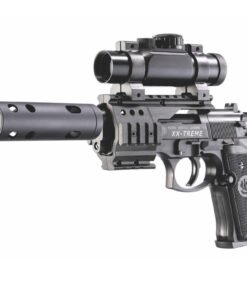
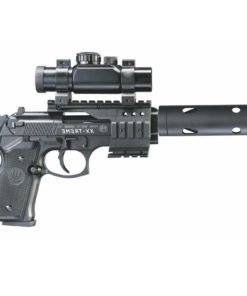
Air Gun Pistol
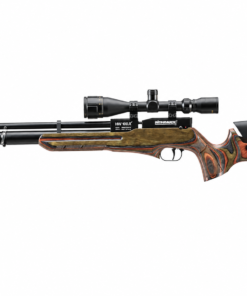
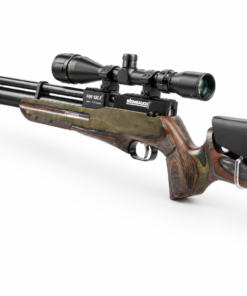
PCP Air Rifles
Reviews
There are no reviews yet.