
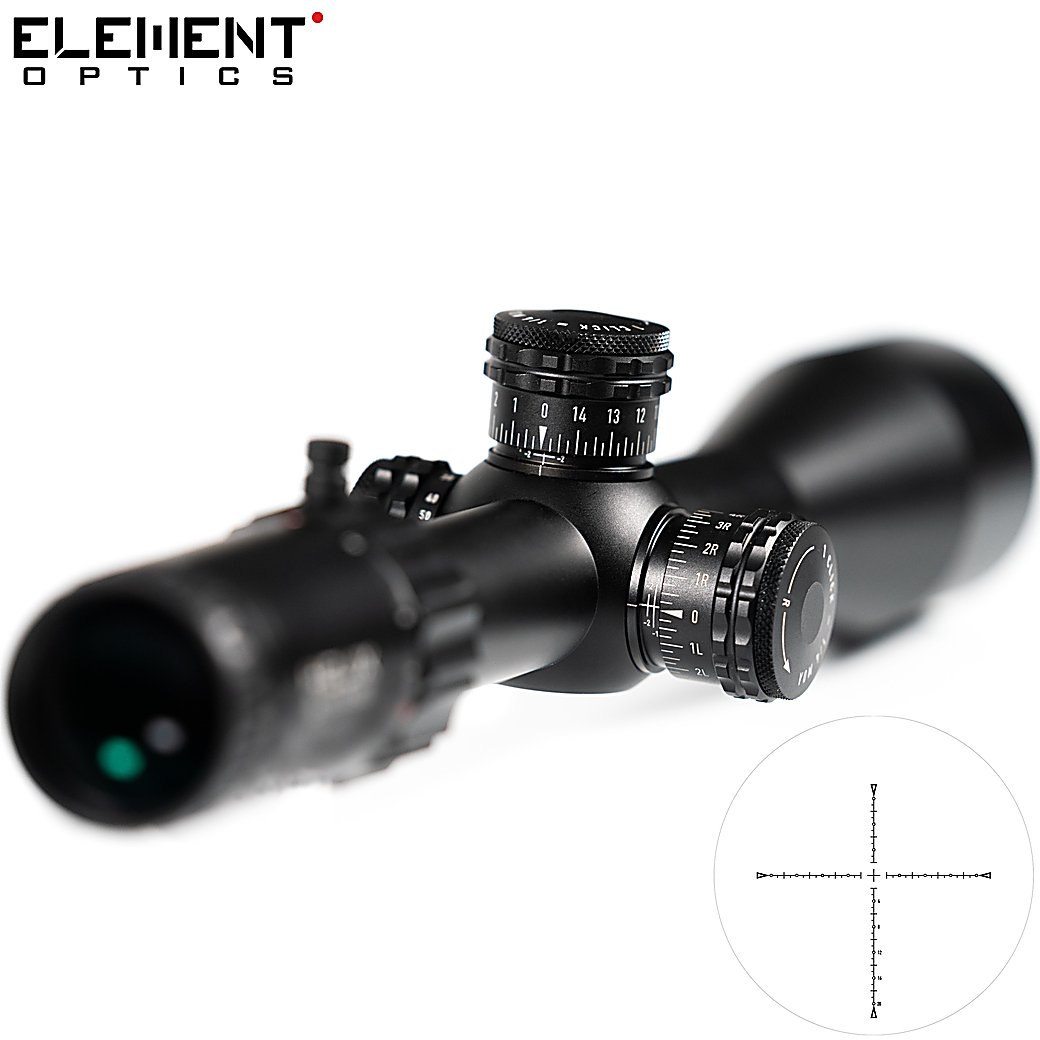
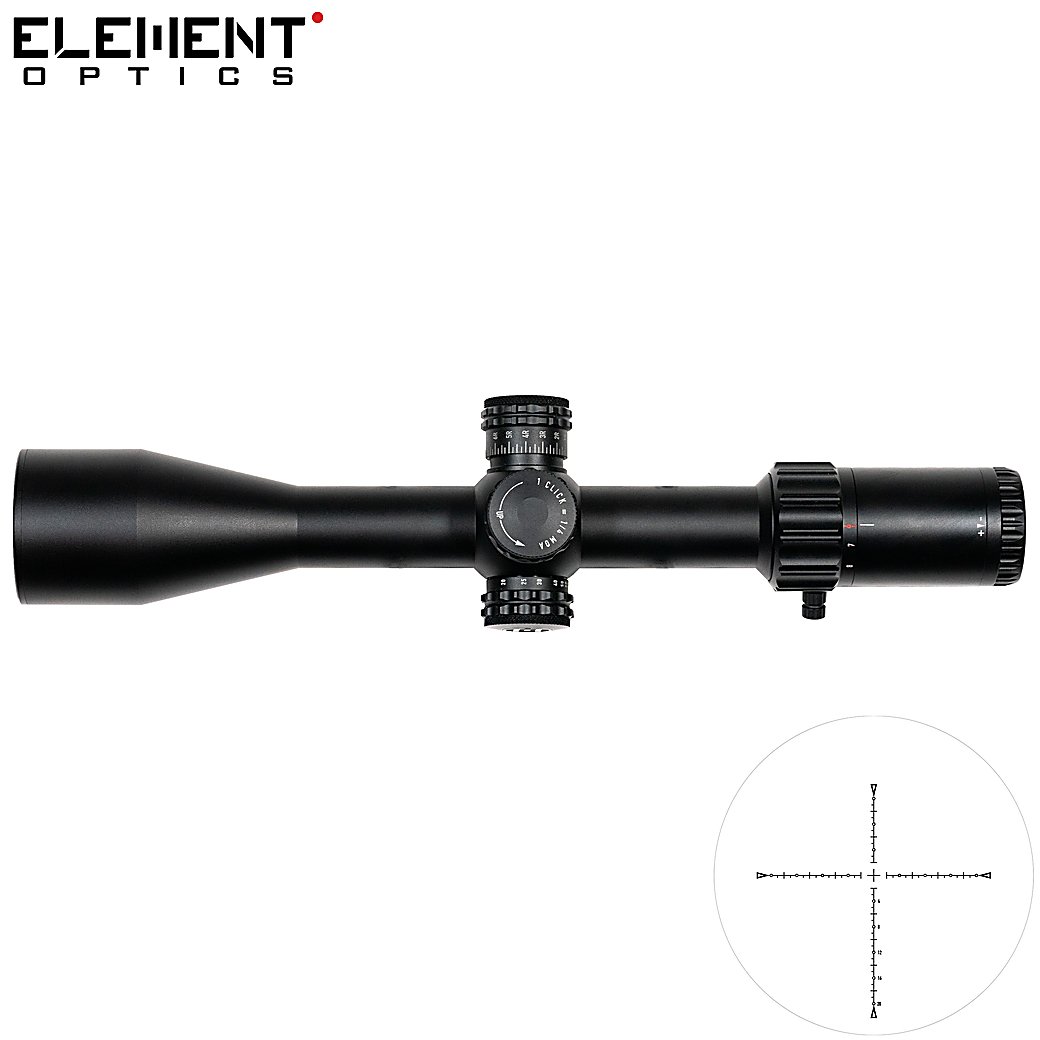
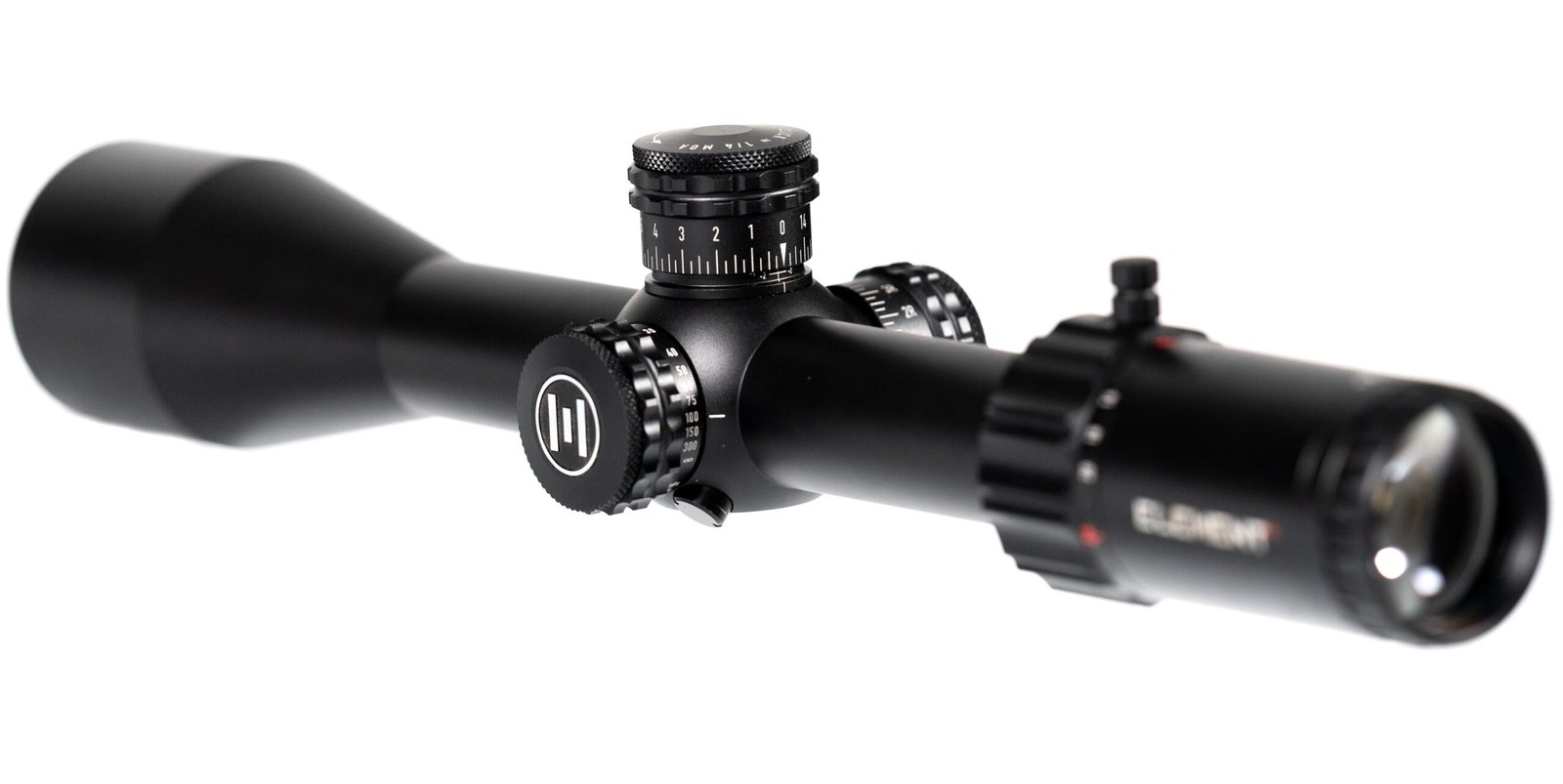
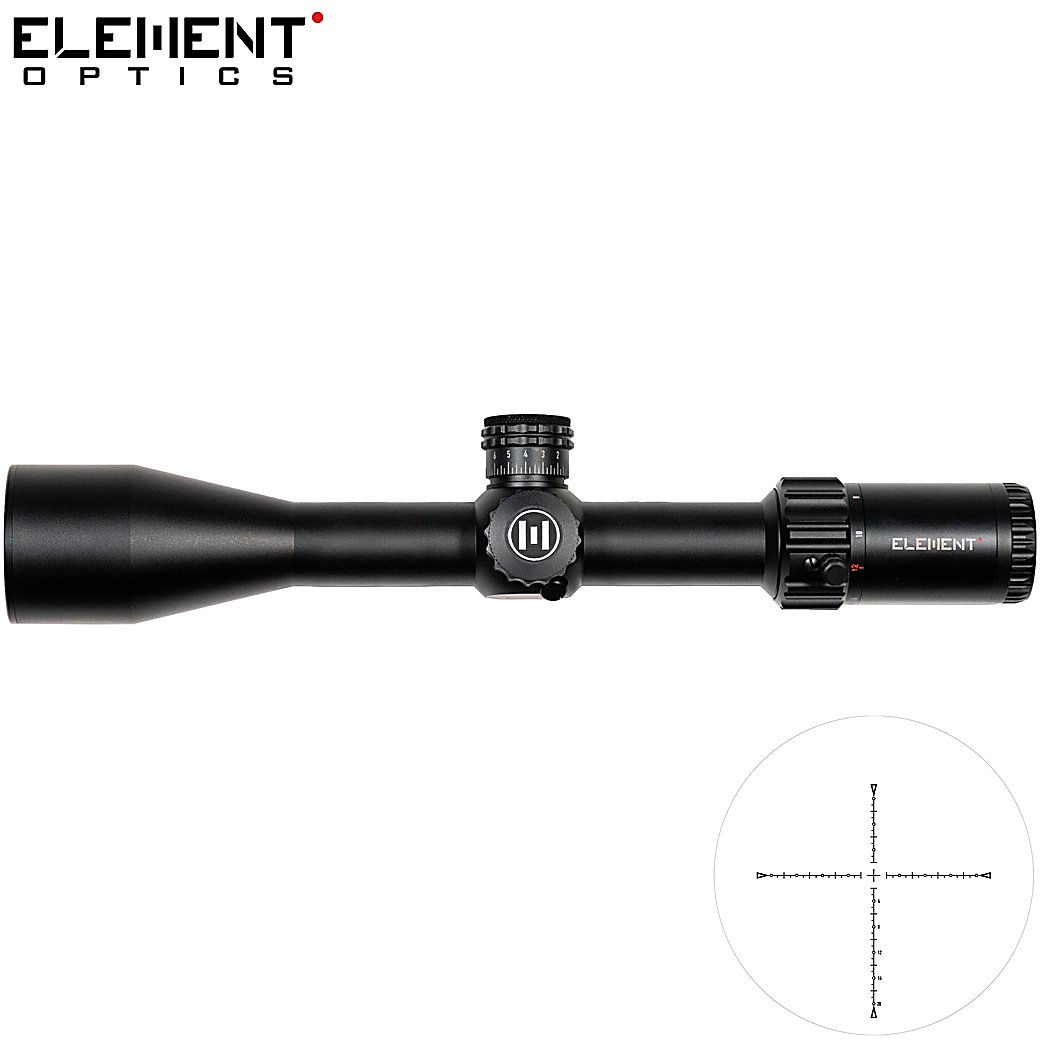
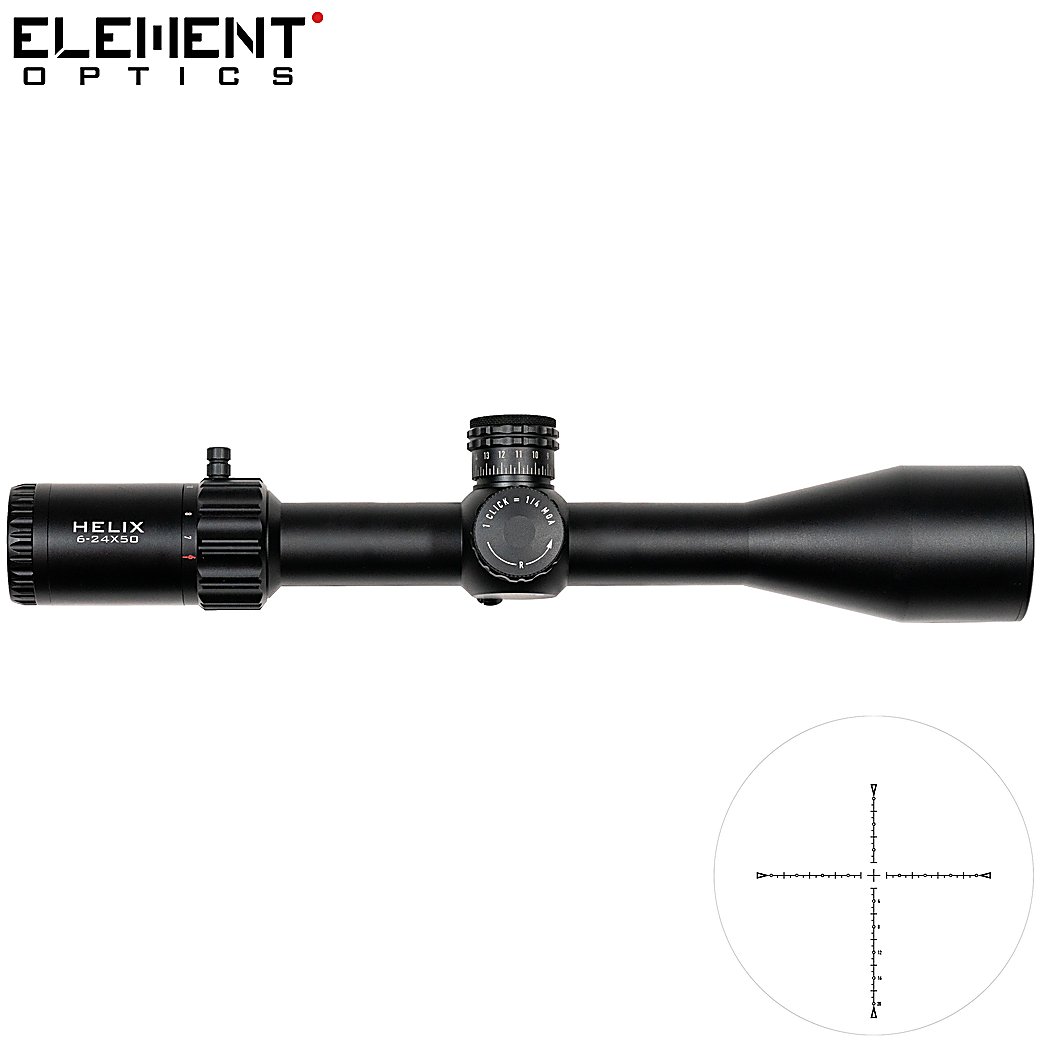
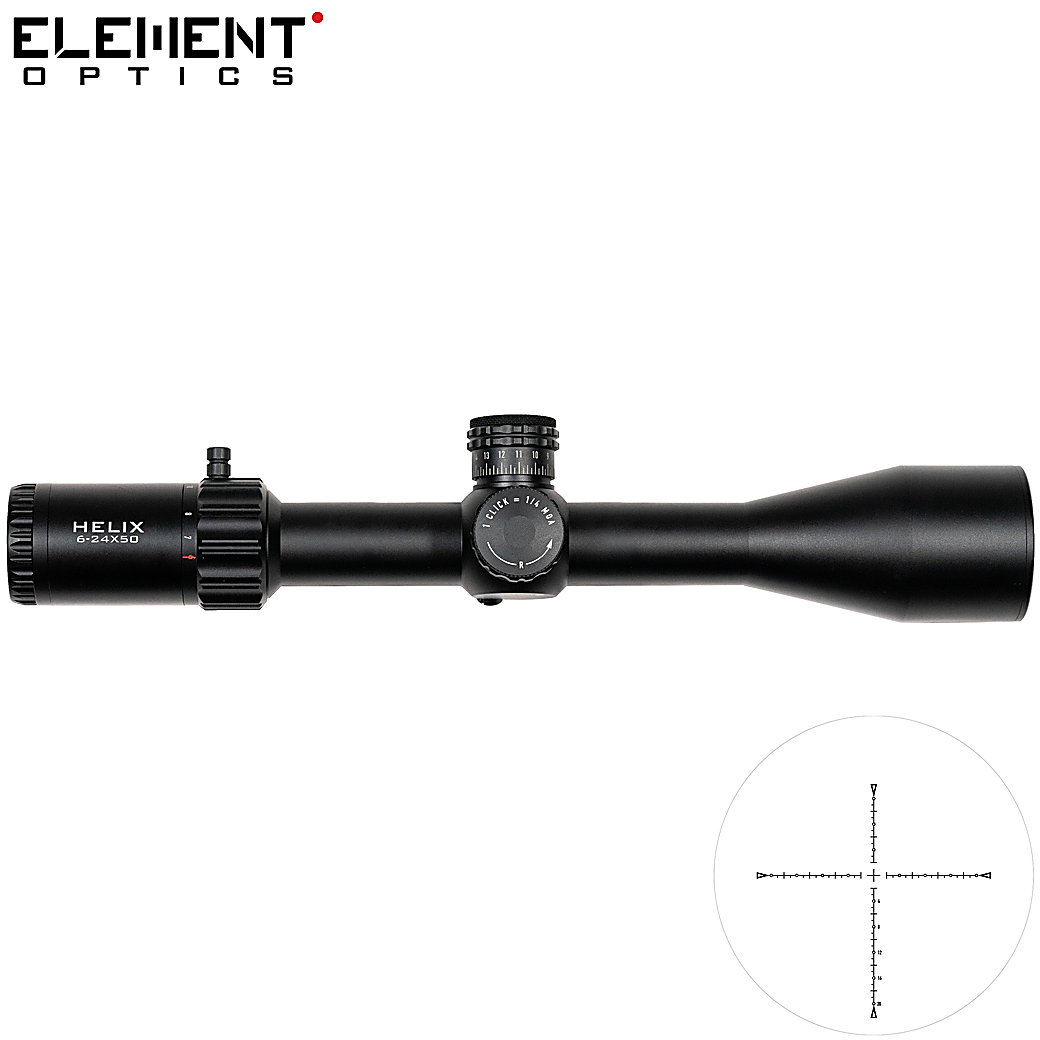
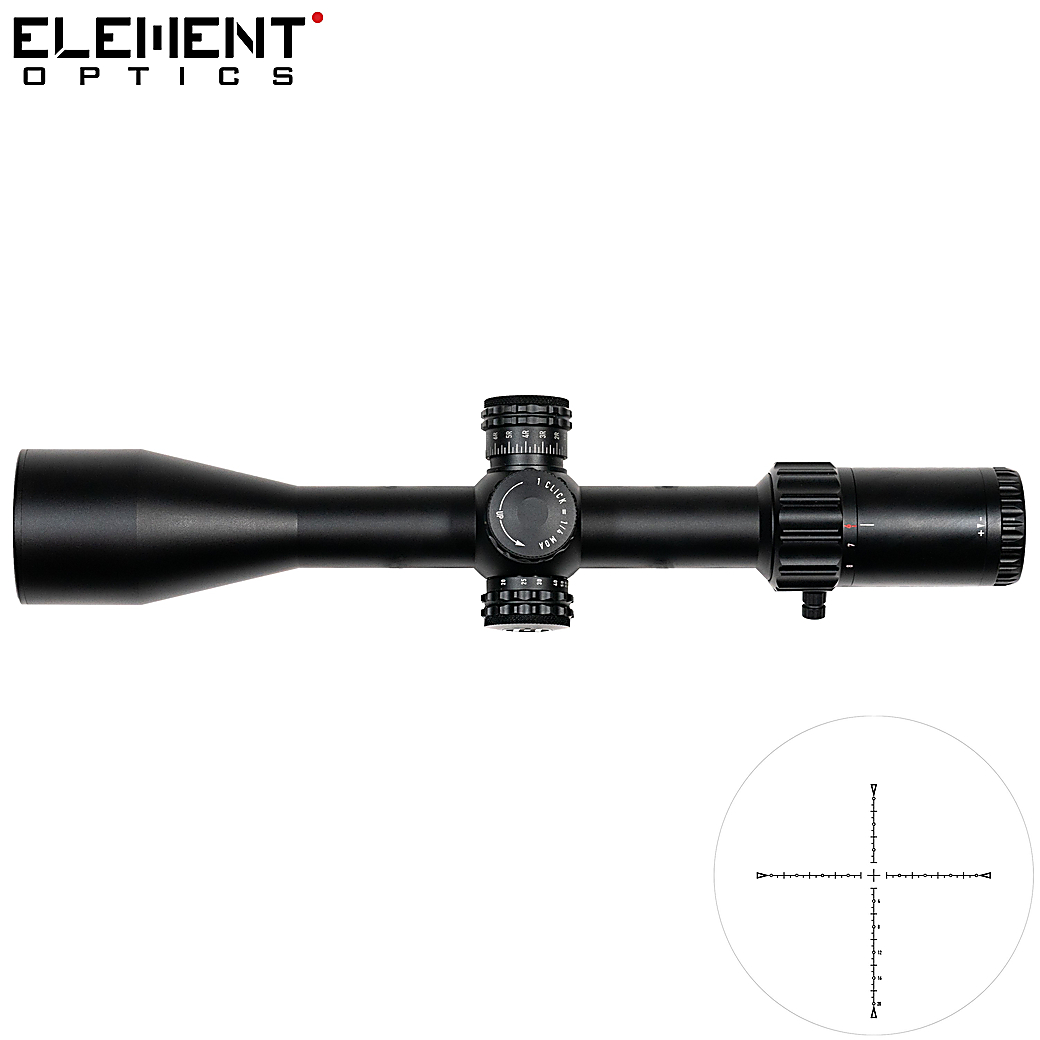
Scope Element Optics Helix 6-24X50 EHR-1C SFP MOA
$220.00
Looking for a riflescope that punches above its weight? Something that holds its own against products twice its price? We’ve designed the HELIX in a way that puts the important things first: clear glass, smart reticles, innovative features and a turret system superior to other products in the same price class.
This Element Optics Helix 6-24×50 SFP rifle scope is developed by a team of professional shooters with decades of experience. The scopes from Element Optics offer a very high quality for a very competitive price.
The clear glass of the fully multicoated lenses provides a bright image and the reticle is positioned in the second focal plane, which means it doesn’t enhance when zooming in, preventing the reticle from blocking the view on your target.
With a magnification range from 6x to 24x, the Element Optics Helix 6-24×50 SFP rifle scope is very suitable for use in middle and long distances. The reticle is calibrated to 24x magnification which -with a tiny bit of maths- makes it also ideal with 12x and 6x magnification. Zooming is made easy by the throw lever that can easily be screwed out and replaced with the included hex screw if preferred
We offer the choice between an APR-1C reticle and EHR-1C reticle, the first having a turret adjustment in clicks of 0.1 Mrad, the latter in ¼ MOA. The turrets of the Element Optics Helix 6-24×50 SFP rifle scope feature durable stainless steel internals to cope with constant adjustments as they often are made in some shooting sport disciplines. Of course, there’s a zero-stop and the total adjustment range is 18.9 Mrad or 65 MOA for both turrets. The parallax can be adjusted from 10 metres until infinity.
Waterproof, shockproof and filled with nitrogen to prevent internal fogging up.
Aluminium sunshade and lens protection caps included
| MAGNIFICATION RANGE | 6-24x |
| TUBE DIAMETER | 30mm |
| OBJECTIVE LENS DIAMETER | 50mm |
| EXIT PUPIL | 9-2mm |
| EYE RELIEF | 3.94-3.54 Inches |
| FIELD OF VIEW | @100yds: 19.1-4.2 ft |
| CLICK VALUE | 1/4 MOA (15 MOA / REV) | 1/10 MRAD (6 MRAD / REV) |
| ELEVATION ADJUSTMENT RANGE | 65 MOA | 18.9 MRAD |
| WINDAGE ADJUSTMENT RANGE | 65 MOA | 18.9 MRAD |
| MINIMUM PARALLAX | 10 YDS | 10 METERS |
| LENGTH | 13.1 Inches | 333 mm |
| WEIGHT | 26oz | 737g |
Data sheet
| Tube diameter | 30 mm |
| UPC | 760655918012 |
Scope Element Optics Helix 6-24X50 EHR-1C SFP MOA
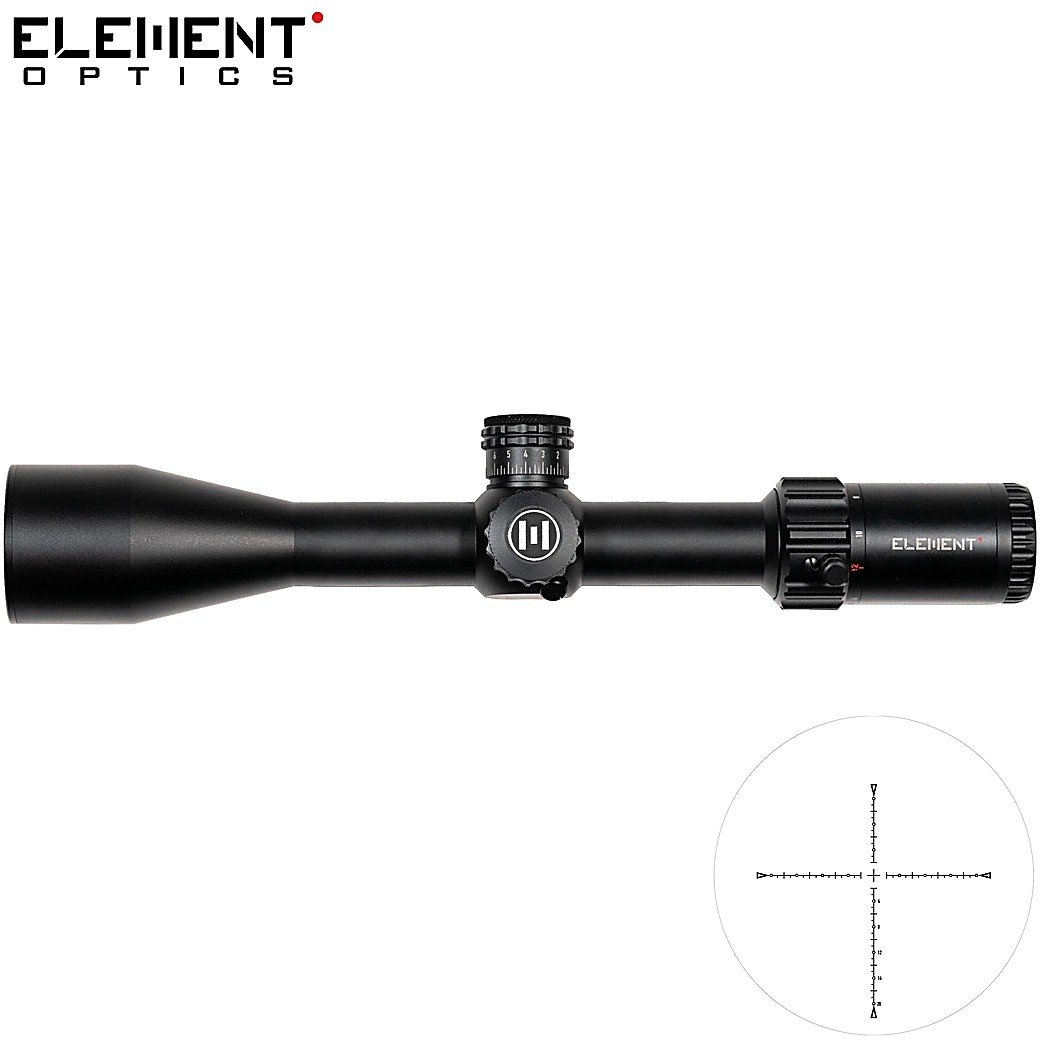
When dependable optical performance, straightforward adjustment, versatile magnification, and carefully designed MOA functionality are required, the Scope Element Optics Helix 6-24X50 EHR-1C SFP MOA provides a highly capable optical platform. A practical combination of a 6-24x magnification range, 50mm objective lens, second focal plane configuration, EHR-1C MOA reticle, 30mm main tube, side-focus parallax adjustment, resettable turrets, and a mechanical zero-stop has been brought together in one thoughtfully engineered riflescope.
Rather than unnecessary complexity being added simply to increase the feature count, the HELIX platform has been designed around features that can actually be used. Clear glass has been paired with fully multi-coated lenses, tactile adjustment controls have been incorporated, and a practical reticle has been positioned in the second focal plane.
Consequently, an optic has been produced that can feel equally comfortable during recreational target shooting, range use, precision-oriented airgun setups, controlled sporting applications, and other legitimate shooting activities where dependable observation and repeatable adjustment are valued.
A magnification range of 6-24x is officially specified, while a 30mm main body tube and 50mm objective lens are used. Side parallax adjustment can be made from 10 yards to infinity, and the MOA configuration provides 1/4 MOA clicks with 15 MOA per turret revolution. Furthermore, approximately 65 MOA of elevation adjustment and 40 MOA of windage adjustment are provided. The original HELIX SFP measures approximately 14.3 inches / 363 mm and weighs approximately 26 oz / 737 g.
An Optic Designed Around Practical Performance
Performance should never be judged only by how impressive a specification sheet appears. Instead, the relationship between optical clarity, mechanical consistency, reticle design, field usability, durability, and adjustment control should be considered together.
That philosophy can clearly be recognized throughout the Scope Element Optics Helix 6-24X50 EHR-1C SFP MOA.
At the lower end of its magnification range, a broader view can be maintained for locating and observing targets. As magnification is increased, smaller details can be examined more closely. Therefore, the optic does not need to be restricted to one narrow style of range use.
In addition, the 50mm objective has been selected to provide a useful balance between light collection and manageable overall dimensions. An excessively large objective can create mounting and handling complications, whereas a smaller objective may not provide the same viewing characteristics at elevated magnification. Here, a balanced approach has been taken.
Likewise, a second focal plane reticle has been chosen. Because the reticle remains visually consistent in apparent size as magnification is changed, a familiar sight picture can be retained throughout the zoom range.
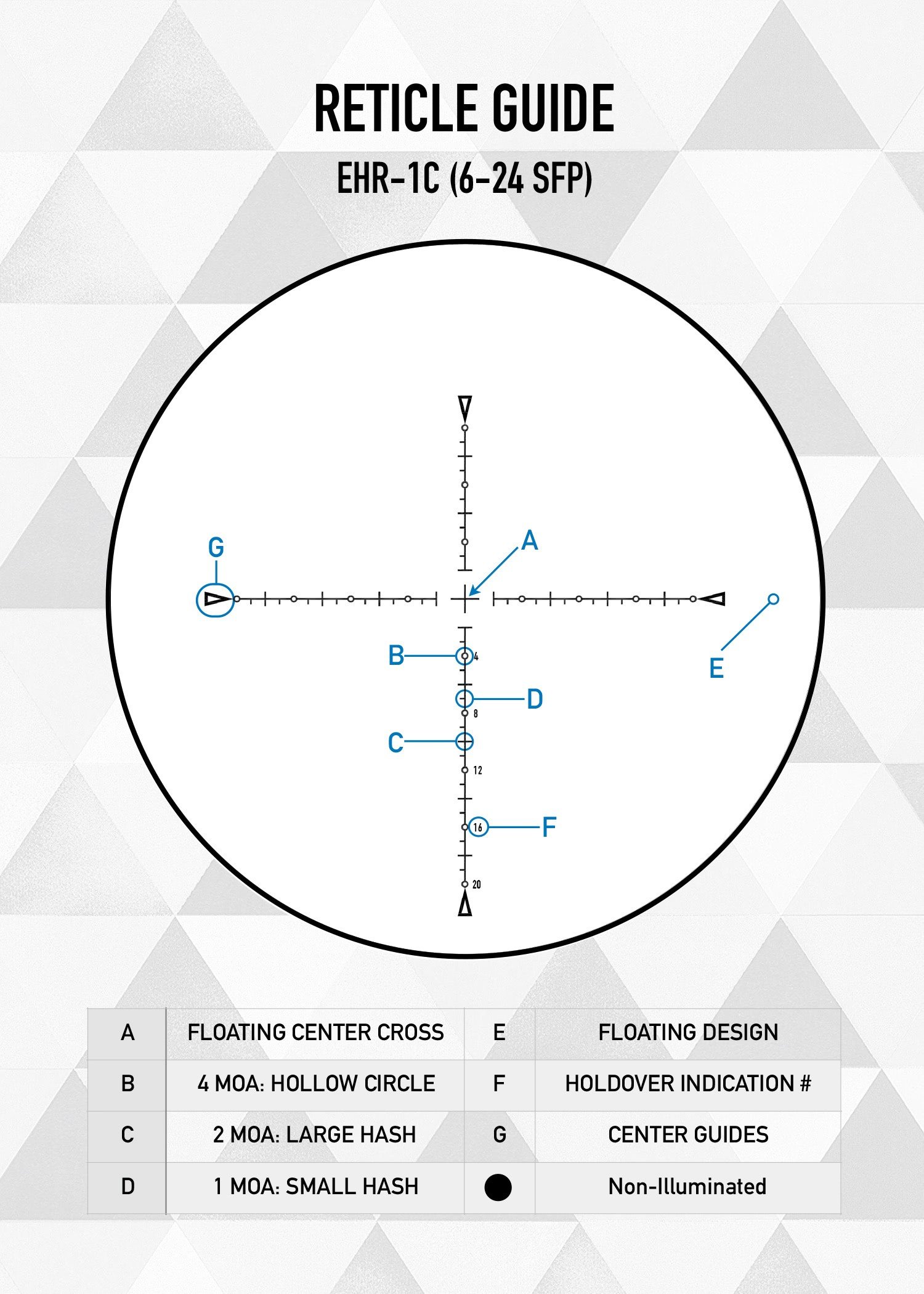
The EHR-1C MOA reticle has also been developed with usability in mind. Element Optics describes “EHR” as Expedited Hold Reticle, with different shapes being used along the horizontal and vertical axes so reference points can be located more quickly. A floating center crosshair is incorporated to provide a clean central aiming reference.
Consequently, the overall design feels purposeful rather than unnecessarily complicated.
Key Features of the Scope Element Optics Helix 6-24X50 EHR-1C SFP MOA
Important product characteristics include:
- 6-24x variable magnification range for flexible target observation.
- 50mm objective lens for a balanced combination of image performance and manageable proportions.
- Second focal plane EHR-1C MOA reticle with an uncluttered, practical layout.
- 30mm main body tube manufactured from aircraft-grade aluminium.
- 1/4 MOA adjustment clicks for the MOA configuration.
- 15 MOA adjustment per turret revolution on the original HELIX SFP MOA model.
- Approximately 65 MOA total elevation adjustment range.
- Approximately 40 MOA total windage adjustment range.
- Side parallax adjustment from 10 yards to infinity.
- Fully multi-coated lenses for improved optical transmission and image quality.
- Tool-free resettable turrets for convenient zero-index management.
- Hard mechanical zero-stop to establish a dependable return reference.
- Removable magnification throw lever for quicker zoom adjustment.
- Waterproof construction for use under changing environmental conditions.
- Fogproof construction to improve dependability when temperatures fluctuate.
- Shockproof construction for greater mechanical durability.
- Nitrogen-purged optical system to help control internal fogging.
- Sunshade included for additional control in bright viewing conditions.
- Rubber lens caps included for protection during storage and transport.
- Lens cloth included for routine lens maintenance.
These characteristics are listed by Element Optics for the original HELIX 6-24×50 SFP platform.
6-24x Magnification for Flexible Observation
A useful magnification system should allow the optic to adapt rather than forcing the shooter to work around it.
With the 6-24x magnification range, a substantial degree of flexibility has been provided.
Why 6x Can Be Useful
At 6x, comparatively wider target-area awareness can be maintained. Targets can generally be located more easily than they can at very high magnification, while surrounding reference points remain visible.
Therefore, lower magnification can be preferred during initial target acquisition, general observation, equipment setup, or situations where a wider field of view is useful.
The manufacturer lists a field of view of approximately 19.1 feet at 100 yards at 6x, narrowing to approximately 4.2 feet at 100 yards at 24x.
Why 24x Matters
At the opposite end of the zoom range, 24x magnification allows smaller visual details to be examined much more closely.
Target markings can be observed more clearly, group placement can be evaluated more easily when atmospheric conditions permit, and fine aiming references can be viewed with greater detail.
However, maximum magnification does not automatically provide the best image in every circumstance. Mirage, atmospheric disturbance, available light, target contrast, shooting stability, and eye position can all influence practical viewing quality.
Therefore, the 6-24x system is valuable because magnification can be selected according to conditions rather than simply being left permanently at maximum power.
50mm Objective Lens
A 50mm objective lens has been incorporated into the Scope Element Optics Helix 6-24X50 EHR-1C SFP MOA.
Objective diameter matters because it influences several practical aspects of a riflescope, including available light transmission, exit-pupil characteristics, mounting height, physical size, and image behavior at higher magnification.
The HELIX has been designed around a 50mm objective because a useful compromise can be achieved.
A substantial optical opening is provided without requiring the extremely large dimensions associated with oversized objectives.
Furthermore, when appropriate rings and mounting geometry are used, the optic can generally be positioned in a manner that supports a comfortable and consistent viewing position.
Fully Multi-Coated Optical System
Image quality is influenced by considerably more than magnification alone.
Every air-to-glass interface can potentially reflect a portion of incoming light. Therefore, lens coatings play an important role in usable optical performance.
The HELIX is equipped with fully multi-coated lenses.
Through appropriate lens coatings, unwanted reflections can be reduced and light transmission can be improved. Consequently, contrast, apparent clarity, and overall viewing comfort can be enhanced.
This becomes particularly relevant when environmental conditions are less than perfect.
Bright backlighting, cloudy skies, shaded targets, changing sun angles, and subdued range lighting can all expose weaknesses in an optical system. Although no riflescope can eliminate environmental limitations, proper optical coatings can help preserve a cleaner and more useful image.
Why Lens Quality Matters at Higher Magnification
As magnification is increased, imperfections can become easier to notice.
Chromatic effects, edge softness, reduced brightness, eye-position sensitivity, and atmospheric distortion can become more apparent.
Therefore, usable 24x performance depends on more than simply printing “24x” on a magnification ring.
An optical system needs to be engineered so that magnification remains useful.
The HELIX platform was developed around this principle, and its fully multi-coated lenses contribute significantly to that objective.
Second Focal Plane Reticle
The EHR-1C reticle is positioned in the second focal plane.
In an SFP optic, the apparent size of the reticle remains essentially unchanged as magnification is adjusted.
For many users, that characteristic is immediately appealing because the reticle always remains visually familiar.
At low magnification, it is not reduced to an extremely fine appearance. Conversely, at high magnification, it does not grow to dominate the target image.
Why an SFP Reticle Can Be Preferred
Second focal plane optics continue to be preferred for many applications because an uncluttered and consistent-looking sight picture can be provided.
A shooter who spends substantial time at known magnification settings may find SFP operation intuitive.
Element Optics specifically states that the original HELIX SFP reticle system is usable at 6x, 12x and 24x, with appropriate interpretation of the reticle scaling.
Therefore, the optic provides flexibility while retaining the visual advantages commonly associated with an SFP design.
Consistent Reticle Appearance
Because the reticle does not visually expand and contract through the zoom range, the center reference remains easy to recognize.
That characteristic can be particularly helpful when the optic is frequently moved between moderate and high magnification.
Rather than being visually transformed as magnification changes, the reticle remains recognizable and predictable.
EHR-1C MOA Reticle
One of the defining features of this particular configuration is the EHR-1C MOA reticle.
Element Optics states that EHR means Expedited Hold Reticle. The design uses three different reference shapes—circles, larger hashes, and smaller hashes—along its axes so hold references can be identified efficiently. A floating center crosshair is also incorporated to create a clean central reference.
The result is a reticle that balances information with visual simplicity.
Clean Central Reference
An excessively busy center can obscure small target details.
For that reason, the floating center crosshair has been designed to maintain a precise central reference while preserving visibility around the immediate aiming area.
That becomes particularly useful when smaller target markings are being observed at elevated magnification.
Reference Marks Without Excessive Clutter
Reticle complexity can be beneficial only when the information being displayed is actually usable.
When too many marks are added, the image can become distracting.
The EHR-1C attempts to avoid that problem.
Clear reference shapes have been incorporated so different positions can be recognized without forcing every portion of the field of view to be filled with markings.
Consequently, traditional target shooters can appreciate the cleaner appearance, while users who want additional visual references are not left with a simple duplex-style reticle.
MOA-Based Adjustment System
The MOA configuration of the HELIX uses 1/4 MOA clicks.
This allows the turret system and reticle language to remain familiar to users who prefer Minute of Angle measurements.
Each click represents one quarter of one MOA.
Furthermore, the original HELIX SFP MOA turret provides 15 MOA per revolution.
Why Matching Reticle and Turret Units Matters
A coherent adjustment system reduces unnecessary mental conversion.
Because both the EHR-1C configuration and turret adjustment are based around MOA, measurements and corrections can be kept within the same angular system.
That makes equipment setup and routine adjustment more straightforward.
Rather than switching between different measurement systems, the optic can be managed consistently.
Tool-Free Resettable Turrets
The HELIX uses tool-free resettable turrets.
Once an appropriate optical zero has been established according to the equipment manufacturer’s instructions and applicable range practices, turret indexing can be reset without requiring a complicated process.
This allows the visible scale to be returned to a practical reference position.
Therefore, subsequent adjustments can be tracked more conveniently.
Why Resettable Turrets Improve Usability
A turret should communicate useful information quickly.
When a zero reference is clearly established, the shooter does not need to remember an arbitrary number on the dial.
Instead, the scale can be reset to a meaningful starting position.
This seemingly small feature can make a major difference in day-to-day convenience.
Hard Mechanical Zero-Stop
A hard mechanical zero-stop has been incorporated into the HELIX.
Zero-stop systems are especially useful because a physical reference point can be established.
When adjustments have been made away from the primary setting, the turret can be returned until the mechanical stop is reached.
Consequently, uncertainty can be reduced.
Mechanical Confidence
A good zero-stop does more than add another specification to a product page.
It provides tactile confirmation.
When equipment is being used in changing environments or when adjustments have been made repeatedly, a physical stop can provide greater confidence than relying only on visually reading turret markings.
This feature helps distinguish the HELIX from extremely basic optics where turret management may require more attention.
Approximately 65 MOA of Elevation Adjustment
The MOA version provides approximately 65 MOA of elevation adjustment range.
A useful internal adjustment range provides flexibility when the optic is mounted on compatible equipment.
However, actual usable adjustment can be influenced by mounting alignment, rail geometry, ring alignment, mechanical zero position, and the equipment on which the optic has been installed.
Therefore, the published adjustment range should be understood as the scope’s mechanical specification rather than a guarantee that every installation will provide the entire amount in one direction.
Nevertheless, 65 MOA represents a versatile internal adjustment envelope for this type of optic.
Approximately 40 MOA Windage Adjustment
Approximately 40 MOA of total windage adjustment is also officially specified.
Windage adjustment allows horizontal optical alignment to be established and controlled.
As with elevation, the available mechanical range should ideally not be used to compensate for severely misaligned mounting hardware.
Correct ring installation and properly aligned mounting components remain important.
Side Parallax Adjustment From 10 Yards to Infinity
One of the most useful characteristics of the Scope Element Optics Helix 6-24X50 EHR-1C SFP MOA is its side parallax system.
Adjustment is officially specified from 10 yards to infinity.
This unusually close minimum distance increases versatility considerably, particularly for precision-oriented airgun and rimfire range environments where targets may sometimes be positioned relatively close.
Why Parallax Adjustment Matters
At elevated magnification, parallax error can become more noticeable.
If the target image and reticle are not optically aligned on the same focal plane, apparent reticle movement can be observed when eye position changes.
By adjusting the side-focus system for the viewing distance, the image can be brought into better focus and parallax effects can be minimized.
Therefore, the side turret should not simply be treated as a basic focus control.
It contributes directly to consistent viewing.
Convenient Side-Mounted Control
Because the adjustment control is located on the side of the scope, it can be reached without moving to the objective bell.
That arrangement can be particularly useful when equipment is being operated from a supported position.
Fine adjustments can be made while the viewing position is maintained.
30mm Main Tube
A 30mm main body tube is used.
Thirty-millimeter scope tubes have become widely adopted because a practical combination of rigidity, internal adjustment capacity, and mounting compatibility can be achieved.
A substantial selection of compatible rings and mounts is generally available in this diameter.
However, the correct ring diameter must always be selected.
A 1-inch mount should not be confused with a 30mm mount, and correct ring height should also be determined according to objective clearance and equipment geometry.
Aircraft-Grade Aluminium Construction
The HELIX body is manufactured using aircraft-grade aluminium, according to Element Optics.
Aluminium allows excellent structural performance to be achieved without introducing the weight that would result from many steel constructions.
Additionally, corrosion resistance can be supported through appropriate finishing processes.
The finished result feels substantial enough for regular use while remaining manageable.
Compact and Manageable Design
The original HELIX 6-24×50 SFP measures approximately 14.3 inches / 363mm and weighs approximately 26 ounces / 737g.
These dimensions allow the optic to provide a broad zoom range and 50mm objective without becoming excessively oversized.
Why Overall Size Matters
Balance is often overlooked when an optic is selected.
A scope can provide excellent specifications yet still feel awkward when its dimensions are poorly matched to the platform on which it is installed.
Weight distribution influences handling.
Ring position influences eye relief.
Objective diameter influences mounting height.
Turret dimensions influence clearance.
Consequently, physical design should always be evaluated alongside optical specifications.
The HELIX has been engineered so those characteristics remain reasonably balanced.
Eye Relief Designed for Comfortable Viewing
Eye relief is officially listed at approximately 3.94 to 3.54 inches / 99 to 90mm, depending on magnification.
Adequate eye relief is important because a full image should be obtainable from a natural viewing position.
Proper mounting remains essential.
Rather than moving the head unnaturally forward or backward whenever the optic is used, ring placement should be configured so the full sight picture is naturally presented.
Building a Consistent Viewing Position
Once a comfortable position has been established, repeatability becomes easier.
A consistent cheek position helps the eye return to the same optical axis.
In turn, the image can be acquired more quickly and parallax-related inconsistencies can be reduced.
Therefore, eye relief should never be regarded as an isolated specification.
It forms part of the entire ergonomic relationship between optic, mount, equipment, and user.
Exit Pupil Performance
Element Optics lists an exit pupil range of approximately 9mm to 2mm for the original HELIX SFP.
Exit pupil naturally decreases as magnification increases.
At lower magnification, a larger exit pupil generally makes eye positioning more forgiving and provides strong apparent brightness.
At maximum magnification, eye alignment becomes more critical because the exit pupil becomes smaller.
This is normal optical behavior.
Therefore, users should not assume that the highest magnification setting will always provide the most comfortable image.
A lower magnification may sometimes provide a brighter, steadier, and more forgiving sight picture.
Removable Magnification Throw Lever
A removable magnification throw lever is supplied as part of the design.
The throw lever provides additional leverage when the magnification ring is being rotated.
This can be particularly helpful when quick adjustments are preferred or when gloves are being worn.
Remove It When a Lower Profile Is Preferred
Because the lever can be removed, the user is not permanently committed to the extended profile.
Some users prefer the additional leverage.
Others prefer a streamlined magnification ring.
Both preferences can therefore be accommodated.
Waterproof Construction
Outdoor optical equipment can be exposed to rain, humidity, condensation, and accidental splashes.
For this reason, the HELIX has been designed to be waterproof.
Water resistance should not be interpreted as permission for unnecessary submersion or improper storage, but environmental sealing provides important protection during ordinary outdoor use.
Fogproof and Nitrogen Purged
The scope is also described as fogproof and nitrogen purged.
Temperature changes can create challenging conditions for optical equipment.
For example, equipment may be moved from a temperature-controlled vehicle into cold outdoor air or from cool storage into a warm, humid environment.
Internal moisture can be particularly problematic because internal lens surfaces cannot simply be wiped clean.
By purging and sealing the optical system, the risk of internal fogging is reduced.
External condensation can still occur under certain environmental conditions, but it can normally be managed once temperatures stabilize.
Shockproof Design
A riflescope is subjected to vibration and mechanical stress during transportation, mounting, regular handling, and use.
Therefore, mechanical durability is essential.
The HELIX has been designed as a shockproof optic.
Turret mechanisms, internal optical assemblies, and exterior construction must work together if long-term consistency is expected.
A scope cannot be judged only by glass clarity on the first day it is removed from its box.
Mechanical integrity over repeated use is equally important.
Included Sunshade
A sunshade is included.
When strong directional light reaches the objective lens, unwanted glare can sometimes be observed.
By extending the front of the objective assembly, stray light can be reduced.
The sunshade can therefore improve viewing comfort under certain bright conditions.
However, it does not need to remain installed at all times.
Its usefulness depends on lighting conditions, available space, and user preference.
Lens Caps and Cleaning Cloth Included
Rubber lens caps and a lens cloth are also included by the manufacturer.
These accessories may seem simple, but lens protection is important.
Dust, sand, fingerprints, moisture, and accidental contact can gradually affect optical surfaces.
Lens caps provide basic protection when the optic is being transported or stored, while an appropriate cloth can be used when careful cleaning becomes necessary.
Why Choose the Scope Element Optics Helix 6-24X50 EHR-1C SFP MOA?
Several qualities make this configuration particularly compelling.
First, a broad and useful magnification range has been provided.
Second, a practical 50mm objective has been included.
Third, a clean second focal plane MOA reticle has been combined with matching MOA turret adjustments.
Moreover, side parallax adjustment begins at only 10 yards.
A mechanical zero-stop has also been incorporated.
Tool-free resettable turrets have been provided.
A removable magnification lever has been included.
Finally, environmental protection has been addressed through waterproof, fogproof, shockproof, and nitrogen-purged construction.
Rather than depending on one headline feature, value has been created through the complete combination.
Balanced Optical Performance
The HELIX 6-24×50 occupies an appealing position between extremely basic scopes and considerably more complicated premium tactical-style optics.
Enough adjustment capability has been provided for serious range use, yet the optic has not been made unnecessarily difficult to understand.
Enough magnification has been supplied for detailed observation, yet the lower 6x setting remains practical.
A detailed reticle has been incorporated, yet the center has not been overwhelmed with excessive information.
This balance is one of the strongest characteristics of the platform.
Suitable for Precision-Oriented Airgun Platforms
Because parallax adjustment begins at approximately 10 yards, the HELIX has characteristics that can be particularly valuable on compatible precision airgun equipment.
Many general-purpose centerfire optics have minimum parallax distances that are much longer.
Consequently, they may not focus ideally on shorter-distance airgun targets.
The HELIX avoids much of that limitation through its close side-focus capability.
In addition, higher magnification can be useful when small target zones are being observed during controlled range sessions.
Useful for Rimfire Range Applications
The same close-focus characteristics can make the optic attractive for compatible rimfire platforms used in lawful sporting and target settings.
Target distances can vary considerably during rimfire shooting.
Therefore, an optic that can be focused at relatively close range while still offering substantial magnification provides valuable flexibility.
Excellent for Recreational Target Shooting
Not every optic needs to be chosen exclusively for competition or specialized use.
Recreational shooters may simply want:
- Clear magnification.
- Dependable adjustment.
- A useful reticle.
- Convenient side focus.
- Comfortable observation.
- Robust construction.
- Simple controls.
Those priorities have been addressed effectively by the HELIX.
Because complexity has been controlled, the scope can remain enjoyable to use rather than turning every range session into a technical exercise.
Practical for Paper-Target Evaluation
High magnification is particularly useful when paper targets are being evaluated.
At suitable distances and under favorable atmospheric conditions, impact patterns and printed reference marks may be observed more clearly.
This can reduce unnecessary movement between the shooting position and target line during appropriate supervised range sessions.
More importantly, the optical system allows small details to be inspected while a stable position is maintained.
Useful for Metallic Target Observation
Metallic targets provide different visual challenges.
Painted impact zones, edges, target movement, and contrast changes can sometimes be easier to identify with additional magnification.
The 6-24x range allows viewing power to be tailored according to target size and distance.
Again, maximum power does not always need to be selected.
The best setting is the one that provides the clearest and most stable image under the actual conditions.
EHR-1C for Shooters Who Prefer MOA
Many shooters think naturally in MOA.
For those users, the EHR-1C MOA configuration avoids unnecessary unit conversion.
Turret corrections, reticle references, and recorded adjustments can remain within one angular measurement system.
That consistency can make equipment management substantially easier.
Why the Mechanical Zero-Stop Adds Value
A zero-stop is sometimes assumed to be useful only on extremely expensive optics.
However, its benefit is simple and universal: a repeatable mechanical reference can be established.
Once adjustment has been made away from the primary reference, returning the dial becomes easier.
Rather than relying only on memory or turret markings, a physical stopping point is available.
This creates confidence and improves convenience.
Why Tool-Free Turrets Matter in Real Use
Small tools are easy to misplace.
If a turret must be reset with a specific wrench or miniature screwdriver every time its scale is re-indexed, simple maintenance can become inconvenient.
By allowing the turrets to be reset without specialized tools, routine setup has been simplified.
That convenience becomes particularly noticeable over long-term ownership.
Why the 30mm Tube Is a Practical Choice
A 30mm tube provides an excellent middle ground.
Mounting components are widely available.
The tube remains reasonably compact.
Internal adjustment space can be provided.
Structural rigidity is maintained.
Consequently, the format has become one of the most commonly accepted dimensions for performance-oriented scopes.
How the 50mm Objective Supports Versatility
Objective size influences more than appearance.
A 50mm front element allows the optical system to support the 24x upper magnification range without requiring an unusually oversized housing.
At lower magnification, generous exit-pupil characteristics can be maintained.
At higher magnification, the objective continues to provide a useful amount of incoming light.
Therefore, the objective diameter complements the intended zoom range effectively.
Ergonomic Controls
A good riflescope should be understandable by touch as well as by sight.
The HELIX provides distinct adjustment areas for:
- Elevation.
- Windage.
- Side parallax.
- Magnification.
- Diopter adjustment.
Each control serves a defined function.
Once familiarity has been established, adjustments can be made naturally without unnecessary complexity.
Diopter Adjustment and Reticle Focus
Correct diopter setup is essential for comfortable viewing.
The diopter should be adjusted so the reticle appears crisp to the user’s eye.
This is different from side-parallax adjustment.
The diopter is primarily intended to accommodate the user’s eyesight when the reticle is viewed.
The side parallax adjustment is then used to bring targets at different distances into appropriate optical focus while reducing parallax.
Confusing these controls can lead to unnecessary eye strain.
Therefore, initial setup should be performed carefully.
Image Clarity Through the Magnification Range
Every variable-power optic behaves somewhat differently at various magnification settings.
At lower magnification, eye position can feel more forgiving.
At moderate magnification, an excellent combination of detail, field of view, brightness, and stability may be achieved.
At maximum power, the smallest exit pupil and narrowest field of view are produced.
Therefore, the best image should always be selected according to viewing conditions rather than assuming 24x must automatically be used.
This flexibility is exactly why a 6-24x system is valuable.
Practical Range Workflow
A straightforward observation workflow can be used with the HELIX.
Initially, moderate magnification can be selected.
Next, the side-focus system can be adjusted until the target appears clear.
The diopter should already have been configured so the reticle itself appears sharp.
Afterward, magnification can be increased gradually if additional target detail is required.
If atmospheric distortion becomes distracting at maximum power, magnification can simply be reduced.
Through this approach, the optic can be optimized for the conditions actually being experienced.
Built for Changing Weather Conditions
Outdoor optics rarely operate in laboratory conditions.
Humidity changes.
Temperature changes.
Dust can be encountered.
Light conditions shift.
Unexpected rain can occur.
Equipment may be transported between vehicles, storage spaces, and exposed outdoor locations.
For these reasons, waterproof sealing, nitrogen purging, fog-resistant construction, and shock resistance all contribute to long-term dependability.
How to Care for the Element Optics Helix
Proper maintenance can extend the usable life of any quality optic.
Fortunately, complicated servicing should not normally be required.
Keep Lens Caps Installed During Storage
Whenever the optic is not being used, the supplied lens caps should be installed where practical.
This reduces exposure to dust and accidental contact.
It also prevents objects stored nearby from rubbing directly against optical surfaces.
Remove Loose Dust Before Wiping
Optical glass should never be aggressively wiped while grit remains on the surface.
Loose particles should first be removed with an appropriate optical blower or soft lens brush.
Only afterward should the lens be cleaned gently.
This reduces the risk of micro-scratching.
Use Optical Cleaning Materials
Ordinary paper towels, clothing, workshop rags, and abrasive tissues should be avoided.
A clean optical microfiber cloth should be preferred.
If cleaning fluid is required, a product specifically intended for coated optical lenses should be selected.
Avoid Excessive Cleaning
Perfectly polished lenses are not required after every use.
Unnecessary repeated wiping can cause more damage than a small amount of harmless dust.
Therefore, cleaning should be performed only when needed.
Protect the Turret Area
Dust and fine particles should not be allowed to accumulate around moving controls.
A soft brush or clean air blower can be used to remove loose debris.
Aggressive solvents should not be applied.
Check Mounting Hardware Periodically
Mounting hardware should occasionally be inspected according to the mount manufacturer’s recommendations.
An optic can appear to be malfunctioning when movement is actually being caused by loose or improperly installed rings.
Therefore, mounting integrity should always be confirmed before mechanical problems are assumed.
Avoid Unnecessary Impact
Although the scope has been engineered to withstand shock, intentional rough handling should still be avoided.
Durability is intended to protect equipment during legitimate use, not to eliminate the need for reasonable care.
Store in a Dry Environment
Long-term storage should ideally occur in a dry, temperature-stable location.
Protective cases can be useful for transportation, but wet equipment should not be sealed inside an airtight case for extended periods.
Moisture should be allowed to evaporate first.
Understanding Second Focal Plane Calibration
Because the EHR-1C reticle is located in the second focal plane, its angular subtensions correspond differently as magnification changes.
Element Optics identifies 6x, 12x, and 24x as usable magnification references for the original HELIX SFP system.
This should be understood before reticle measurements are interpreted.
The advantage is that reticle thickness remains visually consistent.
The trade-off is that subtension interpretation must account for magnification.
For shooters who prefer a stable-looking reticle, that trade-off can be very worthwhile.
SFP Versus FFP: Why This Model Makes Sense
First focal plane optics have become popular, but FFP is not automatically better for everyone.
An FFP reticle grows and shrinks visually as magnification is changed.
This means its subtensions remain proportional at every magnification.
However, the reticle can appear comparatively small at low magnification and substantially heavier at high magnification.
With an SFP optic, the reticle remains visually consistent.
For users who mainly work at established magnification settings and value a stable reticle appearance, SFP can provide an excellent experience.
Therefore, the Scope Element Optics Helix 6-24X50 EHR-1C SFP MOA should not be viewed as an inferior alternative to FFP.
It is simply designed around a different operational preference.
Optical Balance Instead of Specification Competition
Modern optics are sometimes marketed around extreme numbers.
Very high magnification.
Oversized objectives.
Huge main tubes.
Complex reticles.
Massive turret travel.
However, bigger numbers do not automatically produce a better ownership experience.
The HELIX takes a more balanced approach.
Its 6-24x magnification range is substantial without becoming excessive.
Its 50mm objective remains manageable.
Its 30mm tube is widely supported.
Its EHR-1C reticle provides useful detail without becoming visually overwhelming.
Its 737g weight remains substantial but manageable.
Therefore, the optic is defined more by balance than by specification competition.
What Makes the HELIX Different?
The HELIX stands out because several premium-style features have been combined into a comparatively straightforward design.
The most significant examples include:
- Mechanical zero-stop.
- Tool-free turret resetting.
- Close 10-yard parallax.
- Fully multi-coated lenses.
- EHR-1C MOA reticle.
- 6-24x magnification.
- Aircraft-grade aluminium construction.
- Nitrogen-purged optical system.
- Included sunshade.
- Included throw lever.
Rather than one feature carrying the entire product, value is distributed throughout the design.
Who Is This Scope Best Suited For?
The Scope Element Optics Helix 6-24X50 EHR-1C SFP MOA can be particularly appealing to users who value:
- MOA-based adjustments.
- Second focal plane reticles.
- High-magnification target observation.
- Close parallax adjustment.
- Mechanical zero-stop functionality.
- Conventional 30mm mounting compatibility.
- Practical rather than excessively complex controls.
- Strong environmental resistance.
- A clean central aiming reference.
- A versatile magnification range.
Who May Prefer a Different Configuration?
No optic is ideal for every user.
Someone who requires reticle subtensions to remain constant at every magnification may prefer a first focal plane model.
Someone who strongly prefers MRAD measurements may prefer the APR-1C MRAD version.
Likewise, someone who requires a substantially lower minimum magnification may be better served by another optical configuration.
The value of the HELIX therefore comes from how closely its design matches the user’s actual priorities.
Original HELIX SFP Versus HELIX Gen 2
Care should be taken when comparing specifications online because the original HELIX 6-24×50 SFP EHR-1C MOA and HELIX Gen 2 6-24×50 SFP are not identical products.
The original model with the EHR-1C MOA reticle is listed at approximately:
- 14.3 inches / 363mm.
- 26oz / 737g.
- 15 MOA per turret revolution.
- EHR-1C MOA reticle.
By comparison, Element Optics currently lists the Gen 2 at approximately:
- 14.0 inches / 356mm.
- 29.2oz / 830g.
- 20 MOA per revolution.
- APR-1C reticle options.
Therefore, specifications from the two generations should not be mixed when this specific EHR-1C product is being described.
Technical Specifications
Magnification
6-24x
A broad variable magnification range is provided for flexible observation.
Objective Lens
50mm
A balanced objective diameter is used to support image performance while maintaining manageable physical dimensions.
Main Tube Diameter
30mm
Compatible 30mm mounting hardware should be used.
Reticle
EHR-1C MOA
The Expedited Hold Reticle incorporates differentiated reference markings and a floating center crosshair.
Focal Plane
Second Focal Plane
The reticle remains visually consistent in apparent size throughout the magnification range.
Click Value
1/4 MOA per click
Turret Travel Per Revolution
15 MOA per revolution
Elevation Adjustment Range
Approximately 65 MOA
Windage Adjustment Range
Approximately 40 MOA
Minimum Parallax Distance
10 yards
Maximum Parallax Setting
Infinity
Eye Relief
Approximately 3.94-3.54 inches / 99-90mm
Field of View
Approximately 19.1-4.2 feet at 100 yards
Exit Pupil
Approximately 9-2mm
Length
Approximately 14.3 inches / 363mm
Weight
Approximately 26oz / 737g
The specifications above correspond to Element Optics’ original HELIX 6-24×50 SFP listing.
What Is Included?
According to the manufacturer, the HELIX package includes:
- Scope.
- Removable magnification throw lever.
- Sunshade.
- Rubber lens caps.
- Lens cloth.
Package contents can sometimes vary by market or production period, so retailer-specific inventory should be confirmed where necessary.
Practical Benefits at a Glance
Versatility
A 6-24x zoom range allows the optic to adapt to different viewing requirements.
Precision-Oriented Viewing
High magnification helps smaller details remain visible when atmospheric and lighting conditions permit.
Close Focus Capability
The 10-yard minimum parallax setting is particularly useful for shorter-distance target environments.
Straightforward MOA System
MOA reticle references and 1/4 MOA turret clicks provide a consistent measurement language.
Mechanical Confidence
A hard zero-stop provides a physical return reference.
Convenient Adjustment
Tool-free turret resetting and a removable magnification lever improve day-to-day usability.
Environmental Protection
Waterproof, fogproof, shockproof, and nitrogen-purged construction supports dependable outdoor operation.
Durable Construction
Aircraft-grade aluminium is used for the main body.
Frequently Asked Questions
What magnification does the Element Optics Helix offer?
The original HELIX SFP provides a 6-24x magnification range. This means six-power magnification is available at the lower end, while up to twenty-four-power magnification can be selected when greater visual detail is required.
What does 6-24X50 mean?
The numbers describe the basic optical configuration.
“6-24x” represents variable magnification from six to twenty-four times.
“50” represents the approximate objective lens diameter in millimeters.
Therefore, the optic combines variable high magnification with a 50mm objective lens.
What reticle is used in this model?
This specific version uses the EHR-1C MOA reticle.
Element Optics describes EHR as “Expedited Hold Reticle.” Differently shaped reference markings are used to help hold positions be identified more efficiently, while a floating center crosshair provides a clean central reference.
Is the EHR-1C reticle MOA or MRAD?
The EHR-1C version of the original HELIX SFP is an MOA reticle.
The original MRAD alternative is the APR-1C MRAD configuration.
Is this scope first focal plane?
No.
The Scope Element Optics Helix 6-24X50 EHR-1C SFP MOA is a second focal plane optic.
The reticle therefore remains visually consistent in apparent size while magnification is adjusted.
What does SFP mean?
SFP means Second Focal Plane.
In this configuration, the reticle is placed behind the magnification system, causing its apparent size to remain essentially unchanged as zoom is adjusted.
Does the HELIX have adjustable parallax?
Yes.
Side parallax adjustment is provided from approximately 10 yards to infinity.
Why is a 10-yard minimum parallax useful?
A close minimum focus distance makes the optic more versatile for shorter-distance target environments.
It is particularly useful when equipment is used at distances where conventional scopes with 50- or 100-yard minimum parallax settings may struggle to provide ideal focus.
What size scope rings are required?
The main body tube measures 30mm, so compatible 30mm scope rings or mounts are required.
Ring height must also provide sufficient objective and equipment clearance.
Does the scope have a zero-stop?
Yes.
A hard mechanical zero-stop is incorporated.
What is the purpose of the zero-stop?
A mechanical stop allows a physical reference point to be established.
After turret adjustments have been made, the dial can be returned to the predetermined reference more confidently.
Are the turrets resettable?
Yes.
Tool-free resettable turrets are provided.
This allows the visible turret indexing to be conveniently realigned after the desired reference position has been established.
What is the click value?
The MOA model uses 1/4 MOA clicks.
How much adjustment is provided per revolution?
The original HELIX SFP MOA model provides 15 MOA per revolution.
This should not be confused with the newer Gen 2 specification, which is different.
How much elevation adjustment is available?
Approximately 65 MOA of total elevation adjustment is officially specified.
How much windage adjustment is available?
Approximately 40 MOA of total windage adjustment is specified for the MOA configuration.
Is the HELIX waterproof?
Yes.
Element Optics describes the scope as waterproof.
Is the HELIX fogproof?
Yes.
The optical system is described as fogproof and nitrogen purged.
Is the scope shockproof?
Yes.
Shockproof construction is included among the manufacturer’s listed features.
Are the lenses coated?
Yes.
The HELIX uses fully multi-coated lenses.
What is the purpose of fully multi-coated lenses?
Multiple optical coatings are applied to lens surfaces to reduce unwanted reflection and improve useful light transmission.
This can support better contrast, image clarity, and viewing comfort.
Is a sunshade included?
Yes.
A sunshade is included according to Element Optics.
Are lens caps included?
Yes.
Rubber lens caps are included.
Is a lens cloth included?
Yes.
A lens cloth is included for appropriate routine cleaning.
Is a magnification throw lever supplied?
Yes.
A removable magnification throw lever is provided.
Can the throw lever be removed?
Yes.
Because it has been designed as a removable component, it can be detached when a lower-profile magnification ring is preferred.
How long is the original HELIX 6-24×50 SFP?
The original model measures approximately 14.3 inches / 363mm.
How much does it weigh?
The original HELIX 6-24×50 SFP weighs approximately 26oz / 737g.
Is the HELIX Gen 2 the same scope?
No.
The Gen 2 version has been updated and carries different specifications, including different turret travel per revolution, overall weight, length, and reticle options.
Therefore, Gen 2 specifications should not be substituted for those of the original EHR-1C model.
Does the Gen 2 use the EHR-1C reticle?
Element Optics’ current Gen 2 product information lists APR-1C reticle options rather than the original EHR-1C configuration.
Therefore, a listing specifically titled Scope Element Optics Helix 6-24X50 EHR-1C SFP MOA should be treated as referring to the original HELIX SFP generation unless the product itself indicates otherwise.
Is 24x magnification always best?
No.
Maximum magnification is useful when additional target detail is required, but atmospheric conditions, lighting, mirage, stability, field of view, and eye-position tolerance must also be considered.
Often, a slightly lower magnification can provide a clearer and steadier image.
Why choose a 50mm objective?
A 50mm objective provides a useful compromise between optical capability and physical size.
It supports the higher end of the magnification range without requiring an excessively oversized objective housing.
Why choose an MOA scope?
Users who already understand and prefer Minute of Angle measurements can keep turret corrections, reticle references, and recorded optical adjustments within one consistent angular system.
Is this scope suitable for beginners?
The controls are straightforward enough to be understood by newer optics users, while advanced features such as adjustable parallax, MOA reticle references, zero-stop functionality, and high magnification provide room for greater technical familiarity to be developed.
Is it suitable for experienced shooters?
Experienced target shooters can appreciate the combination of precise 1/4 MOA clicks, close-focus capability, high magnification, tool-free turrets, zero-stop functionality, and the EHR-1C reticle.
How should the lenses be cleaned?
Loose dust should first be removed with a suitable lens blower or soft optical brush.
Afterward, a clean microfiber optical cloth can be used gently.
If fluid is required, a cleaner specifically intended for coated lenses should be preferred.
Should ordinary glass cleaner be used?
Ordinary household cleaners should generally be avoided because some formulations can affect lens coatings or surrounding materials.
An optical cleaning product should be used instead.
Should the scope be stored with lens caps installed?
Yes, when practical.
Lens caps reduce unnecessary exposure to dust, fingerprints, and accidental contact.
Can the scope be stored wet?
Extended storage while wet should be avoided.
External moisture should be allowed to dry before the optic is sealed inside a closed case for long periods.
What makes the HELIX appealing compared with basic scopes?
The HELIX combines features that are often absent from entry-level optics, including:
- A hard mechanical zero-stop.
- Tool-free resettable turrets.
- Side parallax beginning at 10 yards.
- Fully multi-coated lenses.
- A removable magnification lever.
- A specialized MOA reticle.
- Environmental sealing.
- Aircraft-grade aluminium construction.
Consequently, a substantially more complete optical system is provided.
Final Overview
The Scope Element Optics Helix 6-24X50 EHR-1C SFP MOA has been developed around a straightforward principle: useful optical and mechanical features should be delivered without unnecessary complication.
A broad 6-24x magnification range has been combined with a 50mm objective, while the familiar dimensions of a 30mm main tube have been retained.
The EHR-1C MOA reticle provides clear visual references without unnecessarily overwhelming the sight picture.
Meanwhile, 1/4 MOA turret adjustments, approximately 65 MOA elevation travel, approximately 40 MOA windage travel, and a hard mechanical zero-stop create a practical adjustment system.
Close-range usability has also been strengthened through side parallax adjustment beginning at 10 yards.
Furthermore, the optical system benefits from fully multi-coated lenses, while the housing has been manufactured from aircraft-grade aluminium.
Environmental reliability has been addressed through waterproof, fogproof, shockproof, and nitrogen-purged construction.
Convenience has also been considered.
Tool-free resettable turrets have been incorporated.
A removable magnification throw lever has been provided.
A sunshade, rubber lens caps, and lens cloth are included.
Most importantly, these features work together.
The HELIX does not depend solely on extreme magnification, an oversized tube, or an unnecessarily complicated reticle to create value.
Instead, usability, optical versatility, mechanical control, and durable construction have been balanced.
For users who specifically prefer a second focal plane MOA optic, the EHR-1C configuration remains particularly attractive.
Its reticle maintains a stable visual appearance as magnification is changed.
Its MOA measurement system remains familiar.
Its 6-24x zoom provides flexibility.
Its close parallax adjustment broadens the distances at which a clear image can be established.
Its zero-stop improves turret management.
Its fully multi-coated optical system supports image quality.
Consequently, the Scope Element Optics Helix 6-24X50 EHR-1C SFP MOA represents a carefully considered optical package for legitimate recreational, sporting, and precision-oriented range applications where clarity, repeatability, flexibility, and user-friendly mechanical controls are valued.
Practical Use Scenarios
A quality variable-power optic becomes most useful when its features can be adapted to real shooting conditions rather than being treated as specifications on a product page. In practical use, the most important advantages are often found in flexibility, visibility, repeatable adjustments, target identification, and the ability to adapt magnification to changing distances. For recreational shooters, precision enthusiasts, airgun users, rimfire shooters, and range-focused users, these characteristics can contribute to a more controlled and enjoyable shooting experience.
Controlled Target Practice at the Range
One of the most common practical applications is regular target practice at an established shooting range. During a typical session, a shooter may begin at moderate magnification to locate the target quickly and establish a comfortable sight picture. Once the equipment has been positioned correctly, additional magnification can be introduced gradually.
At shorter distances, excessive magnification may not be necessary. Instead, a moderate setting can provide a wider field of view and a more forgiving eye position. This can be especially helpful while setting up on the bench, adjusting rests, checking target alignment, or transitioning between several target boards.
As the distance increases, greater magnification can be used to reveal smaller scoring rings, printed markings, and previously placed shot groups. Because the level of magnification can be changed without replacing the optic, one setup can remain useful across several range distances.
For example, a shooter may begin the morning on a relatively close paper target and later move to a more distant target lane. Rather than needing a different scope, the magnification can simply be adjusted to match the new distance. This type of flexibility is particularly valuable for users who visit ranges where target distances vary from session to session.
Benchrest and Supported Shooting
Supported shooting is another environment where the optical system can be used effectively. When equipment is placed on a stable front rest, bipod, or shooting bag, small differences in aim become easier to observe. Higher magnification can then become useful because the platform itself is more stable.
During benchrest-style target shooting, the shooter may spend more time studying target details before each shot. A clear reticle and adjustable magnification allow the sight picture to be refined without rushing the process.
In addition, side-focus control can be particularly useful from the bench because parallax can be adjusted while the shooter remains in position. Instead of reaching toward the objective end of the scope, focus adjustments can be made from the side.
This can improve convenience during longer sessions because the user can continue observing the target while making small corrections.
Supported shooting also provides an excellent environment for learning how different magnification levels affect image brightness, eye position, field of view, and perceived movement. At maximum magnification, even minor movement can appear exaggerated. Therefore, some shooters may discover that a slightly lower power produces a more stable and useful image.
Precision Airgun Target Shooting
Precision airgun shooting can benefit strongly from an optic that can focus at comparatively short distances.
Airgun ranges may include targets positioned significantly closer than those normally encountered in many centerfire environments. Because of that, close parallax adjustment can become especially important.
During a controlled airgun session, the shooter may begin by adjusting the side focus until the target image becomes clear. Afterward, small head movements can be used to check whether apparent reticle movement has been minimized.
This process helps create a more consistent sight picture.
Higher magnification can then be selected when small target zones need to be observed in detail. Pellet holes, scoring marks, and printed aiming points can be easier to identify when sufficient magnification is available.
However, the best setting will still depend on available light, stability, and distance. For that reason, variable magnification offers more practical value than a fixed-power configuration for many airgun users.
A shooter practicing at 20 or 25 yards may prefer moderate magnification, while another using a longer precision lane may increase the power considerably. The same optical system can therefore adapt to a wide variety of airgun range layouts.
Rimfire Range Use
Rimfire platforms are commonly used for recreational target practice, technical skill development, and precision-oriented range shooting.
Because rimfire sessions can take place at both short and moderate distances, variable magnification is highly useful.
At a short-distance range, a lower setting can provide comfortable viewing while allowing multiple target positions to remain visible.
When the target is moved farther away, magnification can be increased gradually.
This makes it easier to evaluate grouping patterns and target markings without immediately relying on a separate spotting optic.
Rimfire shooters may also appreciate the ability to adjust parallax more precisely than with many basic fixed-parallax scopes.
The result can be a more refined optical setup for controlled range use.
Small Paper Targets and Detailed Scoring Rings
Paper targets often contain very small scoring areas, thin printed rings, or fine center dots.
When these details need to be examined closely, higher magnification can be particularly useful.
A shooter working on group consistency may want to place repeated shots around a very small reference point. By increasing magnification, that point can be seen more clearly.
However, magnification should not be increased automatically to the maximum setting.
If mirage, heat waves, poor lighting, or excessive image movement becomes noticeable, lowering the power can often produce a clearer image.
Practical optical use is therefore about choosing the best viewing condition rather than simply choosing the highest available number.
Long Range Observation of Target Boards
At longer target distances, visibility becomes increasingly important.
Printed circles, contrasting colors, and small target features can become difficult to identify with low-power optics.
Greater magnification can help the shooter study these features before firing.
After a group has been completed, the same optical system may allow the shooter to examine the target without immediately leaving the firing line, provided the target markings remain visible under the existing conditions.
This can improve convenience during structured range sessions.
It can also reduce unnecessary interruptions when multiple groups are being evaluated.
Shooting in Changing Light Conditions
Lighting conditions can change considerably over the course of a range session.
A target that appears bright and clear in the morning may become shaded later in the day.
Clouds may reduce contrast.
Direct sunlight may create glare.
Late afternoon light may make darker areas harder to distinguish.
In these situations, magnification can be adjusted according to the available light.
At very high magnification, the image can sometimes appear less forgiving because the exit pupil becomes smaller.
Reducing magnification can make the image appear brighter and easier to acquire.
Therefore, practical scope use involves balancing detail against brightness and stability.
An included sunshade can also be useful when directional sunlight is entering the objective lens.
If glare is affecting image quality, the shade can help reduce stray light.
Use During Training Sessions
A versatile optic can also support skill development.
Newer shooters can learn how magnification affects field of view, target acquisition, image stability, and eye alignment.
For example, a beginner may initially assume that maximum magnification should always be used.
However, after experimenting at different power settings, it often becomes clear that moderate magnification can provide a more comfortable and stable sight picture.
This type of practical experience helps users understand their equipment more effectively.
More experienced shooters may use the same optic to practice consistent position, eye placement, controlled adjustment, and repeatable equipment setup.
Therefore, the scope can serve not only as an aiming device but also as a useful training tool.
Using the Second Focal Plane Reticle Effectively
A second focal plane reticle maintains a visually consistent appearance as magnification changes.
This can be particularly useful for shooters who prefer a reticle that does not appear extremely small at low magnification or excessively large at high magnification.
During practical range use, the user may spend most of the session at one familiar magnification setting.
The reticle will maintain the same visual thickness and central reference throughout adjustments.
This can make aiming feel more natural for users who prefer a stable-looking sight picture.
When reticle measurements are being interpreted, the correct magnification reference should always be understood.
However, for ordinary target aiming and observation, the consistent appearance can be highly comfortable.
Transitioning Between Short and Longer Distances
A useful range session may involve more than one target distance.
The shooter could begin with a close target for equipment checks, then move to a medium-distance target for grouping work, and finally observe a longer-distance board.
This is where variable magnification becomes especially convenient.
At the closer target, lower magnification can be selected.
At the medium distance, moderate power can be used.
At the longer distance, magnification can be increased as needed.
Because these changes can be made with one optic, the equipment remains adaptable throughout the session.
Group Testing and Equipment Evaluation
Many shooters use paper targets to compare equipment performance.
Different pellets, ammunition types, rests, environmental conditions, or equipment settings may be evaluated during the same session.
Clear magnification helps the shooter observe changes in group shape and position.
A clean central reticle can also support consistent aiming because the same visual reference can be placed on the same target point repeatedly.
When several groups are being compared, repeatability becomes especially important.
The mechanical turret system can provide additional convenience if small optical adjustments are required during the evaluation process.
Recreational Plinking on Approved Ranges
Not every session needs to be highly technical.
Recreational plinking on approved ranges can be simple, relaxed, and enjoyable.
Steel plates, reactive targets, and other authorized range targets may be positioned at different distances.
A lower magnification setting can provide faster target location and a wider viewing area.
If a smaller target is placed farther away, magnification can be increased.
This makes the optical system enjoyable for casual range use as well as precision-focused applications.
The shooter can spend less time fighting with limited optics and more time concentrating on a comfortable shooting experience.
Observing Metallic Targets
Metallic targets present different visual characteristics than paper.
Instead of printed scoring rings, the shooter may be looking for movement, paint marks, impact zones, or target edges.
At moderate magnification, the complete target can remain visible.
At higher power, smaller marks may become easier to inspect.
This flexibility can be especially useful when target sizes vary across the range.
Using the Zero-Stop During Repeated Adjustment
A mechanical zero-stop becomes particularly convenient during structured range sessions.
If turret settings are changed during testing, the user can later return to a known mechanical reference.
This can reduce confusion after several adjustments have been made.
For example, a shooter may experiment with different optical settings during a session.
Afterward, the turret can be returned to the established reference point instead of relying entirely on memory.
This contributes to a more organized equipment-management routine.
Practical Use of Resettable Turrets
Resettable turrets are also helpful after initial setup.
Once the desired reference position has been established, the visible turret markings can be aligned more logically.
This makes later adjustments easier to track.
Instead of working from an arbitrary number, the user can begin from a familiar reference.
The benefit becomes more noticeable during frequent range use because repeated adjustments can otherwise become difficult to monitor.
Use With Shooting Bags and Bipods
When an optic is used from a supported platform, visual precision can be increased.
A bipod or front bag reduces some of the movement normally seen when shooting unsupported.
As a result, higher magnification becomes easier to manage.
The shooter can then make more careful observations of target alignment and reticle placement.
A rear bag may also help maintain a consistent position.
Together, stable equipment support and suitable magnification can create a more controlled range experience.
Fine Focus Before Shooting
Before beginning a group, the target should appear clearly focused.
The reticle itself should already have been adjusted through the diopter so it appears sharp to the user’s eye.
Afterward, the side-focus system can be adjusted for the target distance.
This separation between reticle focus and target focus is important.
When both are configured properly, the viewing experience becomes more comfortable and precise.
Hot Weather and Mirage
Warm weather can create visible mirage above the ground or around the target area.
At very high magnification, this movement can become increasingly distracting.
Instead of continuing to increase power, experienced users often reduce magnification until the image becomes more stable.
This is an excellent example of why variable magnification is useful in practice.
The shooter can adapt the optic to the environment rather than forcing the environment to work with one fixed setting.
Cold and Humid Conditions
Cold mornings and humid environments can also affect optical equipment.
External condensation may appear when temperature changes occur.
A sealed and nitrogen-purged optical system helps reduce the risk of internal fogging.
During practical use, the shooter should still allow the equipment to adjust gradually to large temperature changes whenever possible.
Lens surfaces should also be dried carefully rather than aggressively wiped.
Transport Between Range Sessions
Practical use includes transportation as well as shooting.
The lens caps can be installed before the optic is placed in a case.
This protects the glass from accidental contact, dust, and loose objects.
If the equipment becomes wet during use, it should be allowed to dry before being stored for extended periods.
The exterior can also be wiped gently with a clean cloth.
These simple habits can preserve optical performance over time.
Use for Repeated Weekend Range Sessions
For users who shoot regularly, durability and convenience become increasingly important.
Controls are handled repeatedly.
The magnification ring is adjusted often.
The side-focus turret is used at different distances.
Lens caps are removed and replaced.
The equipment is transported to and from the range.
Because of this repeated handling, a practical optic should not only provide clear glass but should also remain easy to operate.
Straightforward controls, a durable body, and useful adjustment features can make regular ownership more enjoyable.
When Moderate Magnification Is Better Than Maximum Power
A common mistake is to assume that more magnification automatically provides more accuracy.
In reality, maximum power can also magnify movement, mirage, and small changes in eye position.
Therefore, moderate magnification is often more practical.
The shooter should choose the lowest power that still provides enough target detail.
This can create a brighter image, wider field of view, and more stable sight picture.
Maximum magnification should be treated as an available tool rather than a permanent setting.
Final Practical Use Perspective
In real-world range use, the most valuable feature is adaptability.
Different target distances, lighting conditions, weather, shooting positions, and target types can all require different optical settings.
A variable 6-24x system allows those conditions to be addressed without constantly changing equipment.
The 50mm objective provides a practical balance between image capability and manageable overall size.
A stable second focal plane reticle keeps the sight picture visually familiar.
Side-focus adjustment helps targets at different distances appear clear.
MOA turret controls provide a consistent adjustment language.
A mechanical zero-stop helps preserve a dependable reference.
Tool-free turret resetting simplifies routine equipment management.
Meanwhile, fully multi-coated optics support clear viewing, and weather-resistant construction helps maintain reliability during changing outdoor conditions.
Whether the equipment is being used for recreational paper targets, supported precision sessions, airgun practice, rimfire range use, metallic target observation, or regular weekend training, the optical system can be adapted according to the situation.
Ultimately, the most effective practical use does not come from leaving every setting at its maximum.
Instead, magnification, focus, eye position, and support should be adjusted according to the target and environment.
When used in this way, the optic becomes more than a simple magnification device. It becomes a versatile viewing and aiming platform designed to support consistent, comfortable, and controlled shooting across a wide variety of legitimate range scenarios.
Why Choose It for Rifle Use?
Choosing the right optic for a rifle requires more than simply comparing magnification numbers. A good scope should provide reliable clarity, predictable adjustment, comfortable viewing, durable construction, and practical controls that remain useful over repeated range sessions. This model stands out because those qualities have been combined into one balanced optical system rather than being treated as isolated features.
For rifle users who value precision, versatility, and straightforward handling, the design offers several practical advantages.
A Better Balance of Magnification and Control
One of the strongest reasons to choose this optic is its flexible magnification range.
A rifle scope should not force the user to remain at one fixed level of magnification. Different shooting distances, target sizes, and environmental conditions often require different levels of optical power.
At lower magnification, a wider field of view can be maintained, making target acquisition easier. Meanwhile, higher magnification can be used when more detail is required.
This versatility makes the optic suitable for users who regularly move between moderate-distance and longer-distance target work.
Instead of buying several optics for different situations, one variable system can be adapted according to the task.
Suitable for Precision-Oriented Rifle Setups
Precision shooting depends heavily on consistency.
A stable reticle, clear target image, predictable turret adjustment, and comfortable eye position can all contribute to a more repeatable shooting experience.
The second focal plane configuration keeps the reticle visually consistent throughout the magnification range. For many users, this makes the sight picture easier to understand because the reticle does not appear dramatically larger or smaller as zoom is changed.
This can be particularly appealing to shooters who spend most of their time at established magnification levels and prefer a familiar visual reference.
Clearer Target Observation
Higher magnification is valuable when small target details need to be observed.
Paper scoring rings, fine target markings, and small aiming points can become easier to identify.
This can be especially useful during controlled rifle range sessions where group placement and consistency are being evaluated.
However, the optic does not require maximum magnification to remain useful.
Moderate power can often provide a brighter and more stable image, while higher settings remain available when additional detail is needed.
This gives the shooter more control over the viewing experience.
Practical 50mm Objective Lens
A 50mm objective provides an effective compromise between optical capability and overall size.
A larger objective can support useful image brightness, especially when magnification is increased. At the same time, the scope remains easier to mount than many oversized high-magnification optics.
For rifle users, this balance matters.
An excessively large objective can require higher rings, which may negatively affect cheek position and handling.
A 50mm objective generally allows good optical performance without creating unnecessary mounting complications.
Strong MOA Adjustment System
Another reason this optic works well for rifle use is its MOA-based adjustment system.
Shooters who already work in Minute of Angle measurements can keep turret adjustments and reticle references within one consistent system.
This reduces unnecessary calculation and simplifies record keeping.
The 1/4 MOA click value provides fine adjustment, while the turret system allows changes to be tracked in a controlled and predictable way.
For range users who regularly evaluate grouping and equipment setup, this level of adjustment is highly practical.
Mechanical Zero-Stop Advantage
The mechanical zero-stop is one of the most useful features for repeated rifle use.
After adjustments have been made, the turret can be returned to a known mechanical reference.
This reduces confusion and creates confidence when multiple adjustments are made during the same session.
Rather than relying entirely on memory, the shooter can use a physical stop as a dependable return point.
This feature is particularly valuable for users who frequently adjust elevation during range sessions.
Tool-Free Turret Resetting
Convenience is another major advantage.
Tool-free resettable turrets allow the visible markings to be realigned after the desired reference point has been established.
This keeps the turret system easier to read and manage.
Small tools do not need to be carried simply for routine indexing.
Over time, this can make the optic easier and more enjoyable to use.
Side Parallax Adjustment Improves Practical Accuracy
Adjustable parallax is especially important when magnification is increased.
If parallax is not correctly managed, apparent reticle movement can occur when eye position changes.
The side-focus system allows the user to fine-tune target focus according to distance.
Because the control is positioned on the side, adjustment can be made conveniently while remaining behind the rifle.
This is particularly useful for precision shooting from a bench, bipod, or supported position.
Better for Different Rifle Range Distances
A fixed optic may work well at one distance but become limiting elsewhere.
Variable magnification allows one setup to remain practical across multiple target distances.
For example, lower magnification can be used for closer target work.
Moderate power can be selected for general range use.
Higher magnification can be introduced when more distant targets need to be examined.
This makes the scope particularly useful for shooters who train at ranges with several distance options.
Durable Enough for Regular Use
A rifle optic should not only be optically capable.
It should also withstand regular transportation, mounting, handling, and environmental exposure.
The aluminium body provides a strong structure without unnecessary weight.
In addition, waterproof, fog-resistant, shock-resistant, and nitrogen-purged construction helps support dependable use in changing conditions.
This means the scope can be used in a broader range of environments without requiring overly delicate handling.
Comfortable Eye Relief
Comfort is often overlooked when choosing a rifle scope.
Proper eye relief allows the user to obtain a full image while maintaining a natural head position.
When the scope is mounted correctly, a consistent cheek position can be established.
This helps improve repeatability and reduces the need to constantly move the head forward or backward.
For long range sessions, this can make a significant difference in overall comfort.
Better Reticle Visibility
The reticle design provides useful references without becoming excessively cluttered.
A clean center is valuable because it allows smaller target details to remain visible.
Meanwhile, additional markings provide visual reference points when needed.
This creates a good middle ground between an overly simple reticle and a highly complicated tactical grid.
For many rifle users, this type of design feels easier to use.
Useful for Bench and Supported Shooting
When a rifle is supported on a bipod, rest, or shooting bag, the benefits of higher magnification become easier to use.
Small changes in aim can be observed more clearly.
The side-focus adjustment can also be reached without disturbing the shooting position significantly.
This makes the optic particularly well suited to precision-oriented bench work and structured range sessions.
Why It Can Be Better Than Basic Entry-Level Scopes
Basic scopes often provide only limited magnification, fixed parallax, simple turrets, and fewer adjustment features.
This model offers a more complete system.
Instead of simply magnifying the target, it provides:
- Variable 6-24x power.
- Adjustable side parallax.
- MOA turret control.
- Mechanical zero-stop.
- Tool-free turret resetting.
- Fully multi-coated lenses.
- A 30mm tube.
- A 50mm objective.
- A removable magnification lever.
- Strong environmental protection.
These features create a more capable platform for users who want to progress beyond basic optics.
Why It Offers Better Long-Term Value
A scope should remain useful as the shooter becomes more experienced.
An extremely basic optic may eventually become limiting.
By comparison, a variable-power system with adjustable parallax, reliable turret control, and higher magnification provides more room for skill development.
The user can begin with simple target shooting and gradually become more comfortable with magnification management, parallax adjustment, turret indexing, and reticle interpretation.
Because of this, the optic can remain useful for a longer period.
Final Reason to Choose It
The strongest reason to choose this optic is balance.
It does not rely on one extreme specification.
Instead, practical magnification, clear optics, reliable MOA adjustment, close-focus capability, mechanical zero-stop functionality, durable construction, and comfortable usability have been combined into one system.
For rifle users who want an optic that can handle regular range sessions, precision-oriented target work, changing distances, and repeated adjustment without becoming unnecessarily complicated, this design offers a strong combination of capability and usability.
Its greatest advantage is not simply that it provides more magnification.
Rather, it provides more control.
That control can help the shooter adapt to different distances, lighting conditions, target sizes, and shooting positions while maintaining a clear and consistent optical experience.
For that reason, it can be a better long-term choice than a basic fixed-feature scope, especially for users who want a dependable rifle optic that remains versatile as their experience and shooting requirements develop.
Air Gun Guide: Types, Technology, Pellets, Optics, Maintenance, and Common Terminology
Air-powered shooting equipment covers a surprisingly broad range of technologies, designs, power systems, calibers, accessories, and sporting applications. Understanding the terminology can therefore make it much easier to distinguish between a traditional spring-powered rifle, a PCP platform, a CO₂ pistol, a gas-ram design, and the many other systems available for lawful recreational and target use.
The term air gun generally describes a device that launches a projectile by means of compressed gas rather than the combustion process associated with conventional firearms. Depending on the design, compressed air, carbon dioxide, a pre-charged pneumatic reservoir, a spring piston, or a gas ram may be used as the energy source.
What Is an Airgun?
Anyone asking what is an airgun or searching for the air guns meaning is usually trying to understand the basic operating principle.
An airgun stores energy mechanically or pneumatically and releases that energy to propel a pellet or BB through the barrel. Because several propulsion systems are available, the term can include many different configurations.
Common categories include:
- Spring-piston air rifles
- Gas-ram air rifles
- Pre-charged pneumatic rifles
- CO₂-powered rifles
- CO₂ pistols
- Pneumatic target pistols
- BB guns
- Pellet rifles
- Pellet revolvers
- Replica-style recreational airguns
The exact laws governing ownership, possession, transportation, power limits, and use vary considerably between countries and jurisdictions. Local regulations should therefore always be checked before any air-powered shooting equipment is acquired or used.
Types of Air Guns
Understanding the types of air guns helps clarify why different platforms feel and operate differently.
Spring-Piston Systems
A spring-piston rifle stores energy in a compressed spring. When the mechanism is released, the spring drives a piston forward and compresses air behind the projectile.
This traditional system remains widely recognized because it requires no external air bottle or CO₂ cartridge.
What Is a Break Barrel Pellet Gun?
People frequently ask what is a break barrel pellet gun.
A break-barrel design uses the barrel itself as a lever to cock the internal spring or gas-ram mechanism. The barrel is pivoted downward, a pellet is loaded, and the barrel is then returned to its operating position.
Its simplicity has helped make the break-barrel format one of the most familiar forms of recreational air rifle.
Gas Ram
A gas ram performs a similar function to a conventional mechanical spring but uses compressed gas within a sealed cylinder.
Advantages commonly associated with gas-ram systems include consistent operation, reduced spring vibration, and simpler long-term mechanical behavior.
PCP Systems
PCP rifle meaning refers to a pre-charged pneumatic rifle.
A PCP system contains a high-pressure air reservoir that is filled before use. A controlled amount of stored air is released for each shot.
PCP platforms are popular in precision-oriented sporting disciplines because they can provide low mechanical movement and repeatable operation.
Examples often discussed by airgun enthusiasts include platforms from FX Airguns, Air Arms, BSA, Crosman, Webley, Umarex, and other established manufacturers.
FX Airguns and Modern PCP Technology
Search terms such as FX DRS, FX Impact M3, FX Airguns Sverige, and FX Leopard .22 PCP specs reflect the growing interest in advanced PCP technology.
Modern PCP systems may incorporate:
- Adjustable regulators
- High-capacity air reservoirs
- Modular barrel systems
- Precision triggers
- Adjustable stocks
- Integrated rails
- Sophisticated pressure-management systems
These features are generally intended to improve consistency, ergonomics, and adaptability for sporting and target environments.
Air Arms and British Airgun Engineering
Air Arms is another familiar name within sporting airgun circles.
British airgun engineering has a long history, with manufacturers producing spring-powered, PCP, pistol, and competition-oriented platforms.
Searches for BSA guns England, BSA Meteor stock, Webley guns, Webley revolver, and Webley MKVI also reflect this history.
Vintage-inspired products may reproduce the external styling of historic designs while using air-powered mechanisms for recreational use.
CO₂ Airguns
A CO₂ airgun uses carbon dioxide stored in a disposable or refillable cartridge.
CO₂ platforms are commonly found in:
- Recreational pistols
- Replica-style pistols
- Pellet revolvers
- BB pistols
- Certain rifles
Searches such as revolver air gun pellet CO2, air gun pellet CO2 revolver, CO2 pistol replica, Smith and Wesson CO2 pistol, Walther CP88 Competition, SA 10 pistol, and Umarex RP5 CO2 pellet gun generally relate to this category.
Temperature can affect CO₂ performance because gas pressure changes as temperature changes. This is one reason CO₂ equipment may behave differently in cold environments.
Cold Air and Airgun Performance
The phrase cold air guns can refer to airgun performance under low-temperature conditions.
Temperature can affect several components, depending on the power system.
CO₂ is particularly temperature-sensitive. PCP systems may also show pressure changes, although their behavior differs from CO₂ systems.
Lubricants, seals, and moving components can likewise respond differently in extreme temperatures.
For that reason, equipment should always be used and stored within the manufacturer’s recommended environmental range.
Airgun Pellets and BBs
Projectile choice is another major part of airgun terminology.
Metal Pellet
A metal pellet is usually designed specifically for rifled airgun barrels.
Pellets come in numerous shapes, including:
- Wadcutter
- Domed
- Pointed
- Hollow-point
- Competition designs
Different shapes may be optimized for different sporting applications.
Metal BB Pellets
The phrase metal BB pellets is sometimes used loosely, although BBs and pellets are technically different projectiles.
BBs are commonly spherical.
Pellets normally have a shaped body and skirt.
Using the correct projectile type is important because some airguns are designed specifically for pellets, others for BBs, and some can accommodate both.
4.5 mm BB
A 4.5 mm BB is commonly associated with .177-caliber BB equipment.
However, nominal measurements and actual projectile dimensions can differ by product, so manufacturer specifications should always be followed.
Pellet Tin
A pellet tin provides convenient storage and protects pellets from contamination and physical damage.
Damaged or dirty projectiles can affect consistency, so pellets should generally be stored clean and dry.
Airgun Maintenance
Proper air gun maintenance is important for reliability and longevity.
Maintenance requirements vary according to mechanism.
Airgun Lubricant
An appropriate airgun lubricant should only be used where the manufacturer specifies it.
Using unsuitable oils can damage seals or other internal components.
Some high-pressure systems also require particular lubricants because ordinary petroleum products may not be appropriate.
Basic Maintenance Principles
Good maintenance generally includes:
- Keeping exterior surfaces clean
- Protecting exposed metal from corrosion
- Keeping lenses and optics clean
- Inspecting seals
- Checking fasteners
- Following manufacturer lubrication instructions
- Storing equipment in a dry environment
- Keeping the bore free from debris
- Avoiding unnecessary disassembly
Complex internal servicing should normally be handled by a qualified technician.
Mil-Dot Scopes
A mil dot scope uses reference marks within the reticle.
The term mil dot refers to angular references that may assist with measurement and target observation.
Modern optics can use MIL, MOA, or other reticle systems.
Understanding the difference between the turret measurement system and reticle measurement system can help prevent confusion.
FPE Calculator
An FPE calculator is used to calculate foot-pounds of energy.
A typical calculation requires projectile mass and velocity.
The resulting value provides an energy measurement that can be used for technical comparison.
Online tools such as a Pyramyd Air calculator or similar calculators are commonly used for this purpose.
However, energy figures should always be interpreted in the context of applicable local laws and manufacturer specifications.
Air Rifle Cases
An aluminium rifle case can provide protection during lawful transportation and storage.
A good case may include:
- Reinforced exterior panels
- Internal foam
- Locking points
- Carry handles
- Secure hinges
Applicable transportation and storage laws must still be followed regardless of the case type.
Airgun Accessories
Common accessories include:
- Optical sights
- Mounting rings
- Cases
- Bipods
- Cleaning equipment
- Pellet storage
- Protective caps
- Appropriate lubricants
- Manufacturer-approved replacement seals
Accessories should always be selected for compatibility with the particular platform.
1/2 UNF Threading
Terms such as 1/2 UNF and 1 2 UNF refer to thread standards rather than airgun power systems.
Thread specifications are used on many mechanical products and accessories.
Exact thread pitch and compatibility must be confirmed from the equipment manufacturer’s documentation before compatible components are selected.
Slingshot and Catapult Terminology
Airgun-related searches sometimes overlap with slingshot terminology.
People may ask for another name for slingshot, a synonym for slingshot, or the difference in catapult vs slingshot.
Terminology varies by region.
In North America, “slingshot” commonly refers to a handheld Y-shaped device with elastic bands.
In parts of the United Kingdom and elsewhere, “catapult” may be used for the same type of handheld device.
Questions such as what’s the difference between a slingshot and a catapult therefore depend partly on regional language.
Legal restrictions can also vary, so anyone wondering are slingshots illegal should consult the current laws that apply in their jurisdiction.
Air Pistols Explained
People asking what is air pistol are generally referring to a compact air-powered platform designed to launch pellets or BBs.
Air pistols can use:
- CO₂
- Pneumatic pressure
- PCP systems
- Spring systems
Some are designed for formal target disciplines, while others are intended for recreational shooting.
Pellet Gun Terminology
The misspelling pillet gun or variations such as airgu commonly appear in search queries, but they normally refer to pellet guns or airguns.
Pellet guns are differentiated by:
- Caliber
- Power source
- action type
- Barrel system
- Stock design
- Intended sporting discipline
Understanding these differences is more useful than treating every air-powered product as the same category.
Crosman Airguns
Searches involving Crosman 2250, Crosman Shockwave .22, and Crosman ST-1 reflect the wide variety of air-powered platforms available from established manufacturers.
Different models may use completely different propulsion systems and projectiles, so exact specifications should always be checked against manufacturer documentation.
Umarex Platforms
Umarex Legends and other Umarex product families frequently appear in recreational airgun searches.
The company is particularly well known for replica-inspired CO₂ and pneumatic products.
Replica styling does not mean identical mechanical operation to the original firearm being visually represented.
The underlying mechanism remains air-powered.
Webley Airguns
Webley has a long association with British shooting equipment.
Searches involving the Webley revolver, Webley MKVI, and general Webley guns terminology often involve historically styled air-powered models.
Collectors and recreational shooters may be interested in these products for their design heritage and mechanical characteristics.
Understanding Different Air Rifle Technologies
There is no single technology that defines every air rifle.
The major categories can be summarized as:
Spring Piston
Mechanical spring-driven compression.
Gas Ram
Gas-cylinder-powered piston movement.
PCP
High-pressure air stored in an onboard reservoir.
CO₂
Carbon dioxide cartridges supplying propulsion gas.
Multi-Pump Pneumatic
Air pressure manually accumulated before operation.
Each technology has different characteristics relating to recoil behavior, consistency, maintenance, convenience, temperature sensitivity, and equipment requirements.
Why Airgun Knowledge Matters
Knowing how an airgun operates helps users make safer and more informed decisions.
Terminology such as PCP, gas ram, CO₂, break barrel, pellet, BB, MOA, MIL, and parallax can initially appear complicated.
However, each term describes a specific part of the system.
Once those terms are understood, product specifications become easier to interpret and equipment can be compared more accurately.
Responsible Airgun Ownership
Air-powered equipment should always be treated responsibly.
Safe ownership includes:
- Following applicable laws.
- Using authorized ranges or other lawful locations.
- Wearing appropriate eye protection.
- Following manufacturer instructions.
- Maintaining safe handling procedures.
- Securing equipment against unauthorized access.
- Using only compatible projectiles and accessories.
- Inspecting equipment before use.
- Following range rules.
- Respecting property boundaries and local regulations.
Airguns may be regulated differently from conventional firearms, but they should never be treated as toys.
Final Overview
Modern air-powered sporting equipment covers a very broad spectrum.
Traditional spring-piston rifles remain widely used, while gas-ram systems provide a different mechanical approach. PCP technology has introduced sophisticated regulated pneumatic platforms, and CO₂ equipment continues to be common in recreational pistols and replica-style products.
Pellets, BBs, optics, cases, maintenance products, thread standards, and accessories add further complexity to the category.
Understanding those differences allows enthusiasts to evaluate technical specifications more accurately and use their equipment more responsibly.
Whether someone is researching PCP terminology, break-barrel mechanisms, CO₂ technology, airgun maintenance, pellet types, British manufacturers such as BSA and Webley, modern manufacturers such as FX Airguns, or optical concepts such as mil-dot reticles, the same principle applies: reliable technical information should come before purchasing or operating decisions.
Knowledge of the equipment, applicable law, manufacturer instructions, and safe range practice ultimately provides the strongest foundation for responsible participation in air-powered shooting sports.
Airgun, Archery, Pellet, Caliber, and Sporting Equipment Guide
Modern recreational shooting and archery equipment covers a wide range of systems, from traditional bows and CO₂-powered pellet rifles to advanced pre-charged pneumatic platforms. Because manufacturers now offer products with very different power systems, projectile sizes, pressure requirements, and sporting purposes, understanding the terminology behind each category is important before equipment is handled, maintained, compared, or used.
Terms such as Mossy Oak bow, Niksan Ozark TW, CO2 pellet rifles, pellet tin, BB metal bullet, Crosman ST-1, and various AEA model names may appear together in online searches even though they refer to very different types of equipment. Some relate to archery, some refer to air-powered sporting platforms, while others are connected to projectile or energy terminology.
Understanding Mossy Oak Bow Equipment
The phrase Mossy Oak bow is generally associated with archery equipment that incorporates Mossy Oak camouflage styling or branding.
Camouflage patterns are commonly used on:
- Compound bows
- Bow cases
- Quivers
- Archery accessories
- Hunting-oriented outdoor equipment
- Protective gear
A bow remains mechanically different from any pneumatic or CO₂-powered platform.
Energy is stored through limb flex and released through the bowstring rather than compressed gas.
Therefore, bow specifications are normally evaluated using characteristics such as:
- Draw weight
- Draw length
- Axle-to-axle length
- Brace height
- Let-off
- Arrow weight
- Cam system
- Overall mass
Understanding these specifications helps distinguish archery equipment from air-powered sporting platforms.
Niksan Ozark TW Terminology
The term Niksan Ozark TW may appear in searches relating to air-powered sporting equipment.
Whenever a specific model designation is being researched, the manufacturer’s current manual and product documentation should be used as the primary reference because specifications can vary by generation, caliber, and market.
Important areas that may need to be verified include:
- Power system
- Caliber
- Reservoir configuration
- Operating pressure
- Overall length
- Weight
- Stock configuration
- Magazine compatibility
- Safety system
Using manufacturer documentation helps prevent specifications from different versions being mixed together.
CO₂ Pellet Rifles
CO2 pellet rifles use carbon dioxide as the source of propulsion energy.
A CO₂ cartridge contains pressurized carbon dioxide. When the mechanism is activated, a controlled portion of gas is released to propel the projectile.
CO₂ systems are widely used in recreational shooting because they can provide:
- Low mechanical vibration
- Simple operation
- Repeatable cycling
- Compact power systems
- Compatibility with certain semi-automatic mechanisms
However, CO₂ pressure is affected by temperature.
Cold conditions generally reduce available gas pressure, while warmer temperatures can increase it.
Therefore, users should always stay within manufacturer-recommended temperature ranges.
Pellet Tin Storage
A pellet tin is one of the simplest but most useful airgun accessories.
Pellets can become damaged if they are carried loose.
Bent skirts, contamination, moisture, and dirt can reduce consistency.
A suitable pellet tin helps keep projectiles:
- Clean
- Dry
- Organized
- Protected from deformation
- Separated by caliber or type
Different pellet designs should also be stored separately whenever possible.
BB Metal Bullet Terminology
The phrase BB metal bullet is commonly used by people unfamiliar with airgun projectile terminology.
Technically, a BB and a pellet are different projectiles.
A BB is normally spherical.
A pellet generally has a shaped head and hollow or tapered skirt.
Typical pellet profiles include:
- Domed
- Wadcutter
- Pointed
- Hollow-point
- Specialty target designs
The correct projectile type must always match the manufacturer’s specification for the equipment.
Crosman ST-1
The term Crosman ST-1 refers to a specific recreational air-powered platform within Crosman’s product ecosystem.
When researching a Crosman model, users should verify the exact specification sheet because product details can change between production versions.
Important information can include:
- Propulsion type
- Compatible projectile
- Magazine or feeding system
- Velocity specification
- Rail configuration
- Overall dimensions
- Safety mechanism
Crosman has produced many air-powered platforms over the years, so model-specific information is always preferable to general assumptions.
Understanding Muzzle Energy
The phrase .45 ACP muzzle energy joules belongs to conventional firearm ballistics rather than airgun technology.
Muzzle energy describes the kinetic energy carried by a projectile as it leaves the barrel.
It can be expressed in:
- Joules
- Foot-pounds
Energy depends primarily on projectile mass and velocity.
The general kinetic-energy relationship is:
E = ½mv²
where:
- E represents energy
- m represents projectile mass
- v represents velocity
Because velocity is squared in the equation, a relatively small increase in velocity can produce a much larger change in energy.
Energy values should be treated as technical measurements rather than direct indicators of suitability for any harmful purpose.
AEA Airgun Platforms
The phrase AEA airgun can refer broadly to products produced under the AEA Precision Airguns brand.
AEA has become known for developing high-powered pneumatic platforms in multiple configurations.
Because product specifications differ substantially between models, individual model names should always be verified against current manufacturer documentation.
AEA Challenger
The AEA Challenger name has been associated with PCP platforms designed around high-pressure air systems.
PCP means pre-charged pneumatic.
A PCP system contains compressed air in a reservoir.
During operation, a controlled amount of that stored air is released.
This differs from spring-piston and CO₂ systems because no large spring needs to move during the firing cycle.
PCP platforms can therefore offer:
- Low mechanical disturbance
- Repeatable pressure delivery
- Adjustable configurations
- Multiple caliber options
- Large onboard air reservoirs
Exact characteristics depend on the specific model.
AEA Element Max
The AEA Element Max belongs to another family of pneumatic air-powered equipment.
When comparing this type of platform, important specifications may include:
- Reservoir size
- Operating pressure
- Regulator design
- Barrel length
- Caliber
- Magazine capacity
- Overall dimensions
- Weight
Marketing names should never be used as substitutes for actual technical documentation.
AEA .22 Platforms
The search phrase AEA 22 generally refers to an AEA platform chambered for a nominal .22-caliber airgun projectile.
In airgun terminology, .22 caliber corresponds approximately to 5.5mm.
It is one of several common pneumatic calibers.
Others can include:
- .177
- .22
- .25
- .30
Larger-bore pneumatic platforms also exist, but those systems can have substantially different legal classifications depending on jurisdiction.
AEA 50 Caliber Platforms
Searches for AEA 50 caliber normally concern large-bore pneumatic equipment.
A .50-caliber pneumatic projectile is significantly larger than conventional small-caliber airgun ammunition.
Large-bore airguns require careful attention to:
- Manufacturer operating pressure
- Reservoir condition
- Projectile compatibility
- Safe backstops
- Range authorization
- Local legislation
They should never be treated like ordinary recreational BB equipment.
AEA Zeus 95 Cal
The AEA Zeus 95 cal name is associated with extremely large-bore pneumatic equipment.
Because very large projectile diameters can carry substantial energy, handling requirements and legal classifications can be significantly different from standard recreational airguns.
Manufacturer safety guidance becomes particularly important.
Users should also verify whether:
- The caliber is legal locally
- The platform requires licensing
- The range permits its use
- Appropriate storage is available
- Transportation restrictions apply
.72 Cal Air Rifle Terminology
The phrase .72 cal air rifle describes a large-bore pneumatic platform with a projectile diameter around .72 inches.
This represents a very different equipment category from conventional .177 or .22 airguns.
Large-bore pneumatic systems are normally associated with substantially greater stored air volume and energy.
Therefore, appropriate range facilities and legal compliance are essential.
AEA Megalodon 45 Cal
The term AEA Megalodon 45 cal refers to a large-bore configuration within the Megalodon family.
A .45-caliber pneumatic platform is considerably larger than ordinary pellet rifles.
Users researching these systems should focus on verified specifications such as:
- Reservoir capacity
- Fill pressure
- Projectile diameter
- Barrel configuration
- Overall weight
- Operating mechanism
No specification should be assumed across different versions.
AEA Megalodon 50 Caliber
Likewise, AEA Megalodon 50 caliber refers to another large-bore configuration.
Increasing projectile diameter changes several engineering factors, including:
- Projectile mass
- Required air volume
- Pressure characteristics
- Barrel dimensions
- Internal valve requirements
Therefore, caliber changes should not be treated as cosmetic variations.
They can significantly change the behavior of the pneumatic system.
AEA Harpoon 12 Gauge
The phrase AEA Harpoon 12 gauge is often used in searches related to large-bore pneumatic equipment.
However, “12 gauge” terminology originates from shotgun bore measurement and should not automatically be assumed to correspond directly to conventional firearm ammunition or operating principles.
When this phrase appears in product discussions, the manufacturer’s official model documentation should be consulted to understand exactly how the platform is configured.
AA Harpoon
The search phrase AA Harpoon may be a shortened or misspelled reference to an AEA Harpoon product.
SEO searches frequently contain abbreviations and spelling variations.
For product-page accuracy, however, the exact manufacturer and official product name should always be confirmed.
Why Caliber Matters
Caliber affects much more than projectile diameter.
It influences:
- Projectile weight
- Barrel dimensions
- Air consumption
- Magazine design
- Potential energy
- Range requirements
- Legal classification
Small-caliber recreational equipment and large-bore pneumatic platforms should therefore not be treated as interchangeable.
Air Reservoirs and PCP Operation
Many modern pneumatic systems rely on a high-pressure reservoir.
This air may be supplied using equipment such as:
- Manufacturer-approved compressors
- High-pressure hand pumps
- Certified diving cylinders
- Approved fill stations
Only rated equipment should be used.
High-pressure air should never be treated casually because reservoir failure can be hazardous.
Understanding Pressure Ratings
Every PCP platform has an operating pressure range.
Important concepts include:
Maximum Fill Pressure
The maximum approved reservoir pressure.
Working Pressure
The pressure range within which the system is designed to operate.
Regulated Pressure
Some systems use regulators to reduce high reservoir pressure to a more consistent internal operating pressure.
Manufacturer pressure ratings should never be exceeded.
Airgun Materials
Modern air-powered equipment can incorporate several materials.
Aluminium
Aluminium is often used for:
- Reservoirs
- Receivers
- Chassis components
- Rails
Steel
Steel may be used for:
- Barrels
- Internal valves
- High-stress components
- Fasteners
Polymer
Polymer can be used for:
- Stocks
- Grips
- Covers
- Magazine components
Material choice often reflects weight, strength, corrosion resistance, and manufacturing requirements.
Optics and Mounting
Many air-powered platforms include mounting rails.
Common optical systems include:
- Variable-power scopes
- Fixed-power scopes
- Red-dot sights
- Prism optics
- Target scopes
The optic should be selected according to lawful sporting use, platform compatibility, recoil characteristics, and mounting geometry.
Cases and Storage
Protective cases help prevent damage during transportation.
A good case can protect:
- Optics
- Turrets
- Barrel surfaces
- Stocks
- Reservoirs
- Accessories
However, long-term storage in a damp case should be avoided.
Moisture should be allowed to evaporate before equipment is sealed away.
Safe Range Use
Air-powered platforms should only be used where lawful and where adequate backstops are available.
The appropriate range will depend on:
- Projectile energy
- Caliber
- Local law
- Facility rules
- Target type
Large-bore pneumatic equipment may require specialized facilities.
Pest-Control Searches and Safety
Searches such as shoot rats with air rifle often appear in airgun-related keyword research.
However, pest control should never be approached casually.
Whether an air-powered platform may legally be used for pest management depends on wildlife laws, animal-welfare requirements, discharge regulations, landowner permission, and local weapon legislation.
The safer approach is to consult:
- Local wildlife authorities
- Licensed pest-control professionals
- Local shooting regulations
- Property-discharge laws
Airguns should not be used against animals unless the activity is lawful, humane, authorized, and performed by someone with the appropriate competence.
Comparing CO₂ and PCP Systems
CO₂ and PCP platforms both rely on gas pressure, but their operation is different.
CO₂
CO₂ systems are often simple and convenient.
However, temperature has a significant influence on gas pressure.
PCP
PCP systems use compressed atmospheric air stored at high pressure.
They can provide greater consistency and more advanced pressure-control options.
Neither system is automatically better.
The best choice depends on the sporting application, range environment, maintenance expectations, and local legal requirements.
Why Understanding Specifications Matters
Online product names can sound similar even when the underlying equipment is very different.
Before comparing any model, users should verify:
- Manufacturer
- Exact model number
- Caliber
- Power source
- Pressure rating
- Projectile type
- Overall dimensions
- Weight
- Intended sporting use
Doing so helps prevent incorrect assumptions and incompatible accessories.
Responsible Ownership
Responsible ownership includes more than safe trigger handling.
It also involves:
- Legal compliance
- Safe storage
- Proper transportation
- Manufacturer-approved maintenance
- Correct projectiles
- Appropriate protective equipment
- Suitable ranges
- Respect for wildlife and property
- Secure access control
Large-bore pneumatic equipment deserves especially careful handling because its capabilities differ dramatically from those of simple recreational BB guns.
Final Overview
Air-powered sporting equipment includes an enormous range of technologies.
CO2 pellet rifles provide convenient gas-powered operation.
Pellet tin storage helps preserve projectile condition.
The term BB metal bullet usually describes spherical metallic BB ammunition, although BBs and pellets should not be treated as identical.
Crosman ST-1 belongs to the recreational airgun market, while model families represented by terms such as AEA Challenger, AEA Element Max, AEA 22, AEA Megalodon 45 cal, AEA Megalodon 50 caliber, AEA 50 caliber, and AEA Zeus 95 cal represent very different pneumatic configurations.
Large-bore terms such as .72 cal air rifle and AEA Harpoon 12 gauge should be researched carefully because these platforms can fall into different legal and operational categories than conventional low-powered pellet equipment.
Likewise, Mossy Oak bow equipment belongs to archery rather than pneumatic shooting technology, while Niksan Ozark TW and other named product searches should always be checked against official manufacturer information before specifications are published.
Finally, ballistic searches such as .45 ACP muzzle energy joules describe kinetic-energy measurements and should be understood as technical terminology rather than as a basis for harmful use.
By separating these categories, checking manufacturer specifications, understanding pressure systems, respecting local laws, and maintaining responsible storage and range practices, users can develop a much clearer understanding of modern air-powered and archery sporting equipment.
Reviews
There are no reviews yet.