
-
 1 × $180.00
Subtotal: $180.00

$250.00
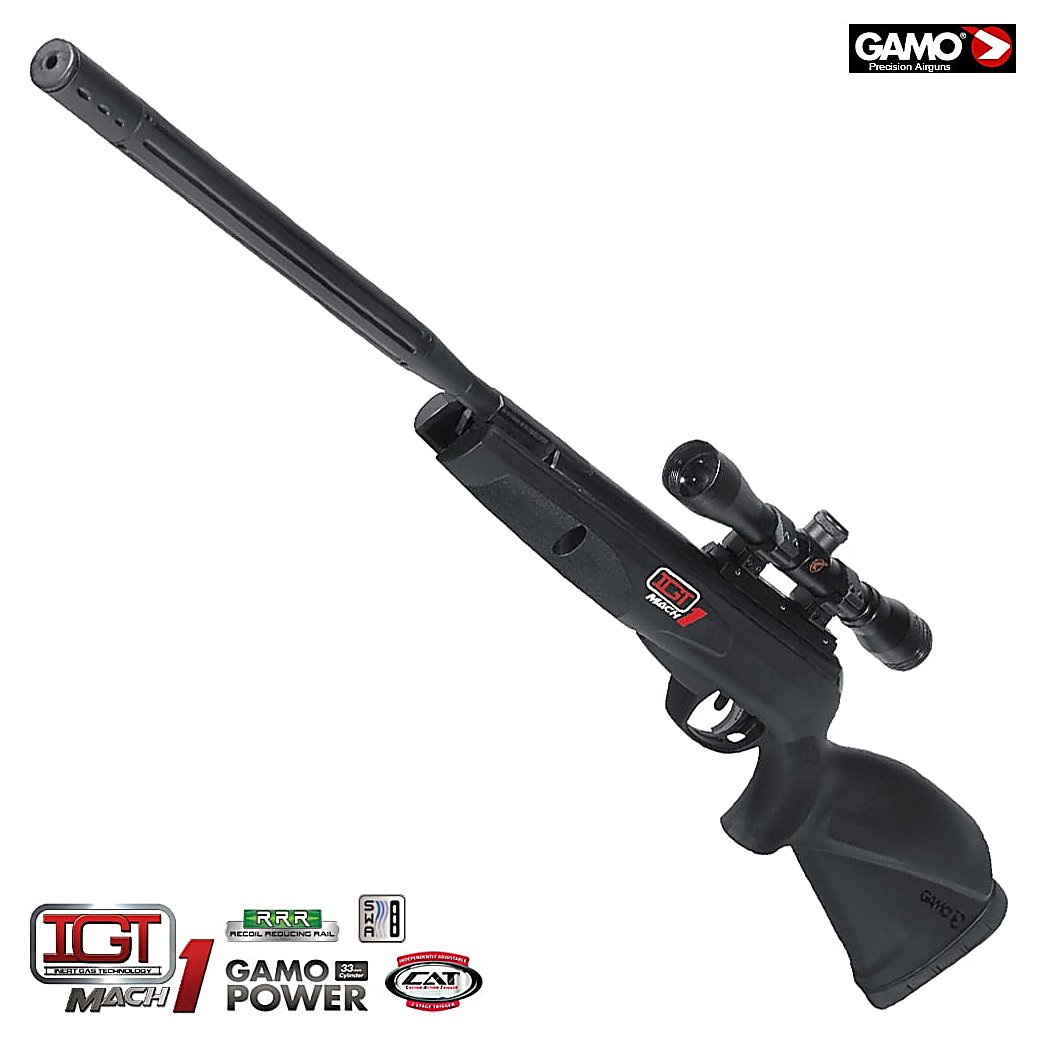
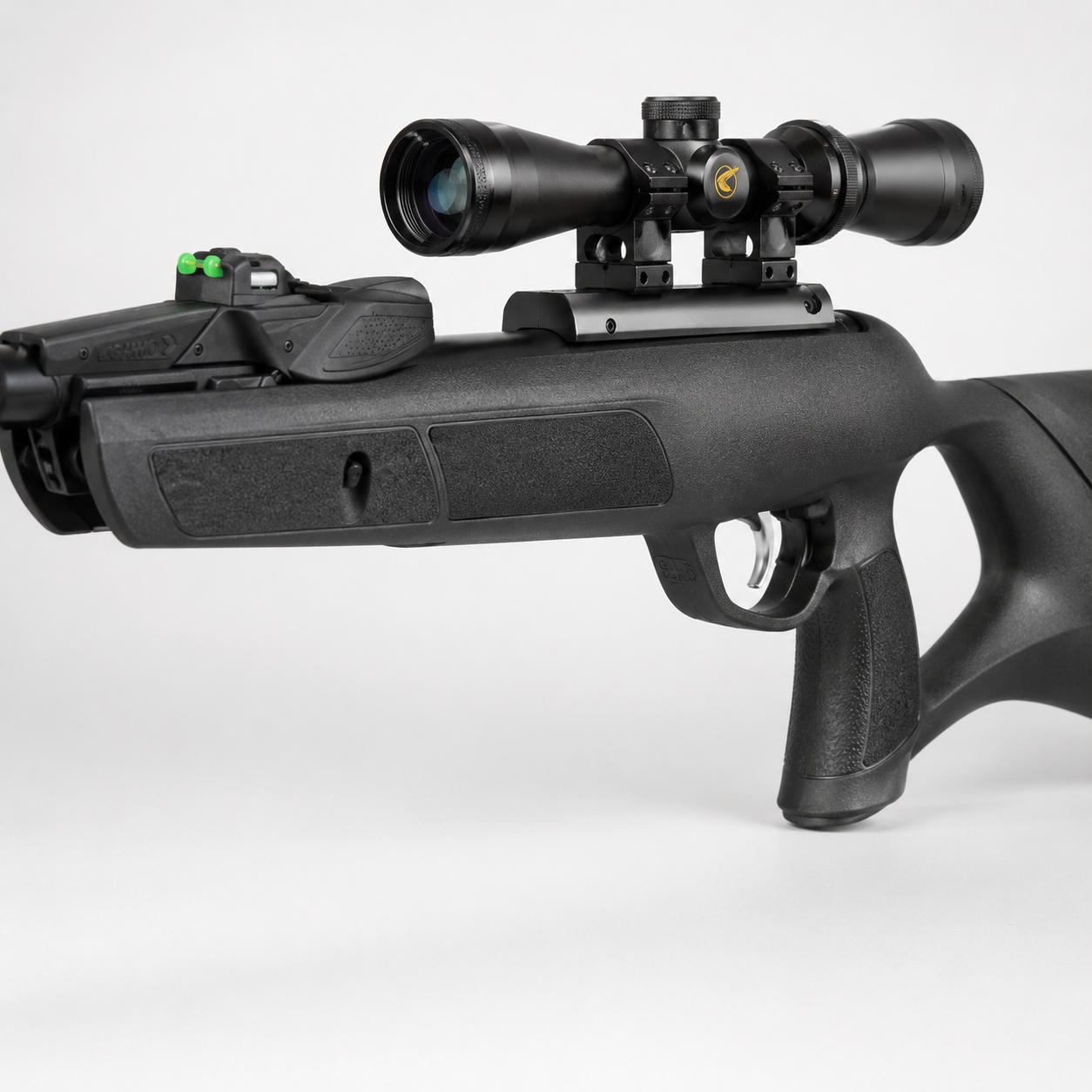
The stock is synthetic and perfectly formed to provide maximum comfort. The rubber butt plate reduces recoil and the new SAT trigger works very well and is a great improvement over the old style trigger. The Black Bull has a “Bull Barrel” with integrated sound moderator and standard equipment includes a 4×32 scope.
| EAN | 793676061931 |
| UPC | 793676061948 |
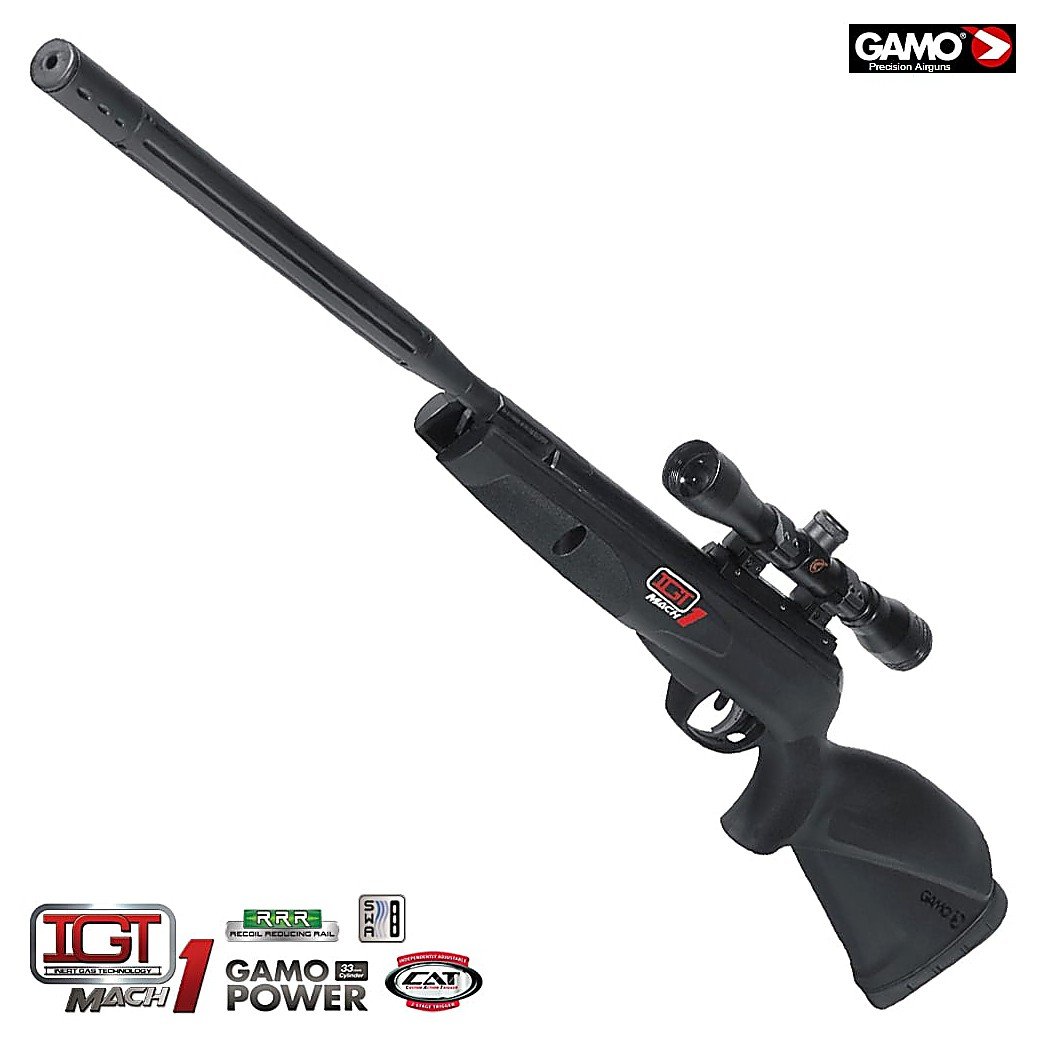
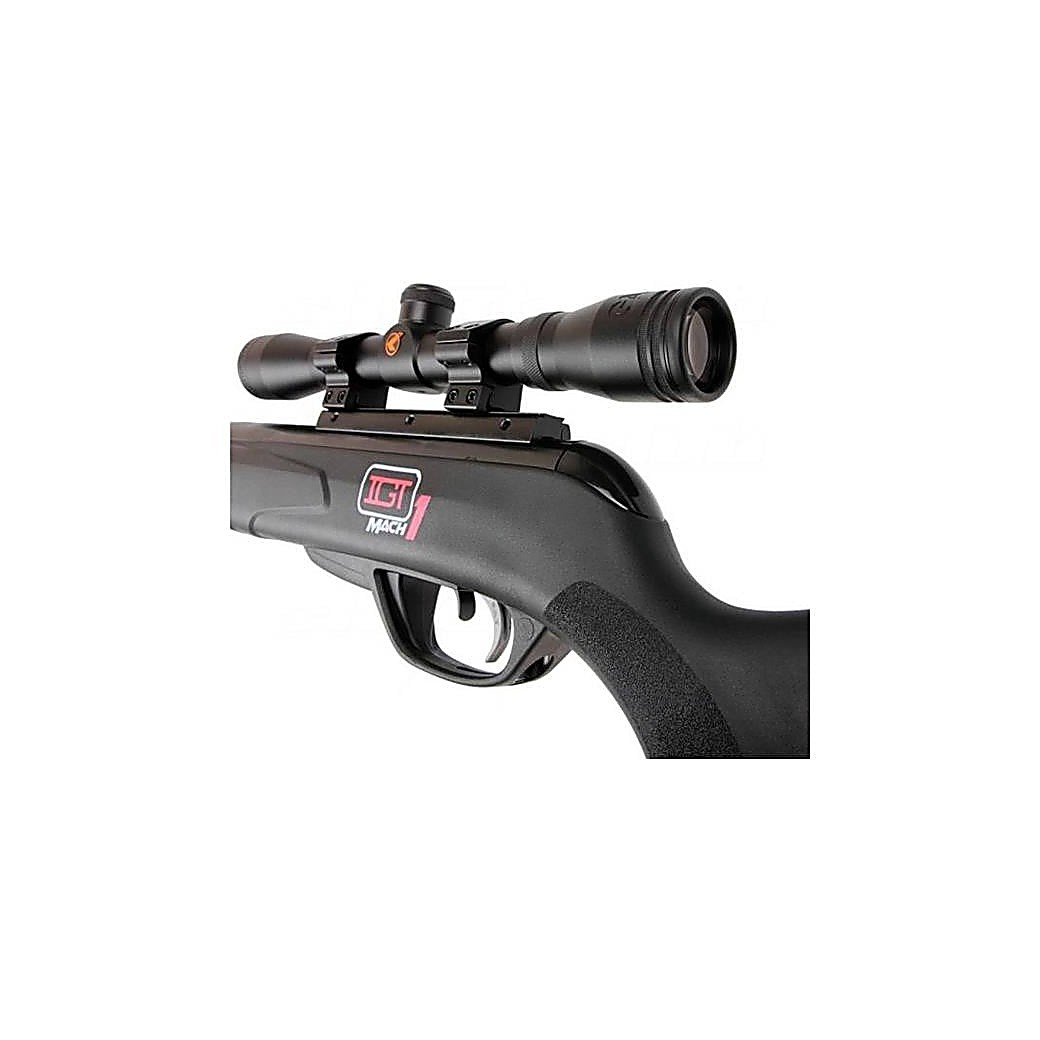
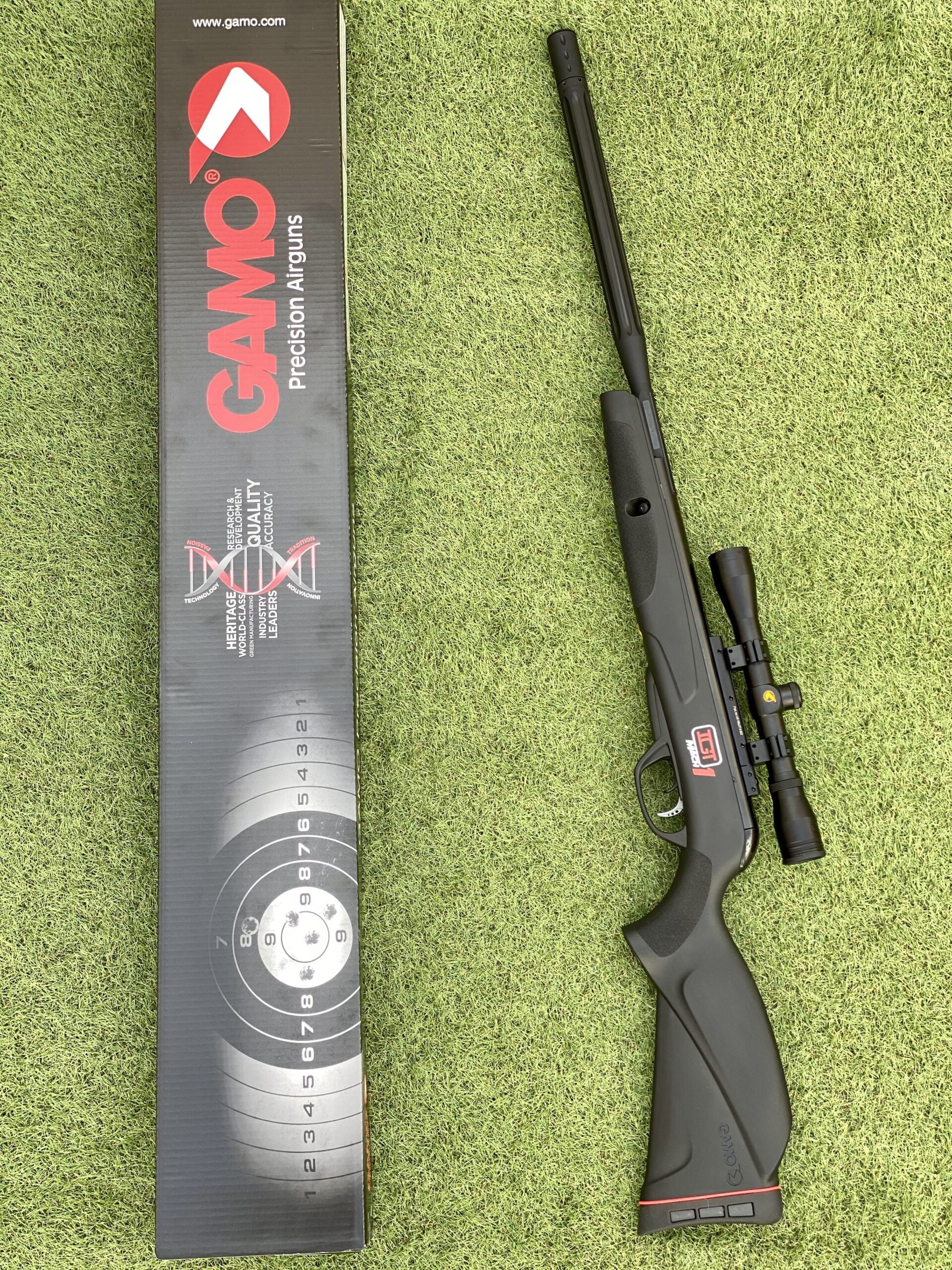
The Air Rifle Gamo Black Bull IGT Mach 1 brings together modern gas-piston technology, a robust synthetic platform, ergonomic handling, and Gamo engineering in a distinctive break-barrel air rifle. Designed around the IGT Mach 1 powerplant, the Black Bull has been developed for shooters who appreciate a straightforward single-shot system while also expecting contemporary technology from their equipment.
Rather than depending on a traditional coiled mainspring, the rifle incorporates Gamo’s inert-gas technology. Consequently, the firing cycle has been designed around a gas-powered piston system that provides a different operating character from conventional spring-powered air rifles.
At the same time, the Black Bull’s full-size configuration provides a stable shooting platform. Its synthetic stock can withstand regular handling more easily than many traditional wooden stocks, while its ambidextrous geometry allows the rifle to accommodate a wider variety of users.
The result is an air rifle that combines established break-barrel simplicity with several features associated with modern Gamo platforms.
Whether the rifle is being examined for recreational target shooting, organized range practice, training, or lawful sporting applications, understanding its design is important. Powerplant technology, stock geometry, trigger configuration, optics compatibility, pellet selection, maintenance, and local regulations can all influence the ownership experience.
The Air Rifle Gamo Black Bull IGT Mach 1 belongs to Gamo’s modern family of gas-piston break-barrel rifles.
Instead of requiring an external air tank, compressor, CO₂ cartridge, or PCP charging equipment, the rifle’s powerplant is self-contained. The barrel is used as the cocking lever, a pellet is loaded individually, and the barrel is then returned to its firing position.
Because of that design, the system remains mechanically straightforward.
Furthermore, the Black Bull combines its break-barrel mechanism with a synthetic stock, adjustable-style trigger architecture, recoil-management features, an optics mounting system, and Gamo’s IGT technology.
Specifications can differ between national markets, energy-limit versions, and caliber configurations. Therefore, buyers should always refer to the specifications stated for the particular rifle being supplied.
Not every break-barrel rifle uses the same powerplant.
Traditional models generally rely on a steel coil spring. When those rifles are cocked, the spring becomes compressed. Pulling the trigger releases that stored mechanical energy and drives the piston forward.
The Gamo Black Bull IGT Mach 1, however, uses an inert-gas piston system.
This distinction changes several aspects of the rifle’s operating behavior.
A gas piston does not rely on the same type of coiled mainspring compression. Instead, a sealed gas cylinder stores the energy required for the firing cycle.
As a result, the Black Bull represents Gamo’s modern approach to high-performance break-barrel construction.
IGT means Inert Gas Technology.
Gamo developed this architecture as an alternative to traditional spring-powered mechanisms. In an IGT platform, a gas-filled cylinder performs the energy-storage function normally performed by a metal spring.
The Mach 1 designation identifies a higher-capacity version of the concept used across selected Gamo rifles.
Several characteristics make gas-piston systems attractive to many air-rifle enthusiasts.
First, the system contains fewer of the mechanical characteristics associated specifically with a compressed steel mainspring.
Second, the powerplant can provide a relatively direct firing cycle.
Third, long-term spring fatigue associated with conventional metal mainsprings is not present in the same form because a coiled spring is not being used as the principal power source.
Nevertheless, the rifle remains a mechanical airgun and should still be maintained, stored correctly, and inspected periodically.
Consistency is an important consideration in any air rifle.
However, consistency never depends on the powerplant alone.
Pellet quality, pellet weight, barrel condition, trigger control, optic mounting, environmental conditions, shooting technique, and the individual rifle can all influence results.
Therefore, IGT Mach 1 technology should be considered one component within the complete shooting system rather than a substitute for proper equipment setup and responsible practice.
One major characteristic of the Air Rifle Gamo Black Bull IGT Mach 1 is its self-contained break-barrel design.
No separate compressed-air cylinder needs to be filled before normal operation.
Likewise, disposable CO₂ capsules are not required.
A PCP compressor, hand pump, or scuba-style filling bottle is also unnecessary for basic operation.
Consequently, the rifle provides a relatively independent shooting platform.
The Black Bull is fundamentally a single-shot rifle.
Each shot requires the rifle to be manually cocked and loaded.
Some shooters prefer this system because the deliberate loading sequence creates a slower and more methodical shooting rhythm.
Moreover, fewer ammunition-feed components are involved compared with repeating systems.
Despite the growth of magazine-fed PCP rifles and multi-shot break-barrel platforms, conventional single-shot rifles continue to have an important place in recreational shooting.
Their appeal often comes from simplicity.
Instead of managing magazines, indexing mechanisms, or compressed-air reservoirs, the shooter interacts directly with the basic loading mechanism.
Accordingly, single-shot rifles remain relevant for range practice, informal target shooting, equipment familiarization, and other lawful sporting activities.
The barrel configuration contributes significantly to the rifle’s appearance.
Rather than presenting the narrow profile traditionally associated with older air rifles, the Black Bull uses a substantial bull-barrel-style assembly.
This produces a modern exterior profile while also providing a convenient surface for operating the break-barrel mechanism.
Air-rifle barrels are designed to stabilize suitable pellets through rifling.
As the pellet travels through the bore, the rifling creates rotational stabilization.
Nevertheless, barrel quality represents only one part of the accuracy equation.
Different pellets can behave differently even when their stated caliber is identical.
Therefore, responsible target testing with manufacturer-compatible ammunition remains useful when evaluating a particular rifle.
The Gamo Black Bull IGT Mach 1 uses a synthetic stock rather than a conventional hardwood stock.
Synthetic construction offers practical advantages for equipment intended to be handled regularly.
The material does not require the same type of cosmetic care normally associated with polished wood. Furthermore, everyday marks, moisture exposure, and temperature changes generally require less attention from the owner.
That does not mean the rifle should be stored carelessly. Metal components still require proper protection, and all airguns should be kept in a dry, secure environment.
A significant feature of the Black Bull stock is its ambidextrous design.
Both right-handed and left-handed shooters can therefore use the basic stock architecture.
For households, clubs, training environments, or sporting situations in which multiple responsible users may handle the same rifle, this characteristic can provide additional flexibility.
Stock geometry affects how naturally a shooter can position the rifle.
Grip angle, cheek placement, length of pull, shoulder contact, and overall balance all contribute to comfort.
Consequently, the Black Bull’s synthetic stock is not simply an exterior shell. It forms an important structural interface between the rifle and its operator.
Many Gamo Black Bull configurations incorporate Gamo’s SWA – Shock Wave Absorber system.
The recoil pad is positioned at the rear of the stock where the rifle interfaces with the shoulder.
Its purpose is to help manage the physical sensation generated during the firing cycle.
Although air-rifle recoil differs considerably from firearm recoil, powerful break-barrel systems still produce movement.
More importantly, their internal piston movement can generate a characteristic recoil impulse that differs from PCP rifles.
For that reason, stock positioning and recoil management remain relevant.
Trigger behavior can substantially influence a shooter’s ability to release a shot without unnecessarily disturbing the rifle.
The Black Bull is commonly supplied with a two-stage Gamo trigger system, with the exact trigger specification depending on the market version.
A two-stage trigger provides an initial movement before the final release stage.
This architecture allows the shooter to identify the transition between the first stage and the release point.
Consistent trigger control contributes to repeatable target performance.
Even an accurate barrel and quality optic cannot compensate completely for significant movement introduced during trigger operation.
Therefore, becoming familiar with the trigger’s normal travel, resistance, and break can help produce a more consistent shooting process.
Adjustment should always be performed only within the manufacturer’s approved parameters.
The Gamo Black Bull incorporates a manual safety system.
A safety mechanism is useful, but it should never replace fundamental handling discipline.
Every air rifle should always be treated as though it is loaded.
The muzzle should remain pointed in a safe direction.
Fingers should remain away from the trigger until the user has made the deliberate decision to fire in a lawful and controlled setting.
Similarly, users should understand their target, surroundings, and adequate backstop.
The Air Rifle Gamo Black Bull IGT Mach 1 has been designed primarily for use with an optic.
Common configurations use an 11 mm dovetail-style mounting system.
Many packages are also supplied with a 4×32 Gamo scope, although the included accessory package can differ by market.
Consequently, customers should confirm the contents of the specific package rather than assuming every Black Bull is supplied identically.
Selected Black Bull configurations incorporate Gamo’s RRR, or Recoil Reducing Rail.
A powerful piston-driven air rifle generates forces that can place stress on scopes and mounting hardware.
Unlike most PCP rifles, a piston-powered rifle creates movement associated with the rapid internal piston cycle.
For this reason, optic mounting deserves particular attention.
The RRR system has been developed to help manage the vibration and recoil energy transferred to the mounted optic.
A scope should be appropriate for the type of rifle on which it will be installed.
Not every optic is intended for piston-powered airgun recoil.
Accordingly, owners considering a replacement optic should verify compatibility with their rifle type.
Correct ring installation, proper eye relief, suitable fastener torque, and stable mounting also contribute to reliable optic performance.
Many versions of the Gamo Black Bull IGT Mach 1 are supplied with a 4×32 WR scope.
A 4× optic provides fixed magnification.
Meanwhile, the 32 mm objective offers a practical compromise between physical size and light-gathering capability for general recreational use.
Fixed-power scopes also provide straightforward operation because magnification does not need to be adjusted.
Package contents may differ internationally, however, so the optic listed on the specific product page should always take precedence.
The Black Bull IGT Mach 1 has been marketed in more than one caliber.
Common European listings identify:
Availability depends on local legislation, distributor configuration, and market demand.
Each caliber produces different ballistic characteristics.
The .177 caliber is widely associated with target shooting because suitable pellets are relatively light and can produce flatter trajectories within their appropriate operating range.
Pellet choice still matters considerably.
Weight, shape, manufacturing consistency, and barrel compatibility can all influence results.
The .22 caliber uses a larger-diameter pellet.
Depending on the rifle’s energy configuration and pellet selection, the caliber normally travels at lower velocity than an equivalent .177 configuration but carries different momentum and ballistic characteristics.
Neither caliber should automatically be considered universally superior.
The appropriate configuration depends on lawful intended use, local energy restrictions, available ammunition, and shooter preference.
Published Black Bull velocity figures vary significantly between markets.
This is normal for air rifles sold internationally.
Different countries impose different energy restrictions, while manufacturers and distributors may publish figures based on different pellets or testing methodologies.
For example, European listings commonly describe configurations around 305 m/s for some 4.5 mm versions and approximately 220 m/s for certain 5.5 mm versions, while other market listings publish higher nominal velocity figures.
Therefore, the specification supplied with the exact rifle should always be considered authoritative.
Furthermore, muzzle velocity alone should never be used as a complete measurement of air-rifle performance.
Pellet mass affects energy.
Pellet shape influences drag.
Environmental conditions influence trajectory.
Individual barrels may also perform differently with different pellet designs.
Muzzle energy is frequently expressed in joules or foot-pounds.
A rifle’s actual energy configuration can vary according to the market for which it was manufactured.
Some countries impose defined energy limits on unrestricted air rifles. Other regions regulate caliber, muzzle energy, ownership age, transportation, storage, or licensing differently.
For that reason, the Air Rifle Gamo Black Bull IGT Mach 1 should always be purchased, possessed, transported, and used in accordance with applicable local law.
Customers occasionally compare two Black Bull listings and notice different velocity figures.
Several explanations are possible.
First, caliber may be different.
Second, the pellet used for testing may be different.
Third, one rifle may be configured for a restricted-energy market.
Fourth, manufacturers occasionally revise products during their production life.
Finally, some retailers may quote manufacturer maximum figures while others publish locally tested specifications.
Accordingly, specification differences do not necessarily mean that one listing is incorrect.
The exact SKU and market configuration should be checked before relying on a particular numerical figure.
Common European listings place the Gamo Black Bull at approximately:
Exact measurements can differ slightly according to version and accessories.
Once an optic and mounting hardware are installed, total system weight will naturally increase.
A heavier rifle can feel steadier when supported properly.
However, additional weight can also become tiring during extended unsupported use.
A lighter rifle is generally easier to carry and reposition, although reduced weight can make movement more noticeable.
Consequently, rifle weight is best evaluated in relation to the user’s size, shooting position, intended activity, and handling preference.
Numbers alone do not describe how an air rifle feels.
Two rifles with the same listed weight can balance differently because their mass is distributed differently.
The barrel assembly, action, scope, stock geometry, and recoil pad all influence the center of gravity.
For a full-size break-barrel such as the Black Bull, balance can affect how comfortably the rifle can be held during target practice.
A stable stance and consistent hold therefore remain important.
Spring-powered air rifles have existed for generations.
They remain durable, simple, and widely used.
However, the IGT system provides an alternative for users who prefer a gas-piston mechanism.
Both systems use stored energy to drive a piston.
Nevertheless, that energy is stored differently.
A traditional spring rifle compresses a steel mainspring.
An IGT rifle compresses gas within a sealed gas-ram assembly.
Because of that difference, their firing characteristics can feel different.
The most appropriate choice ultimately depends on the shooter’s priorities.
PCP rifles operate differently from the Gamo Black Bull.
A PCP stores high-pressure compressed air inside a reservoir.
This reservoir powers multiple shots before refilling is required.
By contrast, the Black Bull contains a self-contained gas piston that is mechanically compressed whenever the rifle is cocked.
The break-barrel format eliminates the need for:
Therefore, the owner can operate the rifle without maintaining a separate compressed-air filling infrastructure.
PCP platforms can provide:
Consequently, the two technologies serve different preferences rather than representing identical products.
Recreational target shooting remains one of the common applications for break-barrel air rifles.
The Black Bull’s self-contained powerplant allows organized practice without managing external air equipment.
At the same time, its scoped configuration provides an opportunity to develop consistent sight alignment and trigger technique.
Any target environment must include an appropriate pellet-catching system or backstop that is designed for the rifle’s energy.
Nearby people, animals, buildings, roads, and property should never be exposed to pellet travel or ricochet risk.
Air rifles should not be fired casually simply because they generate less energy than conventional firearms.
A suitable location needs to account for:
Furthermore, eye protection is advisable during organized shooting activities.
Pellet quality can have a noticeable influence on accuracy.
Even high-quality air rifles may show different grouping characteristics when different pellet designs are tested.
The pellet must match the stated caliber of the rifle.
A .177 rifle should use ammunition specifically intended for its bore specification.
Likewise, a .22 rifle requires compatible .22-caliber airgun pellets.
Never substitute inappropriate projectiles.
Pellet weight influences velocity and trajectory.
Lighter pellets generally accelerate faster.
Heavier pellets usually travel more slowly.
However, velocity alone does not determine accuracy.
The correct pellet is the one that performs consistently and safely within the manufacturer’s recommendations.
Common pellet profiles include:
For paper target practice at suitable distances, flat-head pellets are often used because they can produce defined holes in target paper.
Domed pellets are widely used for general-purpose air-rifle shooting.
Actual performance should be assessed responsibly rather than assumed from pellet shape alone.
Customers often ask, “How accurate is the Gamo Black Bull IGT Mach 1?”
There is no responsible universal group-size figure that applies to every rifle and every user.
Several variables affect results.
Break-barrel rifles can respond noticeably to changes in hold.
Consistency matters.
Shoulder pressure, fore-end support, grip pressure, trigger technique, sight picture, and follow-through can all affect point of impact.
Two pellets of identical caliber can perform differently in the same barrel.
Manufacturing tolerances, weight, head size, skirt design, and aerodynamic characteristics contribute to those differences.
Loose or incorrectly installed mounts can create apparent accuracy problems.
Before evaluating the rifle, users should confirm that all components permitted by the manufacturer are securely fitted and that the optic is appropriate for piston-airgun use.
Wind can move an airgun pellet significantly.
The effect becomes more noticeable as distance increases.
Consequently, target results should always be interpreted in the context of current conditions.
A controlled trigger press reduces unnecessary movement.
Rather than abruptly pulling the trigger, a shooter should apply controlled pressure while keeping the rifle properly aligned with a safe target.
Follow-through also matters.
Maintaining position immediately after the trigger releases can help reveal errors that would otherwise become difficult to identify.
Eye relief describes the distance between the shooter’s eye and the rear ocular lens at which a complete sight picture is visible.
Correct eye relief improves comfort and helps produce a repeatable head position.
The scope should therefore be installed so the shooter achieves a natural sight picture while maintaining a safe and stable position.
Many European air rifles use an 11 mm dovetail system.
This mounting interface differs from Picatinny and Weaver rails.
Therefore, mounting rings need to match the actual interface fitted to the rifle or to an approved adapter.
Using incompatible hardware can lead to poor fit or equipment movement.
Optical equipment should be handled carefully.
Lens surfaces should not be rubbed aggressively with unsuitable materials.
Dust can first be removed using appropriate optical cleaning equipment before a clean lens cloth is used.
Likewise, the scope should not be exposed unnecessarily to severe impacts.
Synthetic stocks require comparatively little cosmetic maintenance.
Normally, surface dust and dirt can be removed with a soft cloth.
Harsh solvents should be avoided unless explicitly approved by the manufacturer because they can affect polymer finishes or nearby components.
Air-rifle barrel cleaning requirements differ from those of powder-burning firearms.
Excessive cleaning can be unnecessary.
Likewise, aggressive brushes, unsuitable rods, or inappropriate chemicals can cause damage.
Therefore, owners should follow Gamo’s maintenance recommendations rather than automatically applying firearm-cleaning routines.
Although the stock is synthetic, the rifle still contains metal components.
Moisture and fingerprints can contribute to corrosion over time.
After handling, exposed metal surfaces can be inspected and maintained according to the manufacturer’s instructions.
Storage in a dry environment is particularly important.
The Air Rifle Gamo Black Bull IGT Mach 1 should be stored securely and responsibly.
Access by unauthorized users or children must be prevented.
Local law may also impose specific storage requirements.
The rifle should normally be stored unloaded, with ammunition secured appropriately and separately when required by applicable regulations.
Transportation laws vary considerably.
Some jurisdictions treat air rifles similarly to conventional firearms for transportation purposes, while others establish separate rules.
Owners should therefore check applicable laws before transporting the rifle between locations.
A suitable protective gun case can help prevent physical damage during lawful transportation.
Gamo has extensive experience manufacturing airguns and associated components.
The Black Bull reflects the company’s modern design philosophy through its synthetic stock, integrated powerplant technology, recoil-management systems, and optics-oriented configuration.
Material selection also reflects the rifle’s intended purpose.
Polymer stock construction reduces dependence on decorative wood while providing a practical exterior structure.
Meanwhile, critical operating components remain engineered for the forces generated during normal use.
The Black Bull name is reinforced by the rifle’s predominantly dark exterior.
Its design presents a modern aesthetic rather than the appearance of a traditional sporting rifle.
The synthetic stock, substantial barrel shroud, and scope-oriented receiver contribute to this contemporary profile.
For users who prefer understated equipment, the black finish provides a straightforward appearance.
At approximately 117 cm on commonly listed configurations, the Black Bull is a full-size air rifle.
Potential owners should therefore consider overall size alongside weight.
Smaller users may find a compact rifle easier to handle.
Conversely, adults and taller users may appreciate the full-length geometry.
The correct fit depends on the individual.
An ambidextrous stock provides practical flexibility.
Left-handed users are not forced into a stock designed exclusively for right-handed operation.
Similarly, households or clubs in which several people use the same equipment can accommodate different dominant hands more easily.
That inclusive design approach improves usability without adding complicated stock adjustments.
One of the strongest practical characteristics of a break-barrel gas-piston rifle is independence from external charging systems.
PCP owners normally need access to high-pressure compressed air.
CO₂ rifles need consumable gas cartridges.
By contrast, the Black Bull’s powerplant is mechanically cocked by the operator.
Therefore, routine use does not depend on remembering to refill an air cylinder before every session.
A powerful gas-piston break-barrel rifle requires physical effort to cock.
The exact force can vary by model and energy configuration.
Users should therefore consider their own physical ability when choosing this category of air rifle.
The barrel should always be operated deliberately and according to the manufacturer’s instructions.
Break-barrel rifles involve opening the barrel assembly during loading.
Users should maintain control of the rifle throughout the process and follow all instructions supplied by the manufacturer.
Improvised loading procedures should never be used.
The correct pellet caliber should be confirmed before ammunition is inserted.
An air rifle is precision mechanical equipment.
Incorrect lubrication, unauthorized disassembly, unsuitable ammunition, improper adjustment, or incorrect accessory installation can compromise performance and safety.
Therefore, the supplied manual should be retained and consulted whenever maintenance or adjustment is required.
Gamo maintains manuals and exploded diagrams for many models within its support resources.
Modern air rifles have evolved substantially beyond the basic spring guns that introduced many shooters to the sport.
Gas-piston powerplants represent one part of that evolution.
Synthetic materials have also become more sophisticated.
Optics mounting systems have improved.
Trigger designs have become more refined.
Recoil-management technologies have become increasingly integrated.
The Black Bull combines several of these developments within one break-barrel platform.
Owning an air rifle involves more than comparing velocity figures.
Long-term usability depends on many smaller considerations.
Pellets need to be available.
The optic needs to remain securely mounted.
The rifle needs to be stored correctly.
The owner needs access to a safe and legal shooting environment.
Local regulations need to be understood.
Maintenance instructions should also remain available.
The Black Bull’s self-contained design simplifies some of these requirements because no PCP filling system is required.
The Gamo Black Bull IGT Mach 1 may appeal to adult airgun enthusiasts who prefer:
Individual requirements vary, however, and purchasers should confirm that the rifle’s caliber, energy configuration, dimensions, and legal classification are appropriate for their intended lawful use.
Entry-level spring rifles can provide an economical introduction to airgun shooting.
The Black Bull sits within a more feature-oriented category.
Its IGT Mach 1 gas piston, modern synthetic stock, recoil-management architecture, optics mounting system, and full-size configuration distinguish it from basic spring-powered models.
Therefore, buyers comparing the two categories should consider more than initial price.
Gamo also produces multi-shot break-barrel rifles using its 10X magazine technology.
The Black Bull follows the traditional single-shot approach instead.
A magazine-fed rifle can offer quicker follow-up loading.
The single-shot Black Bull, however, uses a mechanically simpler ammunition-loading process.
Some shooters specifically prefer this simplicity.
Others prioritize magazine capacity.
Neither choice is universally correct.
CO₂ rifles use replaceable carbon-dioxide cartridges.
They can offer low-effort operation between shots.
However, CO₂ pressure is affected by temperature, and cartridges eventually require replacement.
The Black Bull does not rely on consumable CO₂ capsules.
Instead, its gas piston is mechanically cocked for every shot.
The two technologies therefore provide fundamentally different ownership experiences.
PCP technology dominates many high-end precision-airgun categories.
Its low recoil, multi-shot capability, regulated actions, and extensive adjustability can be advantageous.
Nevertheless, PCP ownership typically includes additional charging equipment.
The Black Bull remains considerably more self-contained.
For users who do not want to manage compressed-air filling equipment, that distinction can be significant.
Because the Black Bull is typically configured without conventional open sights on many market versions, the optic becomes an integral part of the system.
A stable scope installation therefore deserves particular attention.
Mounts should be appropriate for the rail.
The optic should be compatible with piston air rifles.
Fasteners should be checked according to manufacturer instructions.
Eye relief should suit the user.
Finally, zero should be confirmed only in a controlled environment with a safe backstop.
The commonly supplied 4×32 optic uses fixed magnification.
Fixed magnification has several advantages.
Its operation is simple.
The shooter does not need to manage zoom settings.
Likewise, visual references remain consistent from one session to another.
Variable-power optics provide greater flexibility, although they can introduce additional size, weight, and adjustment complexity.
Air-rifle pellets can retain substantial energy after passing through lightweight materials.
Consequently, paper alone is not a backstop.
A proper pellet trap or appropriately engineered backstop should be used.
Hard surfaces that encourage ricochets should be avoided.
The area behind and around the target must also be considered.
Eye protection represents a simple but valuable safety measure during target shooting.
Pellets can fragment or ricochet after striking hard objects.
Eye protection can therefore provide another layer of protection when used alongside an adequate backstop and responsible range practices.
Air rifles are generally quieter than conventional firearms, but sound level varies according to powerplant, pellet, environment, and rifle configuration.
Indoor spaces can make mechanical noise appear considerably louder.
Users should therefore follow the rules of the shooting facility and use suitable protective equipment where appropriate.
Airgun law differs considerably across jurisdictions.
One country may treat a particular energy level as unrestricted.
Another may require registration or licensing.
Age restrictions can differ.
Hunting laws can also be separate from ownership laws.
Therefore, prospective owners should confirm:
Compliance remains the responsibility of the owner and user.
Typical specifications reported for European-market Black Bull IGT Mach 1 configurations include:
Specifications are market dependent. Always verify the specification of the exact SKU before publication or ordering.
The powerplant represents the mechanical heart of the rifle.
When cocked, energy is stored within the gas-piston system.
After the trigger releases the mechanism, the piston rapidly moves and compresses air behind the pellet.
That compressed air propels the pellet through the rifled barrel.
Although the concept sounds straightforward, engineering tolerances are important.
Seals, piston geometry, cylinder dimensions, barrel fit, trigger engagement, and pellet characteristics all contribute to overall behavior.
A bull-barrel-style exterior provides a substantial gripping surface for break-barrel operation while contributing to the Black Bull’s visual identity.
Internally, the rifled bore remains responsible for pellet stabilization.
Owners should avoid placing unnecessary stress on the barrel or using it as a general-purpose handle.
Common descriptions of the Black Bull stock reference a raised cheek area designed to support scope use.
Because the rifle is optic oriented, consistent cheek placement becomes particularly useful.
A repeatable head position helps maintain a consistent relationship between the shooter’s eye and the scope.
Synthetic stocks can incorporate molded texture directly into their surface.
This avoids the need for separate grip panels.
Texture can improve tactile control, especially during longer target sessions.
However, excessive gripping pressure is unnecessary.
A consistent and relaxed shooting position is generally preferable to forcing the rifle into position.
The rear pad provides the final contact point between the stock and the shooter’s shoulder.
Correct positioning helps stabilize the rifle.
At the same time, the pad contributes to comfort during repeated use.
Marketing discussions often focus heavily on velocity.
Yet velocity is only one measurement.
A useful air-rifle setup depends on an interaction between:
Changing any one of these variables can affect results.
Therefore, a well-set-up rifle using a compatible pellet can often be more satisfying than chasing the highest possible velocity figure.
Pellets manufactured with consistent dimensions tend to produce more predictable results.
Damaged skirts, significant weight variation, contamination, or deformation can negatively influence flight.
Pellets should therefore be handled carefully and stored in a clean, dry container.
A barrel should remain free from obstruction.
Before shooting, the rifle should be inspected according to manufacturer guidance.
If any obstruction is suspected, use should stop until the rifle has been properly checked.
Loose components can affect performance.
Periodically inspecting externally accessible hardware according to the owner’s manual can help identify issues before they become more significant.
Internal disassembly should be left to appropriately qualified personnel unless the manufacturer specifically authorizes user servicing.
Before buying any mechanical product, parts availability deserves consideration.
Gamo is an established airgun manufacturer and provides manuals and component diagrams for numerous models.
Part compatibility can nevertheless vary by production period and regional configuration.
Model information and serial details should therefore be retained.
Warranty conditions differ between retailers and countries.
Owners should keep:
Unauthorized modification may affect warranty coverage.
If the rifle develops abnormal behavior, professional inspection is preferable to experimental repair.
Unusual sounds, inconsistent operation, safety issues, mechanical damage, or trigger abnormalities should be evaluated before the rifle is used again.
The Gamo Black Bull IGT Mach 1 is a single-shot break-barrel air rifle using Gamo’s inert-gas piston technology rather than a conventional coiled mainspring.
Its commonly listed features include a synthetic ambidextrous stock, optics rail, two-stage trigger configuration, manual safety, bull-barrel-style assembly, and recoil-management technology.
No.
A PCP rifle stores high-pressure air inside a refillable reservoir.
The Black Bull uses a self-contained gas piston that is mechanically compressed during the cocking cycle.
Therefore, it does not require a PCP compressor, hand pump, or filling bottle for normal operation.
No.
Its IGT system does not depend on disposable CO₂ cartridges.
The rifle’s gas-ram mechanism is contained within the action.
IGT stands for Inert Gas Technology.
It describes Gamo’s gas-piston system, which replaces the conventional coil mainspring with a sealed gas-powered mechanism.
Mach 1 identifies the particular higher-capacity IGT architecture used by Gamo on selected air rifles.
Exact specifications should be checked against the rifle’s regional configuration.
Yes.
The barrel pivots downward as part of the cocking and loading process.
The rifle is then returned to its normal position before use.
Yes.
Traditional Black Bull IGT Mach 1 configurations use a single-shot loading system rather than a multi-shot magazine.
Many retail packages include a Gamo 4×32 scope.
However, package contents vary between markets and distributors.
The accessories shown in the specific product listing should therefore be checked.
Many commonly sold configurations are designed primarily around scope use and may not include traditional open sights.
Verify the exact version before purchase because specifications can differ.
Common versions are offered in 4.5 mm (.177) and 5.5 mm (.22).
Regional availability varies.
Neither caliber is universally better.
The appropriate choice depends on lawful intended use, local regulation, pellet availability, trajectory preference, and the exact energy configuration of the rifle.
Common European listings state approximately 3 kg before accounting for variations in accessories.
The exact weight of the supplied configuration should be confirmed from the product specification.
Commonly published figures place total length at approximately 117 cm.
Production and regional differences may cause minor variation.
Yes, commonly supplied Black Bull synthetic stocks use ambidextrous geometry.
This makes the rifle more accommodating for both left-handed and right-handed users.
Yes.
The modern synthetic stock provides a durable and relatively low-maintenance exterior.
SWA refers to Gamo’s Shock Wave Absorber recoil-pad technology.
It is designed to improve shoulder comfort and manage the sensation associated with the firing cycle.
RRR means Recoil Reducing Rail.
The system is designed to help reduce the vibration and recoil forces transferred to the optic.
Many configurations use an 11 mm dovetail-style mounting interface combined with Gamo’s rail technology.
Always confirm the exact configuration before selecting rings or adapters.
An optic should be mechanically compatible with the mounting interface and appropriate for piston-powered airgun recoil.
The manufacturer’s recommendations should be followed.
Yes.
Air-rifle barrels can show preferences for particular pellet dimensions, weights, and designs.
Testing suitable manufacturer-compatible pellets on paper targets in a safe environment can help identify consistent combinations.
Not necessarily.
Airgun barrels do not automatically require the same maintenance schedule as powder-burning firearms.
Follow Gamo’s official maintenance guidance and avoid unnecessary aggressive cleaning.
Normally, synthetic stocks do not require traditional wood-stock oil.
Cleaning should be performed using suitable non-damaging materials.
Storage should follow the manufacturer’s official instructions.
As a general equipment-management practice, the rifle should be unloaded and securely stored when it is not in use.
Environmental conditions can influence pellet trajectory.
Wind is especially important because airgun pellets are relatively light.
Temperature can also influence certain power systems and lubricants, although the effect varies by technology.
Suitability depends on the user’s age, strength, experience, local law, and supervision.
The Black Bull is a full-size gas-piston rifle, so its dimensions and cocking effort should be considered.
Training from an experienced and responsible instructor is valuable for new airgun users.
Yes.
Suitable eye protection provides an additional safety measure, particularly because pellets can ricochet or fragment if they strike inappropriate surfaces.
A backstop should be specifically suitable for the rifle’s energy and the ammunition being used.
The shooting area must prevent pellets from leaving the controlled target zone.
Yes.
Pellets can retain considerable energy after missing or passing through light target material.
That is why an adequate backstop and a safe area behind the target are essential.
Sound levels are relative.
Gas-piston air rifles remain substantially different from conventional firearms, but their mechanical and muzzle noise can still be noticeable.
Environmental conditions also affect perceived sound.
No mechanical system should be considered completely maintenance free.
However, the IGT system eliminates the traditional coiled mainspring used in conventional spring rifles.
Routine inspection and manufacturer-recommended maintenance still apply.
Owners should not modify internal pressure or disassemble the gas-ram system unless such work is specifically permitted by Gamo.
Professional servicing is appropriate when internal work is required.
No.
A compressor is generally associated with filling PCP reservoirs.
The Black Bull’s IGT powerplant is self-contained.
No external hand pump is required for normal operation.
No separate air bottle is required.
Energy is stored in the IGT gas-piston system when the rifle is cocked.
“Gas piston,” “gas ram,” and “nitro piston” are terms commonly used for broadly similar airgun powerplant concepts.
IGT is Gamo’s terminology for its own inert-gas technology.
Velocity depends on caliber, pellet weight, rifle configuration, national energy restrictions, and test method.
For that reason, international listings can show substantially different figures for what appears to be the same model.
No.
Velocity is only one component of performance.
Accuracy, consistency, pellet compatibility, trigger characteristics, fit, reliability, energy, intended legal use, and owner preference all matter.
No.
Higher velocity does not automatically improve accuracy.
A pellet must remain stable and compatible with the rifle.
Yes.
All else being equal, heavier projectiles generally leave a given air-rifle powerplant at lower velocity than lighter projectiles.
Synthetic construction offers durability, weather resistance, manufacturing consistency, and relatively low cosmetic maintenance.
It also supports the Black Bull’s modern appearance.
Yes, common configurations incorporate a manual safety.
However, mechanical safeties should never replace responsible handling.
The stock is generally described as ambidextrous, making it suitable for left-handed as well as right-handed handling.
A two-stage trigger provides an initial travel stage followed by a second stage from which the trigger releases.
This gives the shooter a clearer tactile transition before firing.
Piston air rifles generate a distinctive recoil and vibration cycle.
A recoil-management rail helps reduce the forces transmitted to the optic and mounting system.
Accessory compatibility depends on the rail and the mounting system used.
Any optic should also be appropriate for piston-powered airgun use.
The rifle should be unloaded, secured, protected from damage, and transported according to local law.
Requirements can vary substantially between jurisdictions.
Storage should prevent unauthorized access and comply with applicable legal requirements.
A dry and secure environment also helps protect the rifle from corrosion and accidental damage.
The single-shot break-barrel system, synthetic stock, scope-oriented configuration, and self-contained IGT powerplant make the platform compatible with recreational target practice where possession and use are lawful.
A suitable range and backstop remain essential.
Its principal distinctions include the IGT gas-piston powerplant, modern stock configuration, recoil-management features, optics-oriented design, and additional Gamo technologies.
The most important difference is the power system.
A PCP requires an external high-pressure air source for refilling.
The Black Bull is mechanically cocked and does not use a refillable high-pressure reservoir.
The airgun market now includes everything from inexpensive recreational spring rifles to electronically controlled competition PCP systems.
Within that broad spectrum, the Gamo Black Bull occupies a distinctive position.
It retains the mechanical independence of a conventional break barrel while incorporating modern gas-piston technology and contemporary synthetic construction.
That combination matters.
Shooters do not need to build an entire compressed-air infrastructure around the rifle.
No charging compressor is required.
No external cylinder needs to be transported.
No disposable CO₂ capsules are consumed.
Instead, the rifle retains the familiar cock-load-close sequence that has defined break-barrel airguns for generations.
Yet the underlying powerplant has evolved.
IGT Mach 1 replaces the traditional steel mainspring architecture with Gamo’s inert-gas technology.
Meanwhile, the synthetic ambidextrous stock provides a weather-resistant and relatively low-maintenance exterior.
The recoil pad contributes additional comfort.
The optics rail recognizes that many modern air-rifle enthusiasts prefer scoped shooting.
Likewise, the full-size geometry gives the Black Bull the proportions of a substantial sporting air rifle.
For those reasons, the platform represents an intersection between conventional break-barrel simplicity and modern airgun engineering.
Performance should never be separated from responsibility.
Although air rifles use compressed gas rather than burning propellant, they are capable of causing serious injury and property damage.
They should therefore be handled with the same disciplined mindset applied to other projectile-launching sporting equipment.
Always know where the muzzle is pointing.
Always understand what lies behind the target.
Always use an adequate backstop.
Never rely entirely on a mechanical safety.
Keep the rifle secured from unauthorized access.
Follow applicable laws.
Read the manufacturer’s manual.
Use ammunition designed for the correct caliber.
Wear appropriate protective equipment.
Stop using the rifle if any mechanical problem is suspected.
These practices protect users, bystanders, property, and the future of responsible airgun sports.
The Air Rifle Gamo Black Bull IGT Mach 1 combines a self-contained break-barrel mechanism with Gamo’s IGT Mach 1 gas-piston technology, a synthetic ambidextrous stock, modern recoil-management features, and an optics-oriented design.
Its principal appeal lies in the way these elements work together.
The rifle does not require PCP charging equipment.
It does not depend on replaceable CO₂ capsules.
Its traditional single-shot loading sequence remains mechanically simple.
At the same time, modern materials and Gamo engineering give the platform a considerably more contemporary character than a conventional entry-level spring rifle.
Available caliber, muzzle energy, velocity, scope package, and other specifications can vary between markets. Therefore, the exact specification supplied with each individual product should always be checked before use.
For responsible adult airgun enthusiasts evaluating modern gas-piston technology, the Black Bull IGT Mach 1 provides an informative example of how the classic break-barrel architecture continues to evolve.
Important: Airgun ownership, power limits, transportation, storage, and permitted uses vary by jurisdiction. Always verify applicable local law and follow the manufacturer’s safety instructions before possessing or operating any air rifle.
The Air Rifle Gamo Black Bull IGT Mach 1 has been produced in different calibre and power configurations, allowing the platform to suit different sporting markets and legal requirements. However, buyers should always check the exact specification supplied with an individual rifle because muzzle energy, velocity, trigger configuration, and included accessories can differ according to country and production version.
The Gamo Black Bull IGT Mach 1 is commonly available in two established air-rifle calibres:
Both versions use the same fundamental IGT Mach 1 gas-piston concept, synthetic ambidextrous stock, break-barrel action, and scope-oriented platform.
The .177 calibre Black Bull IGT Mach 1 uses the smaller of the two commonly available pellet diameters. Because .177 pellets are generally lighter, they can achieve comparatively higher muzzle velocities when fired from an equivalent powerplant.
For sporting target use, .177 remains one of the most established air-rifle calibres worldwide. Its availability also means shooters can choose from a broad range of compatible pellet weights and profiles.
Published velocity figures vary according to market specification. Some restricted versions have been listed at approximately 305 m/s, while historical Gamo catalogue specifications for full-output versions quote considerably higher nominal velocity figures. Consequently, velocity should always be checked against the specific rifle supplied rather than assumed from the model name alone.
The .22 calibre Gamo Black Bull IGT Mach 1 uses a wider and generally heavier pellet.
Because projectile mass increases, nominal muzzle velocity is normally lower than that of the equivalent .177 configuration. Nevertheless, velocity alone does not determine overall ballistic performance because pellet weight also contributes directly to muzzle energy.
Common retailer specifications have listed approximately 220 m/s for some sub-24-joule configurations, while other international versions have been advertised with substantially greater nominal velocity.
For either calibre, suitable pellets should always match the manufacturer’s stated bore size and recommendations.
Power specification is particularly important when describing the Air Rifle Gamo Black Bull IGT Mach 1 because the same basic rifle has been distributed under different national regulations.
Some European-market examples are listed at under 24 joules, while specific restricted versions have also been sold at approximately 16 joules. Historical Gamo catalogue data additionally identifies full-power Black Bull IGT Mach 1 configurations at approximately 29 joules.
Therefore, there is no single universal power figure for every Black Bull IGT Mach 1.
The exact output depends on:
In British airgun terminology, FAC generally refers to an air rifle whose muzzle energy places it within Firearm Certificate requirements.
In England and Wales, an air rifle capable of exceeding 12 ft-lb of muzzle energy must be held on a Firearm Certificate. Therefore, higher-output Black Bull variants can fall into FAC classification if their actual muzzle energy exceeds this threshold. Legal requirements differ in Scotland and Northern Ireland, so owners should check the rules that apply specifically to their jurisdiction.
The rifle should never be modified in an attempt to change its legal power category. Factory specifications and local licensing requirements should always be followed.
The Black Bull’s performance is generated through Gamo IGT Mach 1 – Inert Gas Technology.
Instead of relying on a conventional coiled mainspring, the rifle uses a gas-piston mechanism. When the barrel is cocked, energy is stored within the gas system. Once the trigger mechanism releases the piston during normal use, compressed air propels the pellet through the rifled barrel.
The Mach 1 platform has also been associated with Gamo’s enlarged 33 mm cylinder architecture on full-power catalogue configurations.
This combination gives the Black Bull its characteristic gas-ram operating system while retaining the mechanical independence of a conventional break-barrel rifle.
One advantage of the Gamo Black Bull IGT Mach 1 is its optics-oriented configuration.
Many packages include a Gamo 4×32 WR scope together with suitable mounting rings.
The rifle commonly features an 11 mm dovetail rail, allowing compatible airgun optics to be installed. In addition, many versions incorporate Gamo’s RRR – Recoil Reducing Rail, which is designed to reduce the recoil and vibration transmitted to the mounted optic.
Common accessory categories include:
Any replacement scope should be suitable for piston-powered air-rifle recoil.
Break-barrel gas-piston rifles generate a recoil cycle that differs from most PCP rifles. For this reason, an optic and its mounts should be designed to tolerate the mechanical forces produced by the action.
Depending on the intended sporting application, owners may prefer fixed-power or variable-power optics. However, compatibility with the rifle’s rail and recoil characteristics remains more important than magnification alone.
Before fitting any accessory, confirm:
Accessories should never interfere with the barrel, safety mechanism, trigger, or normal operation of the rifle.
For quick reference, the Air Rifle Gamo Black Bull IGT Mach 1 has commonly appeared in:
Calibres:
4.5 mm (.177) and 5.5 mm (.22)
Power configurations:
Approximately 16 J on certain restricted versions, under 24 J on other European-market models, and approximately 29 J on historical full-output Gamo catalogue configurations.
Powerplant:
IGT Mach 1 gas piston
Optics interface:
11 mm dovetail with RRR recoil-management technology on many versions
Commonly supplied optic:
Gamo 4×32 WR scope
Because regulations and factory specifications vary by country, the precise calibre, muzzle energy, velocity, and accessory package of the individual rifle should always be confirmed before publication, possession, or use.
A modern break-barrel air rifle can fit naturally into several responsible sporting, recreational, and training environments. Because it operates without an external air bottle, compressor, or CO₂ capsule, it is particularly practical for users who prefer equipment that can be prepared and used with relatively little supporting hardware.
Its combination of a synthetic stock, gas-piston powerplant, scope-ready configuration, and single-shot operation also makes it suitable for shooters who value a straightforward platform that encourages deliberate shooting rather than rapid-fire use.
One of the most appropriate real-world applications is recreational target shooting at a recognized airgun or shooting facility.
In this environment, the rifle can be transported securely in a protective case and prepared on a designated firing point. A properly managed range will normally provide established firing directions, suitable pellet-catching infrastructure, distance markers, and clearly defined safety procedures.
The single-shot break-barrel design supports a measured shooting rhythm. Each shot requires the shooter to prepare the rifle again, which naturally creates time to reassess position, sight picture, and trigger control.
For recreational shooters, this slower process can be useful because performance can be evaluated one shot at a time.
Instead of concentrating solely on the number of shots fired, the shooter can pay attention to consistency.
For example, a range session may involve shooting several small groups on paper while comparing how changes in posture, cheek position, or grip affect point of impact.
A suitable optic can help the shooter maintain a repeatable sight picture during the session.
Likewise, the synthetic stock can be advantageous in a club environment because regular handling generally requires less cosmetic care than a polished wooden stock.
Another possible use scenario is controlled paper-target shooting on private property, but only where local law permits it and where the site has been properly prepared.
The important consideration is not simply distance.
The entire shooting area needs to be controlled.
A suitable pellet trap or engineered backstop should be positioned behind the target so that every projectile is contained.
The area beyond the target should also remain safe in case a shot misses the intended paper.
Public roads, neighboring properties, walkways, animals, buildings, and other vulnerable areas must never fall within the potential line of fire.
In this type of environment, the rifle can be used for structured recreational practice.
A shooter might begin with large paper targets before progressing to smaller scoring areas as consistency improves.
The purpose remains the same: controlled practice rather than speed.
Because the rifle uses a self-contained powerplant, there is no requirement to position a compressor or charging bottle near the shooting location.
That can make preparation simpler.
Pellets, eye protection, targets, and an appropriate backstop may be the principal supporting equipment needed for a basic lawful target session.
The rifle can also serve as a useful platform for developing fundamental air-rifle technique.
Break-barrel rifles respond noticeably to inconsistency in the way they are held.
Consequently, they can provide clear feedback when the shooter changes shoulder pressure, grip, cheek position, or trigger technique from one shot to the next.
During a structured training session, the shooter can focus on one variable at a time.
For instance, the first group may be used to establish a comfortable shooting position.
A second group can then be used to evaluate trigger control.
A third can help assess whether head position behind the scope remains consistent.
Rather than making multiple changes at once, this approach allows the shooter to understand what is affecting accuracy.
The single-shot loading process supports this deliberate learning style.
There is no magazine encouraging a rapid sequence of shots.
Instead, the shooter has an opportunity to reset before every attempt.
In a controlled environment, the rifle may also be used as part of an introduction to airgun sports for new adult shooters.
Supervision remains important.
Before any live firing takes place, a beginner should understand safe muzzle direction, trigger discipline, the purpose of the manual safety, how to identify a safe target area, and why an adequate backstop is necessary.
The beginner should also understand that an air rifle is not a toy.
Once these principles have been established, the rifle’s straightforward single-shot operation can support a structured learning process.
The supervising person can control the pace and explain each stage of the shooting session.
A beginner may initially concentrate only on stable positioning and sight alignment.
Trigger technique can then be introduced gradually.
Because the stock is ambidextrous, the platform can accommodate both left-handed and right-handed users more naturally than a strongly one-sided stock design.
The rifle can fit well into informal club-level airgun shooting where break-barrel rifles are permitted.
A club environment provides several benefits.
Range distances are already established.
Backstops are normally designed for airgun use.
Experienced shooters may also be available to help newer participants understand safe equipment handling.
During a typical club session, the rifle can be used for paper targets, basic scoring exercises, or other approved sporting formats.
Owners can also compare different legal pellet types to determine which compatible option produces the most consistent results in their individual rifle.
Such testing should be performed methodically.
Changing pellet type while keeping shooting position and distance constant can help separate ammunition differences from technique differences.
An additional practical scenario occurs after a compatible scope has been installed or remounted.
Before relying on the optic for regular sporting use, the rifle should be taken to a controlled target environment so that the zero can be checked.
The first objective is to confirm that the mounting system remains stable.
The optic should be positioned with appropriate eye relief, and the mounting hardware should be installed according to the relevant manufacturer’s instructions.
Once the rifle is safely positioned at the range, groups can be fired on paper to determine whether point of impact corresponds consistently with the sight picture.
Large corrections should not be guessed from a single shot.
Several shots provide more useful information because they reveal whether the rifle is actually grouping consistently.
After the optic is adjusted, another group can be fired to verify the result.
This process is particularly important for piston-powered air rifles because the firing cycle can place repeated stress on unsuitable mounts or optics.
Airgun owners frequently discover that different pellets produce different results from the same rifle.
A useful sporting session can therefore be dedicated entirely to pellet comparison.
Several suitable pellet types of the correct caliber can be prepared in clearly labeled containers.
The shooter can then use a separate paper target for each pellet type.
To make the comparison meaningful, the shooting distance, position, and aiming point should remain consistent.
The goal is not simply to identify the highest velocity.
Instead, the shooter is looking for repeatability.
A pellet that produces a smaller and more predictable group may be more suitable for target practice than one that merely feels faster.
Damaged pellets should not be included in the comparison because deformation can affect flight.
Outdoor target sessions provide another practical environment.
Unlike indoor shooting, outdoor use introduces wind, changing light, temperature variation, and uneven ground conditions.
These factors can make target shooting more challenging.
Wind is particularly relevant because airgun pellets are relatively light.
A shooter may notice that groups shift horizontally as conditions change.
This creates an opportunity to understand the effect of the environment while still remaining within a controlled sporting context.
The synthetic stock can also be useful outdoors because minor changes in humidity generally require less cosmetic concern than with many traditional wood finishes.
Nevertheless, the rifle should still be dried and inspected after exposure to damp conditions.
Metal surfaces remain susceptible to corrosion if moisture is ignored.
For shooters interested in evaluating the rifle itself rather than unsupported shooting ability, a bench-supported target session can be useful.
The rifle may be supported in a stable and safe manner at an approved shooting location.
The objective is to reduce unnecessary body movement so that ammunition performance, scope stability, and general consistency can be examined more clearly.
Support should never interfere with the rifle’s normal operation.
Additionally, the barrel and action should remain unobstructed.
A bench session can be particularly useful after changing pellets, installing an optic, or returning the rifle to use after a long storage period.
If results become unexpectedly inconsistent, the owner can then investigate simple external causes such as loose optic hardware or damaged pellets before assuming that an internal mechanical problem exists.
A significant practical advantage of this type of rifle becomes clear when compared with PCP ownership.
A PCP session may require a charged reservoir, hand pump, compressor, or external filling cylinder.
A self-contained gas-piston break barrel does not depend on this equipment.
Therefore, a user preparing for a routine range session can concentrate primarily on the rifle, appropriate pellets, protective equipment, and target materials.
This can be convenient for occasional shooters who do not want to maintain high-pressure charging equipment.
It can also simplify transportation because there is no separate compressed-air cylinder to manage.
Practical ownership continues after the shooting session ends.
Once the rifle has been checked and confirmed unloaded, it should be stored securely according to local regulations.
Unauthorized access must be prevented.
Where required, ammunition should be secured separately.
The storage environment should be dry.
A protective case can be useful for transport, but long-term storage conditions should also allow the rifle to remain free from trapped moisture.
If the rifle has been used outdoors, exposed metal surfaces can be inspected before storage.
This helps identify moisture, dirt, or surface contamination before corrosion develops.
The scope lenses can also be checked for dust or fingerprints and cleaned only with appropriate optical materials.
Another realistic use scenario involves lawful transportation.
The rifle should be unloaded before transport and placed inside a suitable case.
The case protects the equipment from knocks while also reducing unnecessary exposure in public areas.
Local law determines how air rifles may be transported, so owners should confirm the requirements that apply in their jurisdiction.
The rifle should not be left unsecured inside a vehicle.
Pellets and accessories should also be organized so that they cannot damage the optic or other components during travel.
Upon arrival at the range, the rifle should remain cased until the facility’s rules permit preparation.
Owners who use their rifle regularly can benefit from occasional external inspection.
This does not mean unauthorized disassembly.
Instead, the owner can examine accessible components for obvious damage or movement.
The scope and rings can be checked for stability.
The stock can be inspected for cracks or impact marks.
The barrel can be checked externally for signs of damage.
The safety and trigger should function only as described by the manufacturer.
If anything appears abnormal, use should stop until the rifle has been properly assessed.
This type of preventive attention can help identify small issues before they interfere with a sporting session.
A rifle that has remained unused for several months should not automatically be taken straight into a full shooting session.
Instead, the owner can perform a careful visual inspection first.
The exterior should be checked for corrosion, moisture, damage, or loose accessories.
The optic should be examined to confirm that it has not shifted.
The bore should be confirmed free from obstruction according to the manufacturer’s instructions.
Once the rifle has passed these basic checks, the first shots should be taken only at a proper range or similarly controlled location.
A paper target can then be used to confirm that the optic remains correctly aligned and that the rifle behaves normally.
Across these scenarios, the most important characteristic is deliberate use.
The rifle is best suited to environments where every shot can be planned, controlled, and evaluated.
Its break-barrel operation discourages careless rapid firing.
Its gas-piston system removes the need for external charging equipment.
Its synthetic stock supports regular recreational handling.
Meanwhile, its scope-ready configuration allows it to be adapted to different lawful target-shooting preferences.
Used responsibly, the platform fits naturally into recreational range sessions, training exercises, equipment testing, pellet comparison, club shooting, and general sporting practice.
The quality of the experience depends not only on the rifle itself but also on the environment in which it is used.
A secure shooting area, proper backstop, suitable ammunition, compatible accessories, protective equipment, legal compliance, and disciplined handling remain essential in every practical scenario.
Choosing the right air rifle depends on more than power alone. Build quality, operating system, ease of ownership, balance, trigger characteristics, stock design, maintenance requirements, and the type of shooting you plan to do all matter. This platform brings together several of those qualities in a way that makes it attractive to recreational shooters who want a modern, self-contained break-barrel system without the additional equipment normally associated with PCP rifles.
One of the strongest reasons to consider this rifle is its combination of simplicity and modern gas-piston engineering. Traditional spring-powered air rifles remain popular, but a gas-piston system offers a different firing cycle and removes the conventional coiled mainspring from the powerplant. For users who prefer contemporary technology while still wanting the familiar break-barrel format, this design provides a practical middle ground.
This rifle is particularly well suited to recreational paper-target shooting in a controlled environment.
Its single-shot action encourages a measured pace. Instead of rapidly cycling through a magazine, the shooter has time to reset after each shot, check posture, correct grip pressure, refine trigger control, and concentrate on sight alignment.
That makes it especially useful for shooters who want to develop consistency.
A slower shooting rhythm can also improve concentration. Every shot becomes an individual process rather than part of a fast sequence.
For target practice, this can be a major advantage.
Another important reason to choose this design is independence from external charging equipment.
PCP rifles often require:
By comparison, a self-contained break-barrel gas-piston rifle can be prepared for use without that additional infrastructure.
This simplicity can be especially valuable for occasional shooters, beginners, or anyone who does not want to invest in a complete PCP filling setup.
It can also make transportation easier because fewer accessories need to be carried to the range.
Because there is no external air reservoir to refill, the rifle can be practical for repeated recreational use.
A shooter can prepare suitable pellets, eye protection, targets, and a proper backstop without having to check whether a charging bottle is full beforehand.
That makes the overall ownership routine more straightforward.
For someone who wants to visit an approved range occasionally rather than maintain a large equipment collection, this can be an important reason to choose a gas-piston break barrel.
The gas-piston system is another major reason this rifle stands out.
Instead of using a traditional coil spring, energy is stored within a sealed gas-ram assembly.
This design avoids some of the mechanical characteristics associated with metal spring compression.
Many shooters also appreciate the more direct firing character commonly associated with gas-piston rifles.
However, performance still depends on proper technique, pellet quality, scope setup, and the specific rifle configuration.
The powerplant should therefore be viewed as one strong component within the complete system.
The synthetic stock makes the rifle practical for regular handling.
Wooden stocks can be attractive, but they usually require greater cosmetic care.
Synthetic materials are generally less sensitive to humidity and everyday handling marks.
For outdoor range sessions or club use, this can be convenient.
The owner still needs to protect the metal components, but the stock itself requires relatively simple maintenance.
This makes the rifle particularly appealing to users who value functionality over decorative finishes.
The ambidextrous stock is another practical advantage.
A rifle designed only for one dominant hand can feel awkward for some users.
An ambidextrous configuration offers greater flexibility.
This is useful for:
The inclusive stock geometry helps more users achieve a natural position without requiring a completely different stock design.
The rifle is also a good choice for shooters who prefer optics rather than traditional open sights.
Many configurations are designed around scope use and include an appropriate mounting system.
This makes the rifle suitable for recreational precision practice, paper targets, and organized range sessions where a clear sight picture is important.
A fixed-power optic can provide simplicity, while a suitable variable-power airgun-rated scope can offer additional flexibility.
The key consideration is ensuring that any optic and mounting hardware are appropriate for piston-airgun recoil.
Break-barrel rifles can respond noticeably to changes in shooting technique.
This may initially seem challenging, but it can actually make the rifle useful for skill development.
If the shooter changes grip pressure, shoulder position, cheek placement, or trigger control, the effect may become visible on the target.
This feedback encourages consistency.
Over time, the shooter can learn to repeat the same stance, support position, trigger press, and follow-through.
For someone interested in improving basic marksmanship skills in a lawful target environment, this can be a useful characteristic.
Another practical use is ammunition comparison.
Different airgun pellets can behave differently even when they share the same caliber.
A shooter can use paper targets to compare several compatible pellet types under controlled conditions.
This helps identify which pellet produces the most consistent grouping in the individual rifle.
The process can also help the owner understand the difference between pellet weight, shape, and manufacturing quality.
Instead of focusing only on maximum velocity, the shooter can prioritize repeatability and accuracy.
When comparing ownership costs, the rifle can also be attractive because it does not require many of the accessories associated with high-pressure air systems.
Basic supporting equipment may include:
This does not mean the rifle is maintenance free, but the overall equipment system remains comparatively simple.
The synthetic construction and self-contained powerplant also make the rifle suitable for outdoor target sessions where legal.
Outdoor use introduces wind, temperature changes, variable lighting, and different shooting positions.
These conditions can help experienced recreational shooters improve consistency and understand how environmental factors affect pellet flight.
After use in damp weather, the rifle should still be dried, inspected, and stored correctly.
At an established shooting club, this type of rifle can be used for structured practice where break-barrel air rifles are permitted.
Club environments offer controlled firing points, suitable backstops, clear rules, and opportunities to learn from experienced shooters.
The rifle’s straightforward operation can make it easy to incorporate into regular sporting sessions without managing complex charging systems.
Some shooters enjoy highly adjustable PCP rifles with regulators, multiple magazines, pressure gauges, and external filling equipment.
Others prefer fewer systems to manage.
For the second group, this design may be the better fit.
Its basic process remains simple:
Prepare the rifle safely, load the correct pellet, use the designated target area, and repeat the cycle deliberately.
That simplicity is one of its strongest qualities.
The rifle sits between older spring-powered designs and advanced PCP platforms.
It retains the independence and straightforward operation of a conventional break barrel while adding modern gas-piston technology, synthetic materials, recoil-management features, and optics compatibility.
This makes it appealing to users who want something more advanced than a basic entry-level spring rifle without moving into the more complicated world of compressed-air filling systems.
The strongest reason to choose this rifle is the balance it offers.
It combines straightforward operation, modern engineering, durable materials, scope compatibility, ambidextrous handling, and relatively simple ownership requirements.
For lawful recreational target shooting, range practice, club use, equipment familiarization, and skill development, these qualities can make it a practical and versatile choice.
It is not automatically the best rifle for every user. A PCP may be more suitable for someone who prioritizes very low recoil and multi-shot capability, while a lighter spring rifle may better suit users who want a simpler entry-level option.
However, for shooters who want a full-size gas-piston break barrel that is self-contained, modern, durable, and suitable for deliberate sporting use, this platform provides a well-rounded combination of features.
Modern airgun equipment covers an unusually broad range of technologies. A recreational shooter researching mundilar airguns, a P15, BR25, traditional carabines, a CO2 airgun, or premium platforms such as the Impact FX, Delta Wolf, FX Crown, and Weihrauch HW100 will encounter very different operating systems, terminology, accessories, and performance characteristics.
For that reason, understanding the technology behind an airgun is often more useful than comparing isolated velocity numbers or model names.
Some rifles use compressed air stored inside a high-pressure cylinder. Others use replaceable CO₂ cartridges. Traditional break-barrel rifles store mechanical energy inside a spring or gas ram. Meanwhile, specialized competition pistols and rifles may incorporate regulators, precision triggers, sophisticated sights, and highly adjustable stocks.
Knowing how these systems differ helps recreational shooters understand equipment specifications, maintenance requirements, range suitability, pellet compatibility, and the accessories commonly associated with each platform.
The term airgun describes a projectile-launching device powered primarily by compressed gas rather than conventional firearm propellant.
Several major categories exist:
Each system produces a different ownership and shooting experience.
People searching how do air guns work are often surprised by how many different mechanisms exist.
In broad terms, an airgun uses stored energy to accelerate compressed gas behind a pellet or BB.
The source of that compressed gas varies.
A PCP stores compressed air inside a reservoir. A CO₂ gun obtains pressurized gas from a disposable or refillable cartridge. A spring-piston rifle rapidly compresses air inside a cylinder when its piston moves forward. Gas-ram systems replace the conventional metal spring with a sealed gas unit.
Despite these differences, all airguns should be treated as potentially dangerous projectile equipment and used only in legal, controlled environments.
The phrase PCP rifle meaning refers to “pre-charged pneumatic.”
A PCP airgun contains a reservoir that is filled with high-pressure compressed air before shooting begins.
The stored air powers multiple shots before the reservoir needs to be refilled.
This operating principle distinguishes PCP equipment from traditional break-barrel rifles because the shooter does not need to compress the powerplant before every individual shot.
Modern PCP models may incorporate:
Platforms frequently researched within this category include the Weihrauch HW100, FX Crown air rifle, Snowpeak P35, P35X PCP, Hunter PCP, Snow Peak PP750, Brocock Commander XR, and numerous models from Kral Arms.
PCP systems have become prominent in recreational and sporting airgun communities because the absence of a heavy internal piston generally produces comparatively little movement during the firing cycle.
Reduced movement can make scope use straightforward and can help shooters maintain consistent positioning during formal target practice.
Nevertheless, PCP ownership comes with additional requirements.
Compressed-air reservoirs eventually need refilling.
Therefore, users may need access to:
This supporting equipment makes PCP ownership different from using a simple break-barrel rifle.
A regulator piston forms part of the pressure-management system found in many regulated PCP airguns.
A regulator separates the high-pressure reservoir from a lower-pressure firing chamber.
The basic purpose is to provide a controlled volume of air at a more consistent pressure.
This approach can help reduce differences between consecutive shots as reservoir pressure changes.
However, regulator design varies considerably between manufacturers.
Owners should not attempt to alter regulator settings unless adjustment is specifically supported by the manufacturer.
Professional servicing is appropriate whenever internal pressure components require attention.
The Weihrauch HW100 and the search phrase HW100 airgun refer to one of Weihrauch’s established PCP platforms.
The HW100 family is associated with German airgun manufacturing, multi-shot operation, precision-oriented construction, and recreational sporting use.
Like many established PCP designs, the exact specifications depend upon caliber and regional configuration.
The related HW50 and Weihrauch HW50 belong to a different category because the HW50 family is traditionally associated with spring-powered break-barrel rifles.
Understanding that distinction is important when comparing airgun technologies.
The terms Impact FX and FX Impact generally refer to FX Airguns’ modular PCP platform.
Enthusiasts often research the Impact alongside the Crown, Maverick, Panthera, and DRS families.
The Impact platform represents a very different concept from traditional sporter-style air rifles because modularity and adjustability form important parts of its design philosophy.
A search such as FX Impact M4 for sale represents commercial purchase intent. Before acquiring any high-powered airgun, buyers should first verify the ownership and power restrictions that apply in their jurisdiction.
Both FX Crown and Crown FX are frequently used search terms for FX Airguns’ Crown platform.
The Crown combines PCP technology with a more traditional rifle-style stock arrangement than some tactical-style models.
Users researching an FX Crown air rifle often compare it with other regulated PCP systems, including premium European airguns.
Important comparison points include:
The phrase Maverick rifle appears frequently in airgun searches related to the FX Maverick PCP platform.
Modern PCP rifles such as the Maverick demonstrate how far pneumatic airgun design has evolved beyond simple recreational pellet rifles.
Nevertheless, the fundamental principle remains similar: compressed air is stored and then released in a controlled quantity to propel an appropriate pellet.
The DRS 600 belongs to search terminology associated with the FX DRS family.
DRS rifles use a streamlined architecture designed around an air reservoir integrated into the rifle’s barrel-area profile, creating an appearance closer to a conventional sporting rifle.
Users may also search for a DRS magazine when researching magazine compatibility, replacement components, or model configuration.
Accessories should always be matched to the specific rifle generation and caliber because magazines are not universally interchangeable.
The term FX bottle valve refers to components associated with removable or bottle-based PCP air reservoirs.
Because these components operate under high pressure, servicing and replacement require particular care.
Damaged reservoir equipment should not be improvised, modified, or repaired using unapproved parts.
Pressure-rated airgun components should always comply with manufacturer requirements.
Searches for FX Panthera 700 price commonly originate from users researching long-format PCP configurations.
Price, specification, and availability can change significantly between markets.
More importantly, energy limits and licensing classifications can also differ by country.
Technical buyers should therefore separate product specifications from legal classification when comparing airguns internationally.
The phrase FX Airguns Sverige reflects FX Airguns’ Swedish origins and the strong association between Scandinavian engineering and the modern PCP market.
FX has become particularly well known among airgun enthusiasts for adjustable pneumatic systems, interchangeable components, and specialized barrel technology.
The Delta Wolf represents another technologically advanced approach to PCP airgun design.
Daystate has developed a reputation for incorporating electronic control systems into selected premium models.
This creates a different technical philosophy from purely mechanical PCP rifles.
Modern electronically managed airguns may use internal systems to control aspects of firing behavior.
Nevertheless, all such equipment still requires safe handling, appropriate ammunition, secure storage, and compliance with local airgun law.
The Brocock Commander XR appears frequently in searches involving premium British-designed PCP equipment.
Its general category is very different from an entry-level spring rifle because PCP systems require pre-charged compressed air and typically support multiple shots per fill.
When comparing models, customers should look beyond maximum velocity and consider:
The S410 search term is commonly associated with the Air Arms S410 PCP family.
The platform has become recognizable among sporting airgun enthusiasts because of its traditional rifle layout combined with pre-charged pneumatic technology.
As with other PCP designs, regional power configurations can differ.
Consequently, one country’s specification should not automatically be copied onto another market’s product page.
Snow Peak and Artemis-branded airguns appear extensively in international search results.
Common model-related searches include:
The exact product category varies considerably between these names.
Some are PCP rifles.
Others are compact pneumatic platforms or pistols.
Still others are designed around different recreational shooting formats.
Therefore, users should never assume that two products from the same manufacturer use identical filling pressure, magazines, pellets, seals, or accessories.
The Snowpeak PP750 is often researched by users interested in compact pneumatic airgun platforms.
Because compact PCP systems combine a small reservoir with a short overall package, reservoir management and appropriate filling equipment become particularly important.
Searches for the Snowpeak P35, Snowpeak P35X, and P35X PCP reflect interest in compact bullpup-style or shortened PCP architectures.
A bullpup places key action components farther rearward than a conventional sporting rifle.
This arrangement can reduce overall length while retaining a relatively long barrel.
Whether someone prefers a bullpup or traditional rifle layout depends strongly on handling preference.
Terms such as P15 and BR25 can refer to airgun models or model families depending on context and market.
Because short alphanumeric model names are often shared across multiple industries, buyers should always confirm:
This is particularly important when ordering accessories or replacement components.
The search phrase rifle M50 can refer to several different products depending on manufacturer.
Model names such as M50 should therefore never be used without identifying the manufacturer and configuration.
This prevents customers from ordering incorrect magazines, seals, stocks, optics mounts, or fill fittings.
The Ataman AP16 belongs to the category of precision-oriented pneumatic air pistols.
Compact PCP pistols differ from conventional CO₂ recreational pistols because they rely on high-pressure air reservoirs.
As a result, filling procedures and pressure limits become important ownership considerations.
The manufacturer’s pressure specifications should always be followed exactly.
The term LP50 is strongly associated with competition-oriented pneumatic pistol shooting.
Competition airguns prioritize different characteristics from general recreational models.
Important features can include:
Such equipment is typically intended for controlled target environments rather than casual backyard use.
The Steyr EVO 10 E SX represents another example of specialized competition airgun technology.
High-level target air pistols place exceptional emphasis on consistency, trigger characteristics, sight picture, balance, and shooter fit.
These considerations show why airgun performance should never be evaluated using velocity alone.
A CO2 airgun obtains its propulsive gas from compressed carbon dioxide.
Common cartridges include small disposable capsules, although larger CO₂ systems have also existed.
When the trigger is operated, a controlled quantity of CO₂ gas expands and propels the pellet or BB.
CO₂ systems are particularly common in recreational pistols and replica-style airguns.
The search question how long do CO2 cartridges last in BB guns does not have one universal numerical answer.
Cartridge life depends on:
Cold conditions can reduce effective CO₂ pressure.
Likewise, blowback mechanisms use some gas to cycle moving components, which can reduce the number of shots obtained from a cartridge compared with non-blowback systems.
People searching what does blowback mean in relation to recreational CO₂ pistols are usually describing a mechanism that uses some gas energy to move the slide or bolt-like component after a shot.
In replica air pistols, this movement can simulate aspects of firearm operation.
However, the term should not be confused automatically with the technical meaning of a blowback operated gun in conventional firearm engineering.
The two applications may share terminology while operating within very different pressure and design environments.
The Spanish phrase pistola de ar comprimido or the Portuguese-equivalent wording generally refers to a compressed-air pistol.
Similarly, pistolas de balines de gas can appear in searches for gas-powered pellet pistols.
International terminology matters for SEO because customers do not always search using English phrases.
Airgun websites serving European markets may encounter searches in:
However, keywords should be used only where they naturally relate to the page.
The term carabines appears in several European-language markets.
Depending on language and context, it may refer generally to rifles or air rifles.
International websites should therefore avoid treating one translation as a precise technical category without context.
Searches involving tir Portugal commonly relate broadly to shooting sports in Portugal.
Anyone considering airgun use in Portugal should verify the latest applicable legislation, club rules, transport requirements, and classification of the specific airgun involved.
Legal requirements can depend upon equipment type and power.
Someone searching shooting range in Spanish may encounter terminology such as “campo de tiro” or “polígono de tiro,” depending on region and context.
For multilingual SEO, contextual translations can be useful when a website provides educational material for international visitors.
Modern airgun performance depends heavily on optics when rifles are designed without open sights.
Several keyword groups relate to this area.
The phrase mira de rifle is commonly used in Spanish-language searches relating to rifle sights or optics.
Airgun optics must be compatible with the mounting interface installed on the rifle.
Common interfaces include:
Searches for types of gun sights may include several general categories.
For sporting airguns, these commonly include:
Each system serves a different purpose.
Precision paper-target disciplines often use highly specialized iron sights, whereas general recreational PCP rifles are frequently fitted with telescopic optics.
The question FFP vs SFP scope refers to first-focal-plane and second-focal-plane reticle placement.
In an FFP optic, the reticle appears to change size as magnification changes because the reticle and target scale together.
In an SFP optic, the reticle normally appears visually constant in size while the target image changes.
Neither arrangement is universally superior.
The correct choice depends on:
The phrase half mil generally relates to reticle markings based on milliradian subdivisions.
Reticle systems can provide structured reference points for sporting target shooting.
However, users need to understand the specific reticle supplied with their optic because visual designs differ between manufacturers.
The Sightron 10-50×60 search phrase is associated with high-magnification precision optics.
Large magnification ranges can be useful in certain controlled target disciplines, although higher magnification also makes rifle movement more visually apparent.
The best optic is therefore not automatically the one with the highest magnification.
A turret wheel is commonly associated with certain precision-scope adjustment systems.
Large accessory wheels can provide easier manipulation or finer reference markings.
Compatibility depends on the scope manufacturer and turret design.
The term Element RF can appear in searches involving Element Optics and rangefinding equipment.
Rangefinding technology exists in several forms, including:
Users should follow all manufacturer guidance when operating laser-based equipment.
Searches involving laser tac, gunlight, or products such as Olight Odin GL M generally relate to illumination or laser accessories.
Accessory legality can vary depending on jurisdiction and use.
Any accessory should also be compatible with the mounting system and should never substitute for safe target identification or established range procedures.
The term RCR123A refers to rechargeable batteries in a size commonly associated with compact electronic devices.
Where optics or illumination accessories use rechargeable batteries, users should confirm:
Installing an incorrect voltage battery can damage electronic equipment.
The Crosman 1077 magazine search phrase commonly relates to replacement or compatible feeding components for the Crosman 1077 platform.
Magazine terminology can be confusing because some airguns use a detachable magazine housing combined with a separate rotary pellet clip.
Replacement parts should therefore be identified using the exact manufacturer part number whenever possible.
A Gamo parts diagram or exploded diagram can be useful for identifying official component names and part numbers.
However, high-energy internal components should not be disassembled casually.
Spring and gas-ram assemblies can remain under significant mechanical pressure.
Where repairs involve internal powerplant components, qualified servicing is preferable.
The phrase bolt action vs lever action usually refers to two different manual operating systems.
In PCP airguns, a bolt or sidelever may be used to load a pellet and cock the firing mechanism.
Lever-action terminology can also describe replica-style recreational airguns.
From a user perspective, comparison factors include:
A sidelever or bolt mechanism in an airgun should not automatically be assumed to operate identically to a firearm action.
Modern airguns may fire pellets, BBs, or specialized projectiles depending on the product.
These ammunition types should never be considered interchangeable unless the manufacturer specifically approves both.
Pellets typically feature a waisted diabolo-style profile.
Steel BBs are spherical.
Barrel design, magazine construction, and internal materials can therefore differ.
Searches for the most powerful air pistol tend to focus heavily on muzzle energy.
However, raw power is not automatically a useful measure of quality.
For controlled sporting use, factors such as accuracy, trigger characteristics, ergonomics, reliability, and legal classification are often equally important.
High-energy air pistols may also be subject to different ownership restrictions.
A responsible buyer should verify legal requirements before considering any high-output airgun.
The phrase air gun for self defense appears in search engines, but airguns should not be promoted as substitutes for approved personal-safety strategies.
Airguns vary widely in energy and legal classification, and presenting them as defensive tools can create serious safety and legal risks.
For personal security, users should rely on lawful safety planning and locally approved defensive measures rather than assuming that recreational airgun equipment is suitable for protection.
Kral Arms is another manufacturer encountered frequently in airgun searches.
The company produces several pneumatic and sporting airgun designs.
As with other brands, technical compatibility depends on the specific model.
Parts such as:
should be matched by exact model rather than brand name alone.
Searches for Hogue and hogueinc generally relate to an established manufacturer of grips, stocks, and accessories.
Accessory compatibility should always be verified against exact model dimensions.
A stock or grip designed for one platform may not fit another even when the products appear visually similar.
Terms such as Walther knife, trad knife, and Gerber MP400 belong more naturally to outdoor-tool and multi-tool categories than to airgun technology.
From an SEO perspective, these terms should generally appear on dedicated accessory or outdoor-equipment pages rather than being forced into a PCP rifle description.
Using unrelated keywords can reduce topical relevance and make content appear artificially optimized.
The search phrase weapon in movies represents entertainment or prop-related intent rather than normal airgun product research.
Replica airguns sometimes visually resemble movie props or conventional firearms, but users should remember that realistic appearance can create serious misunderstandings in public environments.
Airguns should therefore be transported discreetly and securely in accordance with local law.
The term Schofield 6 may appear in searches involving replica-style revolvers modeled after historical designs.
Many recreational replicas use CO₂ rather than conventional firearm cartridges.
Historical appearance does not reduce the need for safe handling.
Searches such as glock17x and 17x are ambiguous because short model designations may refer to different products or informal naming conventions.
Users should verify the precise manufacturer and official model designation before purchasing magazines, holsters, accessories, or replacement parts.
Terms such as welch 45 and hk95 gun can also be ambiguous.
Ambiguous product terminology should not be automatically associated with a specific airgun.
For SEO content, it is better to identify exact products than to publish potentially incorrect technical information.
A code such as 003040 may represent a manufacturer part number, retailer SKU, or internal catalog reference.
Part numbers should be published only when they are confirmed against the relevant manufacturer or distributor database.
Incorrect SKU information creates both SEO problems and customer-service issues.
A phrase such as xol50.com appears to function as a website or domain-style search query rather than a standard airgun technical term.
It should not be inserted into unrelated product descriptions purely for keyword density.
Modern search optimization rewards contextual relevance far more than arbitrary keyword inclusion.
The Portuguese phrase medidor velocidade bala broadly relates to devices used to measure projectile velocity.
In airgun terminology, a chronograph is commonly used for velocity measurement.
Chronographs can be useful for:
Velocity data should always be interpreted together with projectile mass when calculating muzzle energy.
A common mistake is to treat velocity as equivalent to power.
They are not identical.
Muzzle energy depends on both projectile mass and velocity.
Therefore, a lightweight pellet traveling quickly may not necessarily carry more energy than a heavier pellet traveling at a lower velocity.
Manufacturers may also quote velocity figures obtained using very lightweight projectiles.
Consequently, buyers should compare equivalent test conditions.
Common sporting airgun calibers include:
Larger specialist PCP platforms may use additional calibers.
The correct caliber depends on the rifle, intended lawful sporting use, and local legislation.
Never load ammunition of the wrong diameter.
Magazine design varies widely.
A modern rotary PCP magazine may contain an indexing mechanism.
Another model may use a simple removable cassette.
Some designs index automatically when a sidelever is operated.
Others rely partly on the rifle’s internal mechanism.
For this reason, accessories such as the DRS magazine or Crosman 1077 magazine should be identified using exact model and caliber specifications.
Regulated PCP airguns attempt to provide a more controlled firing pressure as the reservoir gradually empties.
Without regulation, reservoir pressure changes continuously.
A well-designed regulator provides a lower working pressure to the firing valve.
However, users should not assume that every regulated rifle performs identically.
Plenum volume, valve design, barrel configuration, ammunition, and factory settings also matter.
PCP air rifles typically require one of three filling systems.
A high-pressure hand pump provides an independent filling method.
It requires physical effort and must be rated for PCP pressure.
Dedicated PCP compressors provide mechanical filling.
Only pressure-rated equipment intended for breathing-air-quality or PCP-compatible use should be considered.
High-pressure cylinders can provide multiple fills when properly maintained and certified.
All high-pressure components should be treated carefully because compressed air contains substantial stored energy.
Optic installation affects practical target performance.
Before installing a scope, users should identify the rifle’s rail.
Common possibilities include:
Ring diameter must also match the scope tube.
For piston-powered rifles, optic durability becomes particularly important because their recoil behavior differs from PCP rifles.
More magnification does not automatically mean better performance.
High magnification can reduce field of view and exaggerate visible movement.
Lower magnification can provide faster target acquisition during informal range practice.
The appropriate range depends upon:
Elevation and windage turrets alter the reticle’s relationship to point of impact.
Some scopes use exposed tactical-style turrets.
Others use capped adjustments intended mainly for initial zeroing.
The correct system depends upon intended sporting use.
Trigger design influences how easily a shooter can release a shot without disturbing sight alignment.
Common characteristics include:
Factory safety limits should never be defeated through unauthorized modification.
Airgun stock design strongly affects comfort.
Important measurements include:
A technically sophisticated rifle that does not fit the shooter comfortably may be less enjoyable than a simpler platform with better ergonomics.
Bullpup airguns position the action farther rearward.
This can reduce overall length.
Traditional rifles position the action farther forward and usually provide familiar sporter-style balance.
Neither layout is universally superior.
Choice depends largely on ergonomics and use case.
Responsible maintenance involves more than lubrication.
Owners should regularly inspect:
Internal servicing should follow manufacturer guidance.
PCP systems rely heavily on pressure seals.
A damaged O-ring can produce gradual air loss.
Only compatible replacement seals and lubricants should be used.
Petroleum-based products can be unsuitable for certain high-pressure air systems.
Manufacturer instructions take priority.
Airgun barrels generally do not require aggressive cleaning after every session.
Excessive cleaning with unsuitable tools may cause unnecessary wear.
Cleaning should be carried out only when needed and with airgun-appropriate equipment.
CO₂ systems rely on seals around the cartridge interface and valve.
Damaged seals can reduce efficiency.
Users should avoid leaving equipment stored in configurations specifically prohibited by the manufacturer.
Airguns should be stored:
A mechanical safety does not replace secure storage.
During lawful transportation, an airgun should generally be unloaded and protected inside an appropriate case.
Local regulations may impose additional requirements.
Realistic-looking airguns should never be displayed casually in public spaces. sabre tactical
A controlled shooting range provides one of the most appropriate environments for recreational airgun use.
A suitable range provides:
Eye protection is also advisable.
No single airgun power system is ideal for everyone.
You value low recoil, multi-shot operation, sophisticated regulation, and advanced configuration options.
You prefer recreational convenience and compatibility with replica-style designs.
You prefer self-contained operation without compressors, charging bottles, or CO₂ cartridges.
Airgun websites frequently attempt to rank by inserting hundreds of unrelated search phrases into one product page.
That strategy can create poor readability.
For example, FX Crown, Snowpeak PP20, Weihrauch HW100, LP50, Gerber MP400, Sightron 10-50×60, and Artemis CP2 represent very different search intents.
Combining them naturally requires educational content rather than pretending that they are specifications of the same product.
A strong SEO structure therefore separates topics into meaningful sections.
A comprehensive website can organize these searches around dedicated categories such as:
Relevant topics can include:
Relevant models and terminology can include:
Relevant terms can include:
Relevant terminology can include:
This type of topical organization produces a cleaner website structure than forcing every search phrase into a single product listing.
The modern airgun market extends from simple recreational CO₂ equipment to highly sophisticated regulated PCP rifles and electronically controlled competition platforms.
Models such as the Weihrauch HW100, FX Crown, Delta Wolf, Brocock Commander XR, Snowpeak PP750, Ataman AP16, S410, and other pneumatic platforms demonstrate how diverse the industry has become.
At the same time, traditional spring-powered designs such as the HW50 remain relevant because they provide mechanically self-contained operation. cheapest pcp airgun
Optics also contribute substantially to the modern shooting experience. Understanding FFP vs SFP scope design, half mil reticles, a turret wheel, scope mounting, and the different types of gun sights helps shooters select suitable equipment for controlled sporting environments. leopard pcp
Likewise, searches such as how do air guns work, PCP rifle meaning, what does blowback mean, and how long do CO₂ cartridges last in BB guns demonstrate that customers are increasingly interested in understanding the technology behind the equipment rather than simply comparing headline specifications. r10 pistola
That technical understanding is valuable.
A responsible airgun owner should know how the powerplant works, how the rifle is filled or cocked, which pellets are compatible, how accessories attach, what maintenance is required, and which laws govern possession and use.
Airgun equipment should always be treated seriously, stored securely, transported responsibly, and used only in lawful environments with reliable projectile containment. gamo riser punisher
Whether the subject is a PCP platform, CO₂ pistol, competition airgun, traditional break barrel, advanced optic, magazine, regulator, or other accessory, accurate technical information provides a stronger foundation than promotional claims alone. 3 700
| a girlCALBS | 4.50mm (.177), 5.50mm (.22) |
|---|

GAMO Air Rifles

CO₂ Air Rifles
PCP Air Rifles
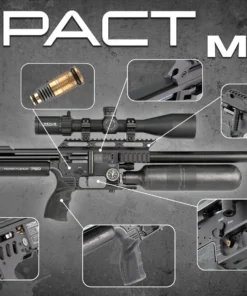
AIRGUN
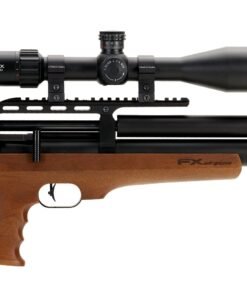
PCP Air Rifles

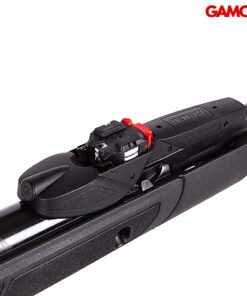

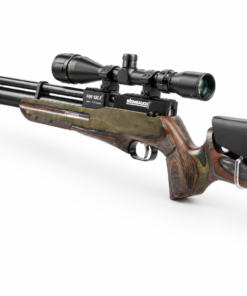


Reviews
There are no reviews yet.