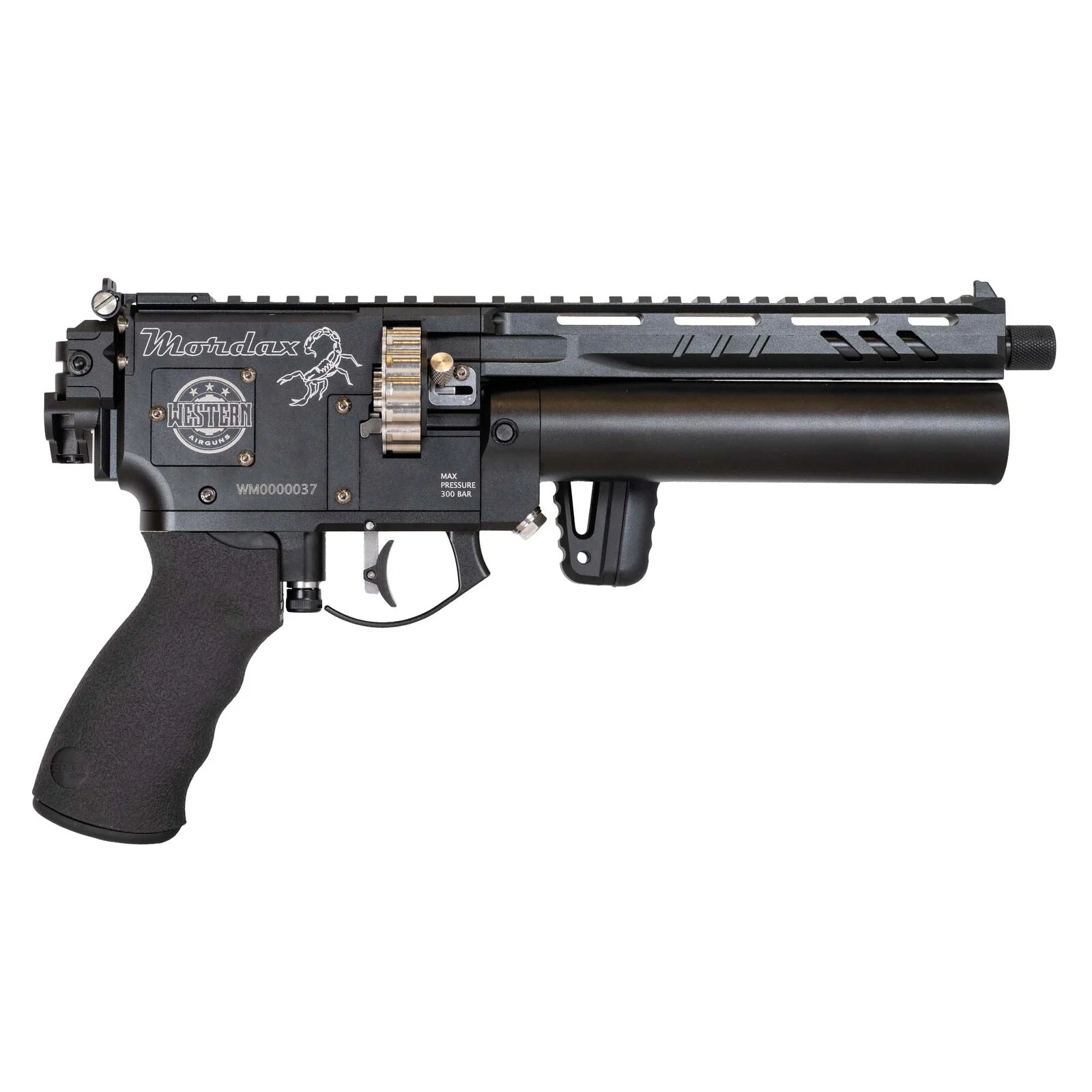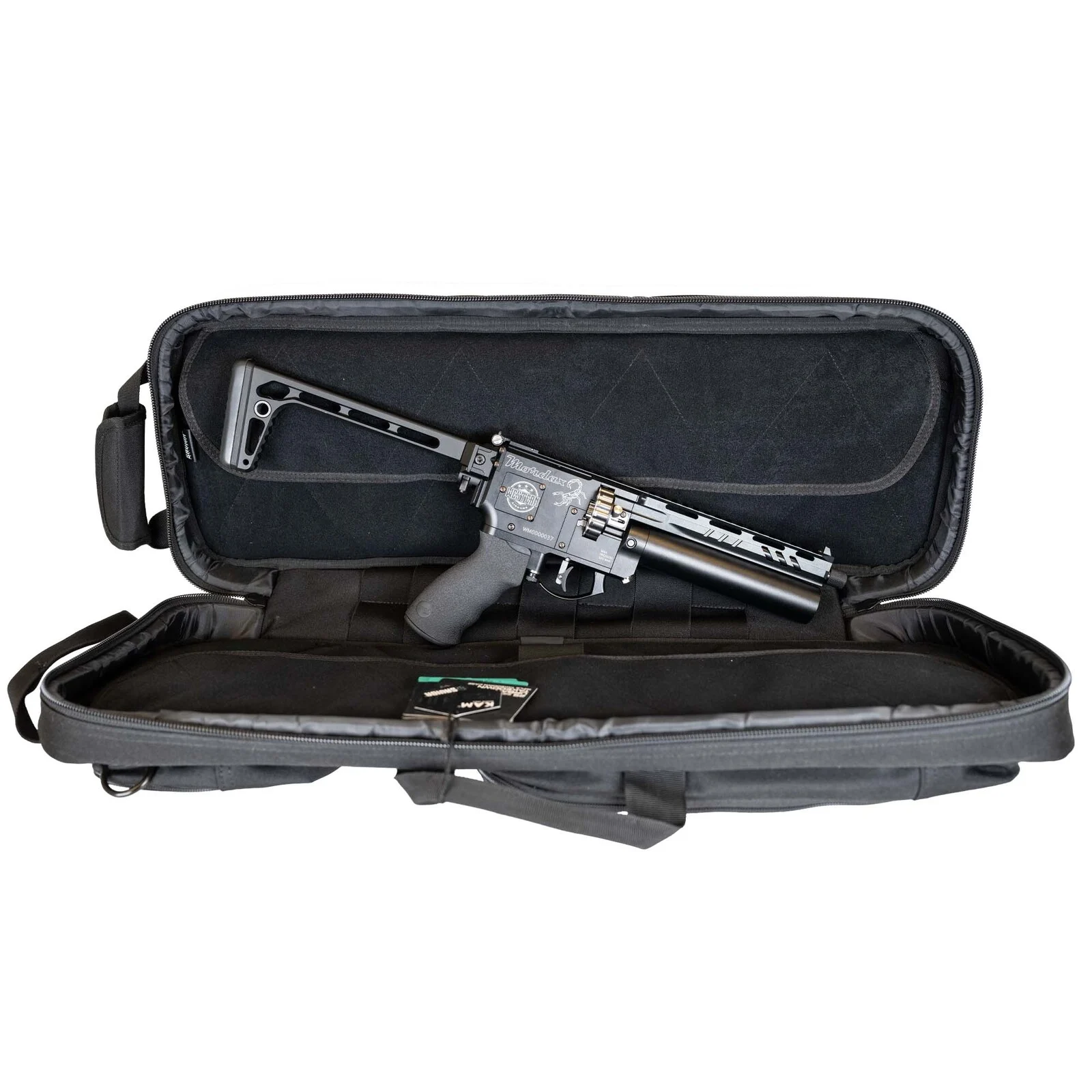
Western Airguns Mordax Semi-Full Auto


The Western Airguns Mordax Semi-Full Auto is a compact pre-charged pneumatic platform engineered around selectable semi-automatic and full-automatic operation, modular configuration, adjustable air management, and a precision-oriented barrel system. Designed by Western Airguns as its first pistol/mini-carbine platform, the Mordax combines the compact proportions of an air pistol with the option of a removable folding stock for a longer carbine-style configuration.
Rather than being built as a conventional single-shot or manually cycled PCP, the Mordax uses a selective-fire pneumatic action. Consequently, another projectile is automatically prepared after each firing cycle, while the selectable operating system allows the platform to function in either semi-automatic or full-automatic mode. Western Airguns’ own manual describes the Mordax as a high-pressure-air-powered selective-fire air pistol.
Western Airguns Mordax Semi-Full Auto Overview
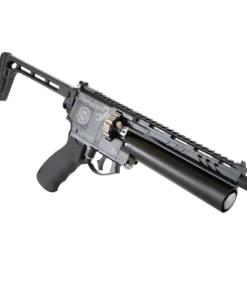
Compact dimensions are one of the platform’s defining characteristics. The standard Mordax measures approximately 13.5 inches in its compact configuration and up to 22 inches with the stock extended, while weight is listed at approximately 3.85 lb. An 8.5-inch barrel is fitted to the standard configuration.
Despite its relatively small dimensions, several features normally associated with larger PCP platforms have been incorporated.
Key Product Features
- Semi-automatic and full-automatic selectable operation
- Available in .22, .25 and .30 calibre
- 8.5-inch precision barrel
- 90cc onboard air reservoir
- Adjustable regulator
- Throttle-style power control
- Removable multi-shot magazine
- 15-round magazine in .22 and .25
- 12-round magazine in .30
- Full-length Picatinny optics rail
- Adjustable open sights
- Dual pressure gauges
- Removable folding stock
- Compact pistol-to-carbine configuration
- Sidewinder-series magazine compatibility
These characteristics create a highly specialized PCP platform built around modularity and pneumatic adjustability rather than the traditional architecture of a spring-powered air pistol or manually operated PCP rifle.
Multiple Calibre Options
.22 Calibre
The .22 version represents the smallest of the three standard Mordax chamberings.
Western Airguns lists maximum output of approximately 40 ft-lb in this calibre. Depending on the factory tune and regulator setting, the number of shots available from one fill can vary considerably. Manufacturer specifications list a range extending from approximately seven shots at maximum output to substantially more shots at lower settings.
Magazine capacity is listed at 15 shots.
.25 Calibre
Moving upward, the .25 configuration provides a larger projectile while retaining the same general platform.
Maximum published energy is approximately 45 ft-lb, with the removable magazine again holding 15 projectiles.
This configuration maintains the compact dimensions and adjustable pneumatic architecture of the Mordax while offering a different balance between projectile size, air consumption and available energy.
.30 Calibre
At the upper end of the standard Mordax range is the .30 configuration.
Western Airguns lists maximum energy of approximately 50 ft-lb for this version. Magazine capacity is reduced to 12 shots, reflecting the larger projectile diameter.
Unlike the .22 and .25 versions, which Western Airguns describes as comparatively straightforward calibre-change options using the appropriate barrel and magazine, the manufacturer identifies the .30 as a standalone configuration.
Precision Barrel Engineering
A significant element of the Western Airguns Mordax Semi-Full Auto is its barrel.
According to Western Airguns, the platform is supplied with a USA-made single-point cut-rifled barrel designed around precision performance. The manufacturer describes the barrel as capable of sub-MOA performance under appropriate conditions.
Actual group size will naturally depend upon projectile selection, environmental conditions, air pressure, optics, mechanical setup and shooter consistency.
Nevertheless, the use of a dedicated precision barrel distinguishes the Mordax from recreational air pistols that prioritize simplicity over repeatable performance.
Adjustable Regulator and Air Management
90cc High-Pressure Reservoir
Compressed air is stored in a 90cc onboard reservoir.
Because the platform uses a relatively compact cylinder, shot count changes noticeably according to regulator pressure and power configuration.
The manufacturer’s manual provides different performance ranges for each calibre. At lower regulator settings, substantially more shots may be available, while maximum-power operation consumes considerably more air per firing cycle.
This trade-off between power and efficiency is normal for adjustable PCP systems.
Dual Pressure Monitoring
Two pressure gauges are incorporated into the design.
One is used to monitor the main air supply while the second provides information relating to regulator pressure. This arrangement makes it easier to distinguish stored reservoir pressure from regulated operating pressure.
For experienced PCP users, separate pressure information can make the system easier to monitor during structured range sessions.
Adjustable Performance
The Mordax incorporates an adjustable regulator together with a throttle-style control.
Consequently, the platform can be configured across a range of pneumatic performance levels within manufacturer specifications.
Western Airguns’ manual lists regulator settings ranging from approximately 110 bar to 190 bar, depending upon configuration. It also states that full-automatic operation requires approximately 135 bar of regulator pressure.
Changes to pressure influence several characteristics simultaneously, including air consumption, muzzle energy and available shots per fill.
Therefore, performance figures should always be understood as configuration dependent rather than fixed.
Semi-Automatic and Full-Automatic Operation
The selective-fire mechanism is one of the Mordax’s most distinctive engineering features.
In semi-automatic mode, one shot is discharged for each trigger activation while the system automatically cycles the next projectile.
Full-automatic mode changes the firing sequence so multiple shots can be discharged while the trigger remains activated, subject to the rifle’s operating pressure and magazine capacity.
Because of this unusual operating system, owners should verify the legal classification applicable to selective-fire airguns in their jurisdiction. Rules can differ substantially between countries, states and provinces.
Compact Pistol and Carbine Configuration
Another major design feature is the removable folding stock.
With the stock folded or removed as legally permitted, the Mordax retains its compact pistol-style dimensions. When the stock is deployed, the platform takes on the handling characteristics of a small carbine.
This modularity explains the manufacturer’s description of the Mordax as a pistol/mini-carbine rather than simply an air pistol.
The resulting configuration can therefore be adapted around different controlled sporting or target environments without changing the underlying pneumatic action.
Picatinny Optics Platform
A full-length Picatinny rail is provided along the upper portion of the platform.
Consequently, compatible sporting optics can be installed when desired.
Adjustable open sights are also included, with windage and elevation adjustment provided by the standard sighting system.
This means the Mordax can be operated with its factory sights or configured around an appropriate optic according to the owner’s range setup.
Removable Magazine System
Magazine compatibility adds another practical element.
Western Airguns states that Mordax magazines are compatible with its Sidewinder series.
The .22 and .25 configurations use 15-shot removable magazines, whereas the .30 version uses a 12-shot design.
A removable magazine also simplifies organized range sessions because magazines can be inspected and handled separately from the action.
A Specialized Modular PCP Platform
The Western Airguns Mordax Semi-Full Auto is fundamentally different from a conventional break-barrel air pistol or manually operated PCP.
Its combination of selectable firing modes, compact dimensions, adjustable regulator, dual pressure gauges, removable magazine, precision barrel, folding stock and Picatinny rail creates a technically distinctive platform.
For experienced PCP enthusiasts, the most important characteristics are not limited to outright power. Instead, the appeal of the design lies in how its pneumatic regulation, calibre options, magazine system and modular architecture have been integrated into a compact package.
Available in .22, .25 and .30 configurations, the Mordax provides different combinations of projectile size, magazine capacity and published energy while maintaining the same basic operating concept.
Before possession or use, however, the exact specification and legal classification should be verified for the relevant jurisdiction, particularly because selective-fire airguns can be regulated differently from ordinary sporting PCP rifles.
Calibres, FAC, Power and Accessories
Western Airguns Mordax Calibre Options
The Western Airguns Mordax Semi-Full Auto is currently offered in .22, .25 and .30 calibre, giving the platform three distinct configurations for experienced PCP users. Western Airguns lists the .22 and .25 versions as closely related platforms, while the .30 is supplied as a dedicated configuration.
Each calibre changes the balance between projectile size, magazine capacity, air consumption and maximum published energy.
The .22 calibre Mordax uses a 15-shot removable magazine and is listed with maximum energy of approximately 40 ft-lb. Because the projectile is smaller than the .25 and .30 options, the .22 configuration can also provide a broader shot-count range depending on regulator and power settings.
Moving to the .25 calibre, magazine capacity remains at 15 shots while maximum published energy rises to approximately 45 ft-lb. This configuration retains the same compact architecture while accommodating a larger projectile.
The .30 calibre Mordax provides the highest published output in the standard range, reaching approximately 50 ft-lb. Because of the larger projectile diameter, magazine capacity is reduced to 12 shots.
Western Airguns states that switching between .22 and .25 requires the appropriate barrel and magazine, whereas the .30 is available as its own dedicated version.
Power Output and PCP Air System
The Mordax uses a regulated pre-charged pneumatic system rather than a spring, gas ram or firearm cartridge.
Compressed air is stored inside a 90cc onboard reservoir, which is considerably smaller than the large bottles found on full-size PCP rifles. The compact reservoir helps maintain the Mordax’s small overall dimensions while still supporting its selectable operating system.
Published maximum energy figures are:
- .22 calibre – up to 40 ft-lb
- .25 calibre – up to 45 ft-lb
- .30 calibre – up to 50 ft-lb
These are maximum manufacturer figures rather than guaranteed output from every individual example. Actual performance can vary with regulator setting, projectile weight, air pressure, mechanical condition and factory configuration.
Shot count changes accordingly. Western Airguns lists approximately 7–45 shots in .22, 7–50 shots in .25, and 6–50 shots in .30, depending on how the pneumatic system is configured.
Higher-output operation naturally consumes more compressed air per cycle, while lower settings can produce a greater number of shots from the same reservoir.
Adjustable Regulated Performance
Another important feature is the adjustable regulator and throttle-style power control.
Rather than being permanently configured around one fixed output, the pneumatic system allows its operating characteristics to be adjusted within the manufacturer’s intended range.
Dual pressure gauges are also included. One provides information about reservoir pressure while the other allows regulated working pressure to be monitored.
For experienced PCP owners, this separation makes it easier to understand the relationship between stored air and regulated operating pressure.
Any adjustments should remain within manufacturer specifications because changing regulator pressure can influence energy, air consumption, shot count and the operation of the selective-fire action.
FAC and UK Legal Classification
The Mordax requires particular care when discussing FAC status.
In England and Wales, an ordinary air rifle capable of muzzle energy above 12 ft-lb must generally be held on a Firearm Certificate. An air pistol exceeding 6 ft-lb falls into a much more restrictive category. Current Home Office guidance also states that short air weapons with a barrel shorter than 30 cm or an overall length below 60 cm and energy above 6 ft-lb are prohibited firearms.
That is especially relevant to the Mordax because Western Airguns lists an 8.5-inch barrel and an overall length between approximately 13.5 and 22 inches depending on stock position. Its published outputs of 40–50 ft-lb also substantially exceed normal low-powered airgun thresholds.
Furthermore, UK firearms legislation separately addresses firearms capable of discharging multiple projectiles successively without repeated trigger pressure, so the Mordax’s full-automatic capability creates additional classification issues beyond simple muzzle energy.
For that reason, describing the Mordax simply as an “FAC air rifle” in the UK could be misleading. Its exact classification should be confirmed with the relevant firearms authority before possession, importation or transfer.
Other countries and states use completely different rules, so UK FAC terminology should not be applied internationally.
Picatinny Optics Rail
The Mordax is fitted with a full-length Picatinny rail, providing a standardized interface for compatible sporting optics.
Depending on the intended lawful range setup, compatible equipment can include:
- Red-dot or reflex sights
- Compact sporting scopes
- Appropriate Picatinny mounting rings
- Protective optic covers
- Compatible rail accessories
Adjustable open sights are also supplied, providing windage and elevation adjustment without requiring an additional optic.
Folding Stock and Modular Configuration
One of the Mordax’s most recognizable accessories is its removable folding stock.
With the stock installed and extended, the platform takes on a compact mini-carbine configuration. When configured differently where legally permitted, its overall dimensions can be substantially reduced.
Because adding or removing a stock can affect legal classification in some jurisdictions, owners should confirm the applicable rules rather than assuming that every factory configuration is treated identically.
Spare Magazines
Western Airguns offers dedicated spare magazines for both the Mordax and Sidewinder.
These magazines are manufactured from titanium and are available in .22, .25 and .30 calibre. The manufacturer specifically states that the magazine system is compatible between the Sidewinder and Mordax platforms.
Magazine capacities remain:
15 rounds in .22
15 rounds in .25
12 rounds in .30
The appropriate magazine must be matched to the rifle’s calibre.
Filling Accessories
Western Airguns also lists a dedicated Mordax fill probe among its factory accessories.
A compatible high-pressure filling system is required to recharge the 90cc reservoir. Depending on the owner’s setup, this may involve an appropriately rated PCP compressor or compressed-air cylinder together with suitable hoses, gauges and connectors.
All filling components should match the pressure specifications provided for the individual rifle.
Barrel and Future Configuration Options
Western Airguns states that additional upgrades are planned or offered for the Mordax platform, including an extended barrel and extended air cylinder intended to alter power capability and shot count, along with wood-stock options. Availability can change over time, so current factory listings should be checked before assuming a particular upgrade is supplied.
The standard platform uses an 8.5-inch precision barrel, while the full-length Picatinny rail and folding-stock arrangement provide substantial configuration flexibility within its compact chassis.
Overall, the Mordax combines three calibre choices, adjustable regulated pneumatic performance, a compact 90cc air system, removable magazines and modular accessory support. Those characteristics make exact model identification particularly important, since calibre, configuration and jurisdiction can materially change both performance and legal classification.
Frequently Asked Questions
What is the Western Airguns Mordax?
The Western Airguns Mordax is a compact pre-charged pneumatic airgun platform designed around selective-fire operation, regulated compressed-air performance, a removable multi-shot magazine, and a modular pistol-to-carbine layout.
Unlike a traditional break-barrel airgun or manually cycled PCP, the Mordax uses a pneumatic action that automatically prepares the next projectile after firing. Depending on the selected configuration, it can operate in semi-automatic or full-automatic mode.
Its compact proportions, removable folding stock, Picatinny rail, adjustable regulator, and multiple calibre options make it a specialized platform intended for experienced adult PCP users.
What calibres are available?
The Mordax is commonly offered in three calibre options:
- .22 calibre
- .25 calibre
- .30 calibre
Each version provides a different balance of projectile size, magazine capacity, air consumption, and maximum published energy.
The .22 and .25 versions use 15-shot magazines, while the .30 version uses a 12-shot magazine because of the larger projectile diameter.
The exact configuration should always be confirmed before purchasing magazines, barrels, or other calibre-specific parts.
How powerful is the .22 version?
The .22 version is commonly listed with a maximum output of approximately 40 ft-lb.
Actual energy can vary depending on regulator pressure, projectile weight, air pressure, mechanical condition, and factory configuration.
Because the rifle uses an adjustable regulated system, users may see lower figures when operating at reduced settings.
Maximum published power should therefore be treated as a specification ceiling rather than an exact figure for every individual example.
How powerful is the .25 version?
The .25 configuration is generally listed with a maximum output of approximately 45 ft-lb.
Its larger projectile diameter gives it a different performance profile from the .22 while retaining the same 15-shot magazine capacity.
As with all regulated PCPs, measured energy can vary according to ammunition and pneumatic settings.
A chronograph provides the most reliable way of determining actual output from an individual rifle where such testing is lawful and appropriate.
What power does the .30 version produce?
The .30 version is commonly specified at approximately 50 ft-lb maximum output.
This makes it the highest-powered standard calibre in the Mordax range.
Magazine capacity is reduced to 12 shots because of the increased projectile diameter.
The .30 should be treated as a separate configuration rather than assuming that every component from the smaller calibres is interchangeable.
Is the Mordax semi-automatic?
Yes.
In semi-automatic mode, one projectile is discharged each time the trigger is activated, while the pneumatic operating system cycles the next round into position automatically.
This removes the need to manually operate a bolt or side lever between individual shots.
The semi-automatic action is one of the major differences between the Mordax and conventional manually cycled PCP rifles.
Does it have a full-automatic mode?
Yes, the platform is designed with a selectable full-automatic mode.
In that mode, multiple shots can be discharged while the trigger remains activated, provided the rifle has sufficient pressure and ammunition remaining in the magazine.
Because full-automatic airguns can be regulated very differently from ordinary sporting air rifles, legal classification should always be checked in the applicable jurisdiction.
The operating mode can also affect air consumption significantly compared with ordinary semi-automatic use.
How large is the air reservoir?
The standard Mordax uses a relatively compact 90cc onboard air reservoir.
This small reservoir helps preserve the compact dimensions of the platform.
However, shot count depends heavily on regulator pressure and power setting.
Higher-output configurations consume more compressed air per shot, while lower settings may allow substantially more shots from a complete fill.
How many shots can be expected from one fill?
There is no single fixed shot count.
The number of shots available depends on calibre, regulator setting, power level, reservoir pressure, and individual rifle configuration.
Published figures for the Mordax vary from relatively low shot counts at maximum output to considerably higher counts when the rifle is operated at reduced power.
This is normal for an adjustable PCP system.
Users interested in efficiency should pay attention to both regulator settings and air consumption rather than evaluating shot count alone.
Does the Mordax use a regulator?
Yes.
The platform incorporates an adjustable regulator that controls the working pressure supplied from the main reservoir to the firing system.
This can help improve consistency because the action receives a more controlled amount of pressure rather than the continuously changing pressure inside the reservoir.
Regulator adjustment can also influence power, air consumption, and the operation of the action.
Any changes should remain within manufacturer specifications.
What are the two pressure gauges for?
The Mordax uses dual pressure gauges.
One gauge monitors the pressure remaining in the main air reservoir.
The other provides information about regulated operating pressure.
This separation allows the user to distinguish between total stored air and the pressure being supplied to the firing system.
For experienced PCP users, dual gauges make it easier to monitor the condition and performance of the pneumatic system during range use.
What barrel does the Mordax use?
The standard platform uses an approximately 8.5-inch precision barrel.
Western Airguns has described the barrel as a single-point cut-rifled design manufactured in the United States.
The short barrel helps maintain the compact overall dimensions of the platform.
Actual accuracy depends on several factors including projectile quality, optic setup, air pressure, barrel condition, environmental conditions, and shooter consistency.
Is it accurate?
The Mordax is built around a precision-oriented barrel and regulated pneumatic system, both of which support consistent target performance.
However, no fixed accuracy figure applies to every rifle.
Performance can change according to projectile selection, regulator pressure, optic quality, firing position, and range conditions.
For practical accuracy testing, users normally obtain the most useful information by keeping the same projectile type and shooting conditions consistent across several groups.
What kind of magazine does it use?
The rifle uses removable rotary-style magazines.
Capacity depends on calibre.
The .22 and .25 versions normally use 15-shot magazines, while the .30 version uses a 12-shot magazine.
The magazine must be matched to the appropriate calibre.
Correct projectile dimensions are also important because a projectile that is too long or incorrectly sized may interfere with magazine rotation or feeding.
Are Mordax magazines compatible with other Western Airguns models?
Western Airguns has indicated compatibility between the Mordax and Sidewinder magazine systems.
This can be useful for owners who already use compatible Western Airguns platforms.
Nevertheless, calibre must still be matched correctly.
A .22 magazine should not be used with a .25 or .30 configuration.
Can the calibre be changed?
The .22 and .25 versions are commonly described as supporting calibre changes using the appropriate barrel and magazine components.
The .30 version is generally treated as a dedicated configuration.
Because calibre changes affect the barrel, magazine, projectile size, and potentially pneumatic performance, the manufacturer’s current instructions should be followed before attempting any conversion.
Does it come with a folding stock?
The Mordax platform is commonly supplied or configured with a removable folding stock.
When extended, the stock gives the platform a compact carbine-style layout.
When folded or removed where lawful, the overall configuration becomes substantially shorter.
Because stock configuration can affect legal classification in some jurisdictions, users should verify applicable local rules before making changes.
Can optics be mounted?
Yes.
A full-length Picatinny rail is provided for compatible optics and accessories.
Depending on the intended range setup, the platform can accommodate compact scopes, red-dot sights, or similar sporting optics.
It also includes adjustable open sights, so an external optic is not mandatory.
Mounting hardware should be compatible with the rail and should not interfere with the magazine or controls.
Does the Mordax have adjustable sights?
Yes.
The factory sighting system includes adjustable open sights.
Windage and elevation can be adjusted to suit the user’s range setup.
This gives owners the option of using the standard sights or installing an optic on the Picatinny rail.
What filling equipment is needed?
The Mordax requires high-pressure compressed air.
Compatible filling equipment may include a PCP compressor, certified compressed-air cylinder, pressure-rated hose, appropriate gauge, and the correct fill probe or connector.
All charging equipment must be rated for the working pressure specified by the manufacturer.
Using unsuitable high-pressure equipment can damage components and create unnecessary risk.
Can a hand pump be used?
A suitable PCP hand pump may be technically possible depending on the pressure requirements, although the effort involved depends on reservoir pressure and pump capability.
Because the reservoir is relatively small, manual filling may be more practical than it would be on a large-bottle PCP.
Nevertheless, many users prefer compressors or certified air cylinders for convenience.
Only clean, dry compressed air should be used.
Is the power adjustable?
Yes.
The platform combines an adjustable regulator with additional pneumatic controls that allow performance characteristics to be changed within the manufacturer’s intended operating range.
Adjustments can affect muzzle energy, air consumption, shot count, and cycling behavior.
Incorrect settings can reduce consistency or cause the action to operate unreliably.
For that reason, tuning should be performed carefully and according to manufacturer guidance.
Is it suitable for beginners?
It is generally better suited to experienced PCP users.
The platform combines high-pressure air, adjustable regulation, selective-fire operation, multiple calibre options, a compact air reservoir, and modular configuration.
These features require more familiarity than a basic spring-powered or entry-level PCP rifle.
A new user would need to understand filling procedures, magazine handling, pressure monitoring, basic maintenance, secure storage, and applicable legal requirements.
What maintenance does it require?
Routine maintenance includes keeping the exterior clean, inspecting seals and fittings, checking air retention, keeping the magazine free of dirt, and monitoring optic mounting hardware.
The fill probe and charging equipment should also be kept clean to avoid introducing contamination into the pneumatic system.
Internal regulator, valve, or reservoir work should generally be left to technicians experienced with high-pressure PCP equipment.
How should it be stored?
The platform should be stored unloaded and secured against unauthorized access.
Magazines should be removed, and the chamber should be checked before storage.
The manufacturer’s recommendations should be followed regarding reservoir pressure during long-term storage.
Optics, magazines, fill equipment, and accessories should also be stored in clean, dry conditions.
Does it require an FAC in the UK?
The legal position is more complicated than simply calling the Mordax an FAC air rifle.
Its published energy levels are well above normal non-FAC air-rifle thresholds, while its short dimensions and full-automatic capability may trigger additional restrictions under UK firearms law.
For that reason, the exact legal status should be confirmed with the relevant firearms authority before importation, possession, transfer, or use.
Legal requirements are different in other countries and regions.
Is the Mordax considered a pistol or rifle?
The manufacturer describes it as a pistol or mini-carbine-style platform depending on configuration.
Its removable folding stock allows the physical layout to change significantly.
However, legal definitions of “pistol,” “rifle,” and “firearm” are determined by local law, not marketing terminology.
The same physical product may therefore be classified differently depending on jurisdiction.
What accessories are commonly used with it?
Common compatible accessory categories include:
- Sporting optics
- Picatinny mounts
- Spare magazines
- Fill probes
- High-pressure filling equipment
- Folding stock components
- Protective rail accessories
- Carry cases
- Manufacturer-approved replacement parts
Accessory compatibility should always be verified for the exact calibre and production version.
What makes the Mordax different from a conventional PCP?
The biggest differences are its compact architecture, semi-automatic and full-automatic operating modes, adjustable regulator, dual gauges, removable magazine system, folding stock, and high level of modularity.
Most PCP rifles rely on manual cycling and are designed around a fixed rifle layout.
The Mordax takes a more compact and mechanically specialized approach.
That makes it more suitable for experienced enthusiasts interested in regulated pneumatic systems, modular configuration, and technically distinctive PCP engineering rather than simple recreational plinking.
Practical Use Scenarios
Structured Indoor and Outdoor Range Sessions
The compact dimensions of this platform make it particularly convenient for organized range sessions where equipment handling, repeatability, and controlled target work are the primary goals. Compared with longer full-size PCP rifles, considerably less overall space is required on a shooting bench, while the folding-stock configuration makes storage and transport easier.
A typical range session can begin with an inspection of reservoir pressure, the regulator gauge, magazine condition, sights, and mounting hardware. Once the equipment has been confirmed to be in normal working order, the shooter can concentrate on consistent groups rather than repeatedly adjusting the setup.
Because the platform is regulated, structured shooting also provides an opportunity to observe how consistently the pneumatic system performs throughout its usable pressure range.
Bench-Rest Accuracy Testing
Bench-rest shooting is one of the most useful applications for a compact regulated PCP.
A stable shooting bench reduces movement and allows greater attention to be given to projectile consistency, optic alignment, and point-of-impact changes.
The rifle can be positioned using an appropriate front support while the shooter maintains a repeatable position behind the stock. Several groups can then be recorded under similar conditions.
Rather than changing multiple variables simultaneously, one projectile type should be evaluated at a time. This creates more meaningful results and makes it easier to identify whether changes in grouping are associated with ammunition, reservoir pressure, optics, or environmental conditions.
Bench testing is also useful after maintenance because baseline performance can be compared against previous records.
Open-Sight Familiarization
An external optic is not always necessary.
The factory adjustable sights allow the platform to be used for conventional sighting practice. This can be useful when becoming familiar with the basic handling characteristics of the platform before additional accessories are installed.
Windage and elevation adjustments can be checked during a controlled range session, followed by several groups to confirm that the sights remain consistent.
Using the factory sighting system also keeps the overall package lightweight and uncomplicated.
For owners who occasionally remove their optic, retaining familiarity with the open sights provides another practical configuration for target work.
Compact Optic Setup
The full-length Picatinny interface makes compact optical systems particularly practical.
A red-dot or similar sporting optic can be mounted where appropriate eye position and control access are maintained. Because the platform itself is relatively short, compact optics generally preserve its balanced proportions.
After installation, the mount should be checked for movement.
A series of controlled groups can then be used to establish and confirm zero according to the optic manufacturer’s procedure.
Once the zero has been established, periodic verification is worthwhile, particularly after transportation or removal and reinstallation of the optic.
This approach provides an efficient way to distinguish an optic issue from an underlying mechanical issue if point of impact changes unexpectedly.
Pistol and Mini-Carbine Configuration
One of the most distinctive practical characteristics is the ability to use different physical configurations where legally permitted.
With the folding stock deployed, the platform takes on the ergonomics of a compact mini-carbine. Additional shoulder support can make a consistent sight picture easier to maintain during deliberate target shooting.
The compact arrangement, meanwhile, significantly reduces overall length.
This modularity allows the same underlying pneumatic system to be configured for different range environments without requiring an entirely separate platform.
However, configuration changes can affect legal classification in some jurisdictions. Owners should therefore understand the rules applicable to stock installation, overall dimensions, and selective-fire airguns before making changes.
Evaluating Different Calibre Configurations
Different calibre versions create opportunities for structured performance comparison.
A .22 configuration provides a different combination of projectile diameter, magazine capacity, air consumption, and published output from the .25 or .30 version.
Instead of assuming that the highest-energy option will automatically be preferable, experienced users can evaluate factors such as consistency, projectile availability, magazine capacity, and expected number of shots per fill.
For example, the .22 and .25 versions normally provide 15-shot magazines, whereas the .30 configuration uses a 12-shot magazine.
The most appropriate version therefore depends on the intended type of target work and the user’s preferred balance between projectile size and pneumatic efficiency.
Monitoring Reservoir Pressure
The dual-gauge arrangement makes air management an important part of everyday use.
One gauge indicates the pressure stored in the primary reservoir, while the second gives information about regulated working pressure.
This makes it possible to observe two separate parts of the pneumatic system without relying on guesswork.
During a normal range session, reservoir pressure can be checked periodically to understand how quickly air is being consumed.
Over time, these observations can help the owner establish a realistic shot-count expectation for the particular calibre and factory-approved configuration being used.
Comparing Air Consumption
Not every shooting session has to focus exclusively on group size.
Air efficiency can also be evaluated.
An owner may begin with a known fill pressure, record the number of shots taken, and then note the remaining reservoir pressure after the session.
Repeating this procedure under similar conditions can provide a useful picture of how much air the platform consumes.
Such information is especially valuable when planning longer range sessions because it helps determine whether additional filling equipment will be required.
The compact 90cc reservoir naturally behaves differently from the much larger bottles fitted to full-size PCP rifles, so understanding real-world air consumption is useful.
Shot-Count Documentation
Maintaining a shooting log can make ownership considerably more organized.
A straightforward record might include starting pressure, finishing pressure, calibre, projectile type, number of magazines used, optic configuration, and any notable changes in performance.
After several sessions, patterns may become apparent.
For example, a gradual reduction in usable shots could indicate that seals or another pneumatic component deserve inspection.
Likewise, consistent results across several fills can provide reassurance that the regulator and reservoir are functioning normally.
This kind of documentation is particularly useful when the platform is used regularly.
Magazine Function Testing
Because the action relies on a removable multi-shot magazine, reliable magazine operation contributes significantly to overall performance.
Before a longer session, each magazine can be inspected for contamination, physical damage, or unusual resistance.
Compatible projectiles should fit correctly without obstructing rotation.
Testing several magazines individually can also help isolate problems. If one magazine repeatedly produces feeding difficulties while another works normally, the issue may be related to that particular magazine rather than the entire platform.
Keeping magazines clean and correctly matched to calibre makes range sessions more predictable.
Semi-Automatic Range Practice
Semi-automatic operation can be particularly useful for structured shooting because manual cycling between individual shots is eliminated.
This allows the shooting position to remain more consistent from one shot to the next.
The benefit is not simply speed. Fewer interruptions can be valuable when assessing equipment consistency because the shooter does not repeatedly move a bolt or side lever.
For group testing, this can help maintain similar positioning throughout a magazine.
Deliberate, paced shooting also allows reservoir pressure and equipment behavior to be monitored between groups.
Selective-Fire Familiarization
Where the configuration and operating mode are legally permitted, familiarization should begin in a controlled range environment.
The platform’s selectable operation differs considerably from that of conventional manual PCP rifles.
For this reason, an experienced owner should first become familiar with selector positions, magazine capacity, air consumption, and the effect that different operating modes have on the pneumatic system.
A major practical difference is air usage. Rapid cycling consumes the limited onboard air supply much faster than slower, deliberate target shooting.
Understanding this behavior is useful for managing range sessions and determining when the reservoir needs to be recharged.
Filling Between Sessions
The relatively small reservoir can make recharging straightforward when appropriate equipment is available.
A compatible high-pressure compressor, certified air cylinder, hose, gauge, and correct fill probe can form part of the range kit.
Before connection, the fill probe and fittings should be kept clean so that debris is not introduced into the pneumatic system.
Once the rifle has reached its specified operating pressure, filling equipment can be disconnected according to the manufacturer’s procedure.
A dedicated storage case for the probe and small fittings can prevent these components from being lost or contaminated.
Portable Range Setup
Compact dimensions become particularly useful when traveling to a shooting facility.
The platform, magazines, optic, fill probe, basic tools, and protective equipment can be organized inside a relatively compact case.
Compared with a long full-size PCP rifle, less vehicle and storage space is required.
For owners who regularly attend formal ranges, this can make equipment preparation easier.
A simple checklist can include the airgun, magazines, suitable projectiles, filling equipment, optic accessories, and necessary documentation.
Organizing these items before departure reduces the likelihood that essential equipment will be forgotten.
Performance Checks After Transport
Transport can occasionally affect optics or mounting hardware.
After arriving at a range, a few controlled shots can be used to confirm that zero remains unchanged.
If point of impact has moved unexpectedly, the optic mounts should be checked before more complicated causes are considered.
Folding-stock hardware and other external fasteners can also be inspected periodically.
A compact platform contains numerous components within a small area, so a brief visual inspection can identify loose hardware before a longer session begins.
Testing After Routine Maintenance
Routine maintenance should ideally be followed by a straightforward function test.
After seals, magazines, optics, or ordinary external components have been serviced, the platform can be checked on the range using familiar ammunition and normal factory-approved settings.
This makes comparison easier because fewer variables have changed.
Air retention, magazine indexing, sight alignment, and general consistency can then be observed.
Unexpected leakage, irregular cycling, or other unusual behavior may indicate that additional inspection is necessary.
Complex work involving the regulator, valve, or pressure vessel is better handled by someone experienced with high-pressure PCP equipment.
Projectile Comparison Sessions
Experienced airgun users often test several compatible projectile designs to determine which performs most consistently with their individual barrel.
A structured comparison can be performed by using the same shooting position, distance, pressure range, and sight setup while changing only the projectile.
Group results can then be recorded separately.
This approach provides more useful information than switching ammunition repeatedly without keeping other variables stable.
Projectile dimensions must also remain compatible with the magazine and barrel specification.
Not every projectile of the nominal calibre will necessarily perform identically.
Cleaning and Post-Range Inspection
After a shooting session, basic care helps preserve the platform.
Exterior surfaces can be wiped down, magazines can be checked for debris, and the filling connection can be kept protected from contamination.
The barrel generally does not need aggressive cleaning after every session. Cleaning frequency should follow manufacturer recommendations and actual performance requirements.
Optic lenses can also be inspected before storage, while exposed fasteners may be checked for movement.
A consistent maintenance routine is usually more useful than repeatedly dismantling the platform unnecessarily.
Practical Use for Experienced PCP Enthusiasts
The strongest practical qualities of this platform come from its combination of compact dimensions, selectable action, regulated air delivery, multiple calibre options, dual gauges, removable magazines, folding stock, and standardized optics interface.
These characteristics allow it to serve several technical range roles without requiring a large full-size rifle.
It can be used for bench-rest group testing, optic evaluation, open-sight practice, projectile comparisons, air-consumption measurements, magazine testing, chronograph verification where appropriate, and general PCP familiarization.
For experienced users, the platform therefore offers more than one type of range experience. Its modular layout can be adapted to different controlled sporting setups, while its regulated pneumatic system provides useful opportunities for consistency testing and detailed performance documentation.
Rather than being defined solely by its selectable operation, its practical value lies in the combination of compact engineering, adjustable pneumatic performance, accessible pressure monitoring, and adaptable range configuration.
Related Airgun Brands, Models and Search Terms
Airgun enthusiasts researching modern PCP platforms often compare a wide range of brands, calibres, operating systems, and rifle configurations. Common searches include air gun, air guns, airgun, airguns, air rifle, air rifles, pellet gun, pellet guns, pellet rifle, pallet gun, bb gun, pcp air rifle, pcp airguns, and broader searches involving air rifle and air pistol platforms.
Among premium PCP manufacturers, fx airguns remains one of the most frequently researched names. Regional searches often include fx airguns sverige, fx airguns sweden, fxairguns, fx usa, fx airguns usa, and fx outdoors. These terms are commonly used by people comparing current FX models, specifications, regional availability, and platform differences.
The Impact family attracts particularly strong interest. Searches such as fx impact, f x impact, fx impact m3, fx impact mk3, fx m3, fx m3 airgun, impact m3, and fx impact m3 air rifle are often used when researching earlier generations. More detailed searches may include fx impact m3 .22cal air rifle, fx impact m3 .22cal air rifle. 600mm barrel, fx impact m3 price, fx impact m3 precio, and fx impact m3 precio en usa.
Newer-generation searches include fx impact m4, fx m4, impact m4 air rifle, and impact m4 500mm. These phrases are frequently associated with users comparing barrel lengths, updated systems, and different configurations within the Impact family.
FX also produces several other recognized PCP platforms. Search interest commonly includes fx leopard, fx leopard airgun, fx leopard .22 pcp specs, fx wildcat, fx panthera, fx king, and fx dreamline.
Another important model family is the fx drs series. Related searches include fx drs tactical, fx drs pro, and fx drs classic. These variants differ in layout, stock design, accessory interface, and intended use, so each configuration should be assessed independently rather than treated as a single identical product.
General searches such as fx air rifle and fx air rifles are useful when comparing the wider FX catalogue before narrowing down to a specific model.
Hatsan is another manufacturer that appears frequently in airgun research. Popular brand-level searches include hatsan air rifle, hatsan air guns, hatsan pcp, hatsanusa, and hatsan usa.
One of the most frequently searched models is the hatsan blitz. Common variations include hatsun blitz and hatzan blitz, although Hatsan is the correct manufacturer spelling. Users may also search for hatsan blitz full automatic, hatsan blitz 30 cal, and hatsan blitz .30 cal when comparing operating characteristics and calibre options.
Another well-known Hatsan platform is the hatsan sortie. Related terms include hatsan sortie tact, hatsan sortie tact semi-auto pcp, and hatsan sortie accessories. These searches generally focus on the compact semi-automatic PCP design and its compatible components.
Traditional Hatsan sporting rifles also attract substantial interest. Common searches include hatsan model 95, hatsan mod 95, mod 95, hatsan 125, hatsan 135, hatsan 135 vortex air rifle, and hatsan 135 carnivore.
Users researching larger-calibre Hatsan platforms may encounter hatsan piledriver, hatsan big bore carnivore rifle, hatsan harpoon, and arrow launcher.
Other popular PCP searches include hatsan hercules, hatsan hercules bully, hatsan bullboss, bullmaster, hatsan flash, hatsan flashpup qe, hatsan invader, and hatsan factor rc.
More compact or newer models may be found through searches such as hatsan airtact, hatsan airtact air rifle, hatsan zada, hatsan velox, hatsan jet 2, and hatsan neutron star.
Used-equipment searches often include hatsan refurbished and refurbished air rifles, which generally refer to previously owned or factory-refurbished models rather than one specific rifle.
Calibre-related searches such as 30 cal air rifle and .177 caliber reflect very different performance categories. A .177 platform is commonly associated with lighter sporting and target use, while a .30 calibre PCP generally belongs to a higher-output category.
Additional technical searches may include range of air rifle, which can refer to effective range, practical target distance, or manufacturer performance claims. Because range depends on projectile design, power, environmental conditions, and shooter skill, no single figure applies to every platform.
Ammunition-related research may include h&n field target trophy bleifrei, while optics searches sometimes include 4×20, referring to a compact scope configuration.
The term econ ii may also appear in broader airgun or equipment research, depending on the specific accessory or platform being investigated.
Users comparing modern PCP platforms should therefore look beyond brand names alone. Important factors include calibre, reservoir size, regulator design, magazine capacity, barrel length, action type, optic mounting, air consumption, and legal classification.
A person researching fx impact m3 air rifle, fx impact m4, hatsan blitz, or hatsan sortie is ultimately comparing very different designs even though all may appear in the same broader PCP category.
Likewise, a traditional spring-powered rifle such as the hatsan model 95 should not be treated as directly equivalent to a regulated semi-automatic PCP platform.
General firearm-related websites such as guns.com may also appear during broader research, but exact airgun specifications should be verified through the manufacturer or an authorized distributor whenever possible.
Overall, these search terms reflect a broad airgun market ranging from compact pistols and traditional spring rifles to highly adjustable PCP systems, large-calibre platforms, and semi-automatic designs. Comparing the exact model, calibre, operating system, and intended sporting application provides far more useful information than relying on brand name or maximum power figures alone.


Reviews
There are no reviews yet.