
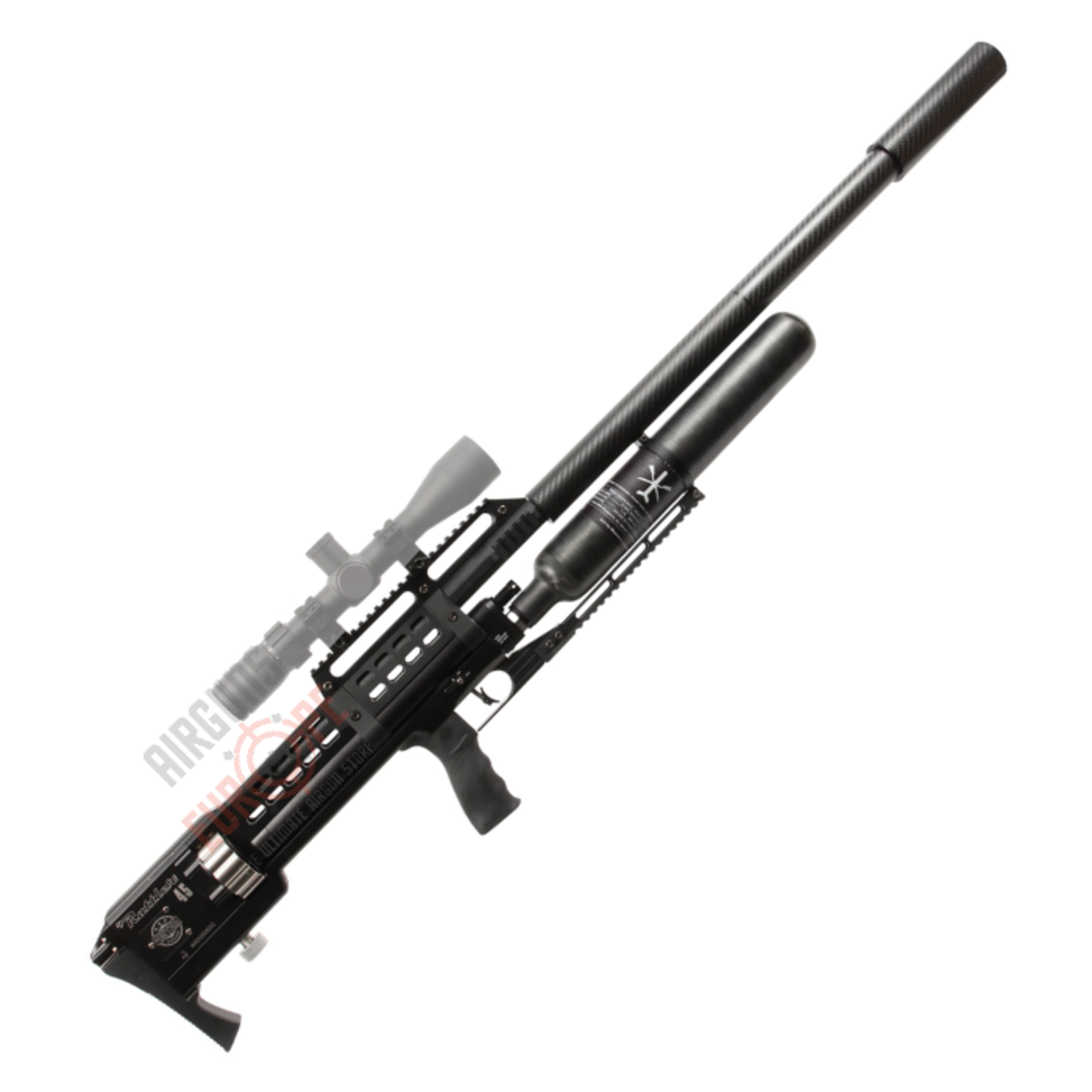
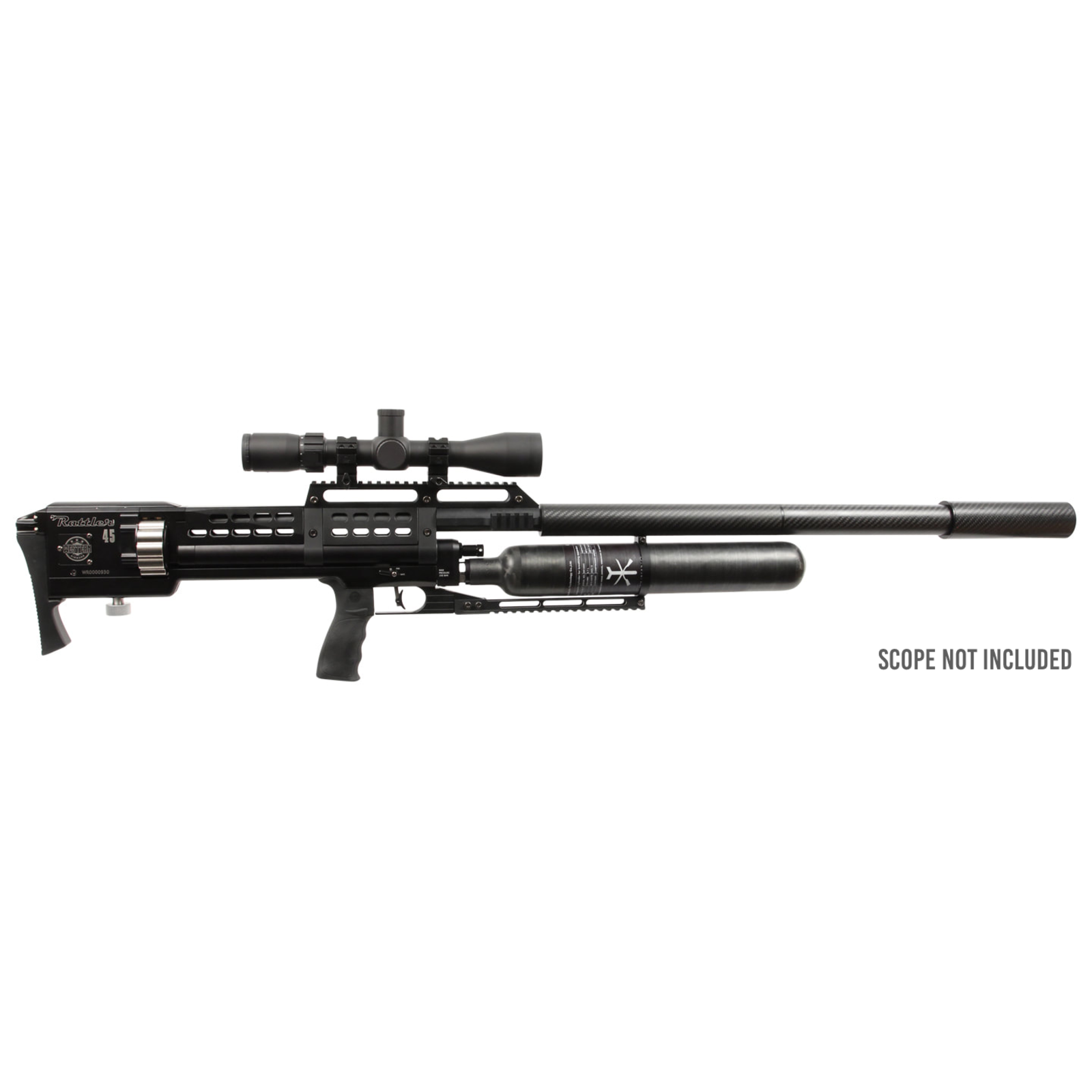



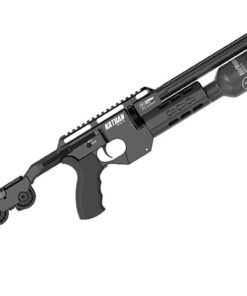
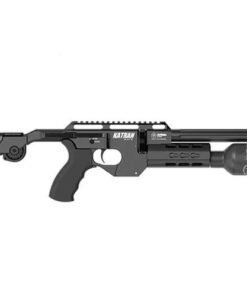
Rattler Long Strike .452 Semi-Automatic PCP Rifle
$2,500.00
Looking for a high quality semi-automatic big bore PCP rifle?
Do you want this rifle to be highly adjustable and customizable?
Want to top that off with a power potential over 550+ joules of energy?
Then the Rattler by Western Airguns is tailored just for you!
Made with the highest quality components and engineered to withstand the taxing demands required to wield the power of this rifle, the Rattler can stand up to the toughest shooting conditions.
The long list of features include a large 700cc air cylinder, an adjustable regulator, and a hammerless firing system uniquely configured for incredible shot-to-shot consistency.
Semi-automatic
The Rattles offers semiautomatic fire in its .452 (11.4mm) caliber.
This means that this rifle fires as fast as you can pull the trigger, without needing to re-cock the rifle in between shots.
This allows the shooter to clean a speed-target in no-time or to fire a quick follow-up shot when necessary.
Power and precision
Reaching maximum power of 589 joules, the Rattler is comfortable shooting heaviest slugs down range.
The Rattler is equipped with a hammer-forged nitrate coated .452 TJ barrel that provides unmatched accuracy, producing sub-MOA groups at 100 yards (with the right tune).
This barrel feeds from the fixed titanium 12 shot magazine (depending on caliber) that has a depth or 21mm. Allowing some of the longest ammunition available!
The barrel is shrouded with in internal sound moderator. This reduces the sounds to make the rifle hearing-safe or to be more effective for pest-control and hunting.
Optionally an threaded adaptor can be mounted for other supressors.
The Rattler is very adjustable. Allowing the user to change the regulator pressure, and the velocity adjustment wheel allows the rifle to offer a wide range of power.
Out-of-the-box settings
Please note that the Rattler LS .452 arrive with the power set to offer a full magazine of shots at around 550-580 joule depending on your ammunition.
You can adjust the power down for more shots p/fill or raise the power, but have less shots.
If you choose to do the latter, keep in mind that the repeating-system needs sufficient air to function.
The Rattler is also available in 7.62mm and 9mm.
You can find these variants here: WS Rattler Semi- and Full-auto PCP Rifle
Modularity
On top of the rifle is the 22mm picatinny/weaver rail for mounting your favourite optics.
The sides and bottom of the rifle also have plenty of rail for mounting accessoires like bipods, lasers, lights, and more!
The pistol grip uses a standard AR-15 connection. This allows the user to change the grip that he/she preffers.
This all allows you to configure the rifle your needs and situation.
The Rattler Long Strike
The Rattler by Western Airguns offers some of the most advanced airgun technology.
This rifle is made for both competition and hunting, resulting in a strongly built rifle that is up for any task.
Long range shooting, hunting and pest control or just plain plinking fun, the Rattler can do it!
Rattler Long Strike .452 Semi-Automatic PCP Rifle
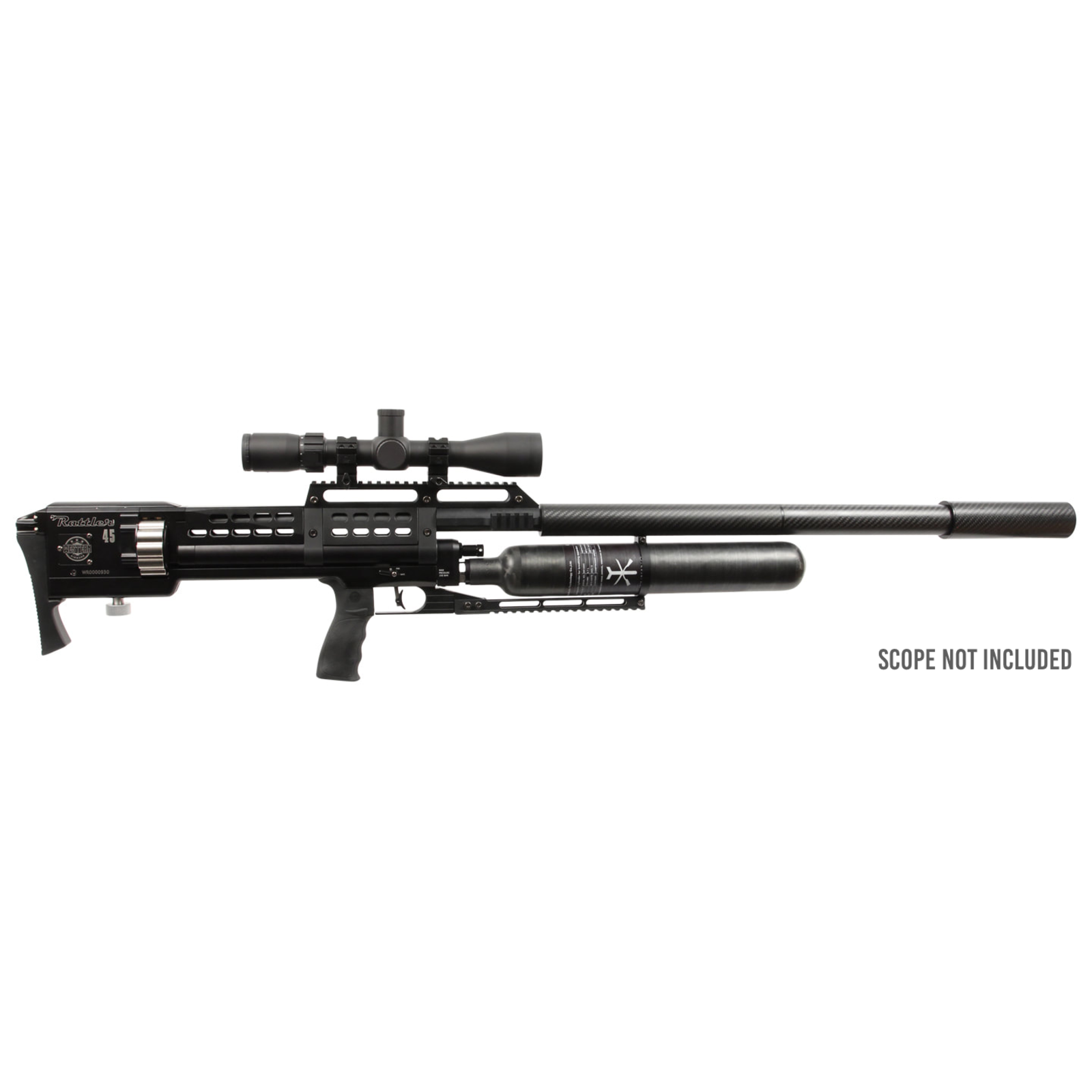
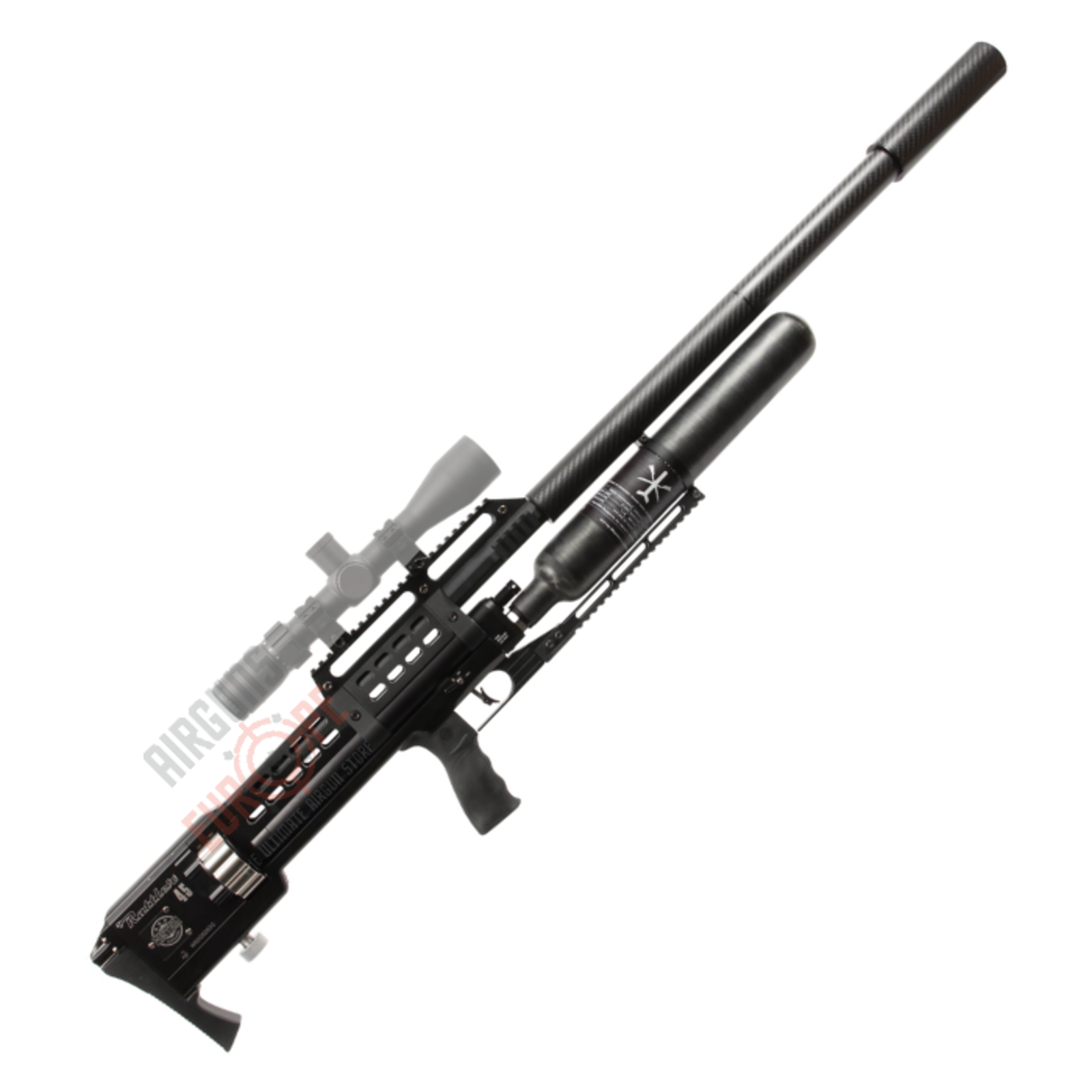
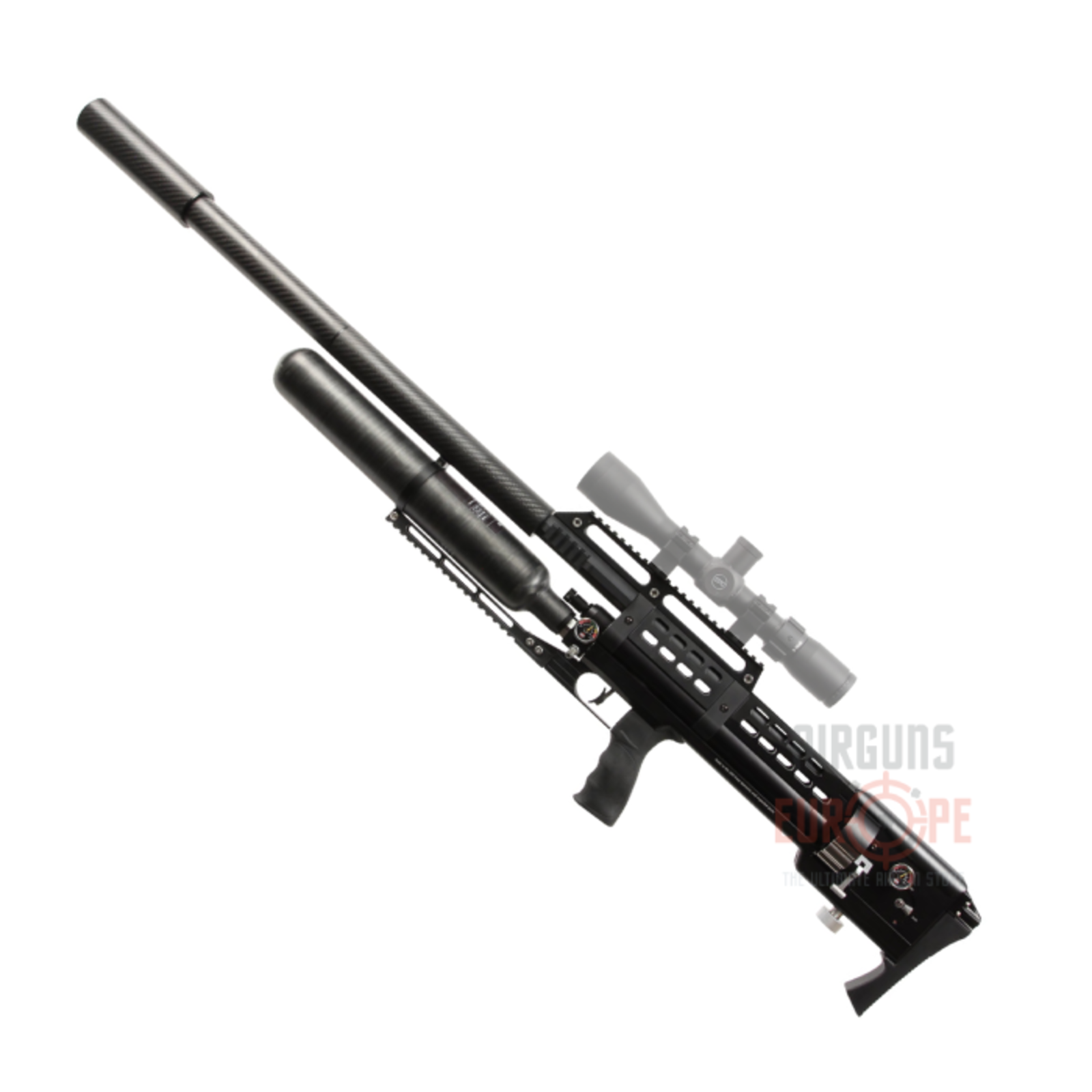
The Rattler Long Strike .452 Semi-Automatic PCP Rifle is a large-calibre pre-charged pneumatic platform developed around high-pressure air delivery, regulated performance, extended barrel length, and semi-automatic operation. Built for experienced airgun users, the Long Strike configuration combines a substantial air reservoir with a long precision barrel and a modular chassis intended for controlled target shooting and other lawful sporting applications.
Unlike a manually cycled PCP platform, the Rattler Long Strike .452 uses a semi-automatic operating system. Therefore, manual cocking between individual shots is not required. A consistent shooting position can consequently be maintained more easily during structured range sessions, while the regulated pneumatic system is designed to provide repeatable air delivery.
The .452 configuration is positioned within the big-bore PCP category. Depending on ammunition, tune, market configuration, and regulator settings, extremely high muzzle-energy figures may be produced. Published European specifications describe output approaching 589 joules, although actual performance should always be verified for the individual rifle and ammunition combination.
Rattler Long Strike .452 Key Features
Several technical characteristics distinguish the Rattler Long Strike .452 Semi-Automatic PCP Rifle from conventional sporting PCP rifles.
- .452 / 11.4 mm big-bore calibre
- Semi-automatic PCP operating system
- Large-capacity pneumatic reservoir
- Adjustable regulated air system
- Long precision barrel configuration
- Multi-shot magazine system
- Picatinny/Weaver optics mounting rail
- Additional accessory mounting rails
- Integrated barrel shroud
- Adjustable performance configuration
- Heavy-duty chassis construction
- Designed for experienced big-bore PCP users
Consequently, the platform can be configured around different lawful range applications while preserving the core characteristics of a regulated semi-automatic PCP system.
.452 Big-Bore PCP Configuration
High-Pressure Pneumatic Operation
Energy is generated entirely through compressed air rather than combustion. Because the rifle operates as a pre-charged pneumatic, its reservoir must first be filled using compatible high-pressure equipment.
A large air cylinder is incorporated into the design. Published specifications commonly list approximately 700 cc of air capacity, although fill-pressure figures can differ between distributors and production configurations. Therefore, the markings and manual supplied with the individual rifle should always take precedence over third-party listings.
Air delivery is also regulated. As a result, pressure supplied to the firing system can be controlled more consistently instead of following the unrestricted pressure decline of the main reservoir.
Semi-Automatic Action
Perhaps the most recognizable characteristic of the platform is its semi-automatic action.
After a loaded magazine has been installed and the rifle has been prepared according to the manufacturer’s instructions, the operating system is designed to cycle without manual cocking between individual shots.
Consequently, interruption to the shooting position is reduced during formal target strings. Nevertheless, responsible muzzle control, trigger discipline, appropriate backstops, and compliance with local regulations remain essential because the platform is capable of substantial projectile energy.
Barrel and Accuracy-Oriented Design
A long barrel configuration is used on the Rattler Long Strike platform. One European specification lists a barrel length of approximately 914 mm, paired with an overall rifle length of approximately 1,232 mm. The same listing specifies a weight of approximately 4.7 kg.
Because barrel length, ammunition selection, air pressure, projectile weight, and regulator tuning all influence performance, accuracy should not be represented by a single universal figure.
Instead, consistent results depend upon the complete system being correctly matched.
Projectile Compatibility
The .452 chambering is intended for appropriately sized airgun projectiles. Projectile dimensions, mass, and overall length must remain compatible with the magazine and chamber.
One published specification lists a maximum projectile length of approximately 28 mm, although owners should confirm compatibility before loading any specific projectile.
For safety and reliability, only ammunition expressly suitable for the particular rifle configuration should be used.
Large-Capacity Air Reservoir
The Rattler Long Strike .452 is designed around the substantial air demand associated with big-bore PCP operation.
Its large reservoir supplies the regulated firing system while reducing the frequency with which the rifle must be returned to a filling source.
However, shot count varies considerably according to:
- Regulator setting
- Reservoir pressure
- Projectile weight
- Desired muzzle energy
- Ambient conditions
- Individual rifle configuration
Therefore, advertised shot counts should be interpreted as configuration-dependent rather than guaranteed values.
Adjustable Regulation
Consistency Through Managed Airflow
A regulated PCP system allows stored air to be reduced to a controlled working pressure before it reaches the firing mechanism.
Consequently, shot-to-shot consistency can be improved when the rifle is configured correctly.
Adjustment should nevertheless be approached carefully. Excessive or inappropriate tuning can affect reliability, air consumption, operating pressure, accuracy, and mechanical stress.
Any servicing beyond normal owner maintenance should therefore be completed according to manufacturer guidance or by a suitably qualified technician.
Optics and Accessory Interface
A 22 mm Picatinny/Weaver-style mounting system is provided on commonly listed configurations. This allows compatible sporting optics to be installed according to the shooter’s lawful range requirements.
Additional rail sections may also be available along the chassis.
Depending on the configuration, compatible equipment may include:
- Sporting riflescopes
- Bipods
- Shooting-rest interfaces
- Sling hardware
- Protective rail accessories
- Approved range equipment
Any accessory should be securely fitted and rated appropriately for the rifle.
Integrated Barrel Shroud
A barrel shroud is incorporated into published Long Strike configurations. Its purpose is to enclose part of the barrel assembly and contribute to the platform’s overall structural and acoustic design.
However, sound-moderation regulations vary substantially between jurisdictions.
Therefore, owners should verify local legislation before installing, modifying, or replacing any sound-moderating component or threaded muzzle accessory.
Ergonomics and Long-Range Platform Layout
Because the Rattler Long Strike is substantially larger than many conventional PCP rifles, its dimensions are better suited to deliberate supported shooting than compact handling.
The extended barrel, large reservoir, chassis system, and optic rail create a platform designed around stability and controlled positioning.
Consequently, users may choose an appropriate bench rest or sporting bipod where permitted.
Nevertheless, individual balance will depend on the optic and accessories fitted to the rifle.
Rattler Long Strike .452 Specifications
Published specifications for the Rattler Long Strike .452 Semi-Automatic PCP Rifle commonly include:
Power source: Pre-charged pneumatic
Calibre: .452 / approximately 11.4 mm
Action: Semi-automatic
Air capacity: Approximately 700 cc
Regulator: Adjustable regulated system
Magazine: Multi-shot configuration; some listings specify 12 shots
Maximum projectile length: Approximately 28 mm
Optics rail: 22 mm Picatinny/Weaver-style interface
Barrel length: Approximately 914 mm on listed Long Strike configurations
Overall length: Approximately 1,232 mm
Weight: Approximately 4.7 kg
Maximum published energy: Up to approximately 589 J on certain .452 configurations
Specifications may differ according to production year, country, tuning, and distributor configuration.
Maintenance and Responsible Ownership
High-Pressure PCP Care
Because the rifle uses high-pressure compressed air, its reservoir, seals, valves, fittings, and filling equipment should be inspected periodically.
Only compatible charging equipment rated for the required pressure should be used.
Furthermore, the rifle should never be filled beyond the pressure specified by its manufacturer.
Routine maintenance should include keeping the barrel and action clean, checking seals for leakage, examining mounting hardware, and storing the rifle unloaded and secured.
Safe Storage and Handling
The Rattler Long Strike .452 should always be handled as a high-powered projectile weapon.
Accordingly:
- Keep the muzzle pointed in a safe direction.
- Keep fingers away from the trigger until ready to fire.
- Use an adequate backstop.
- Wear appropriate eye and hearing protection where required.
- Store the rifle unloaded and securely.
- Keep ammunition and filling equipment appropriately controlled.
- Follow all applicable licensing, transport, ownership, and shooting regulations.
Understanding the Rattler Long Strike .452
The Rattler Long Strike .452 Semi-Automatic PCP Rifle combines a large-bore projectile platform, regulated compressed-air technology, semi-automatic cycling, an extended barrel assembly, and a high-capacity reservoir.
Its engineering places it well beyond the performance category of ordinary recreational pellet rifles. Consequently, proper training, safe high-pressure-air handling, suitable range facilities, and knowledge of applicable laws are particularly important.
For experienced PCP users researching the Long Strike platform, its defining technical attributes are straightforward: .452 big-bore chambering, regulated pneumatic operation, semi-automatic cycling, a substantial air reservoir, and a long precision-oriented configuration.
Before acquisition or use, specifications and legal status should be confirmed for the precise model and jurisdiction involved.
Calibre, FAC, Power and Accessories
Rattler Long Strike .452 Calibre
The Rattler Long Strike .452 Semi-Automatic PCP Rifle is built around an 11.4 mm / .452 calibre big-bore configuration. This places it well above the calibre class normally associated with conventional .177, .22, or .25 PCP air rifles.
Its .452 bore has been designed for compatible big-bore airgun projectiles, including appropriately sized slugs. Published specifications for the Long Strike describe a fixed 12-shot titanium magazine, with some listings specifying compatibility with projectiles up to approximately 28 mm in overall length.
Because projectile dimensions and weight can influence cycling, accuracy, air consumption, and muzzle energy, ammunition should always be selected according to the manufacturer’s specifications for the individual rifle. The Long Strike should therefore not be treated as universally compatible with every projectile carrying a nominal .45 or .452 designation.
A 36-inch / 914 mm hammer-forged barrel is commonly specified for the Long Strike configuration. The extended barrel is one of the main distinctions between the Long Strike and shorter Rattler variants.
FAC Classification and Legal Requirements
The term FAC means Firearm Certificate in the United Kingdom. Whether an air rifle requires certification depends upon jurisdiction, muzzle energy, operating characteristics, and other legal classifications.
In England and Wales, current Home Office firearms guidance states that an air rifle producing more than 12 ft-lb of muzzle energy is treated as a Section 1 firearm and must normally be held on a Firearm Certificate.
The Rattler Long Strike .452 operates vastly above the ordinary 12 ft-lb non-FAC threshold. Consequently, anyone considering possession or use in the UK must establish the exact legal status of the individual rifle before acquisition. Requirements can differ in Scotland, Northern Ireland, and other jurisdictions, while importation, ownership, transport, storage, magazine configuration, and permitted use can also be regulated separately.
Local firearms legislation should therefore always be checked rather than assuming that rules applying to standard low-powered air rifles also apply to this platform.
Rattler Long Strike .452 Power
The Long Strike is distinguished principally by its unusually high output for a PCP air rifle.
Published specifications commonly quote maximum output of approximately 435 ft-lb, equivalent to roughly 589 joules, for the .452 Long Strike configuration.
That figure should nevertheless be regarded as a maximum published specification rather than a guaranteed output from every rifle.
Actual muzzle energy can vary according to projectile weight, regulator setting, reservoir pressure, environmental conditions, individual tuning, and mechanical configuration.
Some distributors describe factory configurations delivering approximately 550–580 joules over a full magazine, depending upon ammunition.
Because this is a regulated PCP platform, compressed air from the main reservoir is reduced to a controlled working pressure before each firing cycle. This arrangement is intended to improve consistency while allowing usable performance to be maintained across a sequence of shots.
700cc High-Pressure Air System
A 700cc air reservoir is commonly specified for the Rattler Long Strike. Published listings also quote fill pressures reaching approximately 300 bar, although owners should always follow the pressure markings and documentation supplied with their individual rifle.
The substantial reservoir capacity is important because high-output big-bore PCP rifles consume considerably more compressed air per shot than lower-powered PCP platforms.
Shot count therefore depends strongly upon the chosen power level.
Some Long Strike listings describe approximately 12 full-power regulated shots, while reduced-output configurations may provide a higher shot count.
Adjustable Power System
The Rattler platform uses an adjustable regulator together with a velocity or power-adjustment system.
This allows the air-delivery characteristics of the rifle to be configured within the operating range intended by the manufacturer.
Any adjustment should nevertheless remain within manufacturer specifications because changes can influence semi-automatic cycling, shot consistency, air consumption, component stress, and reliability.
For servicing or significant changes to the pneumatic system, qualified technical assistance should be used rather than uncontrolled modification.
Optics and Mounting Accessories
The Rattler Long Strike provides considerable mounting space for compatible sporting equipment.
A 22 mm Picatinny/Weaver-style top rail is listed for optic installation.
Depending upon configuration, the rifle may therefore accommodate accessories such as:
- Compatible sporting riflescopes
- Scope rings and mounts
- Approved shooting bipods
- Sling mounting hardware
- Rail covers
- Shooting-rest interfaces
- Protective optic accessories
- Suitable high-pressure filling equipment
Additional accessory rails are positioned along the chassis on commonly listed versions, giving the platform considerable flexibility for lawful sporting configurations.
PCP Filling Accessories
Appropriate high-pressure filling equipment is essential for operating the rifle.
Compatible equipment can include a correctly rated compressed-air cylinder, charging hose, pressure-rated filling assembly, and suitable connector.
One European retailer offers the Long Strike alongside a 300-bar air cylinder, DIN charging set, and Foster-type connector, illustrating the type of equipment commonly associated with filling the platform.
Every component within the filling system must be appropriately pressure rated.
Barrel and Muzzle Accessories
Published versions of the Rattler Long Strike incorporate a shrouded barrel system, while threaded adapters may be available for certain muzzle configurations.
Sound moderators and similar components can be regulated differently depending upon jurisdiction. Their purchase, possession, or installation should therefore be checked against applicable local firearms legislation before use.
Practical Accessory Compatibility
The Rattler Long Strike .452 combines a large PCP reservoir, semi-automatic mechanism, long barrel, regulated air system, and extensive mounting interface. For that reason, accessories should be selected according to compatibility rather than appearance alone.
Optics should suit the rail dimensions, mounts should remain secure, filling equipment must meet the rifle’s pressure requirements, and projectile dimensions must remain compatible with the magazine and chamber.
When correctly configured within manufacturer specifications and local law, the Rattler Long Strike .452 represents a highly specialized big-bore PCP platform built around .452 calibre performance, regulated high-pressure air delivery, semi-automatic operation, and modular accessory support.
Frequently Asked Questions
What type of air rifle is the Rattler Long Strike .452?
The Rattler Long Strike .452 is a high-powered, big-bore pre-charged pneumatic air rifle built around a semi-automatic operating system. Instead of using a spring, gas ram, or cartridge-based combustion system, compressed air is stored inside a high-pressure reservoir and released through the action when the rifle is fired.
The platform is considerably more powerful and mechanically specialized than a conventional recreational pellet rifle. Its combination of large calibre, regulated air delivery, extended barrel length, multi-shot magazine, and semi-automatic cycling places it firmly within the specialist PCP category.
Because of its output and operating characteristics, it should be handled only by experienced adult users in accordance with applicable firearms and airgun regulations.
What calibre does the Long Strike use?
The Long Strike configuration discussed here uses a .452 calibre, approximately equivalent to 11.4 mm.
That makes it a big-bore pneumatic rifle rather than a small-calibre target airgun. Projectiles must be selected carefully because nominal calibre alone does not guarantee compatibility. Overall projectile length, diameter, shape, and magazine clearance can all affect whether ammunition feeds correctly.
Only projectiles that meet the manufacturer’s dimensional recommendations should be used.
Is the Long Strike semi-automatic?
Yes. The rifle is designed around a semi-automatic action.
Once the rifle has been correctly prepared and a compatible loaded magazine has been installed, the action is designed to cycle between individual shots without requiring the user to manually cock the rifle each time.
This distinguishes it from traditional bolt-action or side-lever PCP rifles. Semi-automatic operation also means that correct maintenance, suitable ammunition, consistent air pressure, and proper setup are especially important because the action relies on several components operating together correctly.
How many shots does the magazine hold?
Published specifications commonly describe a 12-shot magazine for the .452 configuration.
Actual magazine capacity should nevertheless be confirmed for the exact production version because manufacturers can revise components between model years or markets.
Projectile overall length is also important. A projectile may technically match the correct calibre but still be unsuitable if it is too long or shaped in a way that prevents proper magazine rotation or chambering.
How powerful is the rifle?
The Long Strike is designed as a very high-output PCP platform.
Published maximum figures for certain .452 configurations have been listed at approximately 435 ft-lb, or roughly 589 joules.
Actual muzzle energy can be lower or higher depending upon the precise configuration, projectile weight, regulator pressure, ammunition dimensions, mechanical condition, and factory settings.
For that reason, advertised maximum figures should not be assumed to represent the exact output of every individual rifle.
Where legal power limits apply, the rifle should be chronographed and its legal status verified before use.
What does regulated PCP mean?
A regulated PCP uses a pressure regulator between the main air reservoir and the firing system.
The reservoir may contain air at very high pressure, but the regulator reduces that pressure to a more controlled working level before each shot.
This can help produce more consistent velocity across multiple shots because the firing valve does not receive the full and continuously changing pressure of the main cylinder.
Regulation can therefore improve shot-to-shot consistency, although performance still depends on projectile choice, pressure settings, temperature, maintenance, and other mechanical factors.
What size air reservoir does it use?
The Long Strike is commonly listed with a reservoir capacity of approximately 700 cc.
A large reservoir is useful because big-bore PCP rifles typically consume significantly more compressed air per shot than lower-powered .177 or .22 rifles.
However, reservoir size should not be confused with shot count. A high-powered setup may use a substantial quantity of air with each firing cycle.
Shot count will therefore depend upon operating pressure, regulator setting, projectile mass, and the amount of energy being produced.
What is the maximum fill pressure?
Certain published specifications list fill pressures approaching 300 bar.
Owners should always follow the pressure markings printed on the actual rifle and the instructions supplied by the manufacturer.
High-pressure pneumatic systems can be dangerous if unsuitable equipment is used.
Charging hoses, connectors, cylinders, gauges, compressors, and fittings must all be rated for the required pressure.
A rifle should never be filled beyond the manufacturer’s stated maximum working pressure.
Can a regular hand pump be used?
Technically, some high-pressure PCP rifles can be filled using specialized hand pumps, but a large reservoir and high operating pressure can make manual filling physically demanding and inefficient.
Owners commonly use appropriately rated high-pressure compressors or certified compressed-air cylinders instead.
Whatever filling method is selected, the equipment must be compatible with the rifle’s connector and pressure requirements.
Moisture control is also important because contaminated or moisture-rich compressed air can contribute to corrosion and premature wear inside pneumatic components.
Is this rifle suitable for beginners?
Generally, this type of platform is better suited to experienced PCP users.
The combination of high pressure, substantial projectile energy, semi-automatic operation, and specialized filling equipment requires more knowledge than a typical entry-level airgun.
A new user would need to understand safe handling, high-pressure filling procedures, secure storage, suitable backstops, ammunition compatibility, and local legal requirements before operating a rifle in this class.
Formal instruction and supervised range experience may be appropriate for people unfamiliar with high-powered pneumatic rifles.
What type of optic can be fitted?
The rifle commonly uses a Picatinny or Weaver-style top mounting rail.
A compatible sporting riflescope can therefore be fitted using properly sized mounts.
Optic selection depends on the intended lawful shooting environment, distance, mounting height, eye relief, and user preference.
Because the rifle is comparatively large and powerful for a pneumatic platform, mounts should be securely installed and periodically checked for movement.
Users should also verify that any optic and mounting hardware provide sufficient clearance around the magazine and other controls.
Can a bipod be fitted?
Compatible bipods can usually be mounted where a suitable rail interface is provided.
A bipod can be useful for supported range shooting because the Long Strike is larger and heavier than many conventional PCP rifles.
However, the exact mounting method depends upon the ch
Practical Use Scenarios
Controlled Long-Range Target Sessions
One of the most suitable environments for the Rattler Long Strike .452 is a professionally managed shooting range equipped to accommodate high-energy air rifles. Its large-bore configuration, extended barrel, substantial air reservoir, regulated pneumatic system, and semi-automatic action make it significantly different from a conventional recreational pellet rifle.
For structured target work, the rifle is generally best used from a stable shooting position. A bench, approved shooting rest, or compatible bipod can help reduce unnecessary movement and make it easier to evaluate consistency. Because the rifle is relatively large and heavy, supported shooting also reduces fatigue during longer sessions.
Before firing begins, the range should be appropriate for the projectile energy involved, and the rifle should be checked for air pressure, optic security, magazine function, and loose hardware.
Once these checks are complete, the platform can be used for repeatable target exercises focused on accuracy, consistency, and overall system performance.
Accuracy Evaluation
A practical use scenario for an experienced owner is accuracy testing with manufacturer-compatible ammunition.
The objective should not simply be to achieve the highest possible velocity. Instead, emphasis can be placed on repeatable grouping, stable performance, and reliable operation.
A consistent target distance should first be selected according to the range setup. The same support position, optic settings, and shooting conditions can then be maintained across multiple groups.
Several short groups may be recorded and compared. If performance changes noticeably, factors such as reservoir pressure, ammunition consistency, optic stability, and environmental conditions can be reviewed.
Because the rifle uses a regulated air system, its usable pressure range is particularly relevant. Structured testing can help reveal how the rifle performs throughout a normal fill without unnecessary mechanical adjustment.
This type of evaluation is also useful after routine maintenance, optic installation, or replacement of normal wear components.
Chronograph Verification
Chronograph testing can be useful where muzzle energy affects legal classification or where the owner wants to confirm actual performance.
A chronograph measures projectile velocity. When projectile mass is known, muzzle energy can then be calculated.
Published manufacturer figures should not automatically be assumed to represent the exact output of every individual rifle. Ammunition, regulator pressure, mechanical condition, and production configuration can all influence measured performance.
Chronograph testing can therefore be helpful after servicing, when evaluating a different compatible projectile, or when confirming that the rifle remains within the limits that apply in a particular jurisdiction.
Optic Setup and Zero Confirmation
The top rail provides a mounting interface for compatible sporting optics, which makes sight setup another common range-based use scenario.
Before an optic is installed, the rail and mounting surfaces should be clean and free from damage. Correctly sized rings or mounts should be used, and the optic should be positioned to provide suitable eye relief without interfering with the magazine or controls.
After installation, the mounting hardware should be checked for security.
Zero confirmation can then be carried out at a suitable distance. Initial adjustments may be followed by several additional groups to verify that the point of impact remains stable.
Because riflescopes and mounts can shift during transport or repeated use, periodic rechecking is worthwhile.
Bench-Rest Shooting
The rifle’s size and weight make bench-rest shooting a logical practical application.
A secure bench allows the shooter to concentrate on consistency rather than supporting the entire weight of the rifle. It also makes it easier to observe pressure readings, magazine operation, and equipment performance.
This environment is particularly useful for comparing ammunition, confirming optic settings, and documenting results after maintenance.
For example, after a scope has been remounted or the rifle has been professionally serviced, controlled groups can be compared with previous records to identify any meaningful change.
Supported Range Practice
A compatible bipod or shooting rest can be used where the chassis provides a suitable mounting point.
Supported practice can help an experienced owner maintain a more consistent position while reducing fatigue. It may also be useful during extended testing of different approved projectile types.
The support should be attached without obstructing the reservoir, controls, magazine, or filling port.
Once fitted, it should provide a stable platform without introducing unwanted movement or contact with components that are not designed to bear weight.
Air-System Management During Range Use
The large high-pressure reservoir is central to the rifle’s operation.
Before a session, the pressure gauge should be checked and the reservoir should remain within the manufacturer’s specified working range.
Compatible filling equipment may include a certified compressed-air cylinder or a suitable PCP compressor. Hoses, connectors, gauges, and fittings should all match the pressure requirements of the rifle.
During a shooting session, changes in performance may indicate that the reservoir is approaching the lower end of the regulated pressure range. At that point, the rifle can be recharged according to the manufacturer’s procedure.
This makes air management an important part of practical ownership, particularly with a high-output big-bore PCP.
Magazine Management
The multi-shot magazine makes organized target sessions convenient, but it also requires careful ammunition selection.
Only compatible projectiles should be used, and the magazine should be checked for damage or contamination before loading.
A projectile may match the nominal calibre yet still be unsuitable if its overall length, shape, or diameter interferes with magazine rotation or chambering.
At the end of a session, the magazine can be removed and inspected before storage.
Any unusual resistance, indexing problem, or feeding issue should be investigated rather than forced.
Equipment Testing After Maintenance
Routine servicing provides another practical reason to use a controlled range.
Following professional maintenance, owners may want to verify air retention, magazine operation, optic stability, and general consistency.
Testing can begin with standard factory settings and a known projectile type.
If an unexpected air leak, unusual sound, cycling issue, or sudden performance change appears, the session can be stopped and the relevant component inspected.
Internal regulator, valve, or reservoir work is best handled by a technician familiar with high-pressure pneumatic systems.
Storage Between Sessions
Practical ownership continues after the range session has ended.
The rifle should be unloaded, inspected, and stored securely.
Magazines can be removed and cleaned if needed, while the exterior may be wiped down to remove moisture, dust, or handling residue.
In many PCP systems, some reservoir pressure is normally retained to help maintain seal integrity, although the correct storage procedure should always follow the manufacturer’s instructions for the specific model.
The optic, mounts, and visible fasteners can also be checked periodically so that minor issues are identified before the next range visit.
Transport to an Approved Range
Transportation should be planned around local legal requirements.
The rifle is typically best carried unloaded inside a suitable padded case that protects the optic, barrel assembly, reservoir, and rail system.
Magazines and projectiles should be organized separately as required, while compressed-air cylinders should be secured appropriately during transport.
A rigid or well-padded case is especially useful for a long rifle because it helps protect the extended barrel and mounted optic from accidental knocks.
Where licences, certificates, or ownership documents are required, they should be carried in accordance with local rules.
Training and Familiarization
For users moving from conventional PCP rifles to a high-output big-bore platform, structured familiarization can be valuable.
The rifle’s physical dimensions, air consumption, magazine system, and semi-automatic operation differ considerably from those of smaller sporting air rifles.
Initial sessions can focus on loading and unloading procedures, magazine handling, pressure checks, use of the filling system, optic setup, and routine inspection.
This type of familiarization helps build consistency and makes later range sessions more efficient.
Responsible Outdoor Sporting Use
Where outdoor sporting use is permitted, the rifle may also be used on private ranges or approved land that is suitable for its energy level.
Terrain, backstop quality, property boundaries, public access, and surrounding structures all need to be considered when selecting a shooting position.
Because big-bore PCP projectiles retain substantial energy, the site should be selected with much more care than would be necessary for a low-powered garden airgun.
Local rules can also affect where and when air rifles may be discharged.
Range Documentation
Keeping basic shooting records can improve long-term ownership.
Useful information may include reservoir pressure, projectile type, number of shots fired, maintenance dates, optic changes, and any observed mechanical issues.
These records can help identify gradual changes in performance.
For example, reduced air retention may suggest that a seal requires inspection, while repeated shifts in point of impact may indicate an optic or mounting issue.
Documentation is particularly valuable when comparing results across different sessions or after servicing.
Ammunition Comparison
Another practical range exercise involves comparing different manufacturer-compatible projectiles.
Rather than changing several variables at once, one projectile type can be tested at a time while the rifle, optic, support, and range distance remain unchanged.
Group size, consistency, feeding reliability, and air consumption can then be recorded.
This structured approach is more useful than relying solely on advertised projectile specifications because individual rifles can show clear preferences for particular projectile designs.
Magazine fit should also be checked before a full session begins.
Scope and Mount Inspection
Long-range optics and mounting hardware are central to consistent use.
After transport, the scope can be checked for movement, loose fasteners, or a change in eye relief.
Mounting screws should be maintained according to the optic and mount manufacturers’ recommendations.
If zero begins to shift unexpectedly, the mounting system should be inspected before assuming the rifle itself has changed.
This simple check can save considerable time during range sessions.
Reservoir and Seal Monitoring
Air retention provides a useful indication of the health of the pneumatic system.
Owners can monitor whether reservoir pressure remains stable between sessions.
A small change caused by temperature may be normal, while a persistent or rapid pressure loss can indicate a seal or fitting that requires attention.
Keeping a record of fill pressure before and after storage can make these changes easier to identify.
Visible damage, damaged O-rings, or repeated leakage should be assessed before further use.
Cleaning and General Care
The rifle does not require excessive cleaning after every outing, but basic care can help preserve consistency.
Exterior surfaces can be wiped down, the magazine can be kept free of debris, and the optic lenses can be cleaned using appropriate materials.
Barrel cleaning should be performed only when required and in accordance with the manufacturer’s recommendations.
Over-cleaning or using unsuitable tools can create more problems than it solves.
A consistent maintenance routine is generally more useful than frequent unnecessary disassembly.
Practical Use for Experienced PCP Enthusiasts
The platform is best understood as a specialist big-bore PCP system rather than a general-purpose recreational air rifle.
Its practical strengths are most apparent during controlled target work, accuracy evaluation, optic testing, chronograph verification, supported shooting, ammunition comparison, and equipment assessment.
The long barrel and large reservoir suit deliberate range sessions, while the regulated system provides a useful basis for comparing shot-to-shot consistency.
Its modular rail system also allows compatible optics and support equipment to be configured around the user’s preferred range setup.
For experienced PCP enthusiasts, that combination creates a platform well suited to technical testing, structured shooting sessions, and detailed performance evaluation.
Why Choose the Rattler Long Strike .452?
The Rattler Long Strike .452 stands apart from ordinary PCP air rifles because it combines big-bore engineering, regulated compressed-air technology, semi-automatic operation, a long barrel, substantial air capacity, and a modular chassis in one specialized platform. For experienced shooters comparing premium PCP systems, these characteristics can make it particularly suitable for controlled target shooting, performance testing, and other lawful sporting applications.
Built Around a Serious Big-Bore Platform
One of the main reasons to consider the Long Strike is its .452 calibre configuration. Rather than being designed around lightweight pellets and modest recreational performance, the platform has been engineered for much larger projectiles and considerably greater pneumatic output.
This makes it a fundamentally different type of air rifle.
The larger bore, extended barrel, substantial reservoir, and dedicated magazine system have been combined around the requirements of a high-output PCP platform rather than adapted from a small-calibre design.
For an experienced enthusiast who already understands conventional PCP rifles, that engineering distinction can be significant.
Semi-Automatic Operation Reduces Manual Cycling
Traditional PCP rifles commonly require a bolt, side lever, or other mechanism to be manually operated after every shot.
The Long Strike instead uses a semi-automatic operating system.
Consequently, the shooter does not need to interrupt the shooting position simply to manually cycle the action after each individual shot. During structured range sessions, this can make the overall operating sequence smoother and more consistent.
The advantage is not simply speed. Maintaining a stable shooting position can reduce unnecessary physical movement between shots, which is useful when evaluating groups, optic stability, ammunition consistency, or the performance of the regulated air system.
Long Barrel Supports an Accuracy-Oriented Configuration
The extended barrel is another defining characteristic.
A Long Strike configuration is typically substantially longer than compact PCP platforms. This gives compressed air additional time to act on the projectile within the barrel while also creating a rifle layout designed around deliberate, supported shooting.
For shooters who primarily work from a bench, shooting rest, or bipod, the added length can be more useful than the extreme compactness offered by bullpup-style alternatives.
The longer configuration also creates the visual and physical proportions of a dedicated precision-oriented platform.
Accuracy itself still depends on ammunition, optics, shooter technique, air pressure, barrel condition, and environmental factors. Nevertheless, the platform provides an appropriate mechanical foundation for repeatable range testing.
Regulated Air Delivery Improves Consistency
Consistency is one of the most important characteristics of a quality PCP rifle.
As compressed air is consumed, the pressure inside an unregulated reservoir gradually changes. A regulator helps manage this variation by supplying the firing system with air at a more controlled working pressure.
That can result in a more predictable firing cycle across the useful portion of a fill.
For practical range use, this means the shooter can spend more time analyzing groups and less time dealing with unpredictable pressure-related changes.
A regulated system is particularly valuable on a large-bore platform because each shot requires considerably more compressed air than a conventional small-calibre PCP.
Large Air Capacity Matches the Platform
High-output PCP rifles require significant air volume.
For that reason, the Long Strike incorporates a large reservoir rather than relying on the comparatively small cylinders commonly found on lighter sporting rifles.
The larger air supply complements the rifle’s big-bore design and allows multiple shots to be produced before refilling becomes necessary.
This does not mean the rifle will provide the extremely high shot counts associated with lower-powered PCPs. Instead, the reservoir capacity should be viewed in relation to the substantially greater amount of air required by each firing cycle.
For its intended class, that balance between reservoir capacity and performance is an important part of the platform’s engineering.
Multi-Shot Magazine Adds Convenience
The magazine system is another practical advantage.
Instead of loading an individual projectile manually before every shot, compatible projectiles can be prepared in the magazine before a shooting string begins.
This can make organized range testing considerably more convenient.
For example, an experienced user evaluating a particular projectile can load a magazine, shoot a controlled group, record the results, and then compare those results against another compatible projectile.
The magazine system therefore complements the semi-automatic action particularly well.
Correct projectile dimensions remain important because big-bore ammunition can vary considerably in length and profile.
Modular Optics and Accessory Support
A modern PCP platform should provide enough flexibility to accommodate different shooting setups.
The Long Strike’s rail system allows compatible optics and support equipment to be installed according to the user’s preferred configuration.
A suitable scope can be positioned along the upper rail, while compatible bipods or other lawful range accessories may be attached where appropriate mounting interfaces are available.
This modularity means the rifle does not force every owner into exactly the same setup.
Someone concentrating on bench-rest shooting may choose a larger optic and substantial support system, while another user may prefer a simpler range configuration.
The ability to configure equipment around the intended use is one of the platform’s practical strengths.
Suitable for Detailed Performance Testing
Experienced PCP enthusiasts often want more than casual shooting.
They may want to compare ammunition, record group sizes, measure consistency, evaluate air consumption, check optic stability, or document performance throughout a complete reservoir fill.
The Long Strike lends itself naturally to this type of technical use.
Its regulated pneumatic system, magazine configuration, large reservoir, long barrel, and supported shooting characteristics provide multiple variables that can be monitored systematically.
A shooting log can therefore become particularly useful.
Reservoir pressure, projectile type, number of shots, observed grouping, maintenance activity, and equipment changes can all be documented over time.
This turns range sessions into structured performance evaluation rather than random shooting.
A Platform for Experienced PCP Owners
Another reason this rifle may appeal to some users is that it offers a substantial progression beyond basic PCP equipment.
Someone already familiar with filling cylinders, pressure gauges, magazines, regulators, optics, and routine PCP maintenance may want a more technically specialized platform.
The Long Strike provides that progression.
Its air requirements, dimensions, calibre, magazine system, and operating mechanism all demand greater familiarity than a conventional entry-level rifle.
Therefore, its appeal is strongest for experienced enthusiasts who appreciate the engineering behind high-pressure pneumatic systems.
Strong Bench and Supported-Shooting Characteristics
The rifle’s physical size can actually become an advantage when used in the correct environment.
Compact rifles are convenient to carry, but extreme compactness is not necessarily important for bench-based target work.
The Long Strike’s substantial dimensions create a stable platform that works naturally with shooting rests and compatible bipods.
With the rifle properly supported, the shooter can concentrate on consistent positioning, trigger control, optic alignment, and equipment evaluation.
Its weight also contributes to the feeling of a substantial, purpose-built system rather than an ultralight recreational rifle.
Designed as an Integrated System
Perhaps the strongest reason to consider the platform is that its major components have been designed to work together.
The .452 bore is paired with a large reservoir. The reservoir feeds a regulated pneumatic system. That system supports the semi-automatic action. The action works with a multi-shot magazine, while the long barrel and rail-equipped chassis complete the overall platform.
Each major feature therefore supports another part of the design.
This integrated approach is preferable to simply adding high-output components to a platform originally intended for much lower performance.
Why It Can Be a Better Choice for the Right User
Whether the Long Strike is a better rifle ultimately depends on what the owner expects from a PCP.
For someone looking for an inexpensive, lightweight rifle for casual short-distance shooting, its size and specialized design may be unnecessary.
However, an experienced user specifically interested in a large-bore, regulated, semi-automatic PCP platform may find considerably more value in its architecture.
Its strongest attributes include the large-calibre configuration, substantial air capacity, regulated operation, extended barrel, multi-shot magazine, semi-automatic mechanism, and flexible mounting system.
Together, these characteristics create a platform focused on technical capability rather than simplicity.
For structured range sessions, ammunition evaluation, chronograph work, supported target shooting, optic testing, and detailed performance analysis, the combination can be especially useful.
Rather than excelling because of one isolated specification, the rifle’s main advantage comes from how its major systems are integrated.
That makes the Rattler Long Strike .452 particularly relevant to experienced PCP enthusiasts looking for a technically advanced big-bore platform with substantial pneumatic capacity, consistent regulated operation, and a configuration designed around deliberate, controlled shooting.
Related Airgun Models, Brands and Search Comparisons
Enthusiasts researching high-performance airguns frequently compare several manufacturers, operating systems, calibres, and rifle configurations before deciding which platform best suits their sporting or target-shooting requirements. Searches for air gun, air guns, air rifle, air rifles, pellet gun, pellet guns, pellet rifle, pallet gun, bb gun, pcp air rifle, and pcp airguns often lead users toward established brands such as FX Airguns and Hatsan alongside other specialized PCP manufacturers.
Among European and international searches, fx airguns, fxairguns, fx airguns sverige, and fx airguns sweden frequently appear when users are researching the Swedish manufacturer and its current PCP platforms. Regional searches may also include fx usa, fx airguns usa, and broader references such as fx outdoors when comparing availability, specifications, and model families.
One of the most widely researched FX platforms is the fx impact series. Search variations include f x impact, fx impact m3, fx impact mk3, fx m3, fx m3 airgun, impact m3, fx impact m3 air rifle, and fx impact m4. Shoppers researching the newer generation may also search for fx m4 or impact m4 air rifle, while barrel-specific searches such as impact m4 500mm are commonly associated with users comparing rifle dimensions and configurations.
Older and current Impact configurations generate more detailed searches as well. Examples include fx impact m3 .22cal air rifle, fx impact m3 .22cal air rifle. 600mm barrel, fx impact m3 price, fx impact m3 precio, and fx impact m3 precio en usa. These terms usually indicate interest in calibre, barrel length, regional pricing, or the differences between generations.
Beyond the Impact family, FX produces several other recognized PCP designs. Research commonly includes fx leopard, fx leopard airgun, and fx leopard .22 pcp specs for users looking at newer platforms. Other popular searches include fx wildcat, fx panthera, fx king, and fx dreamline, each representing a distinct approach to PCP rifle design.
The fx drs family has also developed its own group of search terms. Users may compare the fx drs tactical, fx drs pro, and fx drs classic when examining different stock systems, barrel arrangements, accessory interfaces, and intended sporting roles. These rifles should be considered individually because dimensions, power levels, equipment packages, and market availability can vary between configurations.
General searches such as fx air rifle and fx air rifles are therefore useful starting points for understanding the manufacturer’s broader product range rather than identifying one specific model.
Hatsan represents another major name frequently encountered during PCP research. Searches such as hatsan air rifle, hatsan air guns, hatsan pcp, hatsanusa, and hatsan usa cover a large range of spring-powered and pneumatic products.
One particularly prominent model is the hatsan blitz. Users also search for variant spellings such as hatsun blitz and hatzan blitz, although Hatsan is the correct manufacturer spelling.
Calibre-specific interest frequently produces searches for hatsan blitz 30 cal and hatsan blitz .30 cal, while hatsan blitz full automatic is often used when researching the operating characteristics of the platform. Specifications and legal classifications can vary substantially between markets, so current manufacturer information and applicable local regulations should always be checked.
The Hatsan catalogue extends well beyond the Blitz. Searches for hatsan sortie, hatsan sortie tact, hatsan sortie tact semi-auto pcp, and hatsan sortie accessories generally relate to Hatsan’s compact semi-automatic PCP platform and compatible equipment.
Traditional sporting air-rifle searches include hatsan model 95, hatsan mod 95, mod 95, hatsan 125, hatsan 135, hatsan 135 vortex air rifle, and hatsan 135 carnivore. These models should not be confused with semi-automatic PCP rifles because their operating systems and performance characteristics are different.
Large-bore Hatsan searches commonly include hatsan piledriver, hatsan big bore carnivore rifle, hatsan harpoon, and arrow launcher. Likewise, PCP enthusiasts may encounter hatsan hercules, hatsan hercules bully, hatsan bullboss, bullmaster, hatsan flash, hatsan flashpup qe, hatsan invader, and hatsan factor rc while comparing different pneumatic platforms.
Compact and newer Hatsan models generate searches such as hatsan airtact, hatsan airtact air rifle, hatsan zada, hatsan velox, hatsan jet 2, and hatsan neutron star. Meanwhile, searches for hatsan refurbished and refurbished air rifles usually indicate interest in previously owned or factory-refurbished equipment rather than a particular technical configuration.
Additional airgun-related searches may include 30 cal air rifle, .177 caliber, range of air rifle, air rifle and air pistol, and sporting ammunition references such as h&n field target trophy bleifrei. These terms span very different power classes and should not be interpreted as directly interchangeable product categories.
Accessory searches may include 4×20, which commonly refers to compact optical specifications, while terms such as econ ii may appear in broader equipment or model research depending on the user’s intended platform.
When comparing these products, calibre alone does not determine overall suitability. Reservoir capacity, regulator design, barrel configuration, action type, magazine capacity, rifle dimensions, projectile compatibility, service support, and applicable local law can all influence the final configuration.
For that reason, someone researching an air rifle and air pistol collection should compare verified manufacturer specifications rather than assuming that all PCP systems perform in the same manner.
Search platforms and general firearm-related websites can also appear during research. For example, guns.com may surface in broader search results, although specifications for any specific airgun should ultimately be verified against the manufacturer or an authorized distributor.
Whether research begins with an FX platform, a Hatsan model, a 30 cal air rifle, a conventional .177 caliber rifle, or another high-pressure pneumatic system, meaningful comparisons should focus on the exact model rather than brand reputation alone. The large variety of PCP configurations available today means that seemingly similar rifles can differ considerably in operating system, dimensions, air consumption, calibre availability, and intended sporting application.
Be the first to review “Rattler Long Strike .452 Semi-Automatic PCP Rifle”
Related products
PCP Air Rifles
WESTERN AIRGUNS

PCP Air Rifles
WESTERN AIRGUNS
Air Rifles
Air Rifles
Reviews
There are no reviews yet.