
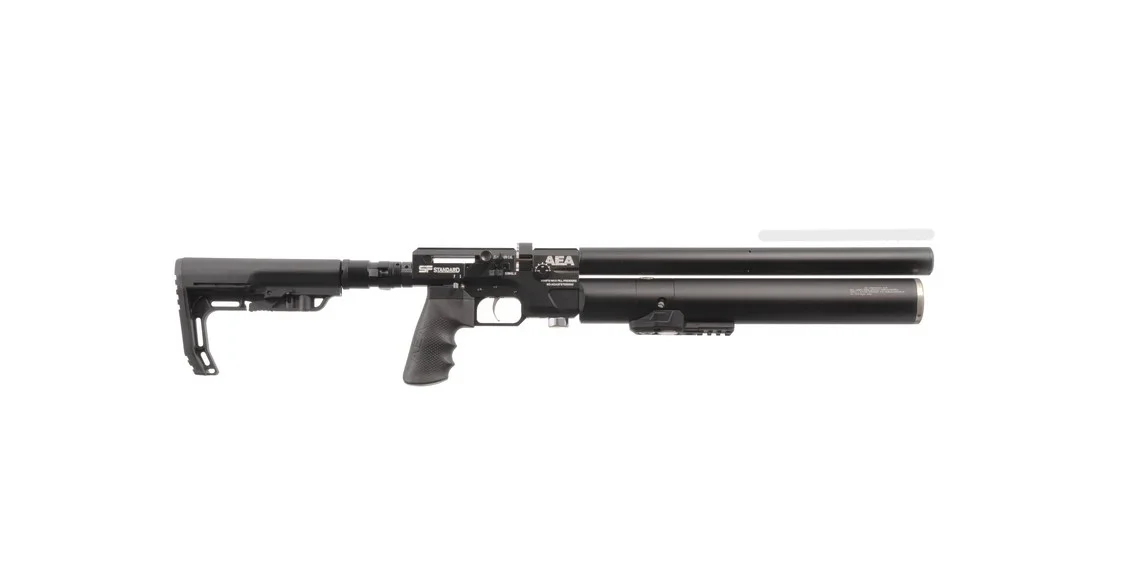

AEA SF Standard
$580.00
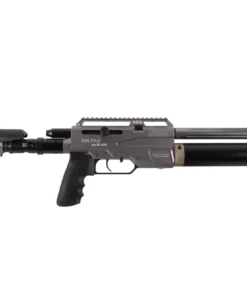
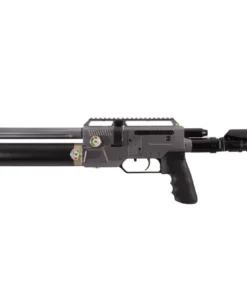
The SF carbines are the next generation of AEA semi automatic airguns. Available in .22, .25 and .30 caliber, the SF provide consistent, semi automatic fire thanks to the externally adjustable regulator. It can also be used as a bolt action.
The Standard version features a 13” barrel and a 330CC air tube, providing a middle ground between the sniper and compact version, being a semi automatic of almost universal application.
NOTE: semi auto operation is available only in full power.
| Caliber | .22 Cal |
| .25 Cal | |
| .30 Cal | |
| Weight | 5.3 LBS (2,40 kg) |
| Barrel Length | 13 Inches (330 mm) |
| Overall Length | 35 Inches (889 mm) |
| Butt-Stock Folded Length | 24 Inches (609 mm) |
| Integrated Shroud w/ baffles | |
| Cocking System | Semi-Auto AND Bolt-Action |
| Adjustable External Regulator | |
| Magazine Capacity | .22 Cal 12 Shots |
| .25 Cal 10 Shots | |
| .30 Cal 9 Shots | |
| Air Tube Capacity | 330 CC |
| Max Air Filling Pressure | 4500 PSI / 300 BAR |
| Muzzle Velocity | .22 CAL Min 12FPS || @ 18.13GR 12 TO 860 FPS |
| .25 CAL Min 12FPS || @ 25.4GR 12 TO 850 FPS | |
| .30 CAL Min 12FPS || @ 44.75GR 12 TO 690 FPS | |
| SHOTS PER FILL | .22 Cal 50+ good shoots |
| .25 Cal 40+ good shoots | |
| .30 Cal 35+ good shoots | |
| Optics | 11mm Dovetail Scope Mount |
Inside the box:
- SF Standard
- x1 Fill probe
- x2 Magazines
AEA semi auto airguns require at least a 30 Joules configuration to cycle and effectively become semi-auto airguns.
When set to a lower power, these airguns cannot function in semi-auto and require the user to manually operate the bolt after each shot.
AEA SF Standard Semi-Automatic PCP Air Rifle


The AEA SF Standard combines compact handling, adaptable performance, and modern PCP technology in one versatile air rifle. Designed for recreational shooting, target practice, and lawful pest-control applications where permitted, this model provides a practical balance between the shorter SF Compact and the longer SF Sniper.
A 13-inch barrel keeps the rifle maneuverable. Meanwhile, the 330cc air cylinder offers useful capacity for extended shooting sessions. Because the folding buttstock reduces the stored length to approximately 24 inches, the rifle can also be transported and stored more conveniently.
Most importantly, the AEA SF Standard provides two operating options. Shooters can select semi-automatic operation for fast follow-up shots or use the manual bolt-action mode when a slower and more deliberate shooting rhythm is preferred. Consequently, one platform can accommodate several shooting styles.
Available in .22, .25, and .30 caliber, the rifle lets each buyer select a configuration that fits their intended legal use. The externally adjustable regulator also adds valuable tuning flexibility, while the integrated shrouded barrel helps produce a more controlled shooting experience.
Why Choose the AEA SF Standard?
Some air rifles prioritize compactness but sacrifice air capacity. Others deliver greater capacity while becoming long and difficult to handle. In contrast, the AEA SF Standard occupies a useful middle position.
Its dimensions remain manageable without reducing the barrel to an ultra-compact length. Furthermore, its 330cc air reservoir offers greater capacity than the smaller SF Compact configuration. This combination makes the Standard an attractive option for shooters who want portability without moving to the longest model in the SF family.
Another important advantage comes from the selectable operating system. Since the shooter can switch between semi-automatic and manual bolt-action operation, the rifle adapts easily to different range conditions and personal preferences.
A Balanced Configuration
The Standard version has been built around a 13-inch barrel and a 330cc air tube. As a result, it balances three important characteristics:
- Compact handling: The 35-inch overall length remains manageable in confined shooting areas.
- Useful air capacity: The 330cc reservoir supports longer shooting sessions between fills.
- Adaptable performance: Three caliber choices allow the platform to serve different shooting requirements.
- Convenient storage: The folding stock reduces the rifle’s length to approximately 24 inches.
- Flexible operation: Semi-automatic and bolt-action modes are included.
For many shooters, this balanced configuration will be more practical than choosing the shortest or longest available version.
AEA SF Standard Key Features
- Available calibers: .22, .25, and .30
- Operating system: Selectable semi-automatic and bolt-action operation
- Barrel length: 13 inches or 330mm
- Overall length: Approximately 35 inches or 889mm
- Folded length: Approximately 24 inches or 609mm
- Air-cylinder capacity: 330cc
- Maximum fill pressure: 4,500 PSI or 300 BAR
- Weight: Approximately 5.3 pounds or 2.40 kilograms
- Regulator: Externally adjustable
- Barrel system: Integrated shroud with internal baffles
- Optics rail: 11mm dovetail
- Folding stock: Included for easier transportation and storage
- Magazine capacity: Caliber-dependent repeating magazine
Published specifications can vary slightly by production version or market. Therefore, the exact configuration supplied should always be confirmed before purchase.
Selectable Semi-Automatic and Bolt-Action Operation
Versatility remains one of the strongest reasons to consider the AEA SF Standard. Unlike an air rifle that limits its owner to one operating style, this platform supports both semi-automatic and manual bolt-action shooting.
In semi-automatic mode, another shot can be prepared automatically after the previous shot has been fired, provided that sufficient air pressure and ammunition remain available. This arrangement can create a fluid shooting experience during suitable target sessions.
Alternatively, bolt-action operation allows each shot to be cycled manually. Many shooters appreciate the deliberate rhythm that comes with manual operation. It can also help conserve air and ammunition by encouraging a more measured pace.
Semi-Automatic Convenience
Semi-automatic functionality gives the AEA SF Standard a distinctive character. Follow-up shots can be taken without manually operating the bolt between every trigger pull. Therefore, the shooter can remain focused on the target and maintain a stable position more easily.
However, responsible handling must always remain the priority. The rifle should be pointed in a safe direction, and the trigger should be kept untouched until the shooter is ready to fire. Eye protection should also be worn during every shooting session.
Manual Bolt-Action Control
Bolt-action mode offers a traditional alternative. Each shot is manually cycled, which may be preferred during careful target shooting, chronograph testing, or pellet evaluation.
This option also makes the rifle more adaptable. Rather than buying separate platforms for two different shooting experiences, an owner can access both within the same PCP air rifle.
Three Caliber Options
The AEA SF Standard is commonly offered in .22, .25, and .30 caliber. Each caliber creates a different balance of magazine capacity, pellet weight, air consumption, and potential energy.
Local regulations must always be checked before a caliber is selected. Airgun ownership, energy limits, hunting permissions, transportation requirements, and permitted shooting locations vary between countries and regions.
AEA SF Standard .22 Caliber
The .22 version offers the highest magazine capacity of the three main configurations. It can be a practical choice for recreational target shooting and other lawful applications where moderate pellet weight and greater shot capacity are preferred.
The lighter ammunition can also be widely available, depending on the buyer’s location. Therefore, shooters who expect to spend considerable time practicing may appreciate the accessibility of the .22 platform.
Its magazine holds up to 12 pellets, according to published specifications. Additionally, reported velocity can vary according to regulator pressure, pellet selection, fill level, temperature, and the individual rifle.
AEA SF Standard .25 Caliber
The .25 configuration occupies the middle position. It uses a heavier projectile than the .22 version while retaining a 10-shot magazine capacity.
This caliber can appeal to buyers who want increased projectile weight without moving directly to .30 caliber. Consequently, it provides a versatile compromise for experienced adult shooters who understand local airgun regulations.
Pellet compatibility should be verified carefully. Different pellet weights, head sizes, and designs can influence accuracy and cycling reliability. Testing should always be completed in a safe, controlled environment with a suitable backstop.
AEA SF Standard .30 Caliber
The .30 version represents the largest commonly listed caliber for the SF Standard. Its magazine holds up to nine pellets, while its heavier ammunition can provide greater energy at the cost of increased air consumption.
Because laws often become stricter as caliber or muzzle energy increases, buyers should confirm all applicable restrictions before ordering. The rifle should never be used for hunting or pest management unless that activity is expressly legal in the intended location.
Magazine Capacity by Caliber
| Caliber | Published magazine capacity |
|---|---|
| .22 caliber | 12 shots |
| .25 caliber | 10 shots |
| .30 caliber | 9 shots |
Having a removable repeating magazine can make range use more convenient. Nevertheless, every magazine should be loaded only with suitable ammunition in the caliber marked on the rifle.
Damaged, distorted, dirty, or incorrectly sized pellets should not be forced into the magazine. Doing so could cause feeding problems or affect accuracy. Furthermore, the air rifle must be completely unloaded and depressurized according to the manufacturer’s instructions before maintenance is attempted.
Externally Adjustable Regulator
A regulator helps manage the air pressure delivered for each shot. Rather than allowing pressure to change freely as the reservoir empties, a regulated system is designed to provide a more controlled supply of air across the usable fill range.
The externally adjustable regulator distinguishes the AEA SF Standard from simpler PCP platforms. Because access is provided externally, adjustments can be made without routine disassembly of the rifle.
However, adjustments should be completed only in accordance with the current manufacturer’s manual. Excessive or incorrect changes could affect reliability, efficiency, accuracy, warranty coverage, or legal compliance.
Why Regulation Matters
Consistency can influence the vertical placement of pellets at longer target distances. When shot velocity varies substantially, pellets may strike at different heights even if the same aiming point is used.
A properly configured regulator can help limit those variations. As a result, the rifle may deliver a more predictable shot string when suitable ammunition is used.
Regulation also allows performance and efficiency to be balanced. Maximum velocity is not always the most accurate or efficient setting. In many cases, a moderate and stable configuration can provide better practical results than an extreme power setting.
330cc High-Pressure Air Cylinder
The AEA SF Standard uses a 330cc air reservoir with a published maximum fill pressure of 4,500 PSI or 300 BAR. This capacity supports the rifle’s repeating action while helping maintain a useful number of shots per fill.
Only clean, dry, high-pressure breathing air from equipment designed for PCP airguns should be used. Oxygen, carbon dioxide, industrial gas, or an unsuitable compressor must never be substituted.
Filling the Rifle Responsibly
Before the reservoir is filled, the cylinder, fill port, seals, hose, and connectors should be inspected. Any damaged component should be replaced by a qualified technician.
The pressure gauge on filling equipment should be monitored throughout the procedure. Additionally, the reservoir must never be filled beyond the limit specified for the exact rifle and production version.
Because 300 BAR represents extremely high pressure, compatible equipment is essential. A correctly rated compressor, hand pump, carbon-fiber tank, hose, and fill connector should be used.
Integrated Shrouded Barrel
The 13-inch barrel is housed within an integrated shroud containing internal baffles. This design gives the rifle a clean exterior profile while helping manage its firing report.
Actual sound levels can differ significantly. Caliber, pellet weight, regulator setting, surroundings, and local configuration can all affect perceived noise. Therefore, the rifle should not be advertised or treated as silent.
Hearing protection may still be appropriate. Furthermore, local laws concerning sound-moderating components must be followed.
Compact 13-Inch Barrel
A shorter barrel helps prevent the rifle from feeling front-heavy. It also supports easier movement between safe shooting positions.
Despite its compact dimensions, the Standard remains longer than the SF Compact. Consequently, it offers a middle-ground configuration for buyers who find the shortest model too limited but do not need the full length of the Sniper version.
Folding Buttstock
The folding buttstock reduces the stored length from approximately 35 inches to 24 inches. This feature can make the rifle easier to place inside an appropriate locked case.
The stock should be fully extended and securely locked before the rifle is fired. Additionally, it should be inspected periodically for loose fittings, visible damage, or excessive movement.
A folding stock does not remove the need for responsible storage. The unloaded rifle should be secured away from children and unauthorized users, while pellets and filling equipment should be stored appropriately.
Lightweight Construction
At approximately 5.3 pounds before optics and accessories are fitted, the AEA SF Standard remains relatively light for a regulated repeating PCP air rifle with a 330cc reservoir.
A lighter base rifle gives the owner greater flexibility when choosing optics. Even after a scope and mounts are installed, the complete setup can remain manageable.
Balance matters as much as total weight. Since the barrel is only 13 inches long, the rifle avoids the extended forward profile found on some full-length PCP platforms.
11mm Dovetail Optics Rail
An 11mm dovetail rail is provided for mounting a compatible scope or optic. Buyers should confirm that their rings are designed for an 11mm dovetail rather than assuming that Weaver or Picatinny mounts will fit directly.
Correct ring height will depend on the optic’s objective diameter, tube diameter, and desired shooting position. Moreover, every mount should be installed according to its manufacturer’s torque recommendations.
Choosing an Appropriate Scope
A lightweight variable-power scope can complement the compact design. Excessively large optics may add unnecessary weight and alter the rifle’s balance.
Useful considerations include:
- Clear glass suitable for the intended shooting distance
- Parallax adjustment for typical airgun ranges
- An uncomplicated reticle
- Appropriate 11mm dovetail rings
- Adequate eye relief
- Sensible overall weight
- Reliable adjustment controls
The rifle should always be unloaded and pointed in a safe direction while optics are being installed.
Expected Shot Count
Published information commonly lists approximately 40 or more usable shots per fill, although some sources provide caliber-specific estimates. Real-world shot count will depend on several variables, including regulator pressure, projectile weight, selected operating mode, fill pressure, temperature, and the condition of the rifle.
Therefore, a fixed shot count should not be guaranteed for every configuration. Owners can evaluate their individual rifle with a chronograph and a safe backstop while following the manufacturer’s instructions.
Performance and Velocity Expectations
Published velocity figures differ among dealers and production versions. That variation is normal because velocity is influenced by pellet weight, regulator setting, environmental conditions, rifle configuration, and testing methodology.
For this reason, performance should be described as configuration-dependent rather than guaranteed. Buyers who must comply with a specific legal energy limit should have the rifle checked with the exact ammunition they intend to use.
Factors That Affect Performance
Several variables can influence the measured result:
- Pellet weight and design
- Pellet head diameter
- Regulator pressure
- Reservoir pressure
- Barrel condition
- Ambient temperature
- Seal condition
- Semi-automatic or bolt-action operation
- Individual production tolerances
Accuracy and dependable cycling are usually more useful than maximum published velocity. Therefore, ammunition should be selected according to consistent real-world results rather than speed alone.
Designed for Experienced Adult Shooters
The AEA SF Standard incorporates an adjustable high-pressure PCP system and semi-automatic functionality. Accordingly, it is best suited to responsible adults who understand airgun handling, filling procedures, maintenance requirements, and local laws.
New PCP owners should receive proper instruction before filling or operating the rifle. They should also read the complete manufacturer’s manual rather than relying solely on a product listing.
What Makes the AEA SF Standard Different?
The combination of features gives this model its distinct identity. A folding stock supports convenient storage. A 13-inch barrel maintains maneuverability. Meanwhile, the 330cc cylinder provides useful air capacity.
Furthermore, the selectable action allows the shooting experience to be changed without replacing the entire platform. Finally, the external regulator adds a level of adjustability that experienced PCP owners may value.
Together, these characteristics make the Standard a highly adaptable member of the AEA SF range.
Ideal Reasons to Buy the AEA SF Standard
The rifle may suit a buyer who wants:
- A regulated PCP air rifle
- Semi-automatic and bolt-action operation
- A balanced 13-inch barrel configuration
- A folding stock for compact storage
- A choice of .22, .25, or .30 caliber
- A 330cc air reservoir
- An integrated shrouded barrel
- An externally adjustable regulator
- A lightweight platform for compatible optics
- A versatile alternative to the SF Compact and SF Sniper
Responsible Ownership and Legal Compliance
Airgun regulations differ widely. Some jurisdictions classify high-powered PCP rifles or larger-caliber airguns as controlled weapons. Others regulate sound moderation, hunting, transportation, public possession, storage, or online sales.
Every buyer must verify the law in their country, state, province, or municipality before ordering. Age restrictions and identification requirements may also apply.
The rifle should be used only on an authorized range or suitable private property with permission, a reliable backstop, and a clearly controlled firing area. It must never be displayed, carried, or discharged in a way that could threaten another person.
Order the AEA SF Standard from Elite Air Guns
The AEA SF Standard delivers a compelling combination of compact dimensions, useful air capacity, caliber choice, and selectable operation. Its 13-inch shrouded barrel keeps the platform maneuverable, while the 330cc cylinder supports productive shooting sessions.
Additionally, the folding stock makes secure transportation more convenient. The externally adjustable regulator provides configuration flexibility, and the 11mm dovetail rail allows a compatible optic to be installed.
Choose your preferred caliber, confirm the current package contents, and verify all local requirements before placing an order through Elite Air Guns.
Optic-Ready Top Cover for Vesta Sentinel PDW50 | Weaver/Picatinny Rail
Transform your Vesta Sentinel PDW50 into a cleaner, more adaptable optic-ready platform with this purpose-built replacement top cover. Designed specifically for the Vesta Sentinel and PDW50, the cover replaces the original upper section and adds approximately 65mm of Weaver/Picatinny mounting space for a compatible red-dot sight.
Rather than relying on a loosely fitted universal adapter, shooters can use a model-specific component that follows the profile of the platform. Consequently, a streamlined appearance can be maintained while additional mounting flexibility is introduced.
Whether your setup is being prepared for recreational target shooting, structured training, or collection display, the Best Optic-Ready Top Cover for Vesta Sentinel PDW50 provides a practical foundation for a compatible compact optic. Moreover, its lightweight configuration helps preserve the maneuverable character of the original platform.
The product is especially suitable for owners searching for dependable airgun accessories Europe, a compact mounting solution, or a straightforward way to modernize the upper section of their Vesta platform. Instead of replacing the complete launcher, the original cover can be exchanged for an optic-ready component.
Key Features of the Vesta Sentinel PDW50 Top Cover
- Designed for the Vesta Sentinel and PDW50 platform
- Approximately 65mm of usable top rail
- Weaver/Picatinny-style mounting profile
- Suitable for compatible compact red-dot sights
- Replaces the original upper cover
- Uses the rear retaining-pin attachment point
- Maintains a compact overall profile
- No permanent frame modification normally required
- Lightweight construction
- Designed for straightforward installation
- Ideal for recreational shooting and training setups
- A practical foundation for future optic customization
A Purpose-Built Optics Upgrade
The original configuration offers fixed sights and an existing lower accessory interface, depending on the exact version. However, shooters who prefer an elevated electronic aiming system may require dedicated mounting space above the platform.
This Tactical Weaver/Picatinny Rail for Vesta Sentinel PDW50 addresses that requirement by integrating the mounting surface directly into a replacement top cover. As a result, the optic can be positioned above the receiver instead of being attached through a bulky universal bracket.
Because the rail forms part of the replacement cover, fewer external components are needed. The finished setup can therefore appear more unified and purpose-built.
A compact red dot may then be selected according to its mounting footprint, clamp dimensions, weight, and intended use. Compatibility should always be checked before purchase because Weaver and Picatinny accessories can share similar dimensions without being completely interchangeable in every case.
Product Specifications
| Feature | Specification |
|---|---|
| Product type | Replacement optic-ready top cover |
| Compatible platform | Vesta Sentinel / PDW50 |
| Top mounting interface | Weaver/Picatinny-style rail |
| Published rail length | Approximately 65–66mm |
| Recommended optic type | Compatible compact red-dot sight |
| Installation type | Replacement of the original upper cover |
| Rear attachment | Existing retaining-pin position |
| Permanent modification | Normally not required |
| Intended use | Legal recreational shooting, training, and customization |
| Product reference | Commonly listed as AC19 |
| Airgun included | No |
| Red-dot sight included | No, unless specifically stated by the seller |
Product appearance, color, construction material, hardware, and packaging may vary by production batch. Therefore, buyers should review the current photographs and package details before ordering.
Premium Vesta Sentinel PDW50 Optics Mount Upgrade
A useful upgrade should improve functionality without making the platform unnecessarily heavy or complicated. That principle is reflected in the Premium Vesta Sentinel PDW50 Optics Mount Upgrade.
The replacement cover introduces a raised mounting surface while preserving the compact dimensions of the Vesta platform. Consequently, a small red dot can be added without converting the launcher into an oversized or awkward setup.
Furthermore, the approximately 65mm rail length provides enough space for many compact optics while discouraging the installation of excessively large scopes. A full-length rifle scope would generally be unsuitable because of its size, eye-relief requirements, and added weight. Instead, an appropriately sized red-dot optic will usually complement the platform more effectively.
Designed Around the Original Platform
Compatibility is one of the most important considerations when choosing an airgun optics mount. Universal accessories may appear convenient, but their fit can vary. They may also sit too high, interfere with controls, or create unnecessary bulk.
This cover has been shaped for the Vesta Sentinel and PDW50. Therefore, the fit is intended to be more integrated than that of a generic clamp-on adapter.
The original upper section is removed, and the replacement is positioned in its place. The existing retaining-pin area is then used to secure the assembly. Once installation has been completed correctly, a compatible optic can be mounted on the top rail.
Compact and Lightweight
Large accessories can alter the handling of a compact air-powered platform. For this reason, the rail has been kept relatively short. The available space is intended for lightweight electronic sights and similarly compact accessories.
Balance can consequently be preserved more easily. In addition, the launcher should remain comfortable to handle during lawful target practice and supervised training.
Vesta Sentinel PDW50 Tactical Rail System
The Vesta Sentinel PDW50 Tactical Rail System creates a dedicated upper mounting point for an optic. It should not be confused with the lower accessory rail already found on certain Vesta models. The lower interface may be used for manufacturer-approved accessories, while the replacement cover is intended to provide a top-mounted aiming solution.
By separating the mounting positions, equipment can be arranged more logically. A compact red dot can occupy the upper rail, while the lower rail remains available where local regulations allow compatible accessories.
However, every accessory should be selected responsibly. Added equipment must not obstruct the muzzle, loading area, pressure indicator, sights, controls, or trigger safety.
A Cleaner Alternative to Oversized Adapters
External bridge mounts can sometimes wrap around a platform and add unnecessary width. Conversely, this replacement-cover design keeps the mounting surface close to the upper profile.
The result is a neater configuration with fewer protruding components. Additionally, the optic can be positioned along the available rail slots to establish a comfortable sight picture.
Exact positioning will depend on the optic. Before the mounting screws are tightened, the sight should be checked for adequate clearance and convenient access to its brightness controls and battery compartment.
Optics Mount Platform for Vesta Sentinel PDW50
The Optics Mount Platform for Vesta Sentinel PDW50 gives users a stable interface on which a compatible red dot may be installed. Nevertheless, the final stability of the setup will depend on several factors:
- Correct installation of the replacement cover
- Proper seating of the rear retaining pin
- Compatibility between the optic clamp and rail
- Appropriate fastener tension
- Condition of the mounting hardware
- Weight of the selected optic
- Regular inspection before use
No mounting platform can compensate for damaged hardware or incorrect installation. Therefore, the rail and optic should be inspected before every shooting session.
Why Choose a Picatinny Rail System?
Many modern accessories are supplied with Weaver- or Picatinny-compatible clamps. Therefore, adding a standardized mounting interface can provide more flexibility than relying on a proprietary optic connection.
When buyers ask Why Choose a Picatinny Rail System, several practical advantages can be considered.
First, compatible products are widely available. Compact red-dot sights, risers, and protective accessories can be found from numerous manufacturers. Second, the cross-slot design helps the mounted component resist movement when the clamp is correctly fitted. Third, accessories can be repositioned along the available slots to achieve a more comfortable layout.
A Picatinny-style rail can also simplify future upgrades. If one optic is later replaced, another compatible model may be installed without changing the entire top cover.
Broad Accessory Availability
Consumers looking to buy airgun accessories online will often find more choices for Picatinny-style mounting systems than for uncommon proprietary interfaces. As a result, it becomes easier to compare optic size, weight, battery type, reticle design, and price.
Nevertheless, “universal” should never be assumed. Clamp width, recoil-lug position, screw length, and rail-slot dimensions must still be checked.
Reliable Positioning
Cross slots help an optic remain in its selected position. Although a CO₂-powered platform generally produces less recoil than a firearm, mounting security is still important.
An optic that shifts can lose its established point of impact. Accordingly, all hardware should be inspected periodically and tightened only to the manufacturer’s recommended setting.
Easy Customization
A standardized rail supports responsible air rifle customization without permanently altering the main frame. The original cover may also be retained, allowing the platform to be returned to its standard arrangement if required.
Weaver vs Picatinny Compatibility
The phrases “Weaver” and “Picatinny” are often used together, but the two systems are not identical. Picatinny rails generally use standardized slot dimensions and spacing. Weaver products may use similar rail widths while having narrower or differently spaced cross slots.
Consequently, some Weaver clamps fit Picatinny rails, while certain Picatinny accessories may not fit every Weaver base. Compatibility depends on the accessory’s recoil lug, clamp design, and required slot width.
For buyers researching Weaver vs Picatinny Compatibility, the safest approach is to compare the optic manufacturer’s requirements with the dimensions of the supplied rail.
Before Ordering an Optic
Check the following:
- Whether the optic uses a Weaver/Picatinny clamp
- The width of its recoil lug
- The number of slots required
- The length of its mounting base
- The optic’s overall weight
- The location of battery and brightness controls
- Whether mounting screws extend too far
- Whether the optic can be removed without disturbing the rail
- Whether installation complies with local regulations
The use of a compatible clamp will help protect the rail and provide a more secure connection.
Best Red Dot Setup for Vesta Sentinel PDW50
The Best Red Dot Setup for Vesta Sentinel PDW50 should remain compact, lightweight, and easy to operate. An oversized optic may overwhelm the available mounting space and negatively affect balance.
A small enclosed or open-emitter red dot will usually be more suitable than a traditional magnified scope. However, the chosen model must include a compatible Weaver/Picatinny mounting base.
Recommended Red-Dot Characteristics
Look for:
- A lightweight housing
- A compact mounting footprint
- Adjustable brightness
- A clearly visible reticle
- Simple controls
- Secure Weaver/Picatinny mounting
- Accessible battery compartment
- Suitable water and impact resistance
- A practical automatic-shutoff feature
- A brightness setting appropriate for indoor and outdoor targets
A model advertised as the best red dot for air rifle use should still be evaluated according to its physical dimensions and clamp compatibility. Marketing language alone does not guarantee a proper fit.
Red-Dot Size
Compact optics generally suit the short upper rail more effectively. In contrast, long magnified scopes may require more mounting space and specific eye relief.
A small airgun red dot sight allows the shooter to maintain a natural head position while placing the illuminated aiming point on a safe target. Additionally, eye relief is generally more forgiving than with a conventional scope.
Reticle Brightness
An excessively bright dot may appear enlarged or distorted. Meanwhile, a setting that is too dim may disappear against a bright background.
For the clearest image, the lowest brightness that remains clearly visible should normally be selected. The exact choice will depend on lighting conditions and the user’s vision.
Mounting Height
A very high mount can create an unnatural sight line. Therefore, a low-profile clamp is often preferred when sufficient clearance is available.
The optic must never interfere with the operation of the platform. Controls, loading points, pressure-related components, and the line of sight should remain unobstructed.
Tactical Airgun Optics Guide
A helpful Tactical Airgun Optics Guide should focus on compatibility, reliability, and lawful recreational use rather than appearance alone. The right optic should support comfortable target acquisition without adding excessive weight.
Open-Emitter Red Dots
An open-emitter sight typically offers a lightweight and compact design. Its lens window can provide a wide field of view, which may be useful for close-range target shooting.
However, the exposed emitter area may collect dust or debris. Routine inspection and gentle cleaning will therefore be required.
Enclosed Red Dots
An enclosed optic protects its emitter inside a sealed housing. This design can provide better resistance to dirt and moisture, although it may weigh slightly more.
Before choosing one, confirm that its base fits the available rail length.
Magnified Optics
Magnified airgun scopes are better suited to platforms that offer adequate eye relief, mounting space, and stability. The Vesta Sentinel PDW50 top cover is primarily designed around compact optics. Therefore, a long traditional scope is unlikely to provide the most balanced configuration.
Reflex and Tube-Style Sights
Reflex sights generally offer a broad viewing window, while compact tube-style dots may provide additional protection around the lenses. Neither format is automatically superior. The ideal selection will depend on weight, durability, reticle clarity, mounting footprint, and personal preference.
How to Upgrade Your Vesta Sentinel PDW50
Owners researching How to Upgrade Your Vesta Sentinel PDW50 should begin with compatibility and safety. The platform must be unloaded, uncocked, and free from a pressurized CO₂ cartridge before installation is started.
The following overview is informational. The instructions supplied with the current product and the Vesta owner’s manual should take priority.
Before Installation
Prepare a clean, well-lit workspace. Additionally, use a padded surface so the finish will not be scratched.
Confirm that:
- The launcher is unloaded
- No projectile remains in the magazine or chamber area
- The CO₂ cartridge has been removed safely
- Residual pressure has been released according to the manufacturer’s manual
- The muzzle remains pointed in a safe direction
- The correct tools are available
- The replacement cover is undamaged
- The retaining pin is in serviceable condition
General Installation Sequence
- Remove any compatible barrel-end accessory or thread protector if it prevents the original cover from being withdrawn.
- Support the platform securely on a padded surface.
- Carefully move the rear retaining pin according to the manufacturer’s instructions.
- Remove the original upper cover without forcing it.
- Position the optic-ready replacement cover correctly.
- Reinstall the retaining pin and confirm that it is fully seated.
- Check that the cover remains secure and properly aligned.
- Attach a compatible optic according to the optic manufacturer’s instructions.
- Confirm that all controls remain accessible.
- Inspect the completed setup before introducing a CO₂ cartridge or ammunition.
If resistance is encountered, installation should be stopped. Forcing the cover or pin could damage the component. Assistance should instead be requested from a qualified airgun technician or the seller.
Installation Advantages
The upgrade is designed to avoid permanent modification. Therefore, drilling, cutting, or adhesive bonding should not normally be required.
This offers several benefits:
- The main frame can remain unaltered.
- Installation can be reversed.
- The original cover can be retained.
- Future maintenance remains more straightforward.
- The platform’s appearance can be changed without extensive work.
- A compatible optic can be removed independently.
These qualities make the cover a practical choice among modern optic-ready airgun accessories.
Selecting Compatible Airgun Scope Mounts
Although the product is usually paired with a red dot, buyers may encounter listings for airgun scope mounts or an air rifle scope mount. The essential requirement is a clamp that genuinely matches the supplied Weaver/Picatinny profile.
An 11mm dovetail mount will not fit directly. Likewise, an RMR-pattern optic without a Picatinny adapter cannot normally be attached straight to the rail.
Before purchase, identify the optic’s mounting standard. If an additional adapter is required, its combined length and weight must be considered.
Avoid Excessive Weight
The rail should not be overloaded. Heavy optics, long risers, and stacked adapters can place unnecessary leverage on the replacement cover.
A direct, lightweight connection will usually produce the cleanest result. Therefore, the fewest suitable components should be used.
A Practical Airgun Tactical Setup
A well-planned airgun tactical setup should remain uncluttered. Every installed component should serve a clear purpose and remain legal in the owner’s location.
The optic-ready cover provides the upper mounting foundation. From there, a suitable red dot can be chosen. If the platform already includes another accessory rail, any additional equipment should be selected carefully so balance and control are preserved.
More accessories do not automatically create a better setup. In many cases, a lightweight optic and a secure mount provide all the functionality required for recreational target use.
Airgun Tactical Upgrades Without Permanent Modification
Many enthusiasts prefer airgun tactical upgrades that can be reversed. Permanent alterations can reduce flexibility and may affect warranty coverage.
This replacement cover offers a more conservative approach. Because the factory cover can be stored, the original appearance may be restored later.
Such reversibility can also be helpful when regulations change or when the platform is transferred, stored, or displayed in its standard configuration.
Premium Airgun Optics and Mounting Choices
Expensive equipment is not automatically appropriate equipment. When comparing premium airgun optics, buyers should prioritize secure mounting, clear glass, dependable electronics, sensible weight, and accessible controls.
A durable compact sight may provide better value than a feature-heavy optic that does not fit the rail properly.
The same principle applies to airgun optics accessories. Protective covers, lens cloths, compatible batteries, and correctly sized tools can be more useful than decorative additions.
What to Look for in Air Rifle Optics
Useful air rifle optics should provide:
- A clear sight picture
- A reticle that remains visible without excessive brightness
- Reliable adjustment controls
- A mount compatible with the platform
- Suitable environmental resistance
- Reasonable battery life
- Manageable size and weight
- Manufacturer support
- Straightforward zeroing instructions
- Stable performance during normal use
An Air Rifle Optics Shop Essential
For an air rifle optics shop, this top cover can fill an important compatibility gap. Owners of the Vesta Sentinel or PDW50 may already have access to lower-mounted accessories but still require an appropriate upper rail for a red dot.
Listing the component with clear compatibility information will reduce ordering mistakes. The product page should state that the launcher, optic, ammunition, and tools are not included unless the selected package explicitly contains them.
Moreover, close-up photographs of the mounting profile, retaining-pin area, and installed rail should be shown whenever possible.
Buying Airgun Accessories Online
Customers who buy airgun optics online or buy tactical air rifle accessories cannot physically test the components before placing an order. Therefore, accurate product details become especially important.
Before checkout, buyers should confirm:
- Exact Vesta model
- Production version
- Rail length
- Mounting profile
- Included hardware
- Material and color
- Return policy
- Delivery restrictions
- Local ownership requirements
- Whether the optic is sold separately
The same checks should be completed by anyone planning to buy Picatinny rail airgun components or buy airgun rail system products from an international seller.
European Airgun Accessory Availability
European customers often face different power limits, transport rules, age restrictions, and accessory regulations. Therefore, the best airgun accessories Europe shoppers select will be those that match both their equipment and their local law.
The top cover itself is an accessory, but installing it can change the external appearance of the platform. Buyers should determine whether that change is restricted in their jurisdiction.
Furthermore, the Vesta Sentinel and PDW50 may be offered in country-specific energy configurations. This cover does not change the power level, caliber, firing system, or magazine capacity.
Legal and Responsible Use
This product is intended only for lawful customization, collection, controlled training, and recreational target shooting. Regulations differ significantly by country and region.
Before ordering or installing the cover, verify:
- Minimum-age requirements
- Airgun ownership rules
- Energy restrictions
- Transportation requirements
- Public-display laws
- Storage obligations
- Rules governing replica-like appearances
- Permitted shooting locations
- Restrictions on specific accessories
The platform should always be stored unloaded and secured away from children and unauthorized users. Eye protection should be worn during recreational shooting, and a safe backstop must always be used.
Why Buy This Optic-Ready Top Cover?
This accessory offers a focused solution for Vesta owners who want a clean top-mounted optic position. Instead of adding a complicated universal frame, the factory-style cover can be replaced with a purpose-designed component.
Choose this upgrade for:
- Model-specific Vesta compatibility
- A compact 65mm mounting surface
- Weaver/Picatinny optic support
- Straightforward installation
- Reversible customization
- Lightweight construction
- A cleaner upper profile
- Compatibility with many compact red dots
- Improved accessory flexibility
- A practical route to an optic-ready configuration
Air Gun Buying Guide: PCP Rifles, CO₂ Pistols, Spring Air Rifles and Shooting Accessories
Choosing the right air gun becomes easier when the differences between power systems, calibers, actions, ammunition, optics, and intended uses are clearly understood. Although many models may look similar, each design can produce a noticeably different shooting experience. Therefore, buyers should consider more than appearance or advertised velocity before ordering.
This comprehensive guide covers the principal types of air guns, including PCP rifles, spring-powered models, CO₂ pistols, pneumatic rifles, BB guns, and modern regulated platforms. It also explains essential accessories, safe handling, ammunition selection, optics, maintenance, and the terminology commonly encountered while shopping online.
Whether you want a lightweight recreational model, a precision target rifle, a historically styled Webley revolver, or a sophisticated PCP such as the FX DRS, the best choice should reflect your experience, local regulations, budget, and intended legal use.
Air Gun Highlights
- Multiple power systems are available, including PCP, CO₂, spring-piston, gas-ram, and pneumatic designs.
- Caliber options commonly include .177, .20, .22, .25, .30, and larger specialized formats.
- Pellets, BBs, darts, and specialty projectiles are not interchangeable unless the manufacturer expressly approves them.
- Lightweight recreational models and advanced regulated rifles are both available.
- Scopes, red-dot sights, cases, targets, and maintenance supplies can complete the setup.
- Local ownership, energy, transportation, hunting, and shooting laws must always be followed.
- Eye protection and a suitable backstop should be used during every shooting session.
Air Guns Meaning and Basic Definition
The phrase air guns meaning generally refers to the definition of a projectile-launching device powered by compressed air, compressed gas, a spring-driven piston, or another non-combustible pressure system. Unlike conventional firearms, most air-powered platforms do not rely on burning gunpowder to propel their projectiles.
However, an airgun should never be dismissed as just gun equipment or treated like a harmless toy. Modern models can produce substantial energy and may cause severe injury or property damage. Consequently, every airgun must be handled with the same fundamental discipline expected around other projectile-launching equipment.
An air powered gun may fire a diabolo-shaped pellet, a spherical BB, an arrow, a dart, or a specialized projectile. Compatibility depends entirely on the model. A projectile should never be loaded merely because it appears to fit the barrel or magazine.
The unusual search phrase only air gun may be used by shoppers seeking an airgun without a scope, pump, case, or accessory bundle. Product listings should therefore make the package contents clear. If a listing includes only the airgun, buyers should be told that optics, ammunition, charging equipment, and protective accessories are sold separately.
Understanding the Main Types of Air Guns
Different power systems influence recoil, accuracy, operating effort, purchase price, and ongoing maintenance. Understanding these differences can prevent an unsuitable model from being selected.
Pre-Charged Pneumatic Air Guns
A pre-charged pneumatic, commonly abbreviated as PCP, stores high-pressure air inside a cylinder or removable bottle. A controlled quantity of that air is released whenever a shot is fired.
PCP models are popular because they can provide:
- Low mechanical recoil
- Consistent power
- Multi-shot magazine systems
- Smooth cocking mechanisms
- Adjustable regulators on selected models
- Compatibility with precision optics
- Numerous caliber and configuration choices
Because high-pressure air is involved, compatible filling equipment must be used. A hand pump, compressor, or charging cylinder should always be rated for the required working pressure. Oxygen and unsuitable industrial gases must never be used.
Spring-Piston Air Rifles
A spring-piston rifle uses a compressed spring and piston to generate air pressure. Cocking the rifle compresses the spring. Once the trigger is activated, the piston moves forward and forces air behind the pellet.
People asking what is a break barrel pellet gun are usually referring to a spring-powered or gas-ram air rifle whose barrel pivots downward for cocking and loading. Once a pellet has been inserted into the breech, the barrel is returned to its locked position.
Break-barrel rifles remain popular because they are self-contained. No external air tank or CO₂ cartridge is required. Nevertheless, the internal movement can create a distinctive forward-and-rearward recoil cycle. Therefore, an optic should be rated for use on spring-piston airguns.
Gas-Ram Air Rifles
A gas-ram rifle operates similarly to a spring-piston model, but a sealed gas strut replaces the traditional coiled spring. The system can provide a smoother cocking and firing cycle, although performance depends on the individual design.
Gas-ram rifles are also self-contained. As a result, they can be convenient for shooters who do not want separate filling equipment.
CO₂ Air Guns
CO₂ airguns commonly use 12-gram or 88-gram carbon-dioxide cartridges. They are available as pistols, revolvers, rifles, and replica-style platforms.
A search for revolver air gun pellet co2 will usually return revolvers that use removable cartridges or rotary magazines. Meanwhile, the phrase air gun pellet co2 revolver describes essentially the same product category.
CO₂ models are easy to operate, but their performance can be affected by temperature. Because carbon dioxide pressure falls in colder conditions, cold air guns powered by CO₂ may produce lower velocity and fewer consistent shots during cold-weather use.
An air gun electric model should not be confused with a CO₂ airgun. Electric airguns may use a motor-driven mechanism, battery-powered firing system, or electronic trigger, depending on the product. The term can also be used incorrectly in marketplace listings, so specifications should be checked carefully.
Multi-Pump Pneumatic Air Guns
A multi-pump pneumatic rifle or pistol requires the user to operate a lever several times before firing. Each pump compresses additional air inside the system.
These models can be useful for recreational target practice because their power can often be adjusted within the manufacturer’s recommended pump range. However, the maximum number of pumps stated in the manual must never be exceeded.
Single-Stroke Pneumatic Air Guns
A single-stroke pneumatic compresses the required air with one complete lever movement. Such models are frequently associated with precision target pistols and entry-level competition equipment.
Their modest power, consistency, and lack of a separate air cylinder can make them suitable for controlled target environments.
Pellets, BBs and Other Airgun Ammunition
Correct ammunition is essential for accuracy, reliability, and safety. Caliber markings alone do not guarantee compatibility because projectile shape and material also matter.
Diabolo Pellets
The traditional airgun pellet has a narrow waist and a hollow or shaped skirt. This design helps the pellet engage the barrel and remain stable in flight.
Common pellet profiles include:
- Wadcutter pellets for paper targets
- Domed pellets for general-purpose shooting
- Pointed pellets for selected outdoor applications
- Hollow-point pellets for lawful applications where expansion is appropriate
- Slugs designed specifically for compatible high-powered PCP rifles
The manufacturer’s caliber and ammunition recommendations should always be followed.
Metal BB Pellets
The phrase metal BB pellets is often used casually, although BBs and pellets are technically different projectiles. A BB is generally spherical, while a conventional pellet has a shaped head, waist, and skirt.
Likewise, the term metal pellet can refer to lead, alloy, or another metallic projectile. Material, caliber, and design should be verified before purchase.
Steel BBs can ricochet from hard surfaces. Therefore, a BB-rated trap and protective eyewear are essential. They should not be fired at metal signs, rocks, concrete, water, or other surfaces likely to cause unpredictable rebounds.
Darts for BB Gun Models
Some older smoothbore airguns were designed to accept reusable darts. Nevertheless, darts for BB gun products should never be inserted into a modern barrel unless the manufacturer specifically approves them.
A dart pellet gun may have a smooth bore and a low-power mechanism intended for short-range target use. Darts can damage rifling, seals, magazines, and internal components when used in an incompatible model.
Ammunition Compatibility
Before loading any projectile, confirm:
- Correct caliber
- Suitable projectile material
- Recommended weight range
- Magazine compatibility
- Barrel compatibility
- Manufacturer approval
- Local legality
Deformed ammunition should be discarded safely. Pellets should never be forced into a breech or magazine.
Choosing the Right Airgun Caliber
Caliber influences projectile weight, trajectory, air consumption, magazine capacity, and potential energy.
.177 Caliber
The .177 caliber is widely used for paper-target shooting, plinking, and formal competition. Its lighter pellets generally produce a flatter trajectory over common target distances.
A broad selection of pellets is normally available, making .177 a practical starting point for many recreational shooters.
.22 Caliber
The .22 caliber uses a larger and heavier pellet. It remains one of the most versatile options for outdoor target shooting and other lawful applications.
Because projectile velocity is often lower than that of a comparable .177 model, trajectory should be understood before longer-range targets are attempted.
.25 Caliber
A .25-caliber airgun can deliver greater projectile mass but normally consumes more air. It is common among experienced PCP users who want a balance between larger-bore performance and manageable ammunition.
.30 Caliber and Larger
Larger-caliber airguns can produce substantial energy. Accordingly, regulations may be stricter, and a stronger backstop will be required.
These platforms should be selected only by responsible adults who understand high-pressure filling equipment, safe range design, projectile energy, and local law.
PCP Air Rifles and the FX DRS
The FX DRS represents a modern approach to PCP rifle design. Instead of positioning a large air bottle beneath the barrel in the traditional manner, the platform incorporates its air-storage system into a more streamlined profile.
This arrangement creates the appearance and handling characteristics of a conventional sporting rifle while retaining modern pneumatic technology. Depending on the selected version, features may include magazine operation, barrel-liner technology, adjustable components, and compatibility with precision optics.
People searching for fx airguns sverige are often looking for information about the Swedish manufacturer behind FX Airguns. Model availability and specifications can vary across markets, so the exact configuration should be checked with the seller.
Why Modern PCP Rifles Are Popular
Advanced PCP platforms can offer:
- Consistent regulated performance
- Low mechanical recoil
- Multi-shot magazines
- Smooth sidelever operation
- Adjustable triggers
- Interchangeable components on selected systems
- Compatibility with a mil dot scope
- Multiple stock and barrel configurations
PCP rifles also require a larger initial investment in filling equipment. Therefore, the cost of a suitable compressor, pump, or charging bottle should be included in the purchase budget.
Air Arms and Precision Air Rifles
Air Arms is associated with sporting, target, and competition-oriented air rifles. The company’s PCP and spring-powered platforms have been used by shooters who value traditional styling, refined triggers, and precision-focused construction.
A prospective buyer should compare action type, stock design, caliber, cylinder capacity, magazine system, and available support. Although appearance can attract attention, practical fit and lawful intended use should guide the final choice.
Webley Revolver and Classic Replica Styling
A Webley revolver airgun can appeal to collectors and recreational shooters who appreciate historical styling. Many replica versions use CO₂ power and removable cartridge-style pellet or BB holders.
The Webley MKVI is particularly recognizable because it reflects the appearance and break-open operation associated with the original service revolver. However, an air-powered replica remains distinct from the historical firearm in construction, power system, and ammunition.
The broader phrase Webley guns may refer to air rifles, air pistols, shotguns, or historical firearms. Therefore, online listings should identify the exact model and power system.
Pellet and BB Versions
Some replica revolvers are produced in both rifled pellet-firing and smoothbore BB-firing configurations. The correct version should be chosen before ammunition is ordered.
Pellets must not be substituted for BBs, and steel BBs must not be loaded into a pellet-only barrel. Manufacturer instructions should always take priority.
Winchester Model 55 Airgun Searches
The name Winchester Model 55 can refer to different historical or air-powered products depending on the context. Therefore, buyers should verify the manufacturer, caliber, power system, and model number.
Airgun listings using a well-known historical name should clearly state whether the item is a modern replica, a BB gun, a pellet rifle, or a firearm-related collectible. Ambiguous titles can create compatibility and legal problems.
Rifle M50 and Model Identification
The keyword rifle M50 may refer to several unrelated products. A model designation alone is not enough to identify an airgun accurately.
| CALIBER | .22(5.5mm), .25(6.35mm), .30(7.62mm) |
|---|
Be the first to review “AEA SF Standard”
Related products
Air Rifles
Air Rifles
AEA PRECISION AIRGUN
Air Rifles


AEA PRECISION AIRGUN
Reviews
There are no reviews yet.