


BRK Ghost .177 HP Blue Special Edition
Price range: $2,500.00 through $3,000.00
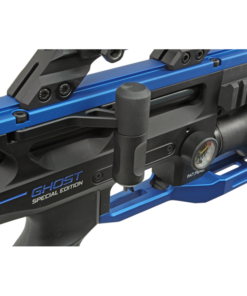
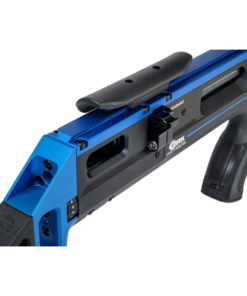
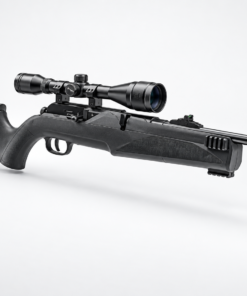
Crafted with a revolutionary monocoque alloy chassis, the Ghost Special Edition blends match-grade precision with all-purpose versatility. Its bold, exclusive finish ensures you stand out on the range or in the field. Loaded with premium upgrades, this Special Edition brings top and bottom Race ARCA and M-Lok rails, a matching BRK silencer, a Race Twin-Clamp optic rail, a precision performance cocking lever, and the innovative Gecko recoil pad for ultimate control.
Take it to the next level with the high-power version, featuring a state-of-the-art tensioned barrel system for pinpoint accuracy. With the micro-adjustable power setting wheel and Ultra Valve technology, you’re in complete control of your shot.
The Ghost SE’s modular platform and user-tuneable Huma-Air regulator let you customize your setup like never before. Fine-tune your performance with the advanced barrel tuning system for unmatched precision.
Every Ghost Special Edition comes packed in a custom-fitted hard case, loaded with a serious suite of extras that deliver incredible value. This is performance, style, and exclusivity – all in one package.
The BRK Ghost Special Edition – Crafted for shooters who aim to excel. Get yours today and experience airgun performance redefined.
BRK Ghost .177 HP Blue Special Edition Precision, Power, and Exclusivity in One Advanced PCP Air Rifle
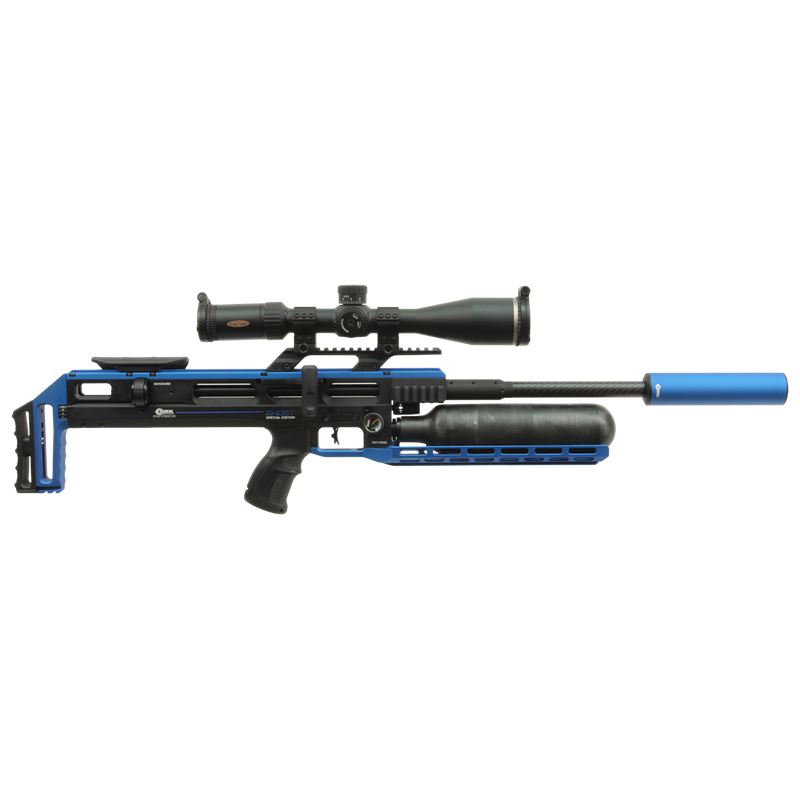
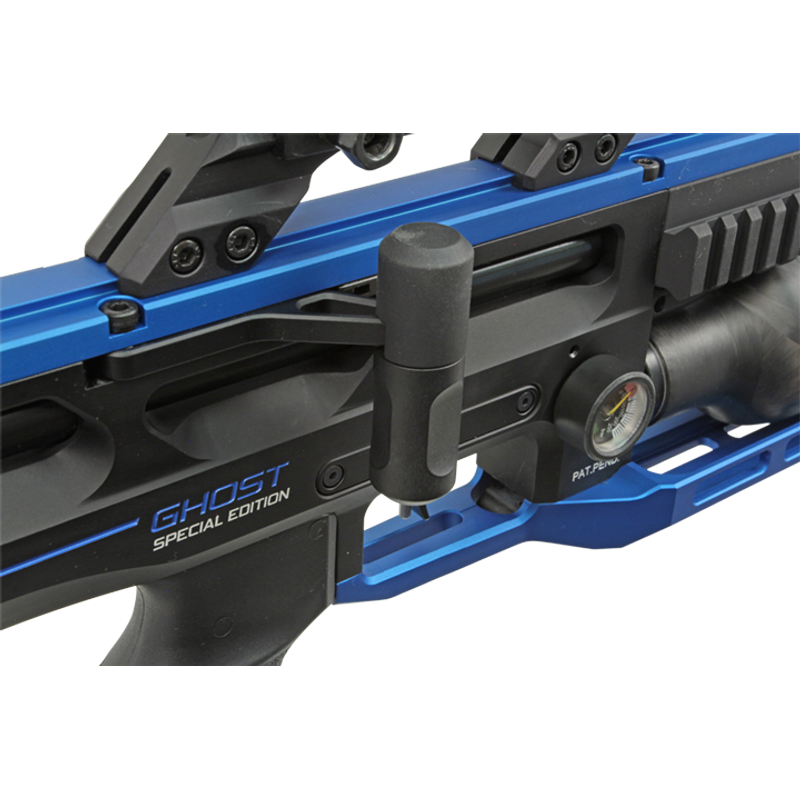
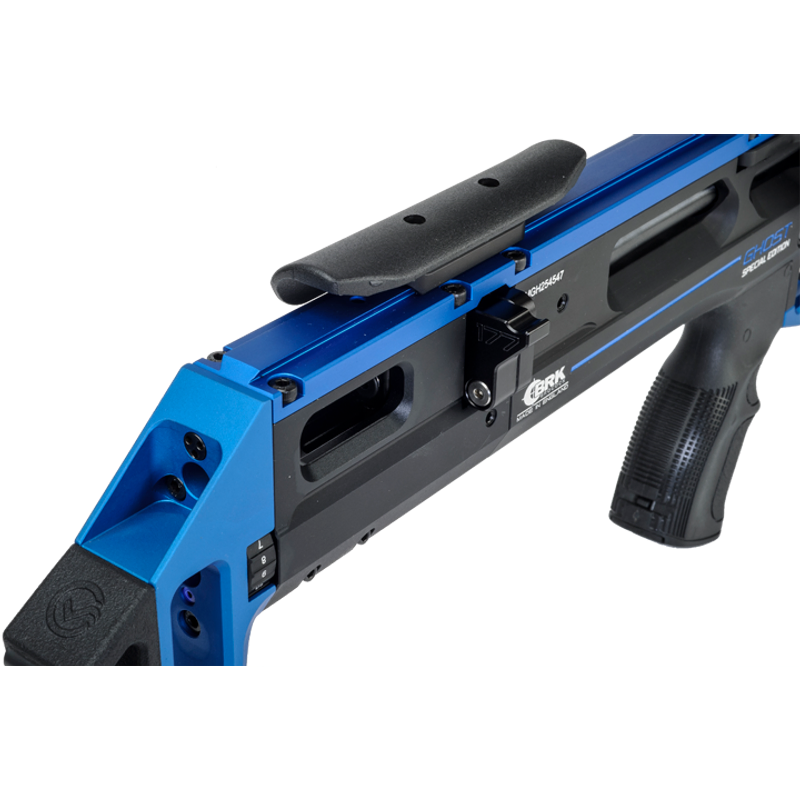
The BRK Ghost .177 HP Blue Special Edition has been created for shooters who expect exceptional accuracy, advanced adjustability, distinctive styling, and dependable high-power performance from one premium PCP platform. Every part of this exclusive air rifle has been designed to provide greater control over fit, balance, power delivery, accessory placement, and shooting comfort. Consequently, it can be adapted for precision target shooting, long-range practice, competitive use, and other lawful shooting applications.
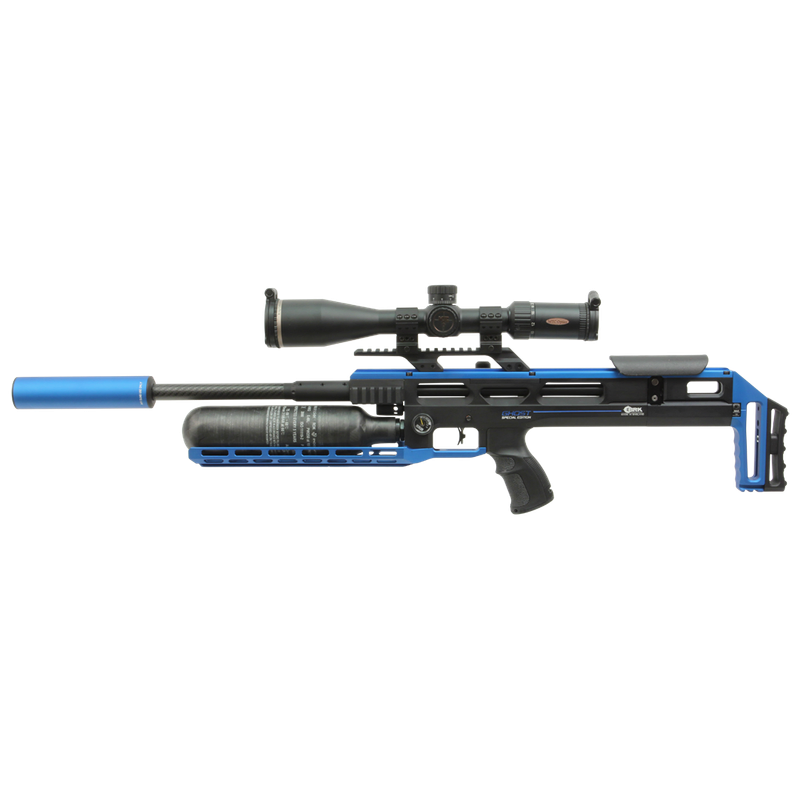
A striking electric-blue finish immediately separates this Special Edition from conventional tactical air rifles. However, far more than a visual upgrade has been provided. A compact monocoque alloy chassis has been combined with a tensioned 23-inch barrel, a regulated PCP action, a 480cc removable carbon-fibre bottle, a 20-position power wheel, and an advanced accessory-mounting system. Therefore, impressive performance is supported by a highly configurable and remarkably refined platform.
In its .177 high-power specification, energy of up to approximately 31 ft-lb is listed for the 23-inch model. A 13-shot self-indexing magazine is supplied, while up to approximately 100 shots may be produced on maximum power, depending on the tune, pellet, environmental conditions, fill pressure, and regulator settings. Because a Huma-Air regulator and BRK Ultra Valve system are incorporated, consistent air delivery can be maintained across the usable fill.
Moreover, the BRK Ghost .177 HP Blue Special Edition is supplied as a premium package. A color-matched BRK moderator, Race ARCA and M-LOK rails, a Race twin-clamp optics rail, a performance cocking lever, a Gecko recoil pad, and a custom-fitted hard case are included. As a result, meaningful upgrades are received rather than decorative changes alone.
Whether a stable bench platform, an adaptable competition rifle, or a compact high-power PCP is being sought, this Special Edition offers a persuasive combination of precision engineering and unmistakable identity.
Key Features of the BRK Ghost .177 HP Blue Special Edition
- Exclusive electric-blue Special Edition finish
- High-power .177-calibre PCP configuration
- Up to approximately 31 ft-lb with the listed 23-inch configuration
- 23-inch tensioned barrel system
- Compact monocoque alloy chassis
- 480cc removable carbon-fibre air bottle
- Maximum recommended fill pressure of 250 bar
- Approximately 100 shots on maximum power under suitable conditions
- 13-shot self-indexing .177 magazine
- Single-shot loading tray
- 20-position micro-adjustable power wheel
- User-adjustable Huma-Air regulator
- BRK Ultra Valve technology
- Race twin-clamp Picatinny optics rail
- Built-in rail inclination for increased scope adjustment
- Top and bottom Race ARCA and M-LOK rails
- Additional side-mounted Picatinny accessory rails
- Adjustable Gecko recoil pad
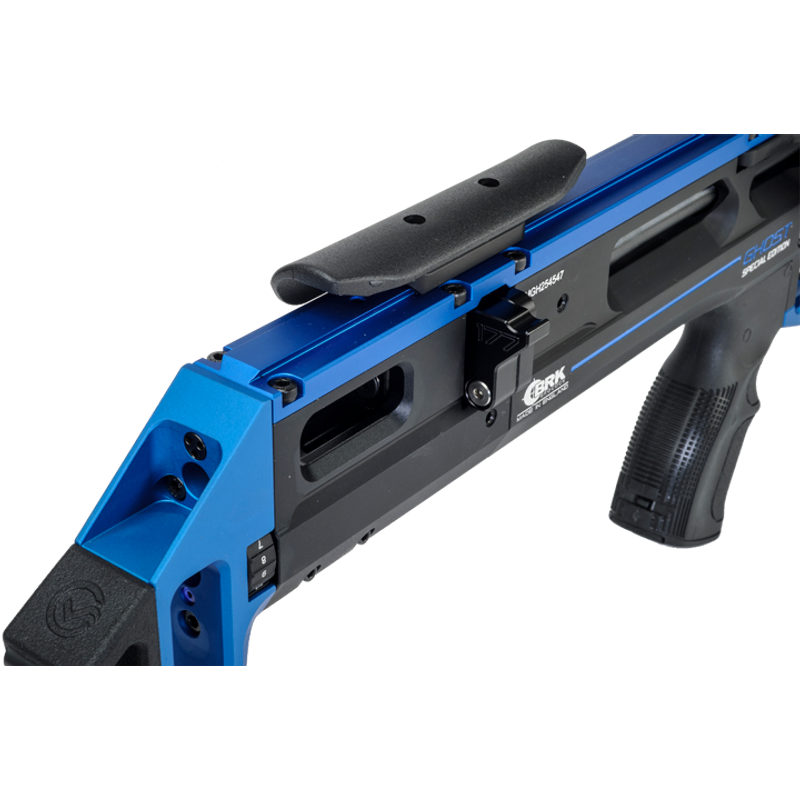
- Adjustable cheek support
- Reversible sidelever operation
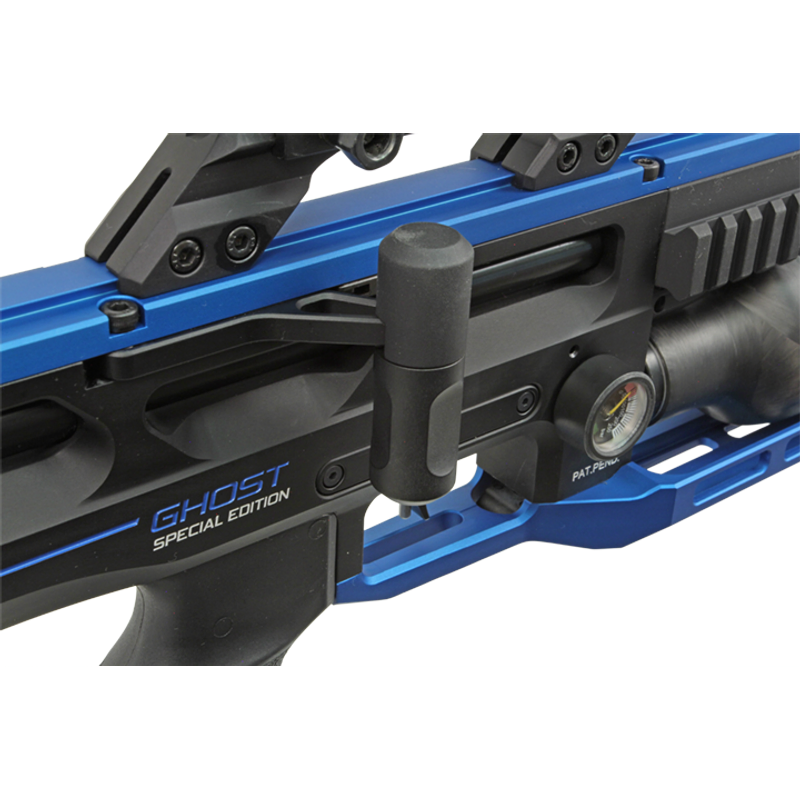
- Oversized performance cocking handle
- Fully adjustable two-stage trigger
- Adjustable match-style trigger blade
- Ambidextrous pistol grip
- Color-matched BRK moderator
- Custom-fitted foam-lined hard case
- Approximately 33.6 inches in overall length without the moderator
- Approximately 7.5 lb in overall weight
- Three-year manufacturer warranty where offered by the supplying dealer
Technical Specifications
| Specification | Details |
|---|---|
| Manufacturer | BRK, formerly Brocock |
| Model | Ghost HP Blue Special Edition |
| Action | Pre-charged pneumatic |
| Configuration | Bullpup |
| Calibre | .177 / 4.5mm |
| Barrel length | 23 inches |
| Barrel system | Tensioned and tunable |
| Maximum energy | Up to approximately 31 ft-lb in the listed 23-inch configuration |
| Magazine capacity | 13 pellets |
| Single-shot option | Included |
| Air capacity | 480cc |
| Air reservoir | Removable carbon-fibre bottle |
| Maximum fill pressure | 250 bar |
| Estimated shot count | Up to approximately 100 shots on maximum power |
| Regulation | User-adjustable Huma-Air regulator |
| Power adjustment | 20-position external power wheel |
| Valve system | BRK Ultra Valve |
| Optics mounting | Adjustable Race twin-clamp Picatinny rail |
| Accessory mounting | ARCA, M-LOK, and Picatinny |
| Trigger | Fully adjustable two-stage system |
| Trigger blade | Adjustable match-style blade |
| Cocking system | Reversible sidelever with performance handle |
| Safety | Manual cross-bolt safety |
| Grip | Ambidextrous, replaceable pistol grip |
| Recoil pad | Height-adjustable Gecko pad |
| Overall length | Approximately 33.6 inches without moderator |
| Weight | Approximately 7.5 lb |
| Moderator | Color-matched BRK moderator included |
| Storage | Custom-fitted hard case included |
| Scope | Not included unless specifically stated |
| Scope mounts | Not included unless specifically stated |
Specifications can vary by market, production configuration, tuning limits, and applicable local regulations. Therefore, the exact package and permitted output should always be confirmed before purchase.
An Exclusive Blue Finish With a Serious Purpose
Although the blue treatment is the most immediately recognizable characteristic, the BRK Ghost .177 HP Blue Special Edition has not been developed merely as a display piece. Instead, a premium visual identity has been applied to a performance-driven tactical platform.
The vivid finish creates a confident and modern appearance. Accordingly, it will be appreciated by collectors, club shooters, benchrest enthusiasts, and anyone who prefers equipment that looks as distinctive as it performs. The coordinated color treatment also extends to selected package components, including the BRK moderator. Therefore, the rifle appears complete and intentionally designed rather than assembled from unrelated parts.
Meanwhile, the underlying chassis remains focused on rigidity and repeatability. Because the action is supported by a monocoque alloy structure, unnecessary movement can be reduced. The barrel, optics rail, grip, cheek support, air system, and butt assembly are integrated around a solid central platform. Consequently, a dependable foundation is provided for repeatable scope alignment and consistent shooting.
The blue finish may attract attention first, but the engineering beneath it is what allows the Ghost Special Edition to satisfy demanding shooters.
Compact Monocoque Chassis Engineering
A compact monocoque alloy chassis is used as the structural foundation of the Ghost. Rather than being installed into a conventional sporting stock, the action is supported by a rigid metal body. As a result, strength can be increased without excessive overall bulk being introduced.
Because a bullpup layout is used, the action and magazine are positioned behind the trigger area. A 23-inch barrel can therefore be included while an overall length of approximately 33.6 inches is maintained. This arrangement offers a useful combination of barrel length and compact handling.
In tighter shooting positions, the reduced overall length can be particularly beneficial. Less front-end movement may be experienced when the rifle is repositioned, while balance can be kept closer to the shooter. Additionally, a long barrel does not have to be sacrificed to obtain a manageable platform.
The square tactical forend provides more than an aggressive appearance. A stable surface can be created when the rifle is used from a bench or supported rest. Furthermore, ARCA and M-LOK mounting points allow the support arrangement to be customized without makeshift adapters being relied upon.
As a result, the chassis can be configured around an individual shooting style. A bipod, bag rider, hand stop, tripod adapter, or other compatible support accessory may be positioned where it provides the best balance.
High-Power .177 Performance
The .177 calibre is often associated with flat trajectories, manageable projectile costs, and broad pellet availability. In the BRK Ghost .177 HP Blue Special Edition, those familiar advantages are supported by a substantially more powerful regulated PCP system.
For the listed 23-inch model, energy of up to approximately 31 ft-lb may be produced. However, actual output will be affected by the selected power setting, regulator tune, pellet weight, barrel condition, fill pressure, temperature, and local market specification. Therefore, chronograph testing should be completed whenever ammunition or tuning settings are changed.
The higher output can be especially useful when heavier .177 pellets are preferred. Instead of being limited to lightweight ammunition, the rifle can be tested with a wider selection of projectile weights. Consequently, the barrel’s preferred ammunition can be identified through careful grouping and velocity evaluation.
Because .177 pellets generally have smaller frontal areas than larger-calibre projectiles, wind and projectile selection must still be considered. Nevertheless, a well-matched pellet can provide a flat and predictable trajectory. This can be valuable for precision targets and long-range practice where accurate holdover information is required.
Power should always be matched to the intended use rather than simply being left at its maximum setting. In fact, one of the greatest advantages of the Ghost is that output can be adjusted. A lower setting may be selected for closer targets or extended shot count, while a higher setting can be chosen when extra velocity is appropriate and legally permitted.
Twenty-Position Power Adjustment
A 20-position external power wheel is incorporated into the Ghost platform. Therefore, different output levels can be selected without the rifle having to be disassembled for routine adjustments.
This broad range of adjustment allows performance to be matched more closely to the chosen pellet. For example, a lightweight target pellet may perform most consistently at a moderate setting, whereas a heavier pellet may benefit from additional energy. By testing several controlled settings over a chronograph and on paper, an efficient balance between velocity, accuracy, and air consumption can be established.
Moreover, the power wheel can be used to conserve air. Maximum output is not required for every shooting session. When targets are positioned at shorter distances, the setting can be reduced, provided that safe and consistent performance is maintained. Consequently, more shots may be obtained from a fill.
Every adjustment should be recorded carefully. The selected power-wheel position, regulator pressure, pellet type, pellet weight, average velocity, extreme spread, group size, and environmental conditions can all be entered into a shooting log. As a result, a successful tune can be reproduced more easily.
The rifle should be pointed in a safe direction and unloaded before any setting is changed. Additionally, local power restrictions must always be observed.
User-Adjustable Huma-Air Regulator
A Huma-Air regulator is installed to manage the pressure supplied from the 480cc bottle to the firing valve. Instead of progressively changing as the main reservoir pressure falls, the firing system is supplied with a more controlled working pressure. Consequently, improved shot-to-shot consistency can be achieved across the regulated portion of the fill.
A separate pressure gauge is provided for regulator monitoring, while another gauge is used for the main bottle. Therefore, both the remaining air supply and the regulator condition can be checked independently.
On the high-power Ghost, external regulator adjustment is provided. This allows the air supply to be tuned for different projectile weights and performance requirements. Nevertheless, regulator pressure should not be changed casually. It must be balanced with the power wheel, hammer system, valve behavior, and chosen ammunition.
If excessive regulator pressure is used with an unsuitable hammer setting, efficiency may be reduced rather than improved. Similarly, if the pressure is set too low, the desired velocity may not be reached consistently. For that reason, small, documented changes should be made, and each adjustment should be evaluated with a reliable chronograph.
When the system has been properly balanced, tight velocity spreads, efficient air usage, and predictable point of impact can be produced.
BRK Ultra Valve Technology
BRK Ultra Valve technology is used to regulate how compressed air is released during each shot. The goal is not simply to release the greatest possible volume of air. Instead, the appropriate amount must be delivered efficiently and repeatably.
Because the valve system, regulator, and power adjustment work together, performance can be tailored rather than being permanently fixed. Air can be conserved at moderate settings, while the higher-power capability can be accessed when needed.
Efficient valve behavior also contributes to a more refined shooting cycle. Although conventional firearm recoil is not produced by a PCP air rifle, internal movement and muzzle behavior can still affect the sight picture. A controlled firing pulse may therefore help the shooter remain settled through the shot.
Furthermore, an efficient valve supports useful shot count. The listed configuration can provide up to approximately 100 shots at maximum power under favorable conditions. However, the precise number will vary. Heavier projectiles, regulator pressure, ambient temperature, and individual tune will all influence consumption.
Tensioned 23-Inch Barrel System
A 23-inch tensioned barrel is fitted to this high-power model. The tensioning arrangement is intended to increase rigidity and support consistent barrel harmonics. Accordingly, the system has been developed for shooters who want to fine-tune their equipment rather than accept a fixed general-purpose configuration.
Barrel behavior can be affected by pellet weight, velocity, moderator installation, air delivery, and accessory pressure. Therefore, the tensioned system provides a more controlled foundation for precision work. When the regulator and power settings are matched correctly, a consistent harmonic pattern can be established.
The longer barrel also allows compressed air additional time to accelerate the pellet. Consequently, the desired energy may be produced more efficiently than it would be through an extremely short barrel. At the same time, the bullpup layout keeps the full rifle comparatively compact.
Accuracy should always be evaluated through structured testing. Several quality pellet types should be tried, and groups should be fired under consistent conditions. The best result will not necessarily be obtained with the lightest or fastest pellet. Instead, it will usually be achieved when the barrel, velocity, and projectile design work together.
Before the rifle is tuned, a stable baseline should be established. The barrel should be inspected, the fasteners should be checked, the optics should be mounted correctly, and the bottle should be filled to the recommended pressure. Only then should individual settings be compared.
Generous 480cc Carbon-Fibre Air Bottle
A removable 480cc carbon-fibre bottle is fitted beneath the barrel assembly. This large reservoir helps support the rifle’s high-power performance while maintaining reasonable weight.
Carbon-fibre construction offers a favorable strength-to-weight ratio. Therefore, substantial air capacity can be provided without the front of the rifle being burdened by an unnecessarily heavy steel cylinder. The bottle’s central position also helps the rifle remain balanced around the action.
The maximum fill pressure is listed at 250 bar. Only clean, dry, properly filtered compressed air should be used. Moreover, filling equipment must be rated for the required pressure and connected with the correct adapter.
The fill port is protected by a magnetic cover near the trigger-guard area. Consequently, dirt and debris can be kept away from the inlet during storage and transport. When filling has been completed, the connector should be depressurized before removal, and the cover should be replaced.
Fast filling should be avoided. Heat can be generated when compressed air is introduced too rapidly, and the displayed pressure may drop after cooling. Therefore, a slow, controlled fill is generally preferred.
The bottle and filling equipment should also be inspected according to manufacturer recommendations. Damaged or out-of-test pressure vessels must never be used.
Approximately 100 Shots on Maximum Power
An estimated shot count of up to approximately 100 shots on maximum power is listed for this .177 HP configuration. This is an impressive figure for a rifle capable of producing high output, although it should be understood as an approximate maximum rather than a guaranteed number in every setup.
Shot count can be affected by:
- Regulator pressure
- Power-wheel position
- Pellet weight
- Average velocity
- Starting and ending bottle pressure
- Valve balance
- Ambient temperature
- Maintenance condition
- Individual production tolerances
When lower output is selected, additional shots may be obtained. Conversely, an aggressive tune may consume more air per shot. Therefore, the most useful figure will be the number of consistent shots delivered within the desired velocity spread.
A full chronograph string can be recorded after the rifle has been configured. Once velocity begins to change beyond the preferred tolerance, the end of the useful regulated range will have been identified. This information can then be used to establish a practical refill point.
Thirteen-Shot Self-Indexing Magazine
A 13-shot magazine is supplied for the .177 configuration. The self-indexing design allows follow-up shots to be prepared quickly through the sidelever action. As a result, concentration can remain focused on the target and shooting position.
The magazine is loaded through a convenient gate-style system and has been designed to handle pellets carefully. Nevertheless, every pellet should be inspected before loading. Damaged skirts, deformed heads, or inconsistent dimensions may reduce accuracy or interfere with smooth operation.
Because the magazine is magnetically retained, insertion and removal can be completed efficiently. Compatible magazines may also be paired in a double arrangement on some Ghost setups, allowing a second loaded magazine to be positioned ready for use.
For precision competition or deliberate ammunition testing, the supplied single-shot loader can be used instead. Each pellet can then be handled and seated individually. This may be preferred when carefully selected pellets are being evaluated or when competition rules call for single loading.
The action must never be cycled repeatedly if uncertainty exists about whether a pellet has already been loaded. Doing so can result in more than one pellet being pushed into the barrel. Therefore, the rifle should be made safe and checked whenever loading status is unclear.
Smooth Reversible Sidelever Action
The performance cocking lever is fitted with an enlarged drop-down handle. Consequently, the action can be cycled with a controlled and natural movement without excessive disturbance to the shooting position.
A smooth sidelever can be particularly valuable during bench shooting. The supporting hand and shoulder position can remain comparatively stable while the next pellet is loaded. Additionally, less movement may be required than with a traditional rear bolt.
The sidelever can be moved to the opposite side of the rifle. Therefore, left-handed and right-handed shooters are not forced into one operating arrangement. This reversible design supports the inclusive, highly configurable character of the Ghost platform.
The lever should always be operated positively and completely. It should not be forced if unusual resistance is felt. Instead, the magazine, pellet, and breech area should be checked after the rifle has been made safe.
Fully Adjustable Match-Style Trigger
A fully adjustable two-stage trigger system is installed. The match-style blade can be altered for height, reach, and angle, allowing the point of contact to be positioned for different hand sizes and shooting styles.
The first stage can be used to take up movement before a distinct second-stage stop is reached. When correctly adjusted, a clean release can then be produced without unwanted creep. As a result, the shot may be released with less disturbance to the sight picture.
Trigger adjustment must be completed responsibly. An excessively light or incorrectly configured trigger can be unsafe. After any change, correct safety engagement, sear retention, and reliable operation should be confirmed with the rifle unloaded and pointed in a safe direction.
If the proper procedure is unfamiliar, adjustment should be completed by a qualified airgun technician. Safety should never be sacrificed in pursuit of a lighter release.
Race Twin-Clamp Optics Rail
A premium Race twin-clamp Picatinny rail is supplied for scope installation. Because two clamping points are used, a rigid connection to the chassis can be maintained. Moreover, the rail can be repositioned along the upper mounting track to accommodate different scopes and eye-relief requirements.
Built-in inclination, sometimes described as droop compensation, is incorporated into the rail. This feature preserves more of a scope’s internal elevation adjustment for longer-range zeroing. Consequently, the optic may be kept closer to the center of its adjustment range.
The rail is especially useful when a large precision optic is installed. However, the scope and mounts shown in promotional images are not necessarily included. Buyers should check the exact package contents before ordering.
Ring height should be selected carefully. The objective bell must clear the barrel and chassis, while comfortable alignment with the cheek support should still be possible. Once the optic has been installed, the rail position, cheek support, and Gecko pad can be adjusted together.
ARCA, M-LOK, and Picatinny Compatibility
A generous selection of standardized mounting interfaces is provided throughout the chassis. Top and bottom Race ARCA and M-LOK rails are included, while additional Picatinny points are positioned along the sides and butt section.
Accordingly, numerous shooting accessories can be mounted without the rifle being permanently modified. Depending on the intended setup, compatible accessories may include:
- Bipods
- Tripod adapters
- Benchrest supports
- Bag riders
- Hand stops
- Sling mounting points
- Compact rangefinders
- Approved illumination equipment
- Accessory weights
- Rail-mounted levels
Only necessary accessories should be added. Although the chassis offers extensive mounting space, excessive weight can reduce handling comfort and disturb balance. Therefore, each component should serve a clear purpose.
For bench shooting, an ARCA-mounted bipod or rest adapter can be positioned to obtain the desired balance. In contrast, a compact M-LOK bipod may be preferred when a lighter setup is required. Because the mounting position can be changed, the rifle can be adapted as the shooting discipline changes.
Adjustable Gecko Recoil Pad
The Gecko recoil pad is one of the most valuable Special Edition additions. Although heavy recoil is not generated, the pad provides a stable and comfortable contact point at the shoulder.
Vertical adjustment allows the butt position to be matched to the shooter’s body and chosen support position. Consequently, the scope can be aligned more naturally without the head being tilted or the shoulder being raised unnecessarily.
A lower position may suit an upright bench posture, whereas a higher position may be preferred for prone or supported shooting. The ideal setting will depend on body proportions, scope height, cheek-support position, and clothing thickness.
Once a comfortable arrangement has been found, all fasteners should be tightened to the manufacturer’s recommended level. The setting can also be marked or recorded so it can be restored after transport.
Adjustable Cheek Support and Ambidextrous Grip
The cheek support can be moved along the chassis rail. Therefore, its position can be coordinated with the optics rail and recoil pad. This three-way adjustment provides a more complete approach to rifle fit.
Consistent cheek contact is essential for reliable scope alignment. If the head is placed differently for each shot, parallax error and inconsistent eye position may be introduced. By positioning the cheek support correctly, a repeatable reference point can be established.
An ambidextrous pistol grip is also supplied. Its textured surface supports secure hand placement without excessive pressure. Furthermore, the grip can be replaced with a compatible alternative if a different profile is preferred.
Together, these features allow the rifle to be fitted to a wide range of shooters. Comfort is not treated as a cosmetic extra; instead, it is used to support repeatability and control.
Color-Matched BRK Moderator
A matching BRK moderator is included with the Special Edition package. Its coordinated finish completes the rifle’s appearance, while muzzle report can be moderated where lawful.
The moderator adds length to the setup, so balance and storage requirements should be considered. Nevertheless, the bullpup configuration keeps overall dimensions manageable compared with a conventional rifle using a similar barrel length.
Before use, the moderator should be attached correctly and alignment should be checked. Pellet clipping can damage the moderator and severely affect accuracy. If an unexpected shift in point of impact or unusual sound is noticed, the rifle should be made safe and inspected.
Sound moderators are regulated differently across jurisdictions. Therefore, ownership and use must comply with all applicable laws.
Custom-Fitted Hard Case
A custom-fitted, foam-lined hard case is included. Consequently, the rifle and its principal accessories can be protected during lawful transport and storage.
Because the interior has been shaped for the Ghost Special Edition, movement inside the case can be reduced. The blue finish, optics rail, moderator, magazine, and other components can therefore be shielded from avoidable contact damage.
The rifle should always be unloaded before storage. Magazines should be removed, the safety should be applied, and local storage laws should be followed. A locked cabinet or safe may still be required even when a hard case is supplied.
Moisture should not be trapped inside the case for extended periods. After use in damp conditions, the rifle should be dried and inspected before being stored.
Why Choose the BRK Ghost .177 HP Blue Special Edition?
The BRK Ghost .177 HP Blue Special Edition offers more than high power or unusual coloring. Instead, a complete premium system has been assembled around adaptability, consistency, and precision.
Its principal advantages include:
- A compact bullpup layout with a full 23-inch barrel
- A regulated high-power .177 action
- External control over power and regulator settings
- A large yet lightweight carbon-fibre air reservoir
- A tensioned barrel system for advanced tuning
- Broad compatibility with modern shooting supports
- Adjustable fit for different users and positions
- Reversible controls for left- and right-handed operation
- Premium Special Edition accessories
- A distinctive finish with strong collector appeal
- A protective custom hard case
- A platform that can evolve with the shooter’s requirements
For enthusiasts who value a factory-configured premium package, considerable appeal is offered. Many accessories that might normally be purchased separately have already been included. Therefore, a cohesive and professionally matched setup can be created from the beginning.
Responsible Ownership and Legal Compliance
The BRK Ghost HP is a high-power air rifle and must be treated with the same care given to any serious shooting equipment. It should never be pointed at anything that is not intended to be shot, and a secure backstop must always be used.
Eye protection should be worn, while hearing protection may also be appropriate. Moreover, the rifle must be stored securely and kept away from unauthorized users and minors.
Power, calibre, moderator, licensing, transport, hunting, and ownership requirements differ between countries and regions. Consequently, buyers are responsible for confirming local regulations before ordering or using this product. Where licensing is required, the rifle must not be acquired or operated without the necessary authorization.
Order the BRK Ghost .177 HP Blue Special Edition From Elite Air Gun Shop
A rare combination of high-power performance, fine adjustment, modular construction, and exclusive presentation is delivered by the BRK Ghost .177 HP Blue Special Edition. Its 23-inch tensioned barrel, Huma-Air regulator, 20-position power wheel, Ultra Valve system, 480cc carbon bottle, and 13-shot magazine create an advanced foundation for precision shooting.
Meanwhile, the Race optics rail, ARCA and M-LOK forend, Gecko recoil pad, reversible sidelever, adjustable trigger, and movable cheek support allow the setup to be tailored to the individual user. Finally, the vivid blue finish, matching moderator, and fitted hard case complete a package that feels genuinely special.
Choose the BRK Ghost .177 HP Blue Special Edition when advanced performance, practical customization, and unmistakable style are required from one premium PCP air rifle.
Calibre, FAC Power, Performance, and Accessories
.177 Calibre Configuration
The BRK Ghost .177 HP Blue Special Edition is configured in .177 calibre, also known as 4.5mm. Although .177 is the smallest calibre offered for the Ghost platform, excellent velocity, a relatively flat trajectory, and precise target performance can be delivered. Therefore, this version is particularly appealing for long-range target practice, benchrest shooting, controlled pest management where legally permitted, and other precision-focused applications.
A 13-shot self-indexing magazine is provided with the .177 model. Consequently, a generous capacity is available before the magazine must be reloaded. A single-shot loading tray is also included, allowing pellets to be loaded individually during formal target competitions, accuracy testing, or careful pellet-selection sessions.
Different .177 pellets may produce noticeably different results. For that reason, several premium domed and heavier projectile designs should be tested. The best pellet should be selected according to accuracy, velocity consistency, energy retention, and reliable magazine operation rather than velocity alone.
Although this listing is specifically for the .177 model, the modular Ghost platform is also produced in .22, .25, and .30 calibres. Magazine capacities vary by calibre, with 13 shots provided in .177, 11 in .22, 10 in .25, and eight in .30. Calibre-conversion components should only be installed according to BRK instructions and applicable regulations.
FAC and High-Power Classification
The HP designation identifies this model as a high-power version. In markets such as the United Kingdom, its output places it above the usual 12 ft-lb limit for an unlicensed air rifle. Therefore, a valid Firearm Certificate would normally be required before this configuration could be possessed or used in the UK.
Regulations differ considerably between countries, states, provinces, and municipalities. An air rifle that may be purchased under one set of rules could require licensing, registration, secure delivery, or additional documentation somewhere else. Consequently, every buyer must verify the laws that apply to their location before placing an order.
The rifle should only be used on approved ranges or private property where lawful permission and a safe backstop have been provided. Furthermore, the selected power must remain within the limit authorized by the owner’s licence or local regulations. Adjustability does not remove the owner’s legal responsibility.
Adjustable High-Power Performance
With its 23-inch tensioned barrel, the listed .177 configuration can produce up to approximately 31 ft-lb under suitable conditions. Actual muzzle energy will depend on the pellet weight, regulator setting, power-wheel position, fill pressure, temperature, and individual rifle tune.
A 20-position external power wheel allows output to be adjusted for different shooting requirements. Maximum power can be selected when the greatest lawful performance is needed, while a moderate setting may be used for shorter distances, economical air consumption, or a pellet that groups more consistently at a lower velocity.
A user-adjustable Huma-Air regulator and BRK Ultra Valve system are incorporated. Together, these systems control the pressure and quantity of air used for each shot. As a result, stable velocity and efficient air consumption can be achieved when the rifle has been tuned correctly.
The 480cc removable carbon-fibre bottle provides substantial air capacity without adding excessive weight. A maximum fill pressure of 250 bar is specified, and up to approximately 100 shots may be produced on maximum power. However, this figure can vary with the tune and shooting conditions.
All adjustments should be verified with a chronograph. Moreover, only small, documented regulator changes should be made. If advanced tuning is unfamiliar, the work should be completed by a qualified BRK technician or experienced airgun professional.
Included Special Edition Accessories
A valuable collection of factory-selected accessories is supplied with the BRK Ghost .177 HP Blue Special Edition. These additions improve fit, support, customization, and protection while complementing the rifle’s exclusive blue appearance.
Included equipment and features generally comprise:
- A color-matched BRK moderator
- A 13-shot .177 magazine
- A single-shot loading tray
- A Race twin-clamp Picatinny optics rail
- Top and bottom Race ARCA and M-LOK rails
- Side-mounted Picatinny accessory points
- An oversized performance cocking lever
- A height-adjustable Gecko recoil pad
- An adjustable cheek support
- A removable 480cc carbon-fibre bottle
- A compatible filling connector
- A custom-fitted, foam-lined hard case
The Race optics rail can be moved to accommodate different eye-relief requirements. Built-in inclination also preserves additional scope elevation for longer-range adjustment. However, the riflescope and scope mounts shown in many promotional photographs are not included unless the selected package specifically states otherwise.
Recommended Optional Accessories
A suitable first-focal-plane or second-focal-plane scope can be installed according to the intended shooting distance. High-quality rings should be selected to match the Picatinny rail, scope tube diameter, and objective-lens clearance. A bubble level may also be added to help reduce cant during precision shooting.
For supported shooting, an ARCA-compatible bipod, M-LOK bipod, tripod adapter, or benchrest bag may be fitted. A rear bag or compatible bag rider can further improve stability. Nevertheless, unnecessary accessories should be avoided because excessive weight may disturb the rifle’s balance.
Additional magazines can be carried for convenient reloading, while a quality pellet case can protect carefully selected ammunition. A chronograph is strongly recommended for monitoring velocity and calculating muzzle energy after any adjustment.
Other useful accessories include a PCP compressor or certified charging cylinder, moisture-filtered fill equipment, protective eyewear, a secure gun safe, cleaning supplies, and manufacturer-approved lubricants. Only pressure-rated filling equipment should be used, and the bottle must never be filled beyond its stated limit.
With the correct accessories and a carefully developed tune, the BRK Ghost .177 HP Blue Special Edition can be adapted into a refined, stable, and highly personalized precision-shooting system.
Air Guns, Pellet Rifles, PCP Airguns, CO₂ Pistols, and Shooting Accessories
Choosing the right air gun requires more than selecting the model with the highest advertised velocity. Calibre, power source, intended use, build quality, available accessories, local regulations, and the shooter’s experience must all be considered. Whether equipment is being selected for recreational target shooting, competition, collecting, or lawful pest management, a carefully matched setup will usually provide better results than a model chosen solely because it appears powerful.
Some buyers search for an only air gun solution that can cover several activities. However, no single platform will be ideal for every shooter. A lightweight spring-powered rifle may be suitable for casual garden targets where legally permitted, while a regulated PCP rifle may be preferred for competition and longer-distance precision. Meanwhile, a CO₂ replica pistol may be selected for short-range practice or collecting.
Our range brings together different types of air guns, including PCP rifles, spring-piston models, gas-ram rifles, CO₂ pistols, CO₂ rifles, BB guns, and specialty air-powered platforms. Products should always be used responsibly, secured from unauthorized access, and operated only in locations where a safe backstop and legal permission have been established.
What Is an Airgun?
Customers frequently ask, what is an airgun? An airgun is a device that launches an approved projectile by using compressed air or another compressed gas instead of combustion from conventional firearm ammunition. Depending on its design, power may be supplied by a spring piston, gas ram, pre-charged pneumatic reservoir, CO₂ capsule, pump mechanism, or electronically controlled air system.
The phrase air guns meaning is commonly entered by new shooters who want to understand this broad category. In simple terms, air guns include rifles and pistols that use stored or mechanically compressed gas to propel pellets, BBs, or another manufacturer-approved projectile.
An air powered gun may look similar to a conventional firearm, especially when a replica design is used, but its internal operating system is different. Nevertheless, it must never be treated as a toy. Serious injury and property damage can be caused, particularly by high-powered PCP rifles.
The misspelling airgu is also used in online searches, yet it generally refers to the same airgun category. Similarly, pillet gun is normally intended to mean pellet gun. Clear terminology helps shoppers find the correct ammunition, maintenance products, magazines, filling equipment, and replacement parts.
Understanding the Main Types of Air Rifles
The principal types of air rifles are spring-piston, gas-ram, CO₂, multi-pump pneumatic, single-stroke pneumatic, and PCP. Each system provides a different combination of convenience, recoil behavior, power, consistency, cost, and maintenance requirements.
A spring-piston model stores energy in a coiled spring. When the trigger is released, a piston is driven forward and air is compressed behind the pellet. These rifles are self-contained and do not require a separate charging cylinder or compressor.
A gas ram uses a sealed gas strut instead of a conventional metal spring. A smoother firing cycle, reduced vibration, and consistent performance may be provided, although the exact experience depends on the rifle and its tune.
CO₂ models are powered by disposable or refillable carbon-dioxide cartridges. CO2 pellet rifles are often appreciated for easy operation and fast follow-up shots. However, CO₂ pressure is affected by temperature, so performance can change in very cold or very hot conditions.
The phrase cold air guns may refer to airguns being used in low-temperature conditions. Spring and PCP systems can be affected by temperature, lubricants, seals, and air density, while CO₂ equipment is particularly sensitive because cartridge pressure falls as temperature decreases.
PCP rifles use air stored at high pressure inside a cylinder or bottle. When pcp rifle meaning is searched, it refers to “pre-charged pneumatic rifle.” These models are filled before shooting and can deliver several consistent shots from one charge. Regulated PCP systems are especially popular for precision shooting because controlled pressure can be supplied to the firing valve.
What Is a Break-Barrel Pellet Gun?
The question what is a break barrel pellet gun is often asked by first-time buyers. A break-barrel rifle is normally a spring-piston or gas-ram airgun that is cocked by pivoting the barrel downward. This movement compresses the spring or gas strut and exposes the breech so a pellet can be inserted.
Once loaded, the barrel is returned to its locked position. The rifle is then prepared for a shot, subject to its safety mechanism. Because no external air tank or CO₂ capsule is usually required, break-barrel rifles are widely chosen as straightforward, self-contained platforms.
Different types of pellet guns are available, and break-barrel designs represent only one category. Fixed-barrel underlever rifles, sidelever rifles, CO₂ pellet guns, pneumatic pistols, and PCP rifles are also included. Selecting the right system depends on intended distance, desired accuracy, physical cocking effort, firing cycle, and budget.
The phrase type of air gun should therefore be considered alongside calibre and power. A beginner may value simplicity, whereas an experienced target shooter may prioritize regulation, an adjustable stock, a refined trigger, and advanced optics mounting.
BBs, Pellets, and Compatible Ammunition
Correct ammunition must always be matched to the manufacturer’s specifications. Metal bb pellets is a phrase sometimes used to describe both BBs and pellets, but the two projectile types are not identical. A BB is usually spherical, whereas an airgun pellet normally has a shaped head and hollow skirt.
A typical 4.5 mm bb is often made from steel and may be zinc- or copper-coated. Steel BBs should only be fired through a model specifically designed for them. They can ricochet from hard surfaces, so a suitable BB trap and eye protection are essential.
The expression bb metal bullet is technically inaccurate because a BB is not the same as a conventional firearm bullet. Likewise, the term metal pellet covers several airgun projectile designs but does not guarantee compatibility with a particular barrel.
A rifled pellet gun should generally be used with the calibre and projectile type specified by its manufacturer. A metal pellet gun may refer to an airgun with metal construction or one that fires metal pellets. Product details should be checked carefully so these two meanings are not confused.
A secure pellet tin protects ammunition from dirt and deformation. Pellets with damaged skirts should not be loaded because accuracy and cycling can be affected. During precision testing, several high-quality pellet weights may be evaluated to identify the option preferred by the barrel.
The phrase darts for bb gun should be approached cautiously. Darts must not be used unless the specific model has been expressly designed and approved for them. Likewise, a dart pellet gun requires compatible ammunition and a suitable target system. Improvised projectiles can damage the barrel and create dangerous, unpredictable behavior.
CO₂ Pistols and Replica Revolvers
A common beginner question is, what is air pistol equipment and how does it differ from an air rifle? An air pistol has a shorter barrel and compact handgun-style form. It may be powered by CO₂, PCP air, a spring piston, or a pneumatic pump.
A revolver air gun pellet co2 model uses a carbon-dioxide capsule and a rotating cylinder or removable rotary magazine. The related phrase air gun pellet co2 revolver describes the same general product category. These designs are often selected for recreational target shooting and replica collecting.
Classic models such as the Webley revolver, Webley MKVI, and other Webley guns are recognized for their traditional appearance. Modern CO₂ replicas may reproduce the controls, proportions, and handling characteristics of historic designs while using airgun ammunition.
The Smith and Wesson CO2 pistol category also includes several replica-style options. Meanwhile, the Walther CP88 Competition is commonly associated with a longer barrel assembly and target-oriented CO₂ configuration. Models such as the SA 10 pistol, Umarex RP5 C02 pellet gun, and products within the Umarex – Legends range are searched by customers interested in recreational and replica airguns.
A CO2 pistol replica must still be treated as a real airgun. Because it may be visually difficult to distinguish from a firearm, it should never be displayed in public or carried carelessly. Secure storage, responsible transport, and local legal compliance are essential.
Electrically Assisted Airguns
The term air gun electric generally refers to an airgun that uses electronic components for firing control, valve management, magazine operation, or another function. Electricity does not necessarily propel the projectile directly. Instead, a battery may control the mechanism that releases compressed air.
Electronically managed PCP rifles can provide advanced tuning and consistent valve operation. However, batteries must be charged, electronics must be protected from moisture, and manufacturer-approved procedures should be followed. Traditional mechanical platforms may be preferred by users who prioritize simplicity, while electronic systems may appeal to shooters who want extensive configuration options.
PCP Rifles From Established Brands
PCP rifles are offered by several respected manufacturers. Air Arms produces sporting and target-oriented air rifles with a strong reputation among enthusiasts. Searches for BSA guns England often relate to the long history of British airgun manufacturing, including classic and contemporary BSA designs.
The BSA Meteor stock is frequently sought as a replacement or restoration component for older rifles. Stock compatibility should be checked against the exact action series and production version because dimensions may vary.
Models such as the RM8 represent bottle-fed PCP configurations associated with substantial air capacity and multi-shot convenience. Meanwhile, the Crosman 2250 is widely recognized as a customizable CO₂ platform, and the Crosman Shockwave .22 is associated with a break-barrel gas-piston configuration.
Searches for Rexymaxx may be intended to locate Reximex products or a particular model whose spelling has been entered incorrectly. Because similarly named models can have different magazines, fill probes, power limits, and replacement parts, the exact manufacturer name should be verified before accessories are ordered.
The phrase cheapest pcp airgun attracts shoppers working within a limited budget. However, the rifle price is only part of the total cost. A suitable pump, compressor or charging cylinder, fill adapter, pellets, secure case, scope, mounts, and maintenance supplies may also be required. Therefore, overall setup value should be compared instead of the rifle price alone.
FX Airguns and Modern Precision Platforms
The FX DRS uses a conventional rifle-like profile while incorporating modern PCP technology. Its air reservoir is arranged around the barrel, contributing to a clean and familiar appearance. Different configurations may be offered, so the specific barrel length, calibre, magazine, power level, and stock should be confirmed.
Customers searching FX airguns Sverige are usually interested in the Swedish origin of FX Airguns. The company is known for adjustable PCP platforms, modular barrel systems, regulated air delivery, and models designed for precise tuning.
The FX Impact M3 is a modular bullpup platform that has been offered in several calibres and barrel lengths. Because numerous editions and upgrade components exist, parts should be matched by model generation and specification.
Searches for FX Leopard .22 PCP specs should be checked against the exact Compact or Sniper version. Barrel length, reservoir capacity, dimensions, weight, energy, and included equipment may differ. Buyers should rely on the specification provided for the selected variant rather than combining figures from different models.
A suitable mil dot scope can complement a precision PCP rifle. The reticle provides reference points that may be used for holdover, wind compensation, and range-related corrections after proper calibration. The shorter term mil dot refers to the same reticle concept, although the exact spacing may be based on milliradians and should be confirmed through the optic’s manual.
AEA High-Power Airgun Platforms
The AEA airgun range includes several PCP platforms in conventional, bullpup, semi-automatic, lever-action, and large-calibre configurations. Availability and permitted power vary by market, so every model must be checked against local law.
The AEA Challenger has been produced in different configurations and calibres. Meanwhile, AEA 22 may refer broadly to an AEA rifle chambered in .22 calibre rather than one specific model. The AEA Element Max is also searched by buyers interested in compact high-powered PCP equipment.
Large-calibre searches include the AEA 50 caliber, AEA Megalodon 45 cal, and AEA Megalodon 50 caliber. These models require appropriate high-pressure filling equipment, secure storage, suitable ranges, and strict attention to the manufacturer’s ammunition recommendations.
The AEA Harpoon 12 gauge and the shortened search phrase AA Harpoon are commonly used for the Harpoon platform, but product naming and calibre terminology should be verified before ordering. Similarly, the AEA Zeus 95 cal and .72 cal air rifle categories represent extremely powerful specialty PCP platforms rather than ordinary recreational pellet rifles.
These products are not beginner equipment. Substantial energy can be produced, and a casual garden target area is not suitable. Use should be limited to lawful, controlled locations with an engineered backstop capable of handling the specific projectile and energy level.
Understanding Power, FPE, and Energy Calculations
Airgun power is commonly expressed in foot-pounds of energy or joules. An FPE calculator estimates muzzle energy by combining projectile weight with measured velocity. The velocity should be recorded with a chronograph, while the projectile’s actual weight should be entered accurately.
A Pyramyd Air calculator or similar ballistic calculator may be used to estimate energy, trajectory, and related values. Nevertheless, calculated figures remain estimates and should not replace controlled testing.
Searches for .45 ACP muzzle energy joules refer to conventional firearm ammunition rather than an airgun calibre. These values should not be applied to a .45-calibre PCP simply because the nominal projectile diameter appears similar. Projectile weight, velocity, operating pressure, and intended ammunition differ considerably.
The question can air rifles kill reflects the fact that airguns can produce dangerous or lethal energy. Therefore, every model must be handled with the same disciplined safety habits expected around other projectile-launching equipment. A loaded airgun should never be pointed at anything that is not an authorized target.
Lawful and Humane Pest Management
Search phrases such as rat gun, rat killing gun, air rifle for rats, and shoot rats with air rifle are used by people considering pest management. However, legality, humane treatment, safe placement, calibre, power, and the surrounding environment must all be evaluated before any action is taken.
Questions including will a BB gun kill a rat and will a pellet gun kill a rat should not be answered through guesswork. Low-powered equipment may wound an animal without producing a humane result, while excessive power may penetrate the intended backstop and endanger people, pets, buildings, or neighboring property.
The repeated phrase shooting a rat describes an activity that may be regulated by animal-welfare, hunting, pest-control, and airgun laws. Professional pest-control assistance may be the safest and most humane option, particularly inside buildings or populated areas.
The term rat shooting should never be interpreted as permission to fire wherever a pest is seen. A lawful shooting position, positive target identification, an effective backstop, appropriate equipment, and a clear zone beyond the target are all necessary.
Queries such as rat with a gun may also refer to illustrations, memes, or fictional material rather than pest control. Products should never be marketed through content that encourages reckless handling or cruelty.
Slingshots, Catapults, and Wrist Rockets
A wrist rocket is a type of slingshot fitted with a wrist brace. The brace can provide support during use, but the device remains capable of causing serious injury.
When someone asks for another name for slingshot, the answer may include catapult, hand catapult, wrist rocket, or sling, depending on regional usage and the exact design. Likewise, a synonym for slingshot is often “catapult” in British English.
The comparison catapult vs slingshot depends strongly on location. In the United States, “slingshot” usually describes the handheld Y-shaped device, while “catapult” may suggest a large siege machine. In the United Kingdom and some other regions, a handheld slingshot is commonly called a catapult.
The question what’s the difference between a slingshot and a catapult can therefore be answered linguistically as well as mechanically. Context should be checked before equipment is selected.
The misspelled search are slingsgots illegsl is generally asking whether slingshots are legal. Laws differ by location, age, possession, public carrying, hunting use, and projectile type. Local regulations must therefore be checked before purchase or use.
Products such as a Mossy Oak bow belong to a separate archery category and should not be confused with slingshots or airguns. Every projectile system requires its own safe target, backstop, storage, and operating technique.
Threads, Moderators, and 1/2 UNF Compatibility
The term 1/2 UNF identifies a common thread specification used on some airgun muzzle accessories. It usually refers to a half-inch Unified National Fine thread, often with 20 threads per inch in common airgun applications.
The alternative formatting 1 2 unf is frequently used in searches for the same thread standard. Nevertheless, thread diameter, pitch, direction, shoulder clearance, and barrel alignment should all be confirmed before an accessory is attached.
A moderator must never be forced onto an incompatible thread. Poor alignment can result in pellet clipping, damaged components, and unpredictable accuracy. Additionally, moderators may be legally controlled, even when intended for an airgun.
Cases, Maintenance, and Essential Accessories
A quality aluminium rifle case provides rigid protection during lawful transport. Internal foam can be shaped to support the rifle, scope, magazines, and approved accessories. However, a transport case may not satisfy local secure-storage requirements, so a compliant cabinet or safe may still be needed.
Correct air gun maintenance helps preserve reliability and accuracy. External metal surfaces can be wiped with a suitable cloth, stock screws can be inspected, and the barrel can be cleaned only when necessary using an airgun-safe method.
An approved airgun lubricant should be used sparingly and only where recommended. Petroleum-based oil must not be introduced into high-pressure air systems unless the manufacturer expressly approves it. Inappropriate lubricant can damage seals and may create a serious hazard.
A complete sniper set is usually a marketing term for a rifle package containing a scope, mounts, bipod, case, or targets. It does not guarantee professional-grade accuracy. Each included component should be evaluated separately, and the word “sniper” should not replace clear technical specifications.
Classic and Unusual Search Terms
The Winchester Model 55 name may refer to different historic products depending on context, including conventional firearms or airgun-related models. Buyers should confirm the manufacturer, calibre, serial information, and operating system before parts are selected.
Likewise, rifle M50 is too broad to identify one product reliably. Several manufacturers may use similar model numbers, and incompatible components can look nearly identical in photographs.
The phrase gun UK can relate to British airgun shops, regulations, products, or conventional firearms. Because UK rules distinguish between different power levels and equipment types, the exact category must be identified before purchasing or using any product.
The word luftgevær is used in Scandinavian languages for an air rifle. Local power limits, age restrictions, transportation rules, and hunting regulations may differ across Norway, Denmark, Sweden, and other jurisdictions.
The term just gun is similarly broad and should be refined by adding the manufacturer, model, calibre, power source, and intended lawful application. More specific searches produce more relevant and safer product results.
A CO2 cannon wedding usually refers to an event-effect device that releases a visible plume using compressed gas. It should not be confused with an airgun. Only event-rated equipment should be used, and venue approval, safe spacing, ventilation, and operator instructions must be observed.
Choosing the Right Airgun Setup
The best rifle or pistol will be the one that fits the shooter, intended distance, lawful use, available charging equipment, and budget. Before choosing, the following points should be considered:
- The correct calibre and approved projectile
- Local ownership and power restrictions
- Spring, gas-ram, CO₂, pump, or PCP operation
- Rifle weight and overall length
- Left- or right-handed compatibility
- Magazine capacity and spare-magazine availability
- Trigger and stock adjustment
- Scope-rail compatibility
- Filling pressure and charging equipment
- Replacement seals and service support
- Safe storage and transport requirements
- Manufacturer warranty coverage
Target shooting with air rifles can provide an enjoyable way to develop concentration, breathing control, trigger discipline, and consistent positioning. A paper target or rated resetting target should be placed in front of a dependable backstop, and everyone in the area should wear suitable eye protection.
| CALIBER | .177, .22, .25, .30 |
|---|---|
| Select an Option | Factory Warranty + 3 Years Warranty Booster (+250) – $250.00 Each, Factory Warranty(+0) – $0.00 Each |
Be the first to review “BRK Ghost .177 HP Blue Special Edition”
Related products
PCP Air Rifles
PCP Air Rifles
Air Rifles

PCP Rifles
PCP Air Rifles
Uncategorized
Reviews
There are no reviews yet.