
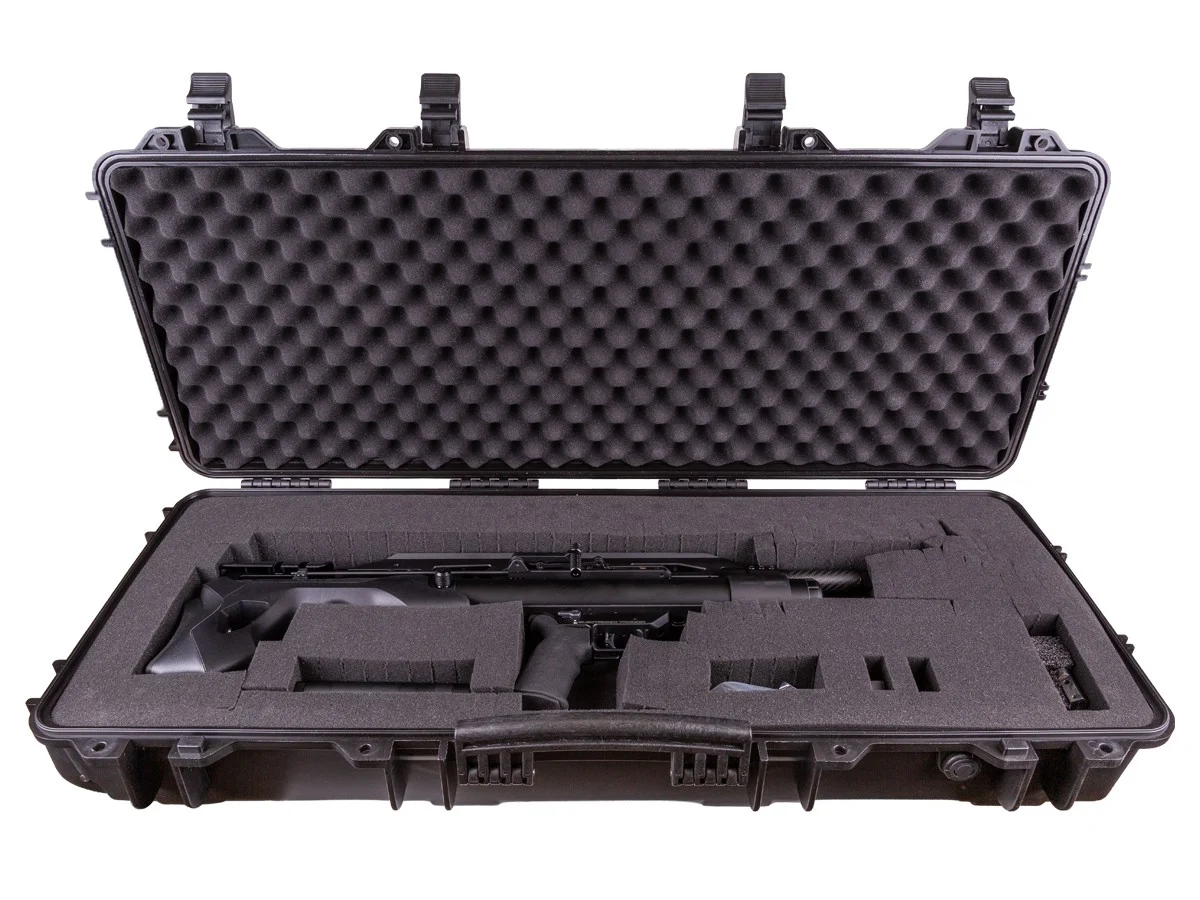

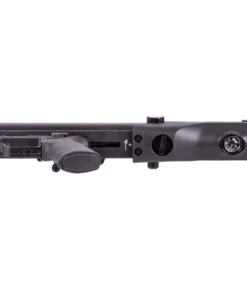
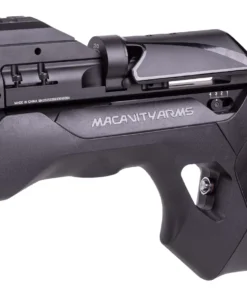
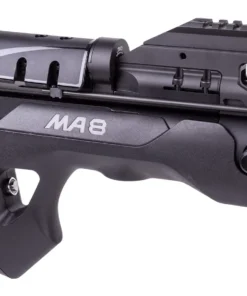
Macavity Arms MA8 PCP Air Rifle
Price range: $1,300.00 through $1,600.00
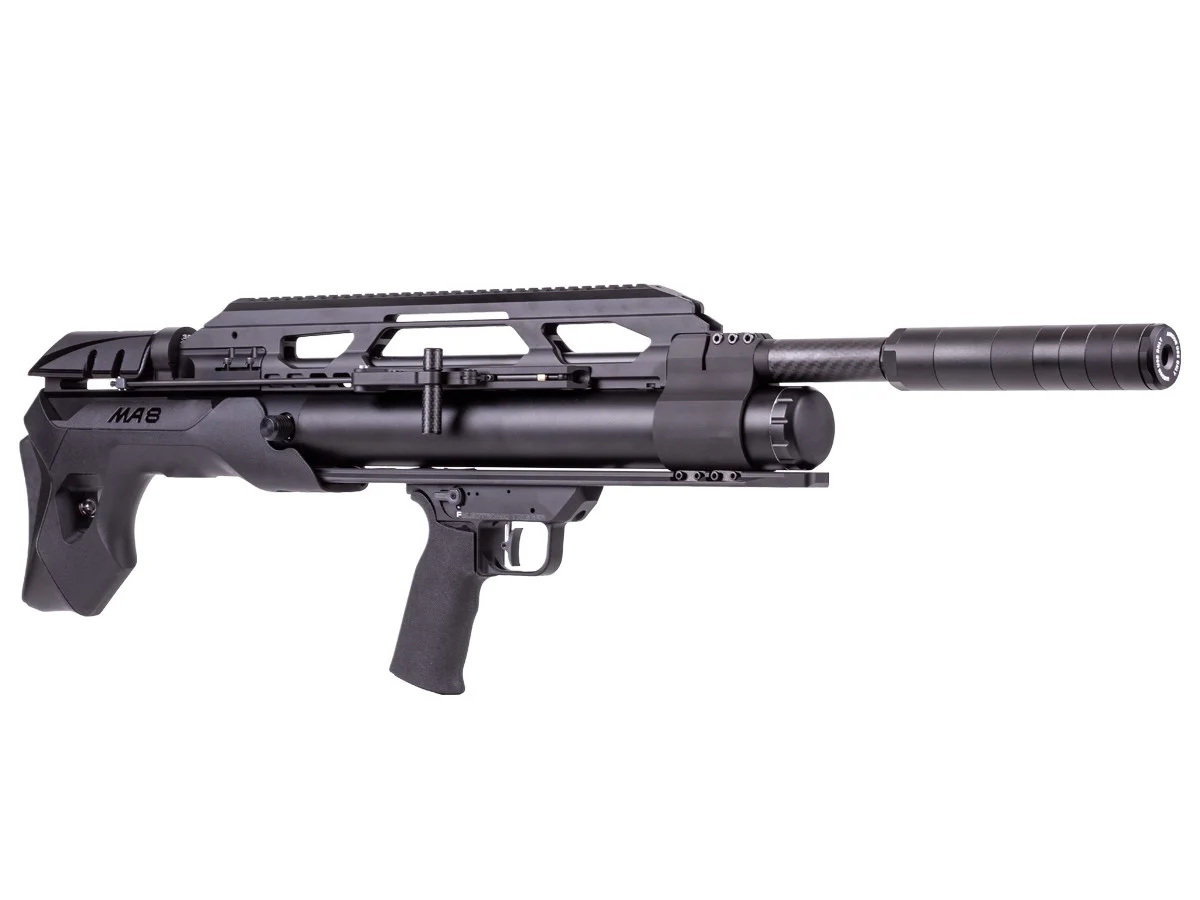
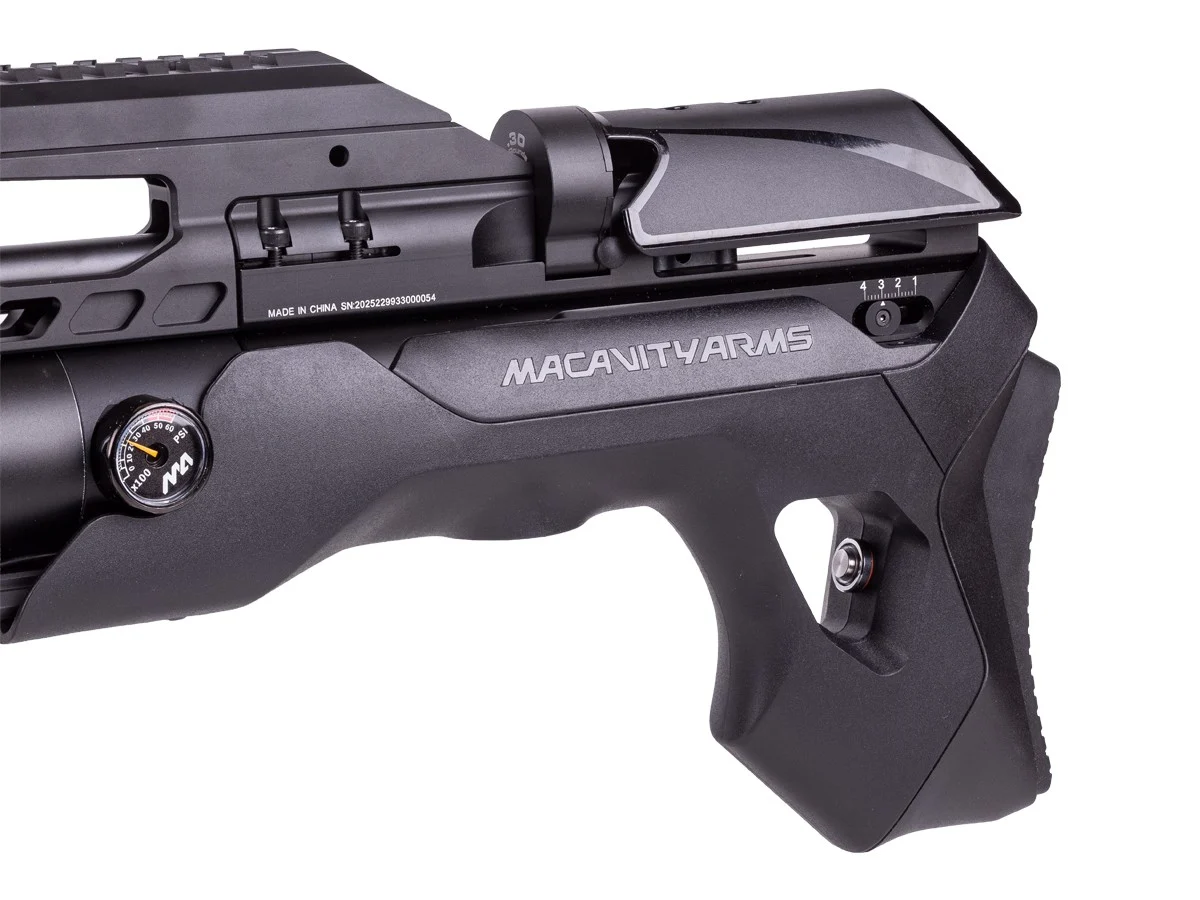
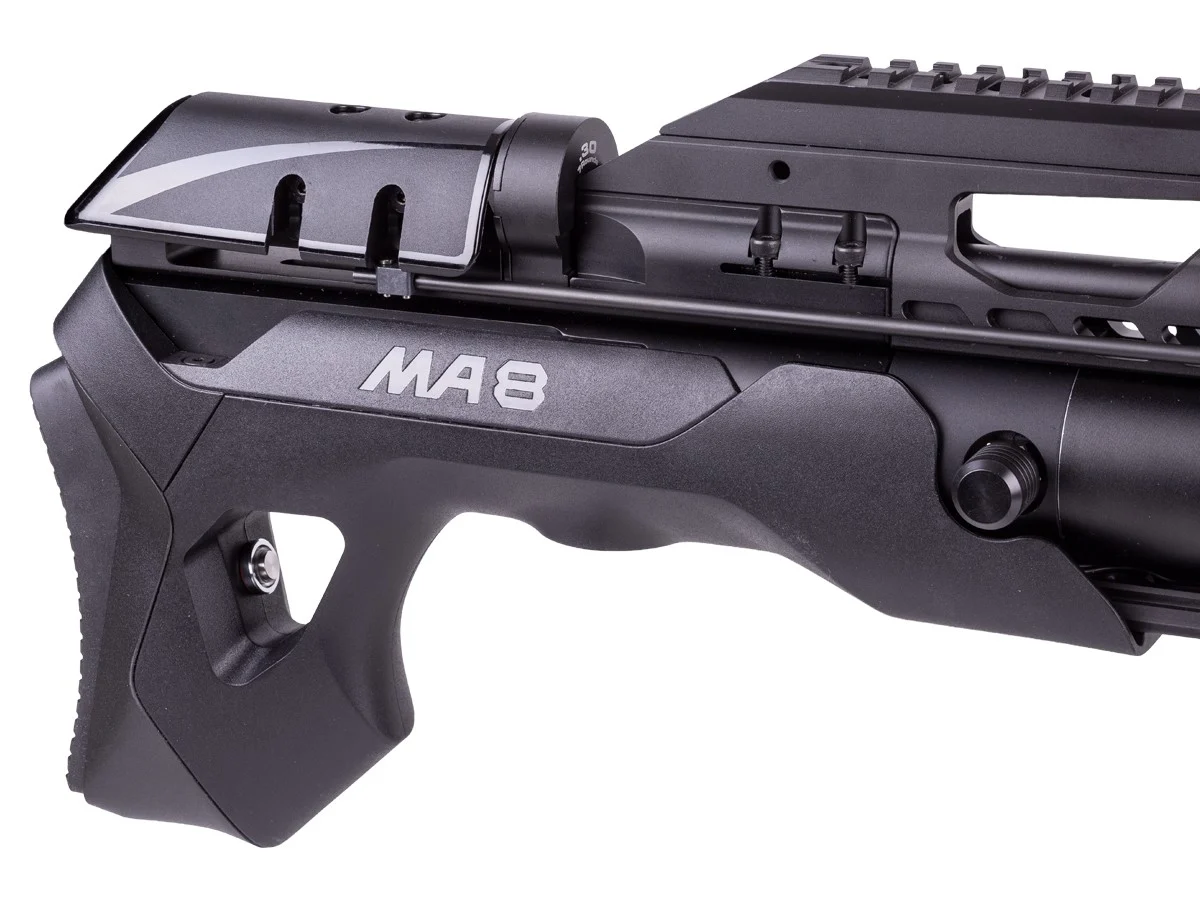
The Macavity Arms MA8 is a bullpup PCP air rifle engineered to deliver powerful and accurate shots for maximum benchrest performance. It has innovative adjustable features that result in a custom setup and repeatable and precise performance fine-tuning that leads to consistent shots.
Key Takeaways
- The Tru-Click externally-adjustable regulator allows precise pressure adjustments for performance fine-tuning, with 1 BAR (14.5 PSI) per click.
- The MSR barrel delivers accurate shots and is compatible with the FX barrel system.
- The two-stage electronic trigger offers a crisp and repeatable break, with consistent feel and pull weight in each caliber and power level.
- The adjustable hammer spring has an index that adds convenience to power level changes, and the Sling Shot hammer system increases stability and efficiency.
- The Multi-Attach bottom rail provides attachment points for M-LOK, Arca-Swiss, and Picatinny accessories, improving versatility and compatibility.
- The carbon fiber barrel shroud, included modular baffled moderator, and 1/2-20 UNF threaded muzzle offer quiet shots.
Precise Performance Tuning With the Tru-Click Regulator
The Macavity Arms MA8 PCP Air Rifle features an externally-adjustable Tru-Click regulator that can be set between 600 and 3200 PSI (41-220 BAR) in one-click increments, where each click changes the regulator pressure by 1 BAR (14.5 PSI).
In addition, the regulator can be adjusted in either direction without needing to degas the air rifle. This makes tuning simple, precise, and repeatable, with clicks that can be felt and heard.
The adjustable hammer spring has an index that makes it possible to see the adjustments to the hammer spring setting and to return to different settings, and the Sling Shot hammer system uses air efficiently by removing hammer bounce.
Smooth and Dependable Electronic Trigger
This air rifle has a two-stage electronic trigger that operates the same regardless of the power level or caliber of the setup. This offers a sharp and consistent break, with a pull weight and feel that is not affected by the tension of the hammer spring, leading to dependable accuracy.
Accurate MSR Barrel With FX Compatibility
The Macavity Arms MA8 PCP Air Rifle uses an MSR (Master Select Rifling) barrel to deliver accurate shots, and the barrel system is compatible with the FX barrel system, allowing for shooters to change to a barrel with well-known performance characteristics. In addition, the barrel has a carbon fiber shroud, a 1/2-20 UNF threaded muzzle, and comes with a modular baffled moderator, all of which leads to quieter shots.
Features and Benefits
| Feature | Benefit |
|---|---|
| MSR (Master Select Rifling) Barrel Compatible With FX Barrel System | Delivers accurate shots and can be switched with FX barrels for convenience and ease of tuning. |
| Externally-Adjustable Tru-Click Regulator | Enables precise and repeatable tuning, with clicks that can be heard and felt, where 1 click equals 1 BAR (14.5 PSI) of pressure, and the air rifle does not need to be degassed to increase or decrease pressure. |
| Electronic Trigger | Offers incredible consistency and a glass-like break, with smooth and repeatable performance that leads to accuracy regardless of the caliber or power level. |
| Position-Adjustable Grip | Allows for a customized setup because the grip can be positioned nearly anywhere on the Arca-Swiss bottom rail. |
| Carbon Fiber Barrel Shroud, Modular Baffled Moderator, and 1/2-20 UNF Threaded Muzzle | Reduces the sound of each shot and provides a way to adjust the balance of the air rifle. |
| Multi-Attach Bottom Rail | Provides the combined convenience of an Arca-Swiss rail, an M-LOK rail, and a Picatinny rail to increase accessory attachment options. |
Why Buy the Macavity Arms MA8 PCP Air Rifle at Elite airguns
Macavity Arms produces top-tier regulated PCP air rifles built for precision and reliability. They are committed to engineering air guns that perform exceptionally in competition, hunting, and pest control.
Their dedication to quality craftsmanship and advanced features ensures that every Macavity Arms air rifle meets the rigorous demands of discerning shooters, providing confidence with every shot.
Our expert staff is always ready to assist, and we boast a huge selection of outdoor gear, ammo, and accessories to meet every need. Buy the Macavity Arms MA8 PCP Air Rifle today from Elite Airguns.
Macavity Arms MA8 PCP Air Rifle
- Precharged pneumatic
- Sidelever cocking
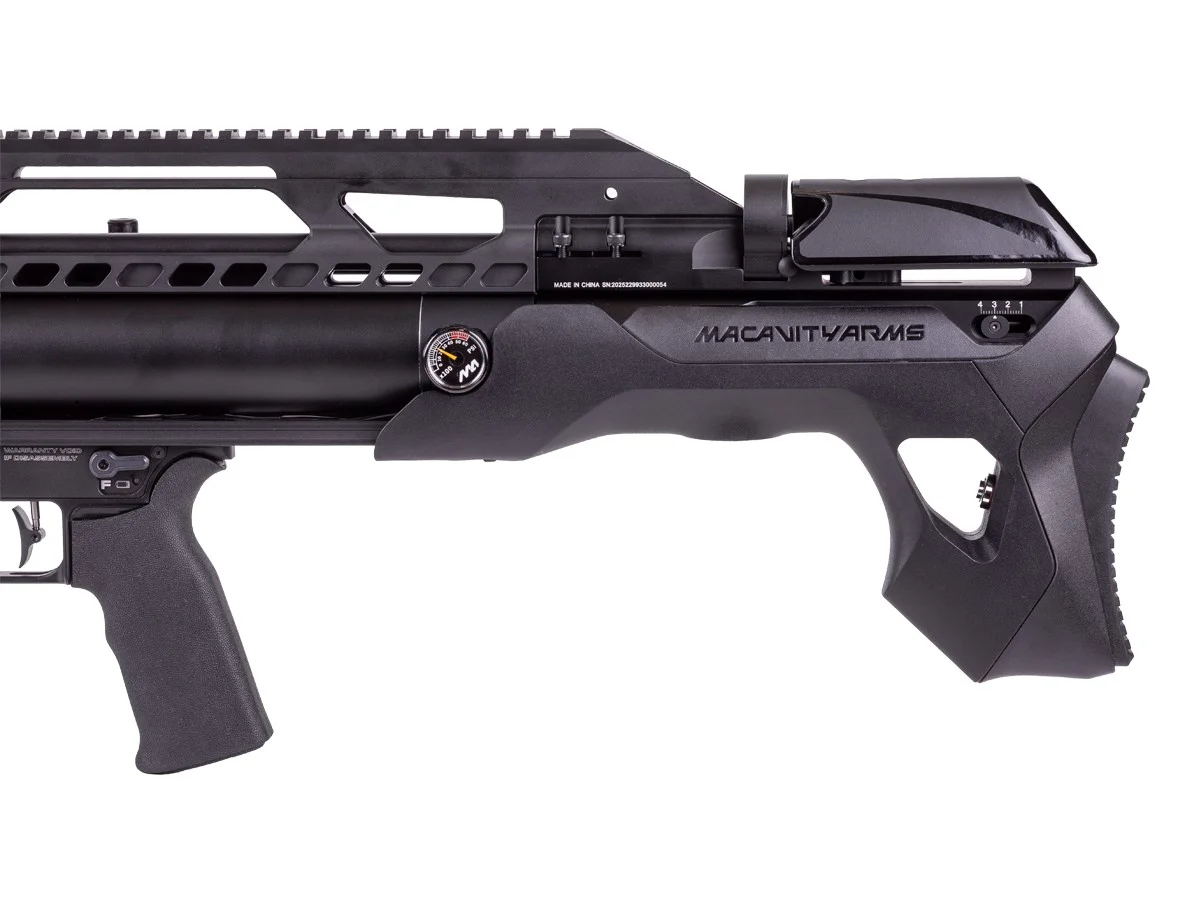
- Synthetic bullpup stock
- Tru-Click externally-adjustable regulator (600-3200 PSI/41-220 BAR), 1 BAR/14.5 PSI per click
- MSR (Master Select Rifling) barrel w/carbon fiber shroud
- Barrel system is compatible with FX barrels
- Single-valve system
- Sling Shot hammer system
- 1/2-20 UNF threaded muzzle
- Includes modular baffled moderator
- Adjustable hammer spring w/index
- 680cc air cylinder
- 4,350 PSI/300 BAR max. fill pressure
- Max. shots per fill: 70 (.30, 500mm), 46 (.30, 700mm)
- Max. energy: 206 FPE (.30)
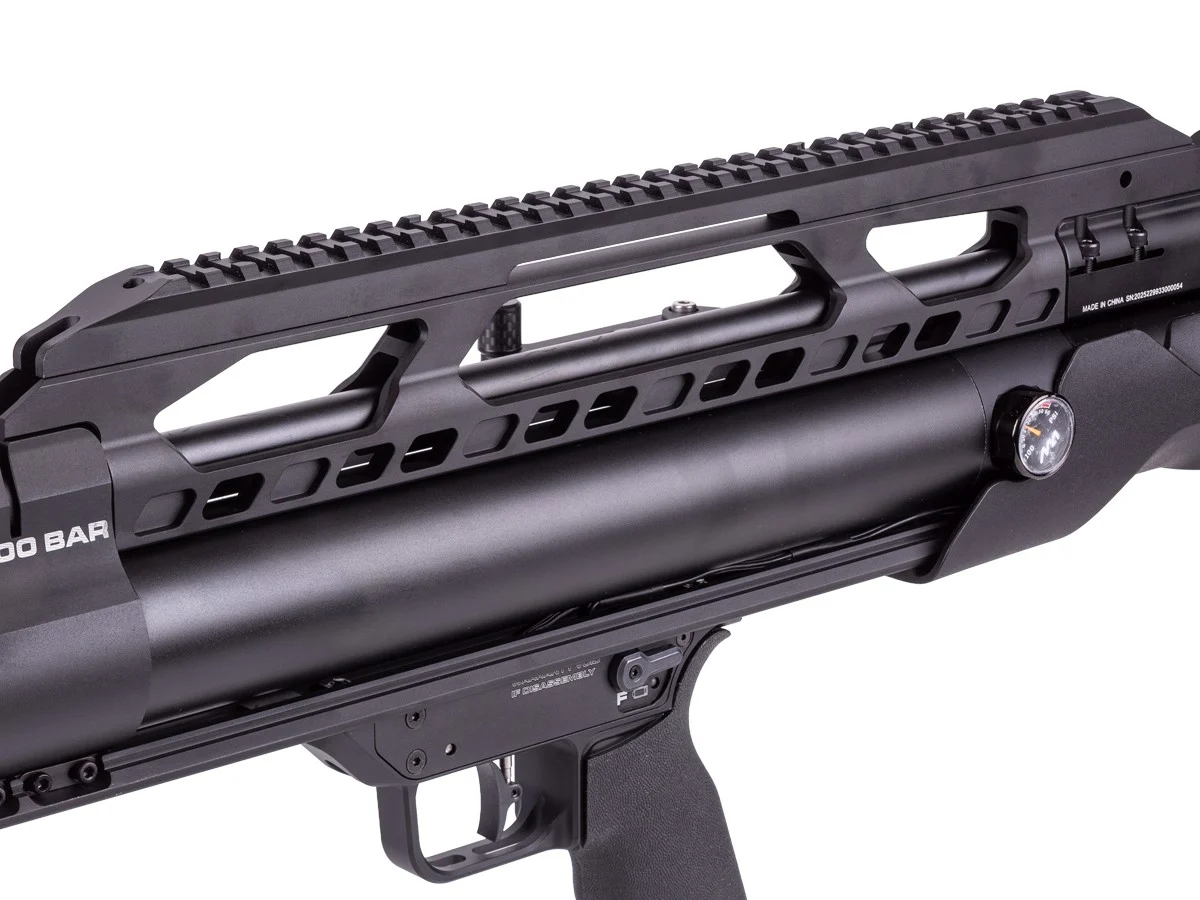
- 2-stage electronic trigger
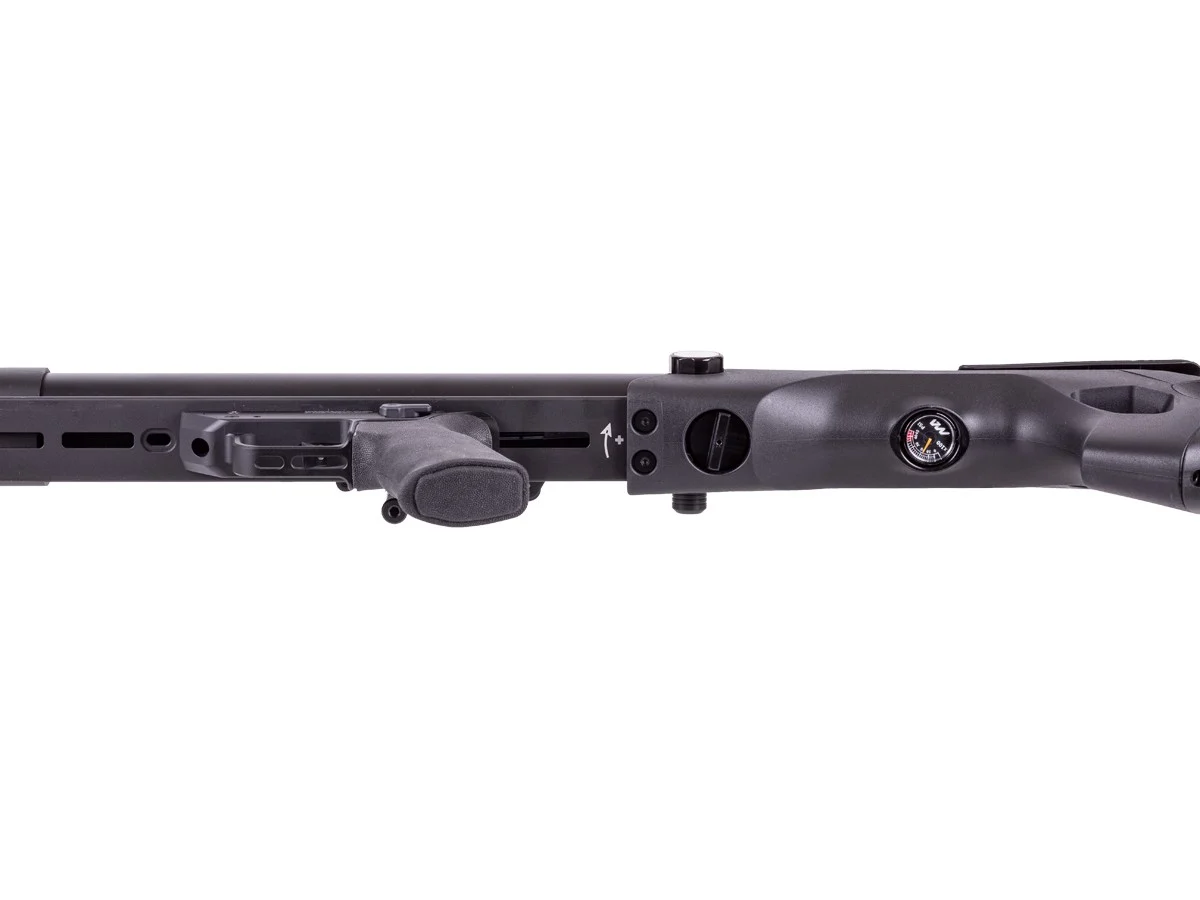
- Position-adjustable stippled grip slides forward and backward on Arca-Swiss rail
- Ridged rubber buttpad
- Height-adjustable cheek rest
- LiPo battery offers over 10,000 shots per charge
- Picatinny/Weaver optics rail w/adjustable angle
- Multi-Attach bottom rail: M-LOK, Arca-Swiss, and Picatinny
- Dual gauges for regulator and reservoir pressure
- Ambidextrous manual safety
- Male Foster quick-disconnect fill fitting
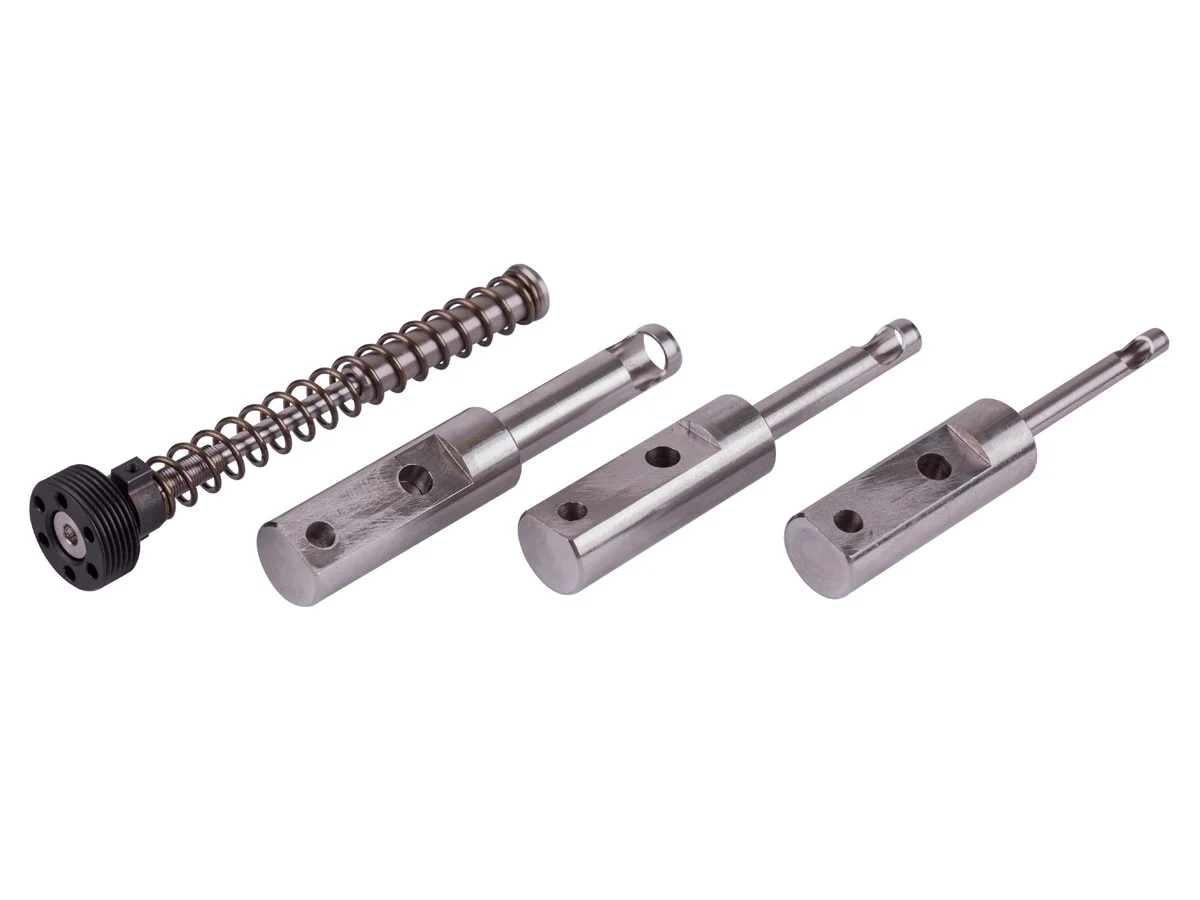
- Includes probes for all calibers (.177, .22, .25, .30, .35)
- Barrel length: 500mm, 700mm
- Overall length: 26.4″ (500mm), 35.6″ (700mm)
- Weight: 8.4 lbs. (500mm), 8.9 lbs. (700mm)
- 3-year limited warranty
Macavity Arms MA8 PCP Air Rifle – Advanced Precision for Benchrest and Long-Range Shooting


The Macavity Arms MA8 PCP Air Rifle has been engineered for shooters who demand exceptional consistency, extensive adjustability, and competition-focused performance. Every major component has been developed to support precision shooting, while a modular platform has been provided for easier customisation. Consequently, the MA8 can be configured around different ammunition, shooting distances, and individual preferences.
A modern electronic trigger has been combined with a proven mechanical firing system. Therefore, an exceptionally clean and predictable trigger break can be experienced without the dependable slingshot hammer mechanism being replaced. Furthermore, precise power adjustments can be made through the externally adjustable Tru-Click regulator and indexed hammer-spring system.
Whether the rifle is selected for benchrest competition, long-range target shooting, or advanced recreational use, a refined and highly adaptable shooting experience can be enjoyed.
Why Choose the Macavity Arms MA8 PCP Air Rifle?

Unlike conventional PCP rifles that may offer limited adjustment, the Macavity Arms MA8 PCP Air Rifle has been designed around user-controlled tuning. Regulator pressure, hammer-spring tension, trigger position, cheek-rest height, grip placement, and scope-rail angle can all be adjusted.
As a result, the rifle can be matched more closely to the shooter, chosen projectile, and intended distance. Moreover, the same platform can be adapted to several calibers by changing the compatible barrel and probe. A complete rifle replacement may therefore be avoided when a different configuration is required.
Most importantly, the MA8 has been built to support consistency. Reliable precision is influenced by far more than maximum power. Accordingly, pressure regulation, barrel quality, trigger control, optic alignment, stability, and ergonomics have all been addressed within the platform.
Highlighted Product Features
- Competition-oriented PCP platform developed for benchrest and long-range precision shooting
- Two-stage electronic trigger designed to deliver a clean and consistent release
- Tru-Click external regulator adjusted in positive one-bar increments
- MSR barrel system produced with FX-compatible barrel dimensions
- Single-valve system designed to support caliber changes from .177 to .35
- Adjustable hammer spring supplied with an index for repeatable settings
- Large 680cc air reservoir rated for a maximum fill pressure of 300 bar
- Dual pressure gauges fitted for reservoir and regulator monitoring
- Adjustable Picatinny/Weaver top rail provided for improved optic alignment
- ARCA-Swiss bottom rail combined with M-LOK and Picatinny mounting options
- Height-adjustable cheek rest included for improved head positioning
- Position-adjustable grip designed to be moved forward or backward
- Carbon-fibre barrel shroud paired with a modular baffled moderator
- Ambidextrous manual safety provided for right- and left-handed operation
- 500mm and 700mm barrel configurations offered to suit different preferences
- Three-year limited warranty provided by the manufacturer
Electronic Trigger Control
A two-stage electronic trigger has been installed to minimise the mechanical movement normally felt during trigger operation. Consequently, a crisp release can be maintained even when other rifle settings are changed.
Because the firing command is electronically controlled, variations caused by traditional mechanical trigger components can be reduced. Meanwhile, the actual firing cycle is still powered by a mechanical slingshot hammer system. Thus, electronic trigger consistency and mechanical firing reliability have been combined.
The internal battery has also been designed to support thousands of trigger operations from one charge. Nevertheless, the battery level should always be checked before a competition or extended shooting session.
Precise Tru-Click Regulator Adjustment
Fine pressure adjustment has been simplified through the externally accessible Tru-Click regulator. One bar of pressure change is represented by each positive click. Therefore, previous settings can be recorded and repeated more easily.
Instead of uncertain partial turns being estimated, controlled adjustments can be counted. This feature can be especially valuable when different pellet or slug weights are being tested. Furthermore, regulator pressure can be monitored through its dedicated gauge, while the remaining reservoir pressure is displayed separately.
Adjustments should always be completed according to the manufacturer’s instructions. Additionally, safe pressure limits must never be exceeded.
Interchangeable MSR Barrel Platform
An MSR, or Master Select Rifling, barrel system has been incorporated into the Macavity Arms MA8 PCP Air Rifle. Each barrel is intended to provide the consistency required for precision-focused shooting. Moreover, FX-compatible barrel dimensions have been used, allowing compatible aftermarket barrel options to be considered.
Through the MA8 single-valve system, calibers ranging from .177 to .35 can be supported when the correct barrel and probe are installed. Consequently, considerable flexibility has been built into one PCP platform.
However, every caliber conversion should be completed with compatible components and according to official guidance. After conversion, the rifle should be retuned and tested in a controlled environment before regular use is resumed.
High-Capacity Air System
A 680cc reservoir manufactured from 7075 aluminium has been fitted to provide substantial compressed-air capacity. A maximum fill pressure of 300 bar, or approximately 4,350 PSI, is supported. Therefore, extended shooting sessions can be accommodated, although the actual shot count will be affected by caliber, regulator pressure, barrel length, projectile weight, and power setting.
A male Foster quick-disconnect fitting has been included for convenient filling. Meanwhile, separate regulator and reservoir gauges have been positioned so that essential pressure information can be checked.
Only correctly rated filling equipment should be used. In addition, the reservoir should never be filled beyond its marked pressure limit.
Stable and Adjustable Shooting Position
Comfort and repeatability have been prioritised throughout the rifle’s design. For instance, the stippled grip can be repositioned along the lower rail. Similarly, the cheek rest can be raised or lowered until a more natural alignment with the optic has been achieved.
A ridged rubber buttpad has been provided to support stable shoulder placement. Additionally, the top Picatinny/Weaver rail can be angled in relation to the barrel. Scope alignment can therefore be refined, while unwanted cant-related complications may be reduced during long-range shooting.
Underneath the rifle, ARCA-Swiss, M-LOK, and Picatinny mounting solutions have been combined. Consequently, compatible bipods, rests, bags, and other lawful shooting accessories can be installed without the platform being unnecessarily restricted.
Available MA8 Configurations
The 500mm version measures approximately 26.4 inches overall and weighs about 8.4 pounds. By comparison, the 700mm version measures approximately 35.6 inches and weighs about 8.9 pounds.
A more compact and manoeuvrable arrangement is provided by the 500mm configuration. Conversely, the 700mm version may be preferred when a longer barrel and a different performance balance are required. Final specifications can vary according to caliber and market configuration; therefore, the selected model should be confirmed before ordering.
A Refined PCP Platform for Serious Shooters
Ultimately, the Macavity Arms MA8 PCP Air Rifle has been created for enthusiasts who value precision, repeatable adjustment, and platform flexibility. A sophisticated electronic trigger has been integrated, an externally adjustable regulator has been provided, and a versatile barrel system has been adopted.
Furthermore, a generous air capacity and extensive accessory mounting system have been included. Because both performance and ergonomics can be adjusted, the rifle can be configured for a broad range of precision-shooting requirements.
The MA8 should always be stored securely, handled responsibly, and used only in lawful locations with a suitable backstop. Local age, ownership, power, moderator, hunting, and transportation regulations must also be verified before purchase or use.
Macavity Arms MA8 Calibres, FAC Power and Compatible Accessories
The Macavity Arms MA8 PCP Air Rifle has been developed as a versatile, multi-calibre platform for precision target shooting, benchrest competition, and other lawful sporting applications. Rather than one fixed configuration being imposed on every shooter, several calibre choices and barrel lengths have been supported. Consequently, the rifle can be selected according to the intended shooting discipline, legal power limit, preferred projectile, and required handling characteristics.
Available MA8 Calibre Options
Calibre flexibility has been provided through the MA8’s single-valve system. With the correct barrel, probe, magazine, and manufacturer-approved components installed, configurations from .177 to .35 calibre can be supported. Because availability may differ between countries and retailers, the exact factory configuration should always be confirmed before an order is placed.
- .177 calibre (4.5mm): A flatter trajectory, lower projectile cost, and suitability for precision target shooting can be provided. This calibre may be preferred when paper targets, structured competitions, and economical practice are prioritised.
- .22 calibre (5.5mm): A useful balance between projectile weight, trajectory, air consumption, and retained energy can be achieved. Consequently, .22 is often regarded as a versatile option for general sporting use where permitted.
- .25 calibre (6.35mm): Greater projectile weight and retained energy can be delivered, while reasonable air efficiency may still be maintained. Therefore, this calibre may be selected for longer-range target work or lawful pest-control applications.
- .30 calibre (7.62mm): Increased stability and strong downrange performance can be produced by heavier pellets or slugs. Moreover, this calibre is commonly associated with high-power precision PCP shooting and long-range benchrest disciplines.
- .35 calibre (9mm): The greatest projectile mass within the supported range can be provided. However, more compressed air will normally be consumed, fewer regulated shots may be available per fill, and stricter licensing requirements may apply.
Although multiple calibres are supported by the platform, conversion should not be attempted casually. Compatible factory components should be used, and installation should be completed by an appropriately qualified technician whenever required. Afterward, safe function, projectile compatibility, muzzle energy, and accuracy should be professionally checked.
FAC and Air-Rifle Licensing Requirements
“FAC” refers to a Firearm Certificate in Great Britain. In England and Wales, an air rifle capable of producing muzzle energy above 12 foot-pounds must generally be held on a valid Firearm Certificate. Because the Macavity Arms MA8 is designed as a high-performance, adjustable PCP platform, many available configurations are likely to be treated as FAC-rated rifles.
A low-power or market-restricted version should never be assumed to be certificate-free merely because a retailer’s description has been used. Instead, the actual rifle and its maximum capability should be considered. Furthermore, muzzle energy can vary according to calibre, projectile weight, regulator setting, mechanical condition, and environmental factors.
Different rules are applied in Scotland, Northern Ireland, the Channel Islands, the Isle of Man, and countries outside the United Kingdom. In Scotland, separate air-weapon certification requirements apply. Therefore, relevant police, licensing, import, storage, transportation, age, and shooting-location regulations must be checked before the rifle is purchased or possessed.
The rifle should not be altered in an attempt to avoid or bypass a legal classification. Likewise, power adjustments should only be performed within the law, within the manufacturer’s specifications, and under any conditions recorded on the owner’s certificate. The current British threshold is explained in the official UK Government air-weapons safety guide.
Adjustable Power and Performance
Considerable performance flexibility has been built into the Macavity Arms MA8 PCP Air Rifle. An externally adjustable Tru-Click regulator has been provided, with one distinct click representing a one-bar pressure adjustment. Additionally, an indexed hammer-spring adjustment and a mechanical slingshot hammer system have been incorporated.
Through these systems, the rifle can be professionally configured around different projectile weights and authorised power requirements. Nevertheless, greater regulator pressure should not automatically be interpreted as better performance. Instead, accuracy, velocity consistency, air efficiency, barrel length, projectile compatibility, and safe operating pressure should be balanced.
A large 680cc aluminium reservoir has been rated for a maximum fill pressure of 300 bar. Accordingly, useful shot strings can be supported, although the number of shots obtained will vary considerably between calibres and power settings. Higher-power configurations will normally use more air per shot than lower-energy target arrangements.
For reliable results, performance should be measured with a suitable chronograph and correctly weighed projectiles. However, tuning procedures should be completed only by knowledgeable owners or qualified airgun technicians. All regulator, hammer-spring, barrel, and valve work should be conducted in accordance with the official manual.
Recommended Accessories for the MA8
A broad accessory system has been integrated into the rifle. Therefore, a complete precision setup can be assembled around the shooter’s intended discipline.
Optics and Mounting Equipment
A quality riflescope can be mounted on the adjustable Picatinny/Weaver top rail. For benchrest and long-range target shooting, clear glass, repeatable turrets, parallax adjustment, and an appropriate reticle may be prioritised. Correctly sized scope rings should also be selected, while sufficient clearance should be maintained around the magazine and cheek rest.
Bipods, Rests and Rail Accessories
An ARCA-Swiss lower rail has been combined with M-LOK and Picatinny mounting provisions. Consequently, compatible bipods, benchrest systems, rail stops, and other lawful accessories can be attached. The selected equipment should be securely mounted without obstructing the fill port, gauges, or controls.
Filling and Pressure Equipment
A 300-bar-rated PCP compressor, charging cylinder, or compatible filling system will be required. In addition, a suitable hose, female Foster connector, moisture filtration system, and accurately calibrated gauge should be used. Ordinary workshop compressors must never be connected to the rifle.
Magazines, Pellets and Slugs
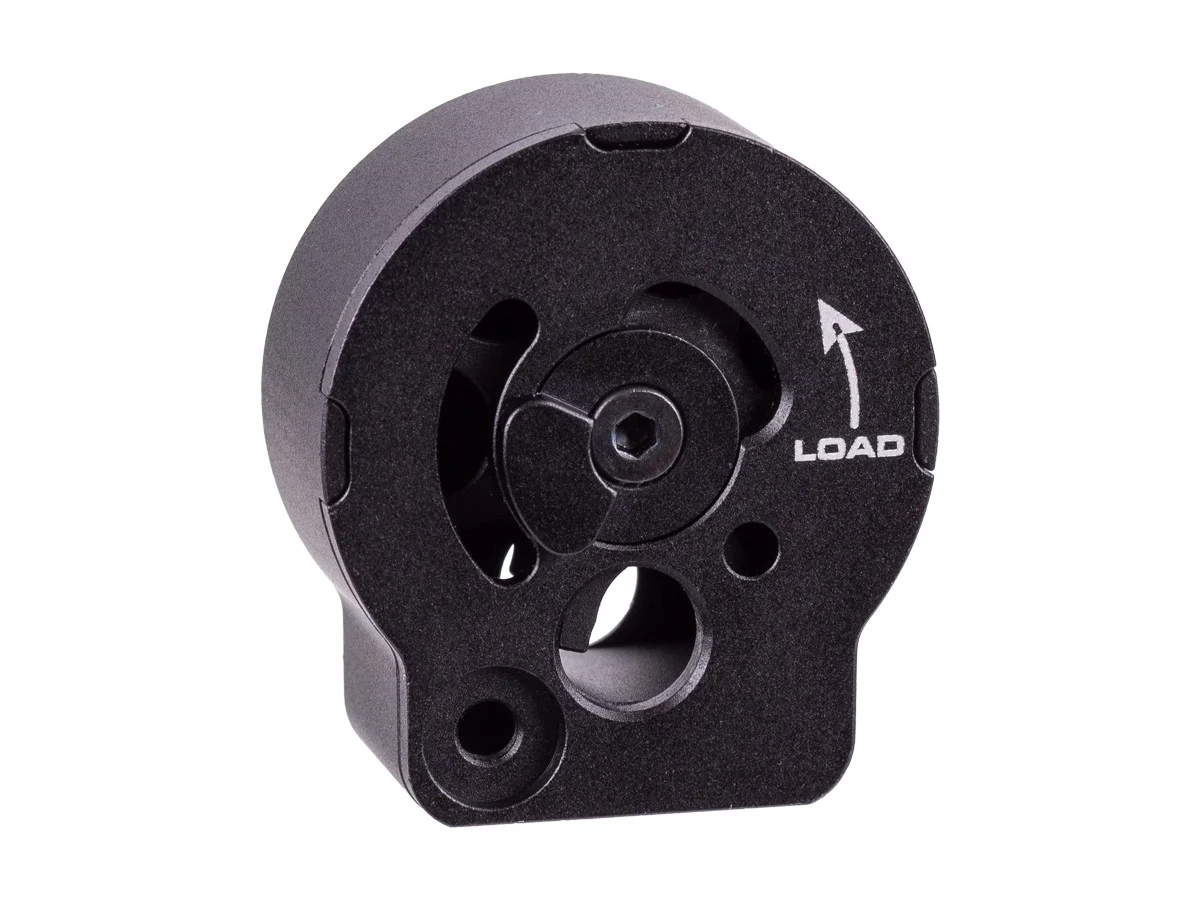
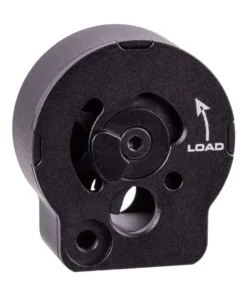
A compatible self-indexing rotary magazine should be selected for the installed calibre. High-quality pellets or manufacturer-approved slugs may then be tested to identify the most consistent option. Projectile diameter, weight, overall length, and magazine fit must all be verified before use.
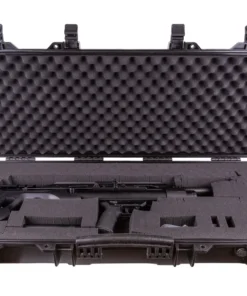
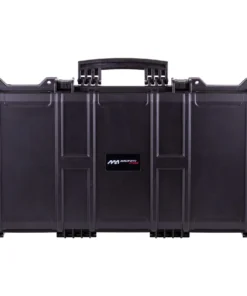
Finally, a padded rifle case, approved secure-storage cabinet, cleaning equipment, spare seals, eye protection, hearing protection where appropriate, and safe backstop should be included. With the correct calibre, lawful FAC status, responsible power configuration, and properly matched accessories, the Macavity Arms MA8 PCP Air Rifle can be prepared as a refined and adaptable precision-shooting platform.
Frequently Asked Questions
What type of air rifle is this model?
It is a pre-charged pneumatic rifle developed primarily for benchrest competition, long-range target shooting, and other lawful precision-shooting activities. Compressed air is stored inside a large onboard reservoir and released in controlled amounts whenever a shot is taken. Furthermore, a regulated firing system has been incorporated to support consistent velocity throughout the usable portion of each fill.
Which calibres are supported?
Calibre configurations ranging from .177 to .35 are supported by the platform’s single-valve design. Depending on market availability, the rifle may be configured in .177, .22, .25, .30, or .35 calibre. However, the correct barrel, probe, magazine, and related components must be installed for the selected calibre. Availability should always be confirmed with the retailer before an order is completed.
Can the calibre be changed later?
Yes, calibre conversion has been made possible through the modular barrel and single-valve system. Instead of the entire valve assembly being replaced, the appropriate barrel and probe can be installed. Nevertheless, every conversion should be performed according to the manufacturer’s instructions. Compatible components must be used, and the completed rifle should be inspected and tested before normal shooting is resumed.
Which calibre should be selected?
The ideal choice will be influenced by the intended discipline, legal power limit, preferred shooting distance, projectile availability, and desired air efficiency. A .177 configuration may be preferred for economical target practice and a relatively flat trajectory. Meanwhile, .22 can provide a versatile balance of efficiency and projectile weight. Larger .25, .30, and .35 calibres may be selected when heavier projectiles and greater retained energy are required for lawful applications.
Is it suitable for beginners?
The rifle can be operated by a responsible new shooter under suitable instruction, but its advanced adjustment systems are more likely to be appreciated by experienced PCP users. High filling pressure, electronic controls, adjustable regulator pressure, and multi-calibre capability must all be understood. Therefore, professional instruction or supervised club use is recommended for anyone who has not previously handled a high-powered regulated PCP rifle.
Is a Firearm Certificate required in the United Kingdom?
A Firearm Certificate is generally required in England and Wales when an air rifle is capable of producing muzzle energy above 12 foot-pounds. Many configurations of this platform are designed for considerably higher performance and may therefore be classified as FAC-rated. Different requirements apply in Scotland and Northern Ireland. Consequently, the applicable police and licensing authorities should be consulted before purchase, possession, transportation, modification, or use.
Can it be purchased in a non-FAC configuration?
Market-restricted configurations may be offered in some regions, but availability must be confirmed directly with an authorised retailer. A rifle should never be assumed to be licence-exempt simply because a lower setting has been selected. Its legal classification may be determined by its capability rather than the setting being used at a particular moment. Accordingly, written confirmation of the supplied specification should be requested before purchase.
How is the power adjusted?
An externally adjustable Tru-Click regulator and indexed hammer-spring system have been fitted. A positive click represents a one-bar regulator adjustment, allowing settings to be recorded and repeated more easily. However, power adjustments should only be completed within the manufacturer’s limits and the owner’s legal authority. Exact tuning should be undertaken by an experienced owner or qualified airgun technician using proper measuring equipment.
Does a higher regulator pressure always improve performance?
No. Greater pressure does not automatically produce better accuracy or efficiency. The regulator, hammer spring, valve, barrel, calibre, and projectile must be balanced. If excessive pressure is applied, air consumption may be increased without a useful improvement in precision. For that reason, consistent groups and stable velocity should be prioritised over the highest possible energy figure.
What is the maximum fill pressure?
The reservoir is rated for a maximum fill pressure of 300 bar, or approximately 4,350 PSI. This limit must never be exceeded. Only correctly rated PCP filling equipment, connectors, hoses, and gauges should be used. In addition, clean and dry breathing-quality air should be supplied whenever possible so that moisture and contamination inside the pneumatic system can be reduced.
How large is the air reservoir?
A high-capacity reservoir of approximately 680cc has been fitted. This generous capacity has been provided to support longer regulated shot strings, especially during benchrest matches and extended range sessions. Nevertheless, the actual number of shots will depend on calibre, barrel length, regulator pressure, hammer setting, projectile weight, and selected energy level.
How many shots can be expected from one fill?
No single shot-count figure will apply to every setup. Smaller-calibre or moderately powered configurations may deliver more shots, while larger-calibre and higher-energy arrangements will generally consume more air. Ambient temperature and the chosen ending pressure may also affect the result. Therefore, owners are encouraged to record pressure and velocity throughout a full shot string to understand their particular setup.
What type of trigger is installed?
A two-stage electronic trigger has been incorporated. Electronic control allows a clean and consistent release to be produced without the mechanical creep commonly associated with some conventional trigger systems. Meanwhile, a mechanical slingshot hammer remains responsible for the firing cycle. As a result, the benefits of electronic trigger control and mechanical hammer operation are combined.
What happens if the trigger battery becomes discharged?
The electronic trigger will require sufficient battery power before the rifle can be fired. Consequently, the battery level should be checked before a competition, journey, or extended shooting session. The battery should be charged only with the recommended equipment and procedure. If the rifle is to be stored for an extended period, the manufacturer’s guidance regarding battery care should be followed.
Is the rifle suitable for left-handed shooters?
An ambidextrous manual safety has been included, and several ergonomic components can be repositioned. Therefore, the platform may be configured for a wide range of right- and left-handed users. However, the location and operation of the sidelever should be evaluated by a left-handed buyer before purchase, particularly if rapid magazine use will be required.
Can the grip and cheek rest be adjusted?
Yes. The grip can be moved forward or backward along its mounting system, while the cheek rest can be adjusted vertically. These features allow the relationship between the trigger, shoulder, cheek, and optic to be refined. A stable head position can therefore be repeated more naturally from shot to shot, which may improve comfort and consistency during long benchrest sessions.
What barrel lengths are available?
Standard 500mm and longer 700mm barrel configurations are commonly offered. The shorter option provides a more compact overall arrangement, whereas the longer version may be preferred for a different velocity, balance, or efficiency profile. Availability can vary by calibre and retailer. Accordingly, barrel length and complete-rifle dimensions should be confirmed before ordering.
What is special about the barrel system?
A Master Select Rifling barrel system has been used, with individual barrels intended to satisfy the manufacturer’s performance standards. Furthermore, FX-compatible dimensions have been incorporated, creating access to a broader selection of compatible barrel options. Nevertheless, compatibility should be verified for every component rather than assumed from dimensions alone.
Can both pellets and slugs be used?
The platform has been developed to accommodate compatible pellets and slugs, although the best projectile will depend on the installed barrel and tune. Some barrels may perform especially well with traditional diabolo pellets, while another liner or twist rate may favour slugs. Several carefully selected projectiles should be tested under controlled conditions before a final preference is established.
How should the best ammunition be selected?
Accuracy testing should be conducted with several reputable projectile types and weights. Each group should be fired under comparable conditions from a stable rest and safe range. Furthermore, velocity consistency, magazine fit, projectile length, and barrel performance should be considered. The projectile that produces the highest advertised speed should not automatically be regarded as the most accurate choice.
What type of magazine is required?
A compatible self-indexing rotary magazine must be matched to the installed calibre. Before loading, projectile diameter and overall length should be checked. Oversized or unusually long ammunition may not rotate correctly inside the magazine. If resistance is experienced, the magazine should not be forced, as damage to the magazine, probe, or projectile may otherwise be caused.
What optics can be installed?
A Picatinny/Weaver-style top rail has been provided for compatible scope rings and optical sights. The rail angle can also be adjusted to support long-range optic alignment. A riflescope with clear glass, dependable turrets, parallax adjustment, and a suitable reticle may be preferred for precision work. Ring height should be selected so that adequate clearance and a comfortable cheek position are maintained.
Why can the scope-rail angle be adjusted?
Long-range scopes sometimes require substantial elevation adjustment. By changing the relationship between the rail and barrel, a more useful portion of the scope’s internal adjustment range can be preserved. Additionally, alignment can be refined for the intended distance. Rail-angle changes should be completed carefully, after which the optic must be securely mounted and properly zeroed.
Which bipods and shooting rests are compatible?
ARCA-Swiss, M-LOK, and Picatinny mounting provisions have been included on the lower rail system. Consequently, many compatible bipods, benchrest devices, rail stops, and support accessories can be installed. Before an accessory is used, its attachment should be checked for security, correct positioning, and interference with the rifle’s gauges, reservoir, fill connection, or operating controls.
Is a moderator included?
A modular baffled moderator and carbon-fibre shroud are commonly listed with the rifle. A 1/2-20 UNF muzzle thread has also been provided. However, moderators are regulated differently across countries and regions. Possession, installation, transportation, and use must therefore be permitted by local law. Package contents should also be confirmed because retailer-specific configurations may vary.
What filling equipment is needed?
A PCP compressor, certified charging cylinder, or another filling system rated for at least 300 bar will be required. A compatible female Foster connection, suitable high-pressure hose, moisture filter, and dependable gauge should be used. Ordinary tyre or workshop compressors must never be connected because they do not provide the required pressure, filtration, or safety standards.
Can the rifle be filled directly from a compressor?
Direct filling may be completed when a suitable high-pressure PCP compressor has been used and the manufacturer’s filling procedure has been followed. The rifle should be filled slowly so that excessive heat is not generated. Moreover, the reservoir gauge and compressor gauge should be watched continuously. The supply must be stopped before the marked maximum pressure is reached.
How should the rifle be maintained?
The exterior should be wiped with a clean, soft cloth after handling. Approved lubricants should be used sparingly and only where recommended. The barrel may be cleaned when accuracy begins to decline, but harsh chemicals and unsuitable rods should be avoided. In addition, seals, fasteners, magazines, gauges, and filling connections should be periodically inspected for damage or abnormal wear.
Should air be left inside during storage?
PCP rifles are commonly stored with a safe amount of pressure remaining so that internal seals stay seated and contamination is discouraged. However, the pressure recommended in the official manual should be followed. The rifle should never be stored completely full in extreme heat. It should also be unloaded, uncocked, switched off, and secured against unauthorised access.
What safety equipment should be used?
Suitable eye protection should always be worn, while hearing protection may be appropriate depending on the power, moderator status, and shooting environment. A secure backstop capable of safely containing the selected projectile must be provided. Furthermore, the rifle should always be pointed in a safe direction and treated as loaded until its condition has been personally verified.
Is the rifle covered by a warranty?
A three-year limited manufacturer’s warranty is commonly provided. Coverage may depend on registration, purchase location, authorised retail supply, correct maintenance, and the absence of unauthorised modifications. Therefore, the receipt, serial-number information, original packaging, and warranty documents should be retained. Exact conditions should be reviewed before repairs or component changes are attempted.
Who is this precision platform best suited to?
It is best suited to responsible adult shooters who value adjustability, calibre flexibility, electronic trigger control, and regulated PCP performance. Competitive benchrest participants, long-range target enthusiasts, and experienced airgun owners may particularly appreciate its design. Nevertheless, lawful ownership, proper instruction, secure storage, careful maintenance, and disciplined handling must always be treated as essential parts of the ownership experience.
Practical Use Scenarios
A precision PCP rifle becomes most valuable when its features are matched to a clear shooting purpose. Its adjustable regulator, electronic trigger, interchangeable barrel system, large-capacity air reservoir, and multiple accessory rails allow it to be prepared for several lawful sporting environments. However, the same configuration will not necessarily be ideal for every activity. A benchrest competitor may prioritise stability and shot-to-shot consistency, while a recreational shooter may place greater importance on comfort, manageable power, and economical ammunition.
The following practical scenarios explain how the platform can be used responsibly and how its main features may support different types of shooters.
Formal Benchrest Competition
Benchrest competition is one of the most natural applications for this rifle. During a match, the rifle is normally supported on a stable front rest, bipod, or approved bench system. Targets are then engaged from a fixed position under carefully controlled rules. Because body movement is reduced by the support equipment, small differences in trigger control, ammunition quality, velocity, wind, and rifle setup become more noticeable.
For this scenario, the ARCA-Swiss lower rail can be used with compatible benchrest equipment. A properly fitted support can be positioned so that the rifle remains stable without excessive pressure being placed on the air reservoir or barrel system. Furthermore, the position-adjustable grip and height-adjustable cheek rest can be set around the shooter’s natural posture.
The electronic trigger becomes particularly useful in this environment. A clean, consistent release can be produced with minimal unwanted disturbance to the rifle. Therefore, the shooter can concentrate on sight picture, breathing, wind conditions, and follow-through.
Before the match, a reliable ammunition type should be selected through controlled testing. Several groups can be fired with each candidate projectile, while velocity and reservoir pressure are recorded. Once a dependable combination has been identified, the regulator and hammer settings should be left unchanged unless adjustment is genuinely required.
Sufficient air, charged batteries, magazines, approved projectiles, and basic tools should also be prepared in advance. During the event, safe muzzle direction and range commands must be followed at all times. The rifle should remain unloaded until loading has been authorised by the range officer.
Long-Range Precision Target Shooting
At longer distances, small inconsistencies become increasingly significant. A minor variation in projectile velocity may produce a noticeable vertical shift, while wind can move a projectile away from the intended point of impact. Consequently, long-range target shooting requires a carefully balanced combination of rifle setup, quality ammunition, reliable optics, and disciplined technique.
A longer barrel configuration may be considered when additional efficiency or a different balance is desired. However, barrel length alone should not be treated as a guarantee of superior accuracy. The installed barrel must still be matched with a suitable projectile and stable tune.
A riflescope with clear glass, parallax adjustment, repeatable elevation controls, and an appropriate reticle can be mounted on the Picatinny/Weaver rail. Because the angle of the top rail can be adjusted, the scope’s usable elevation range may be better positioned for extended distances. Any rail adjustment must be completed carefully, and all mounting screws should be secured to the appropriate specification.
Before longer distances are attempted, the rifle should be zeroed and tested at a closer range. Progressive distances can then be used so that actual projectile behaviour is understood. Reliable data should be gathered rather than estimated, while changes in wind and environmental conditions should be considered.
Only an authorised shooting range or private property where lawful permission has been granted should be used. A substantial backstop must be present, and the complete area beyond the target must be known to be safe.
Precision Practice at an Approved Indoor Range
An approved indoor range can provide a controlled environment for improving technique. Wind is removed as a major variable, lighting is usually consistent, and known distances are provided. As a result, the shooter can focus more directly on trigger release, breathing, head position, grip, and follow-through.
A moderate-power configuration may be preferred where range rules impose energy or calibre limits. Before attending, the operator should be contacted so that the rifle’s calibre, muzzle energy, moderator status, and ammunition type can be confirmed as acceptable. Some facilities may permit pellets but prohibit slugs, while others may restrict larger calibres or high-powered PCP rifles completely.
During practice, the adjustable cheek rest can be used to establish consistent eye alignment behind the scope. Likewise, the grip position can be altered until the trigger is reached without the hand being stretched or compressed. Once a comfortable position has been found, measurements or reference marks may be recorded so that the same arrangement can be restored later.
A stable firing routine can then be developed. The same seating position, shoulder contact, cheek pressure, and trigger-finger placement should be repeated. Rather than chasing maximum velocity, clean groups and predictable performance should be prioritised.
Outdoor Club Target Sessions
Outdoor club shooting offers a useful balance between structured range safety and changing real-world conditions. Different targets and distances may be provided, while wind, temperature, and natural light introduce practical challenges.
For this type of session, the rifle may be fitted with a bipod and a mid-to-high-magnification scope. A shooting mat, rear bag, weather meter, and notebook may also be useful where permitted. The large air reservoir can support an extended session, although shot count will depend on calibre and power configuration.
Before shooting begins, the reservoir pressure and trigger battery should be checked. The bore should be confirmed as clear, the moderator should be securely attached where lawful, and every mounting point should be inspected. If the rifle has been transported over rough roads, scope-ring and rail fasteners should receive particular attention.
Throughout the session, regulator and reservoir readings can be monitored. When the pressure approaches the lower end of the established regulated range, the rifle should be refilled rather than being used until performance becomes inconsistent. Any unusual sound, air leak, stiff action, or unexplained point-of-impact change should be investigated before shooting continues.
Calibre-Specific Accuracy Testing
Because several calibre configurations can be supported, the rifle may be used as a flexible platform for comparing different projectile types. This activity should be approached as careful accuracy testing rather than an attempt to achieve the highest possible energy.
In a smaller-calibre arrangement, inexpensive pellets may be tested for short- or medium-distance precision. A .22 configuration may then be evaluated for its balance of trajectory, projectile weight, and air efficiency. Larger calibres can be assessed where they are legally authorised and supported by the range.
Each configuration should be installed using the correct barrel, probe, and magazine. After installation, safe mechanical function must be confirmed. The rifle should then be tested with a chronograph and secure backstop before accuracy groups are attempted.
Only one variable should be changed at a time. For example, projectile weight can be changed while the remaining setup is left untouched. Alternatively, a minor authorised regulator adjustment can be assessed while the same ammunition is retained. If multiple changes are made simultaneously, the reason for any improvement or decline will be difficult to identify.
Every result should be recorded, including calibre, projectile, barrel, regulator setting, fill pressure, distance, temperature, velocity, and group size. Through this measured process, a reliable configuration can be identified without unnecessary adjustment.
Pellet and Slug Evaluation
Pellets and slugs behave differently because their shapes, weights, bearing surfaces, and aerodynamic characteristics are not the same. A traditional diabolo pellet may perform exceptionally well at moderate distances, while a compatible slug may retain energy and resist wind more effectively in a suitable barrel.
Testing should begin with products recommended for the installed barrel and calibre. Magazine fit must be confirmed, particularly when longer projectiles are being considered. A projectile that does not rotate freely through the magazine should never be forced into position.
Groups should first be fired at a manageable distance where basic accuracy can be evaluated. If stable performance is demonstrated, the distance may be extended gradually. A chronograph can be used to identify velocity consistency, but the fastest projectile should not automatically be selected. Instead, accuracy, reliability, air consumption, and intended application should be considered together.
When a projectile change is made, the point of impact may shift. Therefore, the scope should be checked and zeroed again before the rifle is used for any practical purpose.
Supervised Training for a Developing Shooter
Although the platform includes advanced features, it may be introduced to a developing adult shooter under qualified supervision. The session should begin with the rifle unloaded and its air system, safety controls, magazine, sidelever, trigger, and muzzle direction fully explained.
A lower-powered lawful setup may be more appropriate for initial instruction. A large, clearly visible target can be placed at a manageable distance with a dependable backstop. The shooter can then practise stable positioning, loading, safety engagement, sight alignment, trigger release, and safe unloading.
Only one pellet should initially be loaded at a time, even if a magazine is available. This simplified approach allows attention to remain on safe handling and basic technique. As confidence develops, the magazine system and more advanced features can be introduced.
Electronic trigger sensitivity should also be explained carefully. Because a light and clean release may be provided, the finger must remain outside the trigger guard until the sights are on target and the decision to fire has been made.
Lawful Pest-Control Work
Where local law permits, an appropriately licensed and competent person may use a suitable air rifle for certain pest-control duties. This application requires far more than sufficient power. Correct species identification, landowner permission, legal authority, an effective backstop, suitable ammunition, and the ability to achieve humane shot placement must all be established.
The rifle should be zeroed and tested before any field use is considered. A compact configuration may be easier to handle around farm buildings or confined positions, while a larger calibre may provide more energy where legally appropriate. Nevertheless, power should be matched to the lawful task rather than maximised unnecessarily.
Shots must never be taken toward roads, buildings, livestock, hard surfaces, water, or uncertain ground. Ricochet risk should be evaluated, and no shot should be released unless the projectile can be safely contained. If a humane result cannot be confidently achieved, the shot must not be attempted.
Local regulations vary substantially, and some species may be protected. Therefore, current wildlife, firearms, land-use, and animal-welfare requirements must be checked before any control activity is undertaken.
Farm and Rural Property Target Practice
A rural property may appear suitable for recreational shooting, but space alone does not make an area safe or lawful. Permission must be held, local discharge rules must be followed, and the shooting direction must be carefully selected.
A purpose-built backstop should be installed using materials capable of safely stopping the chosen calibre and energy level. The surrounding area should be inspected for public paths, neighbouring land, roads, buildings, animals, and hard objects that could cause a ricochet. Targets should be positioned so that every projectile enters the backstop even if the intended point of aim is missed.
The rifle can then be used for structured accuracy practice. Distances may be clearly measured, targets may be replaced regularly, and results can be recorded. However, informal objects such as glass, rocks, pressurised containers, or materials likely to produce dangerous fragments should never be selected as targets.
Testing After Maintenance or Component Replacement
After seals, a barrel, probe, magazine, optic, or another important component has been replaced, the rifle should be tested before regular use. Initial checks should be conducted without ammunition to confirm that controls operate correctly and no obvious leak is present.
Once safety has been established, the rifle can be fired into a secure backstop at an approved location. Reservoir pressure should be watched for abnormal loss, while the action and magazine should be checked for smooth operation. A chronograph may then be used to confirm that the rifle remains within its authorised power level.
Accuracy should be evaluated at a modest distance before the zero is extended. If unstable velocity, unusual noise, damaged projectiles, air leakage, or unexpected mechanical resistance is detected, shooting should stop. Qualified technical assistance should then be obtained.
Travel to Competitions and Shooting Events
When the rifle is transported, it should be unloaded, uncocked, switched off, and placed inside a secure padded case. Magazines and projectiles should be stored according to local transport regulations, while certification documents should be carried whenever required.
The scope, moderator, and rail-mounted accessories may remain attached if they are adequately protected. However, large or delicate components may be removed when the risk of impact is high. After arrival, the rifle should be inspected before it is filled or loaded.
Air cylinders, compressors, and batteries may be subject to additional transport restrictions, especially during air travel. Airlines, ferry operators, event organisers, and national authorities should therefore be contacted well in advance. Assumptions should never be made about cross-border legality, even when lawful ownership has been established in the country of departure.
Extended Recreational Shooting Sessions
For a full day at a range, preparation can significantly improve the experience. The rifle should be charged with clean, dry air, and the electronic trigger battery should be checked. Suitable ammunition, spare magazines, eye protection, filling equipment, cleaning supplies, and basic manufacturer-approved tools can then be packed.
The adjustable ergonomics help reduce fatigue during extended sessions. Nevertheless, regular breaks should be taken, particularly when concentration begins to decline. Hydration, weather protection, and safe equipment organisation should also be maintained.
Settings should not be changed simply because performance varies for one or two shots. Wind, shooter technique, loose equipment, and projectile variation should first be considered. By keeping a written record of the setup, reliable performance can be restored more easily after transport, cleaning, or calibre conversion.
Secure Storage Between Uses
Practical ownership continues after the shooting session has ended. The rifle should be unloaded, uncocked, switched off, and wiped clean before storage. The reservoir should be left at the pressure recommended by the manufacturer, while the battery should be maintained according to official guidance.
A locked cabinet or other legally compliant storage system should be used. Keys, access codes, projectiles, magazines, and filling equipment must be protected from unauthorised users, particularly children. Where a certificate is required, every storage condition imposed by the relevant authority must be followed.
Through thoughtful configuration and responsible handling, the rifle can be adapted for competition, precision practice, supervised development, equipment testing, and other lawful sporting purposes. Its greatest practical advantage is not produced by power alone. Instead, value is created through repeatable adjustment, reliable air management, suitable accessories, careful ammunition selection, and a disciplined commitment to safety.
Why This Rifle Is a Better Choice
Selecting a precision PCP rifle should be based on more than appearance or maximum advertised power. Accuracy, consistency, adjustability, reliability, ergonomics, air capacity, and long-term flexibility should all be considered. This platform stands out because those qualities have been combined within one competition-oriented design. As a result, it can be configured around the shooter instead of forcing every shooter to accept the same fixed setup.
Whether it is being considered for benchrest competition, long-range target shooting, supervised practice, or another lawful sporting activity, several practical reasons make it a compelling choice.
Built for Repeatable Accuracy
Consistent accuracy is one of the most important reasons this rifle should be considered. A shot cannot be placed reliably when pressure, trigger release, projectile speed, or barrel performance changes unpredictably. Therefore, several systems have been incorporated to reduce unnecessary variation.
A regulated pneumatic action controls the air released during each firing cycle. Meanwhile, the Tru-Click regulator allows pressure settings to be adjusted and recorded in precise increments. Once an accurate setup has been identified, the same setting can be restored more easily.
Furthermore, the MSR barrel system has been developed for precision-focused performance. When suitable ammunition is selected, dependable groups may be produced without constant mechanical adjustment. Consequently, more attention can be given to reading conditions and improving shooting technique.
A Clean Electronic Trigger Is Provided
Even a highly accurate barrel can be disrupted by a heavy or inconsistent trigger. For that reason, a two-stage electronic trigger has been fitted. A clean, predictable break can be produced with minimal mechanical movement, allowing the rifle to remain more stable as the shot is released.
This advantage becomes especially noticeable during benchrest competition and long-range target shooting. At extended distances, even a small movement can affect the final point of impact. Therefore, the electronic trigger helps the shooter maintain sight alignment and complete a controlled follow-through.
At the same time, a mechanical slingshot hammer remains responsible for the firing cycle. Electronic trigger control has therefore been combined with a proven mechanical hammer system, creating a practical balance between modern operation and dependable performance.
Multiple Calibres Can Be Supported
A major reason to choose this platform is the flexibility provided by its single-valve system. Compatible configurations between .177 and .35 calibre can be supported when the appropriate barrel, probe, magazine, and related components are installed.
A smaller calibre may be selected for economical target practice and flatter trajectory characteristics. Alternatively, a larger calibre may be preferred for long-range precision or other authorised high-energy applications. Because the platform can be converted, an entirely different rifle may not need to be purchased whenever shooting requirements change.
Nevertheless, calibre conversions should always be performed with approved components and according to official guidance. The rifle must also remain within the owner’s legal authority after any change has been completed.
Power Can Be Properly Balanced
The rifle offers substantial adjustment, but its real benefit is not simply the ability to produce high muzzle energy. Instead, power can be balanced with accuracy, projectile stability, air consumption, and the intended shooting distance.
An externally adjustable regulator and indexed hammer-spring system have been incorporated. Therefore, an experienced owner or qualified technician can establish an appropriate setup for a particular barrel and projectile.
When the system has been correctly balanced, compressed air can be used efficiently, velocity variation can be reduced, and unwanted stress on internal components may be avoided. This measured approach is far more useful than pursuing maximum pressure without considering accuracy or reliability.
A Large Air Reservoir Is Included
A 680cc reservoir provides substantial air capacity for long target sessions and organised competitions. As a result, frequent interruptions for refilling may be reduced. This can be particularly valuable at ranges where filling facilities are positioned away from the firing point.
The reservoir is rated for a maximum pressure of 300 bar, although that limit must never be exceeded. Dual gauges have also been installed so that reservoir pressure and regulator pressure can be monitored separately.
Actual shot count will vary according to calibre, barrel length, regulator setting, projectile weight, and selected power. Even so, the generous reservoir capacity provides a strong foundation for extended regulated shot strings.
The Rifle Can Be Adjusted to the Shooter
Every shooter has different body proportions, preferred hand placement, optic height, and firing posture. A fixed rifle may feel comfortable for one person but unsuitable for another. Consequently, several ergonomic adjustments have been provided.
The grip can be moved forward or backward, while the cheek rest can be raised or lowered. These adjustments help align the trigger hand, shoulder, head, and eye with the scope. A more natural position can therefore be established without unnecessary stretching or pressure.
A ridged rubber buttpad supports stable shoulder contact. Additionally, the compact bullpup layout keeps the overall length manageable even when a substantial barrel and air reservoir are used. Comfort can consequently be maintained during longer shooting sessions.
Better Optic Alignment Can Be Achieved
An adjustable Picatinny/Weaver scope rail has been fitted above the action. Unlike a basic fixed rail, its angle relative to the barrel can be refined. This feature can help preserve the useful internal elevation range of a scope when longer-distance targets are being engaged.
Appropriate rings and a quality riflescope can be installed without a specialised mounting system being required. Once the optic has been correctly aligned and zeroed, predictable adjustments can be recorded for different target distances.
However, scope quality remains important. Clear glass, dependable turrets, suitable magnification, and effective parallax adjustment should be prioritised over unnecessary size or complicated features.
Accessories Can Be Mounted Easily
Versatile lower mounting options represent another important advantage. ARCA-Swiss, M-LOK, and Picatinny attachment points have been incorporated, allowing the platform to support a broad selection of compatible accessories.
A precision bipod, benchrest support, rail stop, or other lawful shooting accessory can be positioned according to the chosen discipline. Instead of being limited to one proprietary mounting standard, the owner is given more freedom when assembling a practical setup.
The carbon-fibre barrel shroud and modular baffled moderator also contribute to the rifle’s complete configuration. Moderator ownership and use must, however, be permitted by local law.
Easier Long-Term Development Is Supported
A high-quality rifle should remain useful as the shooter’s experience develops. This platform can be adjusted gradually rather than being quickly outgrown. A straightforward target setup may be used initially, after which different ammunition, optics, accessories, barrel configurations, or authorised calibres can be explored.
Because individual settings can be recorded, purposeful testing can be conducted without random changes being introduced. For example, one projectile may be compared with another while the regulator setting remains unchanged. Similarly, an ergonomic adjustment can be assessed without altering the power system.
This measured flexibility makes the rifle suitable for shooters who enjoy learning how equipment, ammunition, environmental conditions, and personal technique interact.
Strong Competition Potential Is Offered
Benchrest shooters require a stable platform, consistent velocity, a dependable trigger, and high-quality barrel performance. Those requirements have been addressed directly rather than being added as afterthoughts.
The adjustable rail system can accommodate a benchrest support, while the electronic trigger helps minimise movement at the moment of release. Moreover, the high-capacity reservoir supports extended strings, and the regulator allows a repeatable tune to be established.
Accordingly, the rifle can be prepared for serious competition without every major component immediately needing to be replaced. This can make it a more complete option for shooters who want a purpose-built foundation.
Why It May Be Better Than a Basic PCP Rifle
An entry-level PCP may provide enjoyable recreational shooting, but adjustment and future development are often limited. A fixed regulator, basic trigger, smaller reservoir, conventional barrel, and restricted mounting system may eventually prevent the rifle from meeting more advanced requirements.
Here, considerably more control has been provided. Calibre flexibility, precise regulator adjustment, electronic trigger operation, interchangeable barrel options, adjustable ergonomics, and multiple accessory interfaces have all been brought together.
Therefore, better value may be achieved by someone who plans to shoot regularly, test different configurations, or participate in precision disciplines. Rather than several specialised rifles being purchased, one adaptable platform can be maintained and developed.
A Worthwhile Choice for the Right Shooter
This rifle is most suitable for responsible shooters who value accuracy, adjustment, and long-term versatility. It may be more advanced than necessary for occasional informal use, and its high-pressure system requires careful handling. However, for an enthusiast who wants a refined platform capable of supporting serious precision work, its advantages are meaningful.
Ultimately, it is a better choice because performance can be tailored rather than merely accepted. The trigger can be adjusted to support a controlled release, the ergonomics can be matched to the shooter, and the pneumatic system can be balanced around the selected projectile.
When it is used with suitable ammunition, quality optics, correctly rated filling equipment, secure storage, and responsible training, a dependable and rewarding ownership experience can be achieved. Local licensing and power requirements must always be observed, while modifications should remain within the manufacturer’s specifications. Under those conditions, the rifle offers the precision, flexibility, and development potential expected from a modern competition-grade PCP platform.
Air Gun Collection: PCP Rifles, Pellet Guns, CO2 Pistols and Shooting Accessories
Explore a broad selection of air gun products created for lawful target practice, collecting, competition, and responsible pest control. Whether you want an entry-level pillet gun, a realistic CO2 pistol replica, or an advanced PCP rifle, different power systems and configurations can be compared before a suitable model is selected.
If you are asking what is an airgun, the term generally describes an air powered gun that launches a pellet or BB through compressed air, CO2, a spring piston, or a gas ram. The air guns meaning should not be confused with conventional firearms because combustion is not normally used. Nevertheless, every model must still be handled responsibly because projectiles can cause serious injury.
Understanding the Main Types of Air Guns
Several types of air guns are available, including spring-piston rifles, gas-ram models, CO2 guns, pneumatic rifles, and PCP platforms. Each type of air gun provides a different balance of cost, recoil, power, and convenience.
When shoppers ask what is a break barrel pellet gun, they are usually referring to a spring or gas ram rifle that is cocked by pivoting the barrel. Meanwhile, the PCP rifle meaning refers to a pre-charged pneumatic rifle supplied by a refillable compressed-air reservoir. PCP models are often selected for their low recoil, regulated performance, and precision.
Other types of air rifles include CO2-powered, multi-pump pneumatic, single-stroke pneumatic, and electrically assisted platforms. An air gun electric system may use electronics to control trigger operation or another part of the firing cycle. However, the operating mechanism should always be confirmed from the manufacturer’s specifications.
Pellet Guns, BB Guns and Ammunition
Pellet rifles usually fire shaped ammunition supplied inside a pellet tin, while BB guns commonly use round 4.5 mm BB ammunition. Depending on the model, metal BB pellets, a metal pellet, or a round BB metal bullet may be accepted. Ammunition must always match the calibre and barrel specification marked on the product.
A metal pellet gun should never be loaded with random objects. Likewise, darts for BB gun products should only be considered when the manufacturer expressly approves them. A dart pellet gun can require a specialised smoothbore or compatible barrel; consequently, ordinary airguns should not be modified to fire darts.
Searches for only air gun, just gun, airgu, and luftgevær may describe the same general product category in different languages or search styles. Regardless of terminology, the correct calibre, ammunition, power source, and local legal requirements must be verified.
PCP and Precision Air Rifles
Modern PCP choices range from the cheapest PCP airgun for recreational practice to highly adjustable competition systems. Popular searches include FX Impact M3, FX DRS, FX Airguns Sverige, FX Leopard .22 PCP specs, Air Arms, BSA guns England, RM8, Rexymaxx, and rifle M50.
Large-calibre searches may include AEA Airgun, AEA 22, AEA Challenger, AEA Element Max, AEA 50 caliber, AEA Megalodon 45 cal, AEA Megalodon 50 caliber, AEA Zeus 95 cal, AEA Harpoon 12 gauge, AA Harpoon, and .72 cal air rifle.
These are not interchangeable products. Their energy, approved ammunition, intended applications, and licensing classifications can differ substantially.
The FX Leopard .22 PCP specs, for example, should be checked on the current manufacturer or authorised-retailer page instead of being assumed from another FX platform. Similarly, an AEA Megalodon 50 caliber should not be compared directly with a lightweight .177 target rifle solely because both use compressed air.
CO2 Pistols and Replica Models
CO2 platforms are appreciated for convenient operation, repeatable recreational shooting, and realistic styling. Frequently researched models include the Webley revolver, Webley MKVI, Walther CP88 Competition, Smith and Wesson CO2 pistol, Umarex RP5 C02 pellet gun, SA 10 pistol, Crosman 2250, and Crosman ST-1.
A revolver air gun pellet CO2 model may use a rotary magazine or removable cartridge system. The alternative phrase air gun pellet CO2 revolver is often used to find the same category. Meanwhile, the Umarex – Legends collection is generally searched by collectors interested in historically inspired designs.
Other searches, including Winchester Model 55, Crosman Shockwave .22, Niksan Ozark TW, Ekol blank guns, and Webley guns, can refer to very different mechanisms. Blank-firing products are not ordinary airguns and may be regulated differently. Therefore, each product’s classification must be checked before purchase or use.
Optics, Cases and Essential Accessories
A properly selected mil dot scope can make aim points easier to organise at known distances. The mil dot reticle provides measured reference points, but it does not automatically calculate trajectory. A verified FPE calculator or Pyramyd Air calculator can estimate muzzle energy when projectile weight and measured velocity are entered.
Searches such as .45 ACP muzzle energy joules concern firearm ammunition and should not be used as a direct guide for airgun performance. Energy figures alone do not establish accuracy, suitability, or legality.
For transportation, an aluminium rifle case can provide additional impact protection. A suitable sniper set may include a compatible optic, rings, bipod, case, and approved targets, although the word “sniper” is often used loosely in retail listings.
Threaded accessories may be described as 1/2 UNF, 1 2 UNF, or 1/2 unf. The exact thread pitch must be confirmed before any moderator or muzzle accessory is attached. Local laws governing sound moderators must also be followed.
Routine air gun maintenance should include exterior cleaning, seal inspection, careful barrel care, and correct storage. Only manufacturer-approved airgun lubricant should be applied, since petroleum-based oils can damage seals or create dangerous ignition inside some high-pressure systems. Replacement parts such as a BSA Meteor stock must also match the correct production variant.
Target Shooting and Responsible Pest Control
Target shooting with air rifles can provide an accessible way to develop concentration, safe handling, and consistent technique. A lawful range, secure backstop, eye protection, and suitable ammunition should always be used.
Questions such as can air rifles kill, will a BB gun kill a rat, and will a pellet gun kill a rat must be approached responsibly. Airguns can cause fatal injuries, which is precisely why they must never be treated as toys. An air rifle for rats or rat gun should only be considered for lawful pest control by a competent person with the property owner’s permission.
Search phrases such as shooting a rat, rat shooting, shoot rats with air rifle, and rat killing gun do not remove the obligation to follow wildlife, animal-welfare, and firearms laws. Humane control requires correct species identification, suitable equipment, a secure backstop, and certainty that no person, animal, building, or road is placed at risk. Searches for rat with a gun are usually associated with novelty images rather than responsible product selection.
Catapults, Slingshots and Other Equipment
A wrist rocket is a wrist-supported slingshot and should not be confused with an air rifle. If you are asking another name for slingshot or seeking a synonym for slingshot, the words catapult, hand catapult, and wrist-braced slingshot may appear depending on the country.
The question what’s the difference between a slingshot and a catapult depends partly on regional language. Likewise, catapult vs slingshot searches often compare two terms used for similar handheld equipment. Questions such as are slingsgots illegsl should be checked against current local law because possession, carrying, hunting, and public use may be regulated separately.
A Mossy Oak bow and CO2 cannon wedding device also belong to different product classes. Neither should be grouped with ordinary pellet rifles without clear product information.
Choose the Right Airgun Responsibly
Before purchasing, compare calibre, action, reservoir size, trigger system, magazine capacity, noise level, weight, warranty, and available service support. More importantly, verify local gun UK rules or the applicable regulations in your country.
The correct choice should fit the lawful activity, experience level, budget, and available shooting environment. With suitable ammunition, proper maintenance, secure storage, and disciplined handling, an airgun can provide years of accurate and enjoyable sporting use.
| Barrel Length | 500mm (19.68 in), 700mm ( 27.55 in) |
|---|
Be the first to review “Macavity Arms MA8 PCP Air Rifle”
Related products
Umarex Air Rifles
Umarex Gauntlet 2 SL Hunting Combo
PCP Air Rifles
FX DRS Tactical
Air Rifles
Swarm Viper 10X GEN3i caliber 10-shot break barrel air rifle
Air Rifles
Daystate Alpha Wolf Silver
Air Rifles
FX Leopard Sniper Composite (Black or FDE)

PCP Air Rifles
PCP Air Rifle FX Wildcat MKIII Sniper Walnut
Air Rifles
Daystate Wolverine R High Power Regulated Side Lever
Air Rifles
Reviews
There are no reviews yet.