

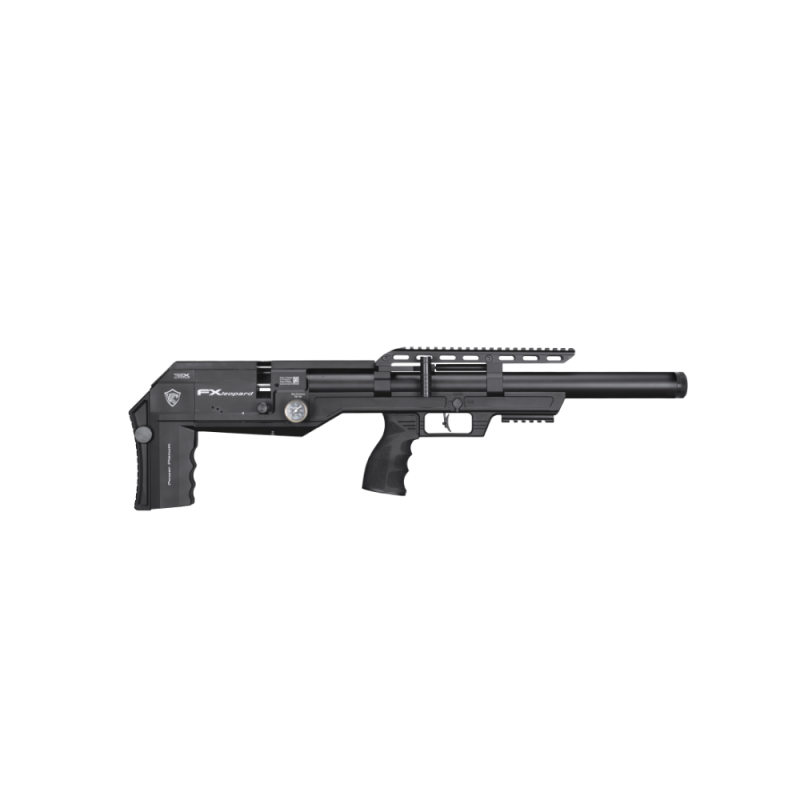
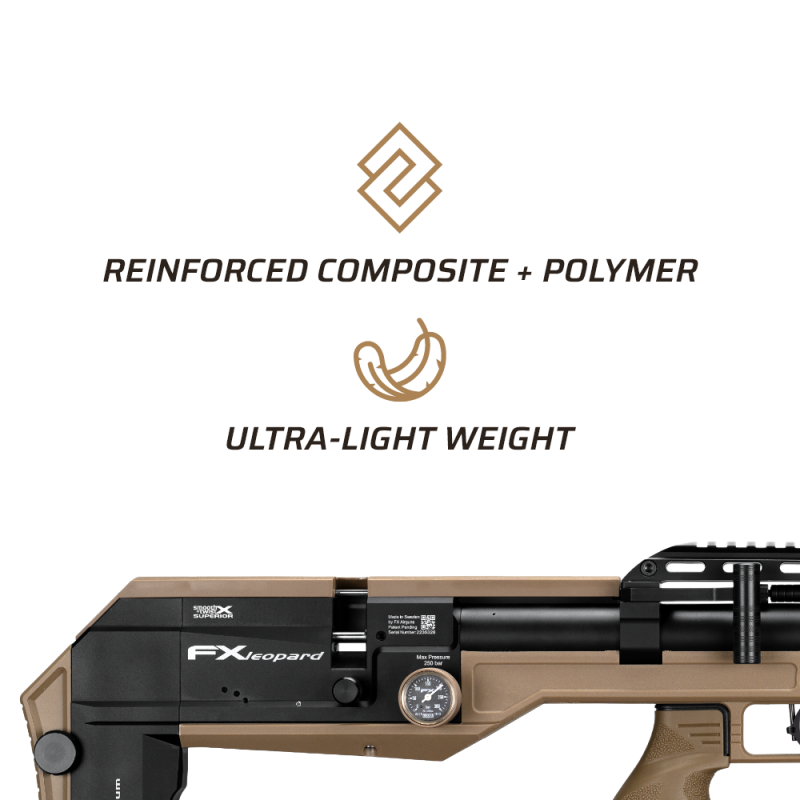
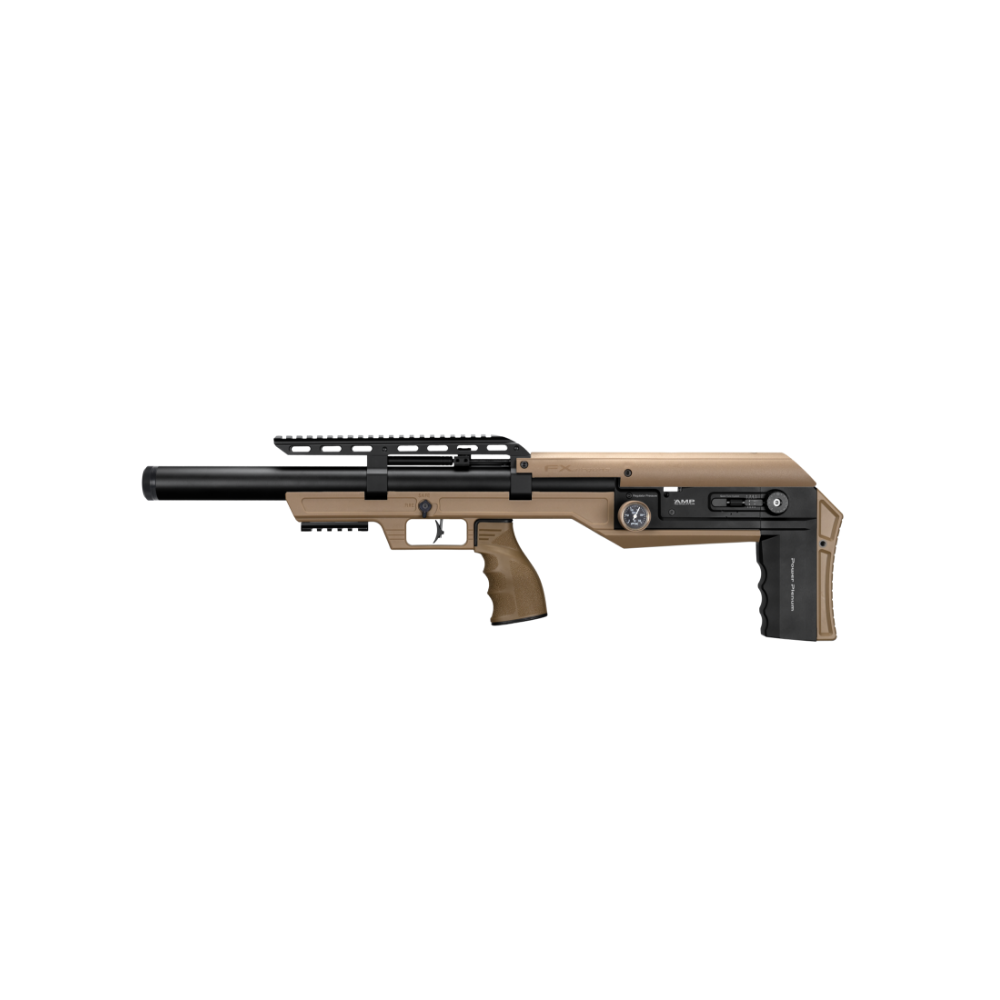

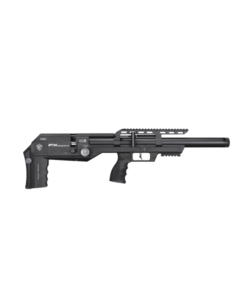
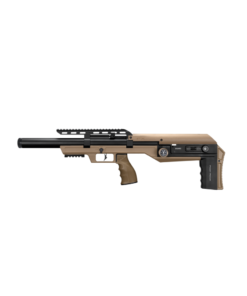
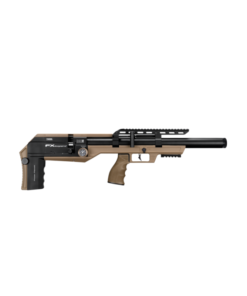
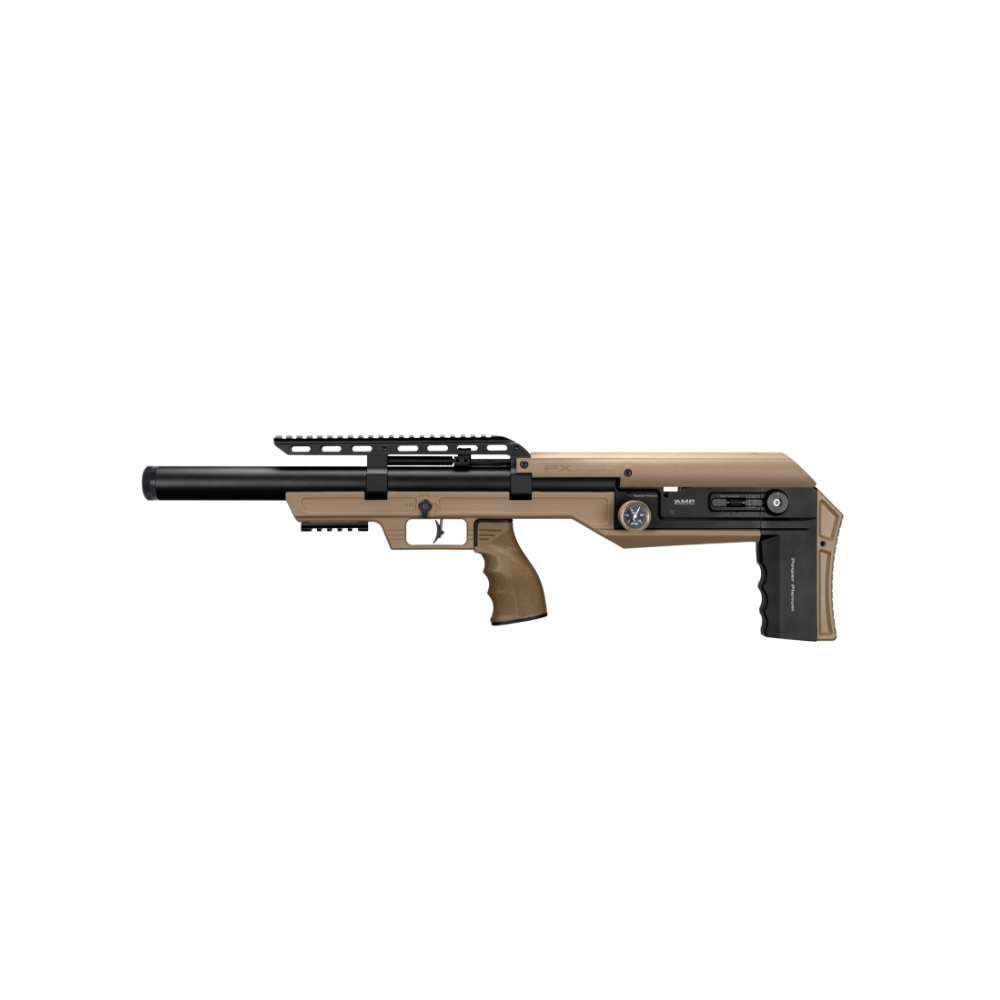
FX Leopard Compact Composite (Black or FDE)

$1,200.00
FX Leopard Compact Composite – Lightweight Strength, Unmatched Performance
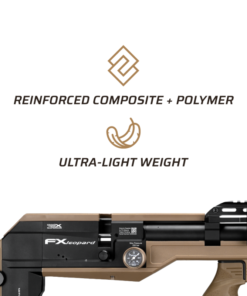
The FX Leopard Compact Composite brings together cutting-edge engineering, modern ergonomics, and the unmistakable precision FX is known for now enhanced with a reinforced composite stock that delivers a lighter overall weight while preserving the rifle’s rigid, competition-grade stability. This platform is built for shooters who demand power, adaptability, and reliability in every scenario.
Designed as the Compact Tube variant of the Leopard family, this model strikes a perfect balance between portability and capability. It’s an exceptional option for hunters and all-around shooters who want maximum efficiency in the field without sacrificing the performance of a full-size powerhouse. The Leopard’s integrated plenum design, built directly into the buttstock, further solidifies its role as a compact yet authoritative airgun.
Purpose-Built Compact Design
The tube version of the Leopard is optimized for balance and maneuverability. With 210cc of onboard air, it’s ready for extended sessions without adding unnecessary bulk perfect for stalking, target transitions, or precise offhand shots.
The modular fore-end includes a rigid bridge system, giving shooters the option to mount accessories with confidence. Along with a full-length Arca-Swiss rail and M-LOK slots on all sides, the Leopard is fully customizable for bipods, lights, slings, and other mission-specific gear
Key Performance Features
54cc Power Plenum
Hidden within the buttstock, the plenum serves as a consistent high-pressure buffer between the regulator and the valve, ensuring each shot receives a steady supply of regulated air for optimized accuracy and power.
AMP MkII External Regulator
This advanced, externally adjustable regulator lets shooters fine-tune pressure for specific ammunition types—whether lighter slugs or traditional pellets unlocking the full precision potential of the platform.
Quick Tune System
Fine-tune hammer control with both macro and micro adjustments, allowing true personalization of airflow, velocity, and performance.
Over-Barrel PCP Reservoir
A sleek, ergonomic over-barrel 310cc air tube design (unique to the broader Leopard lineup) maximizes handling while maintaining impressive air capacity.
20 MOA Optic Rail
Ensures maximum elevation adjustment for long-range shooting setups.
Adjustable Two-Stage Trigger
A crisp, customizable trigger that can be tailored to your preferred break and feel.
FX UG1 Ergonomic Grip
Soft, contoured, and fully compatible with AR-style grips for limitless customization.
Adjustable Butt Pad
Dial in your perfect shoulder weld with tool-less vertical adjustment.
High-Capacity Rotary Magazine
Smooth cycling and compatibility with projectiles up to 13 mm long—ideal for modern pellet and lighter slug shooting.
1/2×20 UNF Muzzle Thread
Compatible with your preferred sound moderator for quieter, more enjoyable shooting.
Dual-Sided Safety
Accessible and intuitive from either side for safe, confident operation.
Superior STX Liner
Specifications
- Overall Length:
- Compact: 690 mm
- Standard: 805 mm
- Sniper: 905 mm
- Fill Pressure: Up to 230 bar (3,335 psi)
- Magazine Capacities:
- .30 cal – 13 rounds
- .25 cal – 15 rounds
- .22 cal – 18 rounds
- .177 cal – 22 rounds
- Caliber Options: .177, .22, .25, .30
FX Leopard Compact Composite (Black or FDE)
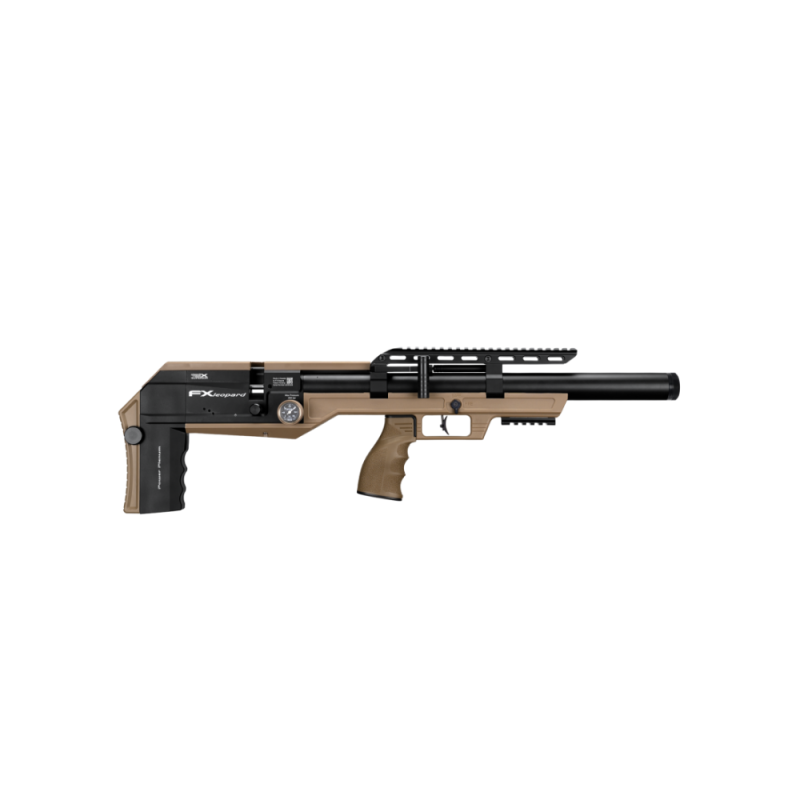
The FX Leopard Compact Composite (Black or FDE) has been developed as a modern, compact PCP platform in which precision engineering, adaptable performance, lightweight handling, and the latest FX Airguns technology are brought together. Rather than being built around a conventional full-length rifle layout, a highly efficient bullpup configuration has been adopted so that useful barrel length can be retained while overall dimensions are kept remarkably manageable.
Through this configuration, the rifle can be carried, positioned, shouldered, and handled with considerably less bulk than might normally be expected from a high-performance regulated PCP. At the same time, the characteristic tuning capability for which FX Airguns has become widely recognized has been retained. FX Leopard Compact Composite (Black or FDE)
Most importantly, the Leopard platform has not simply been shortened. Instead, the internal architecture has been purposefully arranged around a rigid APB barrel system, a large 54cc power plenum positioned within the buttstock, an externally adjustable AMP MKII regulator, the FX Quick Tune System, and an over-the-barrel air cylinder arrangement. Consequently, an unusually compact profile has been achieved without the rifle being stripped of the systems that allow its performance to be refined.
Furthermore, the Composite edition has been offered in Black or FDE, allowing a preferred appearance to be selected while the same functional concept is maintained.
For shooters who have been searching for a modern FX PCP that combines portability with substantial tuning capability, the FX Leopard Compact Composite (Black or FDE) has therefore been created as a particularly compelling option.
Whether carefully controlled target shooting is being enjoyed, a compact rifle is preferred for carrying around a property, or a highly configurable PCP platform is simply wanted, the Leopard Compact provides an exceptionally sophisticated foundation.
Why the FX Leopard Compact Composite Represents a New Approach to Compact PCP Design
A compact rifle is often expected to involve compromise. Usually, barrel length is reduced, onboard air capacity is sacrificed, accessory space becomes restricted, or the shooting position becomes less comfortable. However, a different approach has been taken with the FX Leopard.
Instead of simply removing length from an existing conventional platform, the rifle has been engineered around a bullpup architecture from the outset.
Because the action is positioned farther rearward, a 500 mm barrel can be incorporated while an overall length of approximately 690 mm is maintained on the Compact version. Therefore, substantially more barrel can be accommodated within a comparatively short overall package.
This layout can be particularly useful when a rifle is being carried between shooting positions, transported in confined spaces, used from a bench where excessive length is unnecessary, or handled by users who simply prefer a shorter and more centralized platform.
Additionally, the weight distribution has been concentrated around the shooter rather than being pushed excessively forward.
That difference can be immediately appreciated when the rifle is shouldered.
Instead of the front end being made unnecessarily heavy, much of the working mechanism is positioned close to the body. Consequently, transitions between targets can feel controlled, while unsupported shooting positions can be easier to maintain.
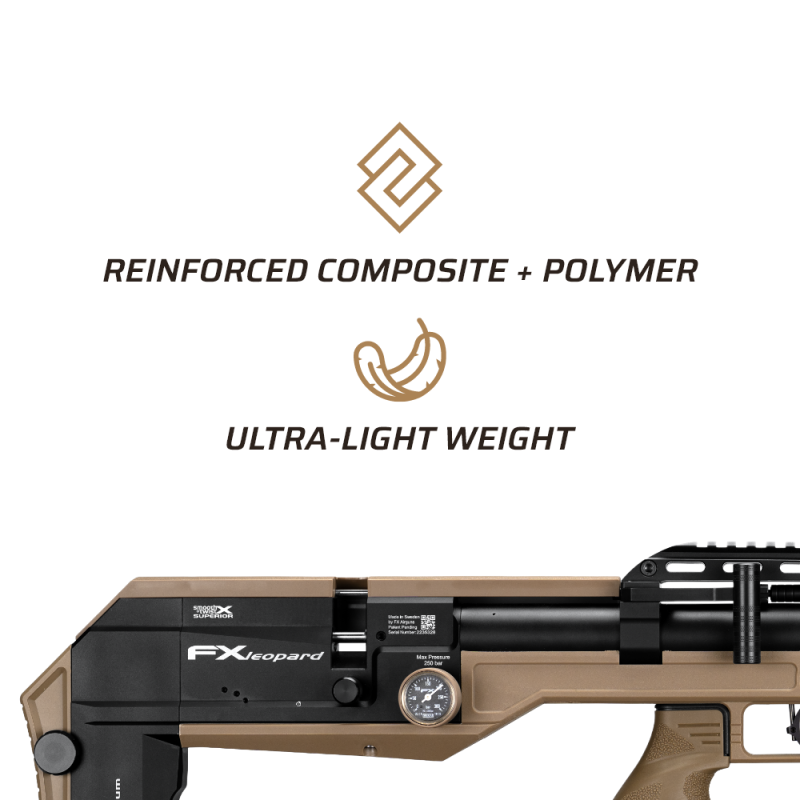
The reinforced composite chassis contributes further to this philosophy.
A strong structural foundation is provided without the unnecessary mass associated with some heavier chassis systems. Moreover, the material is naturally suited to regular handling because minor external contact does not compromise the structural purpose of the rifle.
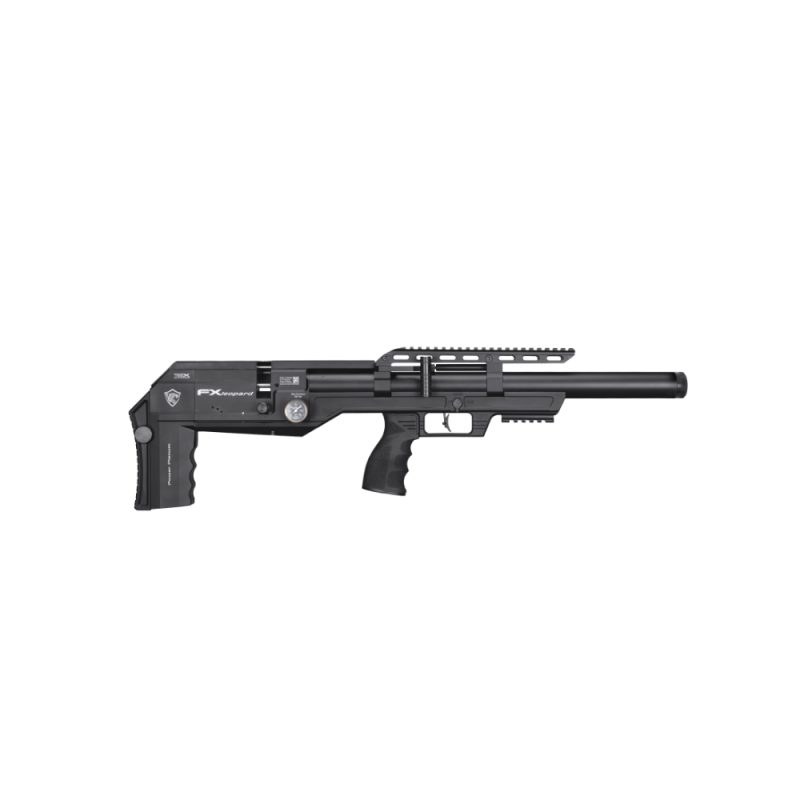
As a result, the FX Leopard Compact Composite Black configuration can be chosen for an understated technical appearance, whereas the FX Leopard Compact Composite FDE configuration can be selected by shooters who prefer Flat Dark Earth styling.
Although the appearance changes, the fundamental Leopard engineering philosophy remains the same.
FX Leopard Compact Composite Key Features
For shoppers who want the essential information quickly, the most important characteristics of the FX Leopard Compact Composite (Black or FDE) include:
- FX Leopard regulated PCP bullpup platform
- Lightweight reinforced composite chassis
- Available in Black or FDE finish
- Compact 500 mm barrel configuration
- Approximately 690 mm overall length
- Approximately 3.0 kg weight, depending on configuration
- 210cc onboard air capacity
- Maximum fill pressure of approximately 230 bar / 3,335 psi
- 54cc power plenum integrated into the buttstock
- FX APB Air Pressure Barrel system
- Interchangeable FX barrel liner architecture
- AMP MKII externally adjustable regulator
- FX Quick Tune System
- Smooth sidelever action
- High-capacity rotary magazine
- Magazine support for projectiles up to approximately 13 mm in length
- Adjustable two-stage trigger
- 30 MOA Picatinny optics rail
- Integrated ARCA mounting interface
- Accessory mounting provisions
- FX UG1 AR-style ergonomic grip
- Adjustable recoil/butt pad
- Dual pressure gauges
- Foster quick-disconnect filling system
- Threaded muzzle configuration
- Ambidextrous-friendly bullpup architecture
- Available in several caliber configurations depending on market
FX currently identifies the Leopard platform with the APB barrel system, 54cc buttstock plenum, Quick Tune System, AMP MKII regulator, extra-wide magazine, adjustable trigger, ARCA interface and 30 MOA optics rail.
Compact Dimensions Without Compact Ambition
One of the most important benefits of the FX Leopard Compact Composite is found in its proportions.
The Compact configuration is generally specified with a 500 mm barrel while an overall rifle length of approximately 690 mm is maintained. A 210cc air cylinder is used, and a maximum fill pressure of approximately 230 bar is specified for the tube configuration.
Those figures demonstrate why the Leopard Compact is substantially different from a conventional rifle.
A useful barrel length has been packaged into a body measuring less than 700 mm overall. Consequently, the rifle does not need to feel excessively long simply because useful ballistic efficiency is desired.
The compact dimensions can also make storage easier.
Rather than requiring the same case length associated with some conventional PCP rifles, a smaller transport footprint may be possible. Similarly, less room is occupied on a shooting bench or equipment rack.
Nevertheless, compactness should not be confused with minimal capability.
Internally, sophisticated airflow management, regulation, tuning, and barrel-support systems have still been incorporated.
Therefore, the rifle has been made physically compact while its mechanical architecture remains distinctly performance-oriented.
Reinforced Composite Chassis
A defining feature of this version is immediately identified in its name.
The FX Leopard Compact Composite is built around a reinforced composite chassis rather than the heavier aluminum-stock configuration available elsewhere within the Leopard family.
This construction provides several practical advantages.
Firstly, overall weight can be reduced.
Secondly, the rifle can remain structurally strong without unnecessary bulk being introduced.
Thirdly, the material can provide a comfortable interface during regular handling because it does not behave exactly like exposed metal under changing environmental temperatures.
During colder conditions, for example, a composite surface may feel less harsh against the hand than bare metal.
During extended range sessions, meanwhile, the reduction in unnecessary weight can become increasingly noticeable.
Because every mounted accessory adds additional mass, starting with a reasonably lightweight rifle provides greater freedom when an optic, bipod, shooting bag rider, sling, or other compatible equipment is later installed.
The result is not merely a lighter rifle.
Instead, a more adaptable starting point is provided.
Black Composite Version
The Black option provides a restrained appearance that can be matched easily with conventional black optics, mounts, bipods, and other accessories.
Its visual design remains distinctly modern, although excessive contrast is avoided.
Consequently, shooters who prefer a cohesive black rifle setup may find this configuration particularly appealing.
FDE Composite Version
Alternatively, the FDE version introduces Flat Dark Earth styling.
The different finish changes the appearance significantly while the fundamental Leopard architecture is retained.
For users who prefer a warmer, earth-toned chassis or who want their rifle to stand apart visually from traditional black PCP designs, the FDE option provides an attractive alternative.
Most importantly, the choice between Black and FDE can be based primarily on personal preference because the central performance systems remain shared.
FX APB Barrel System
Perhaps one of the most technically interesting features of the Leopard platform is the APB barrel system.
APB stands for Air Pressure Barrel.
Instead of following the conventional arrangement in which the barrel and air reservoir are entirely separate structures positioned above and below one another, the Leopard has been engineered around an over-the-barrel air system.
As a result, the rifle’s vertical profile can be reduced while excellent barrel support can be maintained.
FX describes the APB arrangement as running through the air cylinder, producing a low-profile design while contributing exceptional rigidity. Inside the system, the established FX interchangeable liner architecture is retained.
Barrel rigidity is especially important in a precision-oriented PCP.
When a barrel is poorly supported, small movements can influence the point of impact. Moreover, added accessories, transportation forces, or normal handling may introduce stresses that are undesirable when repeatable accuracy is expected.
Through the Leopard’s integrated architecture, greater structural consistency can be provided.
Meanwhile, FX’s liner system allows the fundamental barrel concept to remain adaptable.
Therefore, two benefits are combined.
A rigid external barrel structure is provided, while the internal projectile-guiding component remains part of the established FX liner ecosystem.
Why Barrel Rigidity Matters
Accuracy is not created by one component alone.
Rather, repeatability must be maintained throughout the entire firing process.
The regulated pressure needs to remain consistent.
Valve behavior needs to remain repeatable.
Hammer energy needs to remain predictable.
Projectile fit needs to remain suitable.
Additionally, the barrel must return to the same physical relationship with the action and optic after every shot.
Because modern PCP rifles produce very little conventional firearm-style recoil, it can sometimes be assumed that barrel rigidity is unimportant. However, extremely small mechanical variations can still become visible at greater distances.
For that reason, a rigid barrel structure can be extremely valuable.
The APB system has therefore been integrated not simply for appearance but as an important structural element within the Leopard concept.
Superior FX Barrel Liner Technology
Within the APB architecture, FX liner technology is used.
The interchangeable liner concept has become one of the manufacturer’s most recognizable engineering characteristics because different projectile requirements can be accommodated without the entire rifle being fundamentally redesigned.
For the Compact configuration, current dealer specifications commonly identify the Superior STX liner system.
The importance of a quality barrel system becomes particularly apparent when ammunition is being selected.
Every projectile has a slightly different geometry.
Pellet head diameter may vary.
Skirt shape may vary.
Weight can differ substantially.
Slug dimensions may also differ.
Consequently, the most accurate ammunition should always be established through controlled testing rather than being assumed purely from a label or advertised velocity.
The FX platform gives enthusiasts an excellent mechanical basis from which that testing can be conducted.
54cc Power Plenum Integrated Into the Buttstock
Another major engineering feature is the 54cc power plenum.
Rather than being placed prominently beneath or ahead of the action, this large plenum is integrated into the buttstock structure.
The plenum acts as a regulated volume of compressed air that is made available for each shot.
In simplified terms, the regulator prepares air at a selected regulated pressure, the plenum stores an appropriate volume of that regulated air, and the firing valve releases part of that volume when the trigger is activated.
A larger and efficiently designed plenum can therefore support substantial airflow without excessively high regulator settings always being required.
This architecture is especially valuable when different projectile weights or power levels are being explored.
Instead of the rifle being mechanically fixed around one narrow performance specification, greater tuning flexibility can be provided.
Additionally, because the 54cc plenum has been integrated into the buttstock, valuable space elsewhere within the compact rifle has been preserved.
FX specifically lists a 54cc power plenum within the Leopard buttstock as one of the platform’s principal design features.
AMP MKII Externally Adjustable Regulator
Controlled air pressure is one of the foundations of consistent PCP performance.
For this purpose, the AMP MKII regulator has been incorporated.
The regulator is responsible for reducing high reservoir pressure to a lower operating pressure selected for the firing system.
Without effective regulation, progressively changing reservoir pressure can cause projectile velocity to vary significantly during a shooting session.
When properly configured, regulation allows more predictable pressure to be delivered to the plenum.
Consequently, velocity consistency can be improved across the useful portion of the fill.
Furthermore, the AMP MKII is externally adjustable.
This capability provides experienced users with an additional level of tuning control.
However, regulator adjustments should always be approached methodically.
Increasing pressure does not automatically improve accuracy.
Similarly, maximum velocity should not automatically be treated as the ideal setting.
A balanced relationship between regulator pressure, hammer energy, projectile weight, barrel characteristics, and valve timing is generally more important.
Therefore, the AMP MKII should be viewed as a precision tuning instrument rather than merely a way of increasing power.
FX Quick Tune System
Fine adjustment is further supported by the FX Quick Tune System.
Through this system, important aspects of the rifle’s firing behavior can be adjusted more conveniently than would be possible with a completely fixed platform.
This capability can be valuable when a different pellet weight is selected, a different projectile style is tested, or a preferred velocity window is being established.
The ability to tune a PCP is particularly important because there is rarely one universally perfect velocity.
Instead, a projectile will normally perform best within a particular speed range.
Some pellets remain exceptionally stable at moderate velocities.
Others may perform effectively at higher energy.
Certain slugs may require an entirely different balance of pressure and hammer energy.
As a result, adjustability allows performance to be matched more carefully to the ammunition rather than forcing every projectile through exactly the same configuration.
Tuning Should Be Systematic
When tuning is undertaken, one variable should generally be changed at a time.
A baseline should first be established.
Velocity consistency can then be observed.
Accuracy should subsequently be tested at a controlled distance.
Once the effect of a single change is understood, another adjustment can be considered.
Through such an approach, useful tuning data can be developed.
Random adjustment, by contrast, can make it difficult to determine why a rifle’s performance has improved or deteriorated.
Therefore, although impressive adjustability is provided by the Leopard, disciplined tuning remains the preferred approach.
210cc Compact Air Cylinder
The Compact tube version is commonly specified with approximately 210cc of onboard air capacity.
This volume has been selected to support the compact philosophy of the rifle.
Rather than fitting a substantially larger reservoir that would add considerable size and mass, an appropriate balance between capacity and portability has been pursued.
For many users, this balance can be more useful than simply maximizing total air volume.
A larger reservoir may provide more shots, but it also introduces additional weight.
Furthermore, many shooting sessions do not require hundreds of shots between fills.
Consequently, the best reservoir size depends on how the rifle will actually be used.
Where compact handling is prioritized, the 210cc tube can make considerable sense.
230-Bar Maximum Fill Pressure
The Compact tube configuration is commonly listed with a maximum fill pressure of approximately 230 bar, equivalent to roughly 3,335 psi.
A suitable high-pressure filling system is therefore required.
Depending on the owner’s setup, filling may be completed through an appropriate diving cylinder, carbon-fiber PCP tank, or properly rated high-pressure compressor.
Regardless of filling method, equipment rated for the relevant operating pressure should always be used.
The reservoir should also be filled according to the manufacturer’s current instructions.
Foster Quick-Disconnect Filling
Convenient refilling is supported through a Foster-style quick-disconnect arrangement.
This type of connection has become widely used within the PCP market because rapid connection and removal can be achieved without repeatedly threading a hose directly into the rifle.
Consequently, preparation for a range session can be simplified.
Moreover, users who already operate other PCP equipment around a compatible quick-disconnect standard may find their overall filling setup easier to organize.
Dual Pressure Gauges
Two pressure gauges are incorporated into the Leopard tube system.
One can be used to monitor the main reservoir pressure, while the other allows regulated pressure to be observed.
This is a particularly useful arrangement on a tunable PCP.
Rather than being provided with reservoir information alone, the shooter can also observe the regulator side of the system.
Therefore, tuning and maintenance information can be understood more clearly.
For experienced PCP users, that additional information can be extremely valuable when a particular performance configuration is being documented.
Smooth Sidelever Cocking System
A sidelever action is used to cycle the Leopard.
Sidelever cocking has become popular on premium PCP rifles because the action can be operated quickly without excessive disturbance to the shooting position.
After a shot has been released, the support of the rifle can largely be maintained while the lever is cycled.
The magazine is indexed, a fresh projectile is chambered, and the firing mechanism is prepared for the next shot.
Because minimal movement can be required, a consistent cheek position can often be maintained more easily.
This becomes particularly useful during repeated target shooting.
Furthermore, the mechanism contributes to the modern character of the rifle.
High-Capacity Rotary Magazine
A high-capacity rotary magazine is used by the Leopard platform.
FX describes the rifle as using an extra-wide magazine, and current listings commonly specify approximate capacities of:
- .177 – up to 22 rounds
- .22 – up to 18 rounds
- .25 – up to 15 rounds
- .30 – up to 13 rounds
Magazine configuration can vary by caliber and market, so the exact specification supplied with an individual rifle should be confirmed when ordering. FX officially identifies the Leopard as using an extra-wide magazine, while current dealer data supports the caliber-specific capacities above.
The wider design is particularly relevant where longer projectiles are used.
Some current listings indicate support for ammunition measuring up to approximately 13 mm in length.
Consequently, a broader range of projectiles may be accommodated than would be possible in a narrower conventional rotary magazine.
Pellet and Slug Flexibility
Modern PCP shooters increasingly experiment with both traditional diabolo pellets and appropriately designed airgun slugs.
The Leopard has been created with this broader ammunition environment in mind.
However, projectile selection should always be based on actual accuracy testing.
A projectile that performs exceptionally in one rifle may not produce identical results in another.
Even two rifles of the same model can show preferences for slightly different ammunition.
Therefore, group testing remains important.
Several projectile weights can be evaluated at a controlled distance.
Velocity can be monitored where a chronograph is available.
Regulator and hammer adjustments can then be refined within appropriate manufacturer guidance.
Through this process, an effective combination can be established.
Adjustable Two-Stage Trigger
Precision shooting is strongly influenced by trigger behavior.
For that reason, an adjustable two-stage trigger is fitted to the Leopard.
A two-stage system allows an initial controlled take-up to be felt before the final release point is reached.
When properly adjusted to the shooter’s preference, this arrangement can make the firing sequence more predictable.
Instead of an unexpected release, pressure can be increased smoothly until the second stage is reached.
The shot can then be released with reduced disturbance to the sight picture.
This is particularly beneficial when small targets are being engaged or when groups are being evaluated from a supported position.
Nevertheless, any trigger adjustment should be performed carefully.
A safe and reliable engagement must always be retained.
30 MOA Picatinny Optics Rail
An important feature for optic installation is the 30 MOA Picatinny rail specified by FX for the current Leopard platform.
This built-in inclination provides additional usable elevation range within many riflescopes.
As range increases, progressively more elevation adjustment can be required to compensate for projectile trajectory.
If a completely flat mounting system is used, part of the optic’s internal adjustment range can potentially be consumed simply while establishing zero.
By inclining the mounting rail, more of that internal adjustment can remain available in the useful direction.
Consequently, the 30 MOA rail makes sense on a platform intended to support precision-oriented shooting across different distances.
It should be noted that several early or third-party listings describe a 20 MOA rail. However, the current FX manufacturer page specifies 30 MOA, which is the specification used here.
Choosing an Optic for the FX Leopard Compact Composite
Because a standard Picatinny mounting interface is provided, a broad range of optics can be installed.
The ideal riflescope should be selected according to the intended use rather than magnification alone.
For general target shooting, a moderate variable magnification range may provide an excellent balance.
For small targets at greater distances, increased magnification may become useful.
However, optical quality, parallax adjustment, turret repeatability, reticle design, eye relief, and overall weight can be equally important.
On a Compact rifle, optic weight deserves particular consideration.
A very large scope can alter the balance of an otherwise lightweight bullpup.
Therefore, shooters who specifically choose the Leopard Compact for portability may prefer an optic that complements that philosophy.
Integrated ARCA Mounting Capability
An ARCA interface is incorporated into the Leopard platform.
ARCA-style rails have become increasingly common within precision shooting because equipment can be positioned over a wide range without being restricted to a handful of fixed mounting points.
A compatible bipod can therefore be moved forward or rearward until the preferred balance is achieved.
Similarly, other compatible supports can be positioned according to the shooting style being used.
This flexibility can be especially useful when the rifle is transitioned between bench, tripod, and supported shooting arrangements.
Rather than one permanent mounting location being imposed, accessory placement can be optimized.
Accessory Mounting Architecture
Additional mounting interfaces are also provided around the fore-end, depending on configuration.
Consequently, practical accessories can be installed without requiring improvised clamping arrangements.
However, accessories should be selected selectively.
Adding equipment simply because mounting space is available can make a compact rifle unnecessarily heavy.
Instead, every accessory should serve a specific purpose.
A bipod may be useful for supported precision work.
A sling can improve carrying convenience.
A compatible rail weight may alter balance for some competition disciplines.
Likewise, a tripod interface can be useful where stable elevated shooting positions are required.
The modular Leopard chassis allows such configurations to be explored.
FX UG1 AR-Style Grip
The FX UG1 ergonomic grip is fitted to the Leopard.
Because an AR-style grip interface is used, the hand can be positioned naturally beneath the action.
This arrangement separates the grip geometry from the main stock body, which provides greater freedom than would normally be possible with a traditional one-piece stock.
The supplied UG1 grip is designed to provide a comfortable and controlled interface.
However, compatibility with AR-style architecture can also be attractive to users who already have a preferred grip profile.
Hand size varies significantly between shooters.
Finger length also differs.
Furthermore, wrist angle preferences are influenced by shooting position.
Therefore, the ability to adapt grip geometry can contribute considerably to comfort.
Adjustable Butt Pad
An adjustable rear pad is provided to help refine the shoulder position.
Although bullpup rifles are compact, correct alignment between the shoulder, cheek, eye, and optic remains essential.
A poorly positioned butt pad can force the head into an unnatural position.
Conversely, a properly adjusted rear interface helps the rifle settle into the shoulder consistently.
This can improve comfort while also contributing to repeatability.
The ability to adjust the pad becomes especially valuable when optics of different heights are fitted.
Instead of forcing the shooter to adapt entirely to the rifle, part of the rifle can be adapted to the shooter.
Bullpup Balance and Handling
The Leopard’s bullpup configuration deserves particular attention because it affects nearly every aspect of handling.
On a traditional rifle, the action is positioned ahead of the trigger.
Consequently, substantial length extends forward from the shooter.
On a bullpup, the action is repositioned behind the trigger.
Therefore, the barrel can begin farther rearward within the overall structure.
The result is a shorter rifle without an equally drastic reduction in barrel length.
For the FX Leopard Compact Composite, this principle allows a 500 mm barrel to be accommodated within an approximately 690 mm overall package.
That relationship is central to the rifle’s appeal.
The platform can feel compact while remaining mechanically substantial.
Approximately 3.0 kg Overall Weight
Current specifications for the Compact tube configuration generally place weight at approximately 3.0 kg, although exact finished weight can vary with caliber, configuration, accessories, and market specification.
Once an optic and mounts are installed, total system weight will naturally increase.
A bipod or other equipment will add further mass.
Consequently, the composite chassis provides a useful starting point.
Rather than beginning with an unnecessarily heavy rifle, weight can be added only where a functional benefit is obtained.
Compact 500 mm Barrel
The 500 mm barrel is a particularly important element of the Compact configuration.
It is sufficiently long to make efficient use of compressed air while remaining consistent with the Leopard’s compact purpose.
Barrel length can influence several aspects of PCP behavior.
More barrel length can allow expanding air additional time to accelerate a projectile.
However, longer does not automatically mean more accurate.
Accuracy is primarily determined by consistency, projectile compatibility, barrel quality, stability, and a suitable velocity regime.
Therefore, the 500 mm format can offer an excellent compromise where portability and performance are both valued.
Caliber Options
The FX Leopard platform is offered in several caliber options depending on market availability.
Common configurations include:
- 4.5 mm / .177
- 5.5 mm / .22
- 6.35 mm / .25
- 7.62 mm / .30
FX lists all four calibers for the current Leopard platform.
Each caliber provides a different performance character.
.177 Caliber
The .177 configuration can be particularly attractive for target-oriented shooting because projectile cost can be comparatively economical and trajectories can remain relatively flat within appropriate ranges.
Magazine capacity is also highest in this caliber.
Consequently, longer strings can be fired before reloading becomes necessary.
.22 Caliber
The .22 configuration provides an extremely versatile middle ground.
A broad selection of pellet weights is available, and many shooters appreciate the balance between projectile mass, efficiency, and magazine capacity.
For general recreational and target applications, it remains one of the most widely chosen PCP calibers.
.25 Caliber
The .25 configuration moves toward heavier projectile capability.
Its larger projectile mass can provide greater retained momentum while maintaining excellent precision potential when an appropriate tune is established.
The caliber has consequently become popular among users who want more energy than typical .177 or .22 setups provide.
.30 Caliber
At the upper end of the standard Leopard caliber selection, .30 offers substantially heavier projectile capability.
Air consumption generally increases as higher energy is requested, so shot count per fill will normally be lower than with smaller calibers.
Nevertheless, users who prioritize heavier-projectile performance may find the larger caliber particularly attractive.
Local regulations and the intended lawful application should always be considered when a caliber is selected.
Shot Count and Efficiency
Shot count should never be viewed as one fixed number for every FX Leopard Compact.
Caliber, regulator pressure, hammer setting, projectile weight, required velocity, environmental conditions, and usable pressure range can all influence the final number.
A lower-powered .177 configuration may produce substantially more shots from the same 210cc reservoir than a high-energy .30 configuration.
Therefore, advertised shot counts should be treated as configuration-specific reference figures rather than universal guarantees.
This distinction is especially important with a highly tunable PCP.
Because the Leopard allows meaningful performance adjustment, air consumption can also change meaningfully.
An efficiency-focused tune can stretch available air farther.
A high-output tune will generally consume more air per shot.
The owner can therefore decide which characteristic matters most.
Power and Velocity
Maximum velocity is frequently emphasized in airgun marketing.
However, velocity should not be evaluated independently of projectile weight, accuracy, energy, barrel behavior, and consistency.
An extremely fast pellet that produces a poor group is of little practical value for precision shooting.
By contrast, a slightly slower projectile that repeatedly lands within a significantly smaller group may represent the superior setup.
The Leopard’s tuning systems make it possible for this relationship to be explored.
Instead of chasing the highest possible chronograph figure, a velocity window can be identified in which the selected ammunition behaves consistently.
This approach is generally more productive.
Repeatable Performance Through Regulation
Consistency remains one of the defining objectives of a regulated PCP.
When each projectile is launched under similar pneumatic conditions, vertical dispersion caused by changing velocity can be reduced.
The AMP MKII regulator and 54cc plenum work together toward this objective.
Reservoir pressure is reduced to the selected regulated pressure.
Regulated air is made available within the plenum.
The firing valve then draws upon that controlled supply.
As long as sufficient reservoir pressure remains above the regulated requirement, comparatively stable operating conditions can therefore be maintained.
Why the 54cc Plenum Matters on a Compact Rifle
A compact exterior does not necessarily imply a tiny firing system.
This is demonstrated particularly well by the Leopard.
A substantial 54cc plenum has been integrated into the buttstock, allowing a useful volume of regulated air to be available without a bulky conventional plenum assembly dominating the rifle’s profile.
Consequently, power capability and physical compactness do not have to be treated as mutually exclusive.
This packaging efficiency represents one of the most interesting engineering characteristics of the platform.
Ergonomics Designed Around the Shooter
A technically sophisticated rifle still needs to be comfortable.
Therefore, several ergonomic adjustment points have been incorporated.
The AR-style grip provides a natural hand position.
The butt pad can be adjusted.
The bullpup architecture centralizes weight.
Accessory position can be altered through the mounting interfaces.
Meanwhile, optic height and position can be selected through the Picatinny rail.
Together, these characteristics allow the rifle to be configured around different users.
That adaptability matters because no single body shape exists.
Different shoulder widths, neck lengths, hand sizes, and shooting styles require different ergonomic relationships.
Consequently, adjustable equipment can support a broader range of shooters than a completely fixed layout.
Suitable for Left- and Right-Handed Users
The Leopard’s general architecture is designed to be highly accessible.
Although individual control preferences should always be evaluated personally, the rifle’s centralized bullpup layout and ergonomic grip arrangement can be appreciated by a broad range of users.
Its symmetrical visual character also contributes to a balanced feel.
Anyone with specific left-handed requirements should confirm the exact control and sidelever configuration being supplied before purchase.
Precision Target Shooting
For target shooting, several Leopard features work together particularly effectively.
Firstly, the adjustable trigger allows release characteristics to be refined.
Secondly, the regulator supports consistent pressure.
Thirdly, the rigid APB barrel architecture helps maintain mechanical stability.
Fourthly, the 30 MOA Picatinny rail provides a strong optical mounting foundation.
Finally, the ARCA interface allows support equipment to be positioned according to the shooting discipline.
As a result, the rifle can be configured for serious precision work without losing the portability that defines the Compact version.
Bench Shooting
When used from a bench, the Leopard’s compact overall length becomes particularly convenient.
Less rifle extends across the bench.
The central mass can remain easier to manage.
A bipod or front support can be attached appropriately.
Furthermore, the sidelever can be cycled without repeatedly breaking the entire shooting position.
For group testing and ammunition evaluation, these characteristics can be valuable.
A chronograph can also be incorporated into the testing process so that velocity consistency can be compared with group size.
Through this method, tuning decisions can be based on measurable performance rather than assumption.
Supported Field Shooting
Where lawful field use is intended, portability can become even more important.
A shorter rifle is generally easier to carry around obstacles than a long conventional platform.
Weight distribution close to the body can also reduce the sensation of front heaviness.
When a stable shooting position is available, the ARCA rail or compatible support interface can be utilized.
Nevertheless, responsible field shooting requires far more than mechanical capability.
A safe backstop, legal location, appropriate projectile, correct target identification, and compliance with all local regulations remain essential.
Recreational Range Use
Not every owner requires competition-level specialization.
Many simply want a premium PCP that is enjoyable to use.
For recreational range shooting, the Leopard provides considerable flexibility.
A comfortable optic can be installed.
A preferred pellet can be selected.
The rifle can be tuned for a sensible combination of consistency and air efficiency.
Once that setup has been established, repeated sessions can be enjoyed without constant modification being necessary.
The advanced tuning capability remains available, but it does not have to dominate every shooting session.
Advanced Tuning Enthusiasts
At the opposite end of the spectrum, technically minded users can explore the relationship between regulator pressure, hammer adjustment, projectile mass, velocity, and barrel behavior.
This is where the FX design philosophy becomes especially apparent.
The rifle is not intended to be treated as a sealed system whose factory configuration must remain the only possible configuration.
Instead, meaningful adjustability is incorporated.
That flexibility can make the platform particularly rewarding for enthusiasts who enjoy optimizing equipment.
However, changes should always remain within manufacturer guidance and applicable legal limits.
Building a Consistent Tune
An effective tuning process normally begins with clearly defined objectives.
For example, a shooter might prioritize:
- Maximum shot count
- Minimum extreme velocity spread
- Best group size with a preferred pellet
- Compatibility with a particular projectile weight
- Moderate energy with reduced air consumption
- A balanced general-purpose setup
Once the objective has been selected, unnecessary changes can be avoided.
The regulator can be treated as one part of the complete pneumatic system rather than as an isolated power control.
Hammer energy can then be balanced against the regulated air supply.
Ultimately, chronograph data and actual target results should be used to judge success.
Why More Power Is Not Always Better
It can be tempting to assume that additional power automatically represents improvement.
However, precision shooting rarely works that way.
If a projectile is pushed outside its preferred velocity window, stability may deteriorate.
Air consumption can also rise sharply.
Mechanical noise may increase.
Shot count may fall.
Moreover, the additional energy may provide no useful advantage for the intended application.
Therefore, the best tune is usually the one that achieves the required performance efficiently and consistently.
The Leopard’s adjustability allows that balance to be pursued.
Premium PCP Engineering
The FX Leopard Compact Composite (Black or FDE) belongs to a category of air rifles in which the entire system has been engineered around refinement rather than basic operation alone.
A basic PCP only needs to store compressed air, chamber a projectile, and discharge it.
The Leopard goes considerably farther.
Air is regulated.
A substantial plenum is used.
Power tuning is externally accessible.
Barrel rigidity is intentionally addressed.
The liner architecture is adaptable.
Optic elevation requirements are anticipated through an inclined rail.
Accessory mounting is integrated.
Trigger behavior can be refined.
Ergonomics are adjustable.
Consequently, the rifle should be understood as an integrated shooting platform rather than simply a compressed-air launcher.
Modern Industrial Styling
Visual design also plays an important role.
The Leopard does not attempt to imitate a traditional sporting rifle.
Instead, its appearance reflects the mechanical architecture underneath.
The bullpup proportions are clearly visible.
The chassis is compact.
The straight-line profile emphasizes the APB barrel arrangement.
The external adjustment systems reinforce the technical character.
In Black, the rifle has a particularly cohesive appearance.
In FDE, the geometry becomes more visually distinctive.
Therefore, buyers can choose a finish that suits their preferred style without changing the fundamental purpose of the rifle.
Black or FDE: Which FX Leopard Compact Composite Should You Choose?
From a functional perspective, either finish can provide the same fundamental Leopard experience.
The choice is consequently based largely on appearance.
Choose Black if a conventional technical finish is preferred or if most existing accessories are already black.
Choose FDE if a contrasting earth-tone appearance is desired.
Neither choice should be treated as inherently superior.
The best option is simply the one that fits the owner’s preferred setup.
Scope Mounting Considerations
Because the Leopard uses a bullpup architecture, scope placement deserves careful attention.
The optic should be positioned so that full eye relief is obtained naturally when the rifle is shouldered.
The shooter should not need to stretch the neck forward or pull the head excessively backward.
Ring height should also be considered.
If the optic sits too low, comfortable head alignment may become difficult.
If it sits unnecessarily high, cheek support may be reduced.
Therefore, mounting should be completed around actual shooting posture.
Once eye relief has been established, the optic can be leveled carefully and secured according to the mount manufacturer’s torque guidance.
Parallax Adjustment
For airgun shooting, adjustable parallax can be particularly useful.
Targets are often engaged at distances substantially shorter than those for which many centerfire hunting scopes are optimized.
A riflescope with suitable close-focus capability can therefore provide a clearer image and reduce parallax-related aiming error.
For precision use, this characteristic can be more valuable than simply selecting the highest available magnification.
Choosing Pellets
Pellet testing should be conducted systematically.
Several respected designs can be selected in appropriate weights.
Groups should then be fired under consistent conditions.
If one pellet clearly produces better repeatability, additional testing with that design can follow.
Head-size variations may also be explored where available.
The goal should be consistency rather than brand loyalty.
A rifle effectively chooses its preferred ammunition through group performance.
Considering Airgun Slugs
Where slugs are legal, appropriate, and supported by the chosen barrel configuration, the Leopard’s tuning range and wide magazine can make experimentation possible.
Slugs differ aerodynamically from diabolo pellets.
They may therefore prefer different velocities, barrel characteristics, and power settings.
Because their bearing surface is generally different, compatibility should never be assumed merely from nominal caliber.
Testing should be performed carefully.
Manufacturer recommendations should also be consulted where applicable.
Maintenance Philosophy
Premium PCP rifles generally perform best when unnecessary disassembly is avoided.
Routine external cleaning can be performed with suitable non-abrasive materials.
Dust and debris should be kept away from the fill connection.
O-rings and seals should only be serviced with materials appropriate for high-pressure pneumatic systems.
Petroleum-based products should never be introduced casually into high-pressure air components.
Furthermore, internal regulator or valve work should be undertaken only by competent individuals using correct procedures.
The Leopard is highly adjustable, but adjustability does not mean every internal component requires frequent intervention.
Keeping the Fill Connection Clean
The Foster-style fill connection should be protected from contamination.
Small particles introduced during filling can eventually affect sealing surfaces.
Therefore, connectors should be kept clean before attachment.
If a protective cap is supplied or available, using it can help reduce contamination during storage.
This simple habit can contribute significantly to long-term reliability.
Barrel Care
Airgun barrels generally do not require aggressive cleaning after every session.
Over-cleaning can sometimes disturb a barrel that is already shooting consistently.
Instead, cleaning should be considered when accuracy noticeably changes, when a different projectile lubricant has created contamination, or when manufacturer guidance recommends service.
Appropriate airgun-safe cleaning methods should be used.
The crown and liner should never be damaged by unsuitable rods or abrasive materials.
Protecting the Composite Chassis
The composite chassis requires relatively little maintenance.
Dust can normally be removed with a soft cloth.
More persistent marks can be cleaned with materials compatible with polymer surfaces.
Strong solvents should be avoided unless their compatibility has been established.
Because the structural material itself is not dependent on a decorative wood finish, maintenance requirements remain straightforward.
Storage
The rifle should be stored safely, unloaded, and in accordance with applicable local requirements.
Extreme heat should be avoided.
The rifle should not be left where unauthorized individuals can access it.
If long-term storage is planned, the manufacturer’s current guidance regarding reservoir pressure should be followed.
A dry environment is preferable so that external metallic components and optical equipment remain protected.
Practical Advantages of the Composite Model
Several practical advantages are offered by the composite chassis:
- Reduced unnecessary chassis mass
- Comfortable handling
- Durable everyday surface
- Modern appearance
- Black and FDE color choices
- Greater freedom to add accessories without creating an excessively heavy overall system
- Compatibility with the Leopard’s advanced pneumatic architecture
- Strong structural foundation
- Easy external maintenance
These characteristics make the Composite model especially attractive to users who value portability.
Why Choose the Compact Rather Than Standard or Sniper?
The answer depends primarily on priorities.
The Compact emphasizes minimum overall dimensions and maneuverability.
A Standard configuration can provide additional barrel length and air capacity.
A Sniper configuration can move farther toward maximum ballistic efficiency and extended shooting sessions.
However, those benefits are accompanied by increased overall length.
Therefore, the Compact should be selected when compact handling is a major priority.
For many shooters, the approximately 690 mm overall length represents one of the platform’s strongest advantages.
Compact Versus Bottle Configuration
The broader Leopard family is offered in tube and bottle configurations.
FX describes the bottle version as combining the APB barrel system with a carbon-fiber bottle and substantially increasing onboard air capacity, while the tube version preserves a lighter, more compact profile.
Consequently, the choice is straightforward in principle.
A bottle system is attractive when maximum air capacity and extended shot strings are prioritized.
The Compact tube system becomes especially compelling when balance, reduced bulk, and portability are more important.
Neither architecture is universally better.
Each has been optimized around a different priority.
The Role of the 30 MOA Rail at Longer Distances
Projectile trajectory becomes increasingly curved as distance increases.
Because airgun projectiles normally have lower velocity than firearm bullets, optic elevation can become particularly relevant.
The 30 MOA incline built into the Leopard’s rail helps preserve adjustment range.
That does not mean every owner needs to shoot at extreme distances.
Instead, the design simply gives the optic greater usable adjustment potential.
For serious target shooters, this is a thoughtful feature.
Stability From the ARCA Interface
A rifle is only as steady as the support system being used.
Through the ARCA interface, compatible equipment can be positioned where balance is most effective.
For example, a bipod may be moved farther forward when maximum stability is preferred.
Alternatively, it can be moved rearward to reduce the footprint on a smaller bench.
The rifle can also be balanced around a tripod clamp where compatible equipment is available.
This adjustability is difficult to achieve with a single fixed accessory stud.
Trigger Control and Group Size
Mechanical accuracy can only be realized when the rifle is released without unnecessary movement.
A heavy, inconsistent, or poorly understood trigger can make that difficult.
The adjustable two-stage system allows a predictable sequence to be developed.
First-stage travel is taken up.
The second-stage wall is identified.
Final pressure is applied.
The shot is released.
When the same process is repeated consistently, unwanted disturbance can be minimized.
Thus, trigger quality contributes directly to practical precision.
A Platform Designed for Personalization
Very few serious shooters leave a premium rifle completely unchanged forever.
An optic is selected.
Mount position is refined.
A preferred grip may be fitted.
Support equipment may be added.
Different ammunition is tested.
The tune may be adjusted.
The Leopard has been designed with this reality in mind.
Instead of forcing every user into one configuration, multiple interfaces have been made adaptable.
That philosophy is one of the strongest reasons the rifle can appeal to both experienced enthusiasts and owners who intend to develop their setup gradually.
Practical Range Setup
A well-balanced range configuration might include:
- FX Leopard Compact Composite
- Appropriately sized variable-power optic
- Quality Picatinny-compatible mounts
- Compact ARCA-compatible bipod
- Several tested pellet types
- Chronograph for tuning work
- High-pressure filling source
- Suitable shooting bag
- Eye protection
- Secure transport case
Not every accessory is required immediately.
In fact, starting simply can make it easier to understand how the rifle performs before additional equipment is introduced.
Why Chronograph Data Can Be Valuable
A chronograph provides information that cannot be obtained from appearance alone.
Velocity can be measured.
Extreme spread can be observed.
Standard deviation can be calculated.
Changes caused by tuning adjustments can be documented.
However, chronograph numbers should always be compared with target results.
A tune producing exceptionally low velocity spread is valuable, but the final objective remains consistent point of impact.
Therefore, both data sources should be used together.
Air Efficiency
Efficient PCP tuning means useful projectile performance is produced without wasting unnecessary compressed air.
The 54cc plenum, regulator, valve, hammer system, barrel length, and projectile all influence this relationship.
When properly balanced, compressed air can be used effectively.
When poorly balanced, excess air may simply be released after the projectile can no longer benefit significantly.
Consequently, refinement can improve not only shot consistency but also shot count and acoustic behavior.
Sound Management
The muzzle is configured to accept compatible muzzle accessories according to the specification supplied in the applicable market.
Where sound moderation equipment is lawful, appropriate compatible equipment may therefore be considered.
Local laws differ significantly regarding moderators and related accessories, so legality should always be confirmed before purchase or installation.
Even without discussing accessories, the efficiency of a PCP tune can influence perceived discharge noise.
An excessively wasteful tune may discharge more unused air than necessary.
Therefore, efficient tuning can contribute to a more refined shooting cycle.
Mechanical Feel
Premium rifles are often distinguished as much by mechanical feel as by headline specifications.
A smooth sidelever provides tactile feedback.
A predictable trigger contributes to confidence.
Secure magazine indexing makes repeated shots more convenient.
Stable mounting interfaces prevent accessories from feeling improvised.
Together, these details influence the overall ownership experience.
The Leopard has been engineered as a complete system, and that integration can be appreciated during repeated use.
Why the FX Leopard Compact Composite Works Well as an All-Round Platform
Specialized rifles can perform exceptionally within one narrow discipline.
However, the Leopard Compact has been positioned more broadly.
Its compact dimensions favor portability.
Its trigger and barrel architecture support precision.
Its regulator and tuning system allow different performance requirements to be explored.
Its accessory interfaces support several shooting styles.
Its composite chassis limits unnecessary weight.
Consequently, a single rifle can be configured for very different range environments.
That flexibility can make the platform especially attractive to enthusiasts who prefer one sophisticated rifle over several narrowly specialized ones.
Premium Build Philosophy
FX Airguns has become associated with externally adjustable PCP systems because shooters increasingly want control over how their rifles perform.
The Leopard continues that philosophy.
Rather than concealing every variable inside the action, meaningful adjustment has been made accessible.
At the same time, structural innovations such as the APB barrel system have been introduced.
Therefore, the platform combines established FX concepts with a newer physical architecture.
This combination allows the Leopard to feel familiar to experienced FX users while still representing a distinct design.
Who Is the FX Leopard Compact Composite Best Suited For?
The rifle may be particularly appealing to:
- PCP enthusiasts who value tuning flexibility
- Shooters who prefer bullpup handling
- Users wanting a premium compact air rifle
- Target shooters who appreciate regulated consistency
- Owners who want ARCA accessory compatibility
- Shooters who prefer an adjustable trigger
- Users who want a lighter composite chassis
- Buyers choosing between Black and FDE styling
- Experienced enthusiasts interested in pellet and appropriate slug optimization
- Anyone who values a short overall platform without reducing barrel length excessively
Who May Prefer Another Leopard Configuration?
A different configuration may be better where maximum onboard air capacity is the dominant requirement.
Similarly, users who deliberately prefer a long conventional rifle may not prioritize the bullpup concept.
The Standard or Sniper Leopard configurations may also be more appropriate when longer barrel lengths are specifically desired.
The Compact should therefore be selected because its dimensions and balance serve the intended application—not simply because it is the shortest model.
Technical Specification Overview
Platform
Manufacturer: FX Airguns
Model: Leopard
Version: Compact Tube Composite
Stock/Chassis: Reinforced composite
Color: Black or FDE
Powerplant: Pre-Charged Pneumatic
Configuration: Bullpup
Cocking: Sidelever
Regulated: Yes
Regulator: AMP MKII
Dimensions
Barrel length: approximately 500 mm / 19.7 in
Overall length: approximately 690 mm / 27.2 in
Weight: approximately 3.0 kg depending on configuration
Air capacity: approximately 210cc
Maximum fill pressure: approximately 230 bar / 3,335 psi
Power plenum: 54cc integrated into buttstock
These Compact dimensions and pneumatic specifications are consistently reported by current dealers carrying the platform.
Barrel System
Architecture: FX APB Air Pressure Barrel System
Internal technology: FX interchangeable liner system
Compact liner: commonly specified as Superior STX
Barrel configuration: rigid over-the-barrel air architecture
Trigger and Controls
Trigger: adjustable two-stage
Safety: manual/switch-style configuration
Grip: FX UG1 AR-style ergonomic grip
Butt pad: adjustable
Optics and Accessories
Optics rail: 30 MOA Picatinny
Fore-end interface: ARCA mounting capability
Accessory system: additional modular attachment provisions depending on configuration
Fill connection: Foster quick disconnect
Pressure monitoring: dual gauges
Magazine
Approximate capacity by caliber:
.177: 22 rounds
.22: 18 rounds
.25: 15 rounds
.30: 13 rounds
Exact specifications can vary by caliber and regional version.
FX Leopard Compact Composite Black
When a clean monochromatic setup is preferred, the FX Leopard Compact Composite Black provides an excellent foundation.
Black optics and mounting hardware can blend naturally with the chassis.
Similarly, bipods and other accessories are commonly available in matching finishes.
The result can be visually cohesive while the modern Leopard architecture remains immediately recognizable.
For buyers who want the advanced Leopard platform without contrasting colors, Black is therefore likely to be the natural choice.
FX Leopard Compact Composite FDE
For a more distinctive appearance, the FX Leopard Compact Composite FDE provides the same core design in Flat Dark Earth.
The warmer chassis tone highlights different parts of the bullpup structure and can create a particularly modern appearance when paired with complementary accessories.
Because visual preference is personal, the FDE model offers genuine choice rather than a functional compromise.
Reasons to Choose the FX Leopard Compact Composite
The strongest reasons can be summarized simply.
A short rifle is provided without an extremely short barrel.
A lightweight composite chassis is used without abandoning a rigid structural platform.
A sophisticated regulator is incorporated.
A substantial 54cc plenum is packaged into the buttstock.
External tuning is provided.
The innovative APB barrel architecture increases rigidity.
An inclined optics rail is included.
ARCA accessory mounting is supported.
The trigger can be adjusted.
Several popular calibers are available.
Black and FDE finishes are offered.
Together, these characteristics make the Leopard Compact one of the more technically interesting FX platforms currently available.
Engineering Rather Than Gimmicks
Modern air rifles are sometimes covered with features that add visual complexity without significantly improving performance.
The Leopard’s major systems, by contrast, each serve a recognizable engineering function.
The APB arrangement supports barrel rigidity and packaging efficiency.
The regulator controls working pressure.
The plenum supplies regulated air volume.
The Quick Tune System facilitates adjustment.
The 30 MOA rail supports optic elevation requirements.
The ARCA interface improves support-equipment positioning.
The composite chassis reduces unnecessary mass.
Therefore, the design can be understood as a collection of connected engineering decisions rather than unrelated accessories.
Ownership Experience
A premium PCP is often purchased not only for immediate use but also because it provides room for continued refinement.
The Leopard fits that model well.
Initially, the rifle can be used in a straightforward factory configuration.
Later, ammunition can be compared.
The optic setup can be refined.
A support system can be added.
Tuning data can be collected.
Ergonomics can be adjusted.
Consequently, the rifle can evolve alongside the owner’s experience.
This characteristic can make long-term ownership particularly rewarding.
Important Notes Before Ordering
Before the FX Leopard Compact Composite (Black or FDE) is ordered, the desired caliber and color should be selected carefully.
Local regulations should also be checked because allowable energy levels, ownership requirements, transportation rules, and accessory laws differ between jurisdictions.
Furthermore, specifications may vary according to regional configuration.
For that reason, exact caliber, included accessories, magazine capacity, and factory energy configuration should be confirmed for the individual product being purchased.
Frequently Asked Questions
What is the FX Leopard Compact Composite?
The FX Leopard Compact Composite is a regulated PCP bullpup air rifle built around the Leopard platform and fitted with a lightweight reinforced composite chassis. The Compact tube version combines a 500 mm barrel with approximately 690 mm overall length and a 210cc air reservoir.
Is the FX Leopard Compact Composite available in Black?
Yes. A Black composite configuration is offered.
Is the FX Leopard Compact Composite available in FDE?
Yes. An FDE, or Flat Dark Earth, composite configuration is also offered.
Is there a performance difference between Black and FDE?
The color itself does not create a meaningful performance difference. Selection can therefore be based on preferred appearance, subject to the exact regional configuration being ordered.
What type of air rifle is the FX Leopard?
It is a pre-charged pneumatic, or PCP, air rifle.
Is the FX Leopard Compact a bullpup?
Yes. The action is positioned rearward within a bullpup layout, allowing useful barrel length to be retained within a short overall rifle.
How long is the FX Leopard Compact Composite?
Current Compact specifications generally list approximately 690 mm, or 27.2 inches, overall length.
What is the barrel length?
The Compact version is generally specified with a 500 mm, or approximately 19.7-inch, barrel.
How much does it weigh?
Current specifications generally place the Compact tube rifle at roughly 3.0 kg before additional accessories, although exact weight may vary with the configuration supplied.
What is the air capacity?
The Compact tube version is generally specified with approximately 210cc of onboard compressed-air capacity.
What is the maximum fill pressure?
Approximately 230 bar, or around 3,335 psi, is commonly specified for the Compact aluminum-tube configuration.
What regulator is used?
The FX AMP MKII externally adjustable regulator is used.
What size is the power plenum?
A 54cc power plenum is integrated into the buttstock. FX highlights this as a central Leopard feature.
What is the APB barrel system?
APB stands for Air Pressure Barrel. On the Leopard, the barrel system passes through the air-cylinder architecture, which allows a low-profile design and contributes to barrel rigidity while retaining FX interchangeable liner technology.
Can the FX Leopard Compact Composite be tuned?
Yes. The Leopard incorporates the FX Quick Tune System as well as the externally adjustable AMP MKII regulator.
Should the regulator simply be turned up for maximum power?
No. A higher regulator setting does not automatically produce better accuracy or efficiency. Tuning should be matched carefully to the projectile, required velocity, hammer setting, and intended use.
Does the Leopard use a sidelever?
Yes. A smooth sidelever action is used for cycling the rifle and magazine.
Does it have a magazine?
Yes. A high-capacity rotary magazine is used.
What is the magazine capacity?
Common specifications are approximately 22 rounds in .177, 18 in .22, 15 in .25, and 13 in .30. Exact supplied configuration should be confirmed.
Which calibers are available?
FX currently lists .177, .22, .25, and .30 for the Leopard family.
Can pellets be used?
Yes. The platform is designed around precision airgun ammunition, with pellet selection depending on caliber and individual barrel preference.
Can airgun slugs be used?
The Leopard’s wide magazine and tunable architecture can accommodate appropriately configured projectile setups, but exact slug compatibility should be confirmed for the chosen liner, caliber, projectile dimensions, and manufacturer recommendations.
How long can magazine-loaded ammunition be?
Current third-party specifications indicate compatibility with projectiles up to approximately 13 mm long. Exact compatibility should nevertheless be verified for the individual caliber.
What trigger does the FX Leopard use?
An adjustable two-stage trigger is provided.
Can the trigger be adjusted?
Yes. Adjustment capability is provided, although a safe level of sear engagement and reliable operation must always be retained.
What scope rail does the current FX Leopard use?
FX currently specifies a 30 MOA Picatinny scope rail.
Why do some websites say 20 MOA?
Some third-party listings appear to contain older or conflicting 20-MOA information. Because FX currently identifies the Leopard with a 30-MOA scope rail, the manufacturer specification should be prioritized.
What does 30 MOA mean?
It means the mounting rail is mechanically inclined relative to the barrel. This helps preserve more of a scope’s elevation adjustment for trajectory compensation.
Does a riflescope come with the rifle?
Unless explicitly stated in a particular product package, an optic should not be assumed to be included.
Can standard Picatinny scope mounts be used?
Yes, appropriately sized and compatible Picatinny mounts can be used.
Does the Leopard have an ARCA rail?
Yes. FX lists an ARCA interface among the Leopard’s principal features.
Why is ARCA useful?
It allows compatible bipods, tripods, and support equipment to be repositioned more freely along the fore-end.
Does the Leopard use an AR-style grip?
Yes. An FX UG1 AR-style ergonomic grip is fitted.
Is the butt pad adjustable?
Yes. An adjustable rear pad is incorporated to help refine shoulder positioning.
Does it have pressure gauges?
Yes. The tube configuration uses dual manometers so reservoir and regulated pressure can be observed.
How is the rifle filled?
A Foster-style quick-disconnect fitting is used.
What equipment is required for filling?
A properly rated PCP filling source capable of safely supplying the required pressure is needed. Depending on the setup, this may be a suitable high-pressure cylinder or an appropriately rated PCP compressor.
Is the FX Leopard Compact good for target shooting?
Its regulated action, rigid barrel system, adjustable trigger, optics rail, and support interfaces make it particularly well suited to precision-oriented target use.
Is the Compact easier to handle than a longer rifle?
Its approximately 690 mm overall length and centralized bullpup balance can make it considerably easier to maneuver than many conventional full-length rifles.
Why choose the Composite model?
The reinforced composite chassis reduces unnecessary weight while preserving the advanced Leopard pneumatic and barrel architecture.
Why choose the Compact?
The Compact is especially appropriate where portability, short overall dimensions, and balanced handling are prioritized.
Why choose the Standard instead?
A Standard configuration may be preferred when additional barrel length and air capacity are considered more important than minimum overall dimensions.
Why choose the Sniper version?
A longer configuration may be preferred when maximum ballistic efficiency and greater air capacity are prioritized over compactness.
Why choose the bottle Leopard?
The bottle version is designed around substantially greater onboard air volume and therefore suits users who prioritize extended shooting sessions. FX states that the bottle architecture can raise Leopard onboard air capacity substantially compared with the compact tube concept.
Is more air capacity always better?
No. More capacity normally means additional size or weight. The Compact tube configuration deliberately prioritizes balance and portability.
Is the rifle suitable for beginners?
It can be operated straightforwardly, but the extensive tuning capability is most fully appreciated by users who understand PCP pressure systems and systematic adjustment. New users should familiarize themselves carefully with the manufacturer’s manual before attempting tuning.
Do I need to tune it immediately?
No. A factory configuration can first be evaluated. Tuning should only be undertaken when a clear reason exists, such as optimizing a preferred projectile or changing an appropriate performance objective.
How should ammunition be selected?
Several quality projectiles should be compared under controlled conditions. The load producing the best consistent groups should be favored rather than selecting ammunition purely from advertised velocity.
Should maximum velocity be the goal?
Not necessarily. The velocity producing the smallest repeatable groups and sensible efficiency is usually more useful than the highest possible velocity.
Why does regulation matter?
A regulator helps deliver similar working pressure from shot to shot even while reservoir pressure gradually decreases. This can support improved velocity consistency.
What does the plenum do?
The plenum stores regulated compressed air so an appropriate volume is immediately available when the firing valve opens.
Why is the Leopard’s plenum placed in the buttstock?
The arrangement allows a large 54cc regulated volume to be packaged efficiently without compromising the compact external shape.
Is the composite chassis durable?
It has been developed as a reinforced structural chassis designed to provide strength while reducing unnecessary weight.
Which finish should I choose?
Black is ideal for a traditional coordinated technical appearance, while FDE provides a distinctive earth-tone finish. Performance should not be selected on color alone.
Why Buy the FX Leopard Compact Composite (Black or FDE)
For buyers comparing premium modern PCP rifles, the Leopard Compact offers a combination that is difficult to ignore.
Its approximately 690 mm overall length makes the platform genuinely compact.
Nevertheless, a 500 mm barrel is retained.
A 210cc reservoir supplies the firing system.
The externally adjustable AMP MKII regulator controls pressure.
A substantial 54cc plenum is integrated into the rear of the rifle.
The Quick Tune System provides additional performance control.
FX’s APB barrel architecture supports rigidity.
The interchangeable liner concept provides adaptability.
A two-stage adjustable trigger supports precise release.
A 30 MOA Picatinny rail provides an excellent optics foundation.
ARCA compatibility supports modern shooting accessories.
Meanwhile, the reinforced composite chassis keeps unnecessary weight under control.
Therefore, the FX Leopard Compact Composite (Black or FDE) does not rely on one headline feature.
Its appeal is created by the way numerous systems are integrated into one compact platform.
A Compact FX Built Without Stripping Away Premium Features
Perhaps the most important characteristic of the Leopard Compact is what has not been sacrificed.
Compact rifles are sometimes simplified to reduce dimensions.
The Leopard takes a different route.
A premium regulator remains.
External tuning remains.
A substantial plenum remains.
A sophisticated barrel architecture remains.
A high-capacity magazine remains.
An adjustable trigger remains.
An inclined optics rail remains.
A modular fore-end remains.
Consequently, the rifle has been compressed physically rather than conceptually.
That difference is significant.
Final Overview
The FX Leopard Compact Composite (Black or FDE) represents a sophisticated interpretation of the modern bullpup PCP.
A reinforced composite chassis has been combined with FX’s advanced pneumatic architecture so that low weight, compact dimensions, rigid barrel support, external adjustability, and useful accessory compatibility can coexist within one platform.
At its core, the Leopard is built around a 54cc buttstock plenum, the AMP MKII regulator, the FX Quick Tune System, and the APB Air Pressure Barrel arrangement. These technologies are complemented by an adjustable two-stage trigger, 30 MOA Picatinny optics rail, ARCA mounting capability, ergonomic AR-style grip, adjustable butt pad, high-capacity magazine, and dual pressure monitoring.
For the Compact tube configuration, approximately 690 mm overall length is combined with a 500 mm barrel, 210cc reservoir, and 230-bar maximum fill pressure. Consequently, a serious performance-oriented PCP can be carried in a package significantly shorter than many traditional rifles.
The Black version provides a clean and understated technical appearance.
The FDE version provides a distinctive Flat Dark Earth alternative.
Whichever finish is selected, the same fundamental Leopard philosophy is maintained.
Precision has been prioritized.
Rigidity has been engineered into the barrel structure.
Air management has been carefully controlled.
Tuning flexibility has been incorporated.
Ergonomic adjustment has been provided.
Modularity has been anticipated.
Most importantly, compact dimensions have been achieved without turning the rifle into a simplified version of a larger platform.
For shooters looking for an advanced FX Airguns bullpup that can be configured around different precision-shooting requirements while remaining relatively short and manageable, the FX Leopard Compact Composite (Black or FDE) deserves serious consideration.
FX Leopard Compact Composite at a Glance
Brand: FX Airguns
Model: Leopard Compact Composite
Available finish: Black or FDE
Configuration: Compact tube bullpup PCP
Barrel: approximately 500 mm
Overall length: approximately 690 mm
Air capacity: approximately 210cc
Maximum fill pressure: approximately 230 bar / 3,335 psi
Power plenum: 54cc
Regulator: AMP MKII externally adjustable
Tuning: FX Quick Tune System
Barrel technology: APB Air Pressure Barrel with FX liner architecture
Cocking: Sidelever
Trigger: Adjustable two-stage
Optics rail: 30 MOA Picatinny
Accessory interface: ARCA and modular mounting provisions
Grip: FX UG1 AR-style grip
Pressure monitoring: Dual gauges
Magazine: High-capacity rotary design
Calibers: .177, .22, .25 and .30 depending on regional availability
Primary strengths: Compactness, adjustability, regulated consistency, lightweight composite construction, barrel rigidity and modularity
For current Leopard production, FX confirms the 54cc power plenum, APB barrel system, Quick Tune System, AMP MKII regulator, 30 MOA scope rail, adjustable trigger, ARCA interface and extra-wide magazine as central features of the platform. Compact tube specifications including the 500 mm barrel, approximately 690 mm overall length, 210cc reservoir and 230-bar fill pressure are corroborated by current specialist retailers.
When advanced FX engineering, reduced overall dimensions, modern composite construction, flexible tuning and premium PCP performance are wanted in the same platform, the FX Leopard Compact Composite (Black or FDE) provides a compelling combination for today’s precision airgun enthusiast.
Practical Use Scenarios
Precision Bench Shooting
One of the strongest practical applications for this compact regulated PCP platform can be found at the shooting bench. Because the overall layout is short and centrally balanced, less unnecessary length extends across the rest or shooting table. As a result, the rifle can be positioned comfortably without requiring the same amount of space normally associated with a longer conventional platform.
When the rifle is supported on a bipod, front rest, or shooting bag, its regulated air system can help maintain consistent performance across a useful pressure range. Meanwhile, the adjustable trigger allows the release point to be refined to suit the shooter’s preference. Therefore, small changes in aim can be controlled more effectively during group testing.
A variable-power optic can also be mounted securely on the inclined Picatinny rail. Once the eye relief and height have been correctly established, repeatable head positioning becomes easier to maintain. Consequently, the shooter can concentrate on breathing, trigger control, and follow-through rather than constantly repositioning the rifle.
This type of setup is particularly useful when different pellet weights are being compared. Several groups can be fired using one projectile, the results can be recorded, and a second projectile can then be tested under similar conditions. If a chronograph is available, velocity consistency can also be monitored. Through this process, the most accurate combination can be identified systematically.
Pellet Testing and Accuracy Evaluation
Another practical use involves detailed ammunition testing.
Different airgun barrels frequently show preferences for particular projectile shapes, weights, and dimensions. Therefore, the ability to tune the rifle can become extremely useful when several ammunition types are being evaluated.
A sensible testing session can begin with the rifle left in a known, stable configuration. Three or five-shot groups can then be fired with several pellet types at the same distance. Once an obvious preference appears, larger groups can be fired with the best-performing options.
Afterward, small tuning adjustments may be made if needed.
For example, velocity may be refined gradually until the selected projectile produces its most consistent group. Instead of chasing maximum speed, the shooter can focus on the performance window in which the projectile remains stable.
This method can be particularly effective for experienced PCP users who enjoy developing a rifle around a preferred pellet rather than accepting one fixed factory setup.
Chronograph-Based Tuning Sessions
For technically minded shooters, chronograph testing can become a major part of practical ownership.
A chronograph can reveal whether the rifle is producing consistent velocities across several shots. Extreme spread, average velocity, and overall shot behavior can then be observed.
If results are inconsistent, changes can be made carefully and one variable can be altered at a time.
The regulator setting, hammer adjustment, projectile weight, and air consumption all influence the final result. Therefore, random tuning should generally be avoided.
A structured approach produces better information.
First, a baseline string can be recorded.
Next, a single adjustment can be introduced.
Another string can then be fired.
The results can be compared before additional changes are made.
Through this method, the shooter can determine whether a particular adjustment improves consistency, reduces air consumption, increases efficiency, or improves group size.
Compact Range Rifle for Limited Space
The shortened bullpup configuration can also be highly practical at smaller private ranges or compact shooting stations where space is restricted.
Instead of maneuvering a long rifle around benches, doors, or storage areas, the shorter overall length allows easier handling.
This advantage may be especially noticeable when several rifles, bags, fill tanks, and shooting accessories are being used within the same space.
Furthermore, the shorter footprint can make transportation in smaller cases more convenient.
The rifle can be placed in a compact padded case, while the optic can remain mounted if sufficient protection is provided. Consequently, range preparation can be simplified because the rifle does not need to be repeatedly disassembled.
For users who move equipment frequently between storage, vehicle, and firing point, this reduction in bulk can become an important everyday advantage.
Supported Outdoor Target Shooting
Where outdoor shooting is lawful and properly controlled, the rifle can also perform well from supported positions.
A bipod can be attached through the compatible mounting interface, while a rear bag can be used to control elevation. This creates a stable shooting position for paper targets, steel targets designed for airguns, or other suitable reactive targets.
The compact layout can be particularly useful when firing from a bench under a covered range where space around the shooter is limited.
Wind conditions can also be studied more effectively at longer distances. Because the platform supports precise adjustment and repeatable shooting, the shooter can observe how projectile drift changes as wind direction and strength vary.
This type of practice is useful because it develops a better understanding of trajectory rather than relying solely on theoretical ballistic data.
Tripod-Supported Shooting
The ARCA-style accessory interface can be especially valuable when compatible tripod equipment is used.
Instead of balancing the rifle awkwardly on an improvised support, the platform can be secured more effectively to a suitable clamp or mounting system.
Once attached, the rifle can be repositioned easily for different target heights.
This makes tripod use particularly practical when a conventional bench is unavailable.
A standing or seated shooting position can be created without requiring the rifle to be held entirely by muscle tension.
Because the rifle remains compact, the center of mass can also stay relatively close to the mounting point. Therefore, the system can feel more manageable than a long, front-heavy rifle on the same support.
Recreational Plinking Sessions
Not every shooting session needs to involve extensive tuning or precision measurement.
The rifle can also be configured simply for relaxed recreational use.
A reliable pellet can be selected, a practical zero can be established, and the rifle can then be enjoyed without constant adjustment.
For casual target shooting, the high-capacity magazine can reduce interruptions because several shots can be taken before reloading is required.
Meanwhile, the sidelever allows the action to be cycled quickly between shots.
This combination can make informal sessions more enjoyable, especially when multiple targets are positioned at different distances.
Instead of concentrating only on group size, the shooter can practice smooth target transitions, consistent shoulder placement, and controlled trigger release.
Extended Practice Through Efficient Air Management
A well-balanced tune can also help extend useful shooting time between fills.
Rather than selecting unnecessarily high power, the rifle can be configured around the energy actually required for the intended target distance.
When the regulator, hammer system, projectile, and barrel are working efficiently together, less compressed air may be wasted.
This can improve practical shot count.
For recreational range use, that advantage may be more valuable than maximum output.
Fewer interruptions for refilling mean more time can be spent shooting.
Furthermore, reduced air consumption can make a smaller portable filling tank more practical for a typical range session.
Testing Different Power Settings
Because the rifle has been designed with tuning capability, different power levels can be evaluated for different tasks where local laws permit adjustment.
A moderate setting may be suitable for short-range target work.
A different configuration may be preferred for heavier projectiles or longer-range precision shooting.
However, adjustments should always be carried out gradually.
A useful method is to record the original configuration before changing anything.
Regulator pressure, hammer position, projectile type, and average velocity can all be documented.
This makes it easier to return to a previous setting if a new tune does not perform as expected.
Such record keeping can save considerable time and helps prevent confusion when multiple projectiles are being tested.
Learning External Ballistics
The rifle can also be used as a practical tool for learning projectile trajectory.
After a reliable zero has been established, targets can be placed at several known distances.
The shooter can then record the required holdover or turret correction.
By doing this repeatedly, a personalized ballistic reference can be created.
This information is often more useful than relying only on generic calculator data because it reflects the actual rifle, projectile, velocity, optic height, and environmental conditions being used.
The 30 MOA rail also provides useful elevation potential for shooters who want to explore greater distances within appropriate and safe conditions.
Practicing Consistent Shooting Technique
A highly accurate rifle can also help reveal mistakes in shooting technique.
If the equipment is producing consistent performance, changes in group shape may be traced more easily to the shooter.
For example, horizontal dispersion may suggest inconsistent trigger pressure or grip.
Vertical variation may indicate breathing errors, unstable support, or inconsistent velocity.
Because the rifle includes an adjustable trigger and a stable barrel architecture, the platform can be used effectively for refining fundamentals.
Repeated practice can focus on identical shoulder pressure, cheek placement, trigger contact, breathing, and follow-through.
Over time, these habits can produce more consistent results across other shooting platforms as well.
Indoor Range Use
At suitable indoor facilities, the compact dimensions can become especially advantageous.
Indoor firing points are often narrower than outdoor benches, and movement around neighboring shooters can be limited.
A shorter rifle is easier to manage in such spaces.
In addition, target distances are often fixed, so a dedicated indoor tune can be established.
A moderate velocity setting may be preferred depending on the range rules and projectile type.
Once configured, the rifle can provide an extremely controlled practice platform for repeated accuracy work.
Using the Rifle With Different Optics
Another practical advantage comes from the standardized optics interface.
A lightweight variable-power scope may be selected for general use.
Alternatively, a higher-magnification optic can be fitted for detailed group testing.
Because the platform itself remains compact, optic choice can significantly influence overall balance.
Therefore, users can tailor the setup according to their priorities.
A lighter scope helps preserve mobility.
A larger optic may provide more detailed target resolution.
Either approach can be effective when the mounting position and eye relief are properly adjusted.
Portable Setup for Frequent Range Visits
For users who travel regularly to a range, equipment portability can become almost as important as accuracy.
The compact rifle can be transported in a smaller case than many conventional full-length PCPs.
A compact fill bottle, pellets, magazines, shooting bags, and basic tools can then be stored in a separate range bag.
This creates a relatively efficient setup.
Rather than carrying oversized equipment, the shooter can maintain a streamlined kit that remains suitable for serious practice.
The lighter composite chassis also helps prevent the complete system from becoming excessively heavy once optics and support equipment are added.
Practical Use for Experienced PCP Enthusiasts
Experienced PCP owners may appreciate the platform most when they begin experimenting with different configurations.
The regulator, plenum, barrel system, and Quick Tune controls can all be studied together.
Rather than treating each component independently, the shooter can learn how the complete pneumatic system behaves.
For example, increasing hammer energy without matching airflow may provide little benefit.
Similarly, increasing regulator pressure unnecessarily may reduce efficiency.
By observing these relationships, the owner can develop a deeper understanding of PCP tuning.
That technical involvement can become a significant part of the ownership experience.
Practical Use for Newer PCP Owners
Although advanced tuning capability is available, a new PCP owner does not need to modify everything immediately.
A better approach is often to begin with the factory configuration.
The rifle can first be zeroed.
Several suitable pellets can then be tested.
Basic filling procedures can be learned.
Pressure gauges can be monitored.
Magazine loading and sidelever operation can become familiar.
Only after consistent results are being achieved should deeper tuning be considered.
This gradual approach allows the shooter to understand the original behavior of the rifle before changes are introduced.
Final Practical Perspective
In real-world use, the greatest strength of this platform is versatility.
It can be used as a compact bench rifle, a precision testing platform, a chronograph tuning tool, a recreational range rifle, or a highly configurable PCP for experienced enthusiasts.
Its short overall dimensions make handling easier.
The regulated air system supports consistency.
The large plenum provides useful airflow potential.
The barrel architecture supports rigidity.
The adjustable trigger improves control.
Meanwhile, the mounting interfaces allow optics and support equipment to be positioned according to individual requirements.
Therefore, the rifle can be adapted to many different shooting styles without losing the compact character that defines the design.
For users who value portability, precision, tuning flexibility, and modern ergonomics, these practical scenarios demonstrate how the platform can be configured around real shooting needs rather than one single purpose.
Why This Is a Better Rifle to Use
Choosing a premium PCP rifle should never be based on power alone. Instead, the complete shooting experience should be considered, including balance, consistency, adjustability, accuracy potential, air efficiency, ergonomics, transport convenience, and long-term versatility. For that reason, this platform stands out because several advanced systems have been combined into one compact and highly adaptable package.
Rather than being designed for only one shooting style, the rifle can be configured around different preferences. Consequently, it can serve experienced PCP enthusiasts, precision target shooters, recreational users, and owners who simply want a sophisticated rifle that remains manageable during regular use.
Better Compact Handling
One of the strongest reasons to choose this rifle is its compact bullpup configuration.
A useful barrel length has been retained while the overall rifle remains significantly shorter than many traditional designs. Therefore, the shooter receives the benefits of a substantial barrel without having to manage unnecessary overall length.
This shorter format becomes particularly useful when the rifle is being carried between shooting positions, placed on a bench, transported in a vehicle, or stored in a case.
Furthermore, the weight is concentrated closer to the shooter.
Instead of the rifle feeling excessively front-heavy, much of the action is positioned toward the rear. As a result, aiming can feel more controlled, while target transitions can be completed with less effort.
For shooters who dislike long and cumbersome rifles, this characteristic alone can make the platform considerably more enjoyable to use.
Better Balance Between Weight and Strength
A reinforced composite chassis has been used to reduce unnecessary mass while maintaining structural strength.
This creates a practical advantage because every riflescope, mount, bipod, and other accessory adds weight.
If the base rifle is already excessively heavy, the complete shooting system can quickly become uncomfortable.
By starting with a lighter chassis, accessories can be added selectively without immediately producing an overly heavy setup.
Moreover, composite construction can be comfortable during changing environmental temperatures. The surface does not react exactly like exposed metal, which can make handling more pleasant during extended shooting sessions.
Therefore, the rifle provides a sensible balance between durability, weight, and everyday usability.
Better Air Management
Another important reason to choose this rifle is the advanced regulated pneumatic system.
A modern PCP performs best when compressed air is delivered consistently rather than simply released at maximum pressure.
For that reason, a high-quality adjustable regulator has been incorporated.
The regulator controls the pressure supplied to the firing system, while the large integrated plenum stores regulated air for each shot.
As a result, more consistent operating conditions can be maintained through a useful portion of the reservoir pressure.
That consistency matters because variations in air pressure can produce variations in projectile velocity.
When velocity changes excessively, vertical dispersion can appear on the target.
Therefore, improved air regulation contributes directly to more predictable performance.
Better Tuning Flexibility
Many air rifles are purchased with one fixed factory configuration.
This platform takes a different approach.
Important performance characteristics can be adjusted so that the rifle can be optimized around the projectile being used.
This is valuable because different pellets and slugs do not always perform best at the same velocity.
A lightweight pellet may prefer one setting.
A heavier projectile may perform better at another.
Consequently, the shooter is not forced to accept one universal tune.
Instead, performance can be refined according to real target results.
This level of flexibility is particularly useful for owners who enjoy testing ammunition and finding the most accurate combination.
Better Accuracy Potential
Accuracy is produced by consistency throughout the entire firing system.
The regulator needs to behave consistently.
The trigger needs to release predictably.
The projectile needs to match the barrel.
The barrel itself also needs to remain stable.
For this reason, a rigid barrel architecture is particularly valuable.
The barrel system has been designed to increase structural support while maintaining the manufacturer’s interchangeable liner concept.
Consequently, the rifle provides both rigidity and adaptability.
When these characteristics are combined with controlled air delivery and a refined trigger system, an excellent foundation for repeatable accuracy is created.
Of course, ammunition selection remains important.
However, the rifle gives the shooter a sophisticated mechanical platform from which accurate performance can be developed.
Better Trigger Control
Trigger quality has a significant influence on practical accuracy.
If excessive pressure is required to release the shot, the rifle can be disturbed at the exact moment accuracy matters most.
An adjustable two-stage trigger helps reduce this problem.
The first stage can be taken up smoothly.
The second-stage wall can then be identified clearly.
Final pressure can be applied without rushing the shot.
Consequently, trigger release becomes more predictable.
This can be particularly useful during precision bench shooting, group testing, and small-target practice.
Furthermore, different shooters can adjust the trigger characteristics to better match their preferences while maintaining safe operation.
Better Optics Setup
A precision rifle requires a strong and practical optic mounting system.
The inclined Picatinny rail provides a secure interface for a wide range of compatible scope mounts.
Additionally, the built-in elevation angle helps preserve more of the riflescope’s usable adjustment range.
This becomes particularly useful when trajectory compensation is required at greater distances.
Rather than using improvised mounting solutions, the shooter begins with a purpose-designed optics platform.
The scope can therefore be positioned according to eye relief, height, and personal shooting posture.
Better Support Equipment Compatibility
Modern shooters increasingly use bipods, tripods, shooting rests, and other support systems.
For that reason, an ARCA-style mounting interface provides an important practical advantage.
A compatible bipod can be moved forward or backward until the preferred balance is achieved.
Similarly, compatible tripod systems can be attached more effectively than would normally be possible with one fixed mounting point.
This makes the rifle especially adaptable.
The same setup can be configured for bench shooting one day and tripod-supported target shooting another day.
Instead of being restricted to one style, the platform can be changed according to the situation.
Better Magazine Capacity
A high-capacity magazine reduces the number of interruptions during shooting sessions.
This can be especially valuable during recreational practice or repeated target engagement.
Rather than reloading after only a few shots, more time can be spent concentrating on shooting technique.
The wider magazine design also supports longer projectiles than some conventional rotary magazines.
Consequently, additional ammunition options may be explored depending on caliber and barrel configuration.
Better for Different Types of Shooters
Another reason this rifle stands out is that it does not demand one specific shooting style.
A beginner can use it in a straightforward factory configuration.
An intermediate user can begin experimenting with pellet selection and basic tuning.
An experienced enthusiast can explore regulator pressure, hammer adjustment, projectile velocity, and efficiency in much greater detail.
Therefore, the platform can remain relevant as the owner’s knowledge develops.
Instead of being quickly outgrown, it provides additional capability that can be explored over time.
Better for Long-Term Ownership
Premium equipment should ideally remain useful for many years rather than becoming limited as soon as the owner’s preferences change.
The combination of interchangeable barrel technology, adjustable performance settings, modular accessory mounting, and adaptable ergonomics gives this rifle strong long-term potential.
A different optic can be installed.
Support equipment can be changed.
A different compatible projectile setup can be tested.
The tune can be refined.
Ergonomic accessories can be adjusted.
Consequently, the rifle can evolve rather than remaining completely fixed.
Better Overall Value for Serious PCP Users
The strongest reason to choose this rifle is not one single specification.
Instead, its value comes from the way numerous systems work together.
Compact dimensions improve handling.
Composite construction reduces unnecessary weight.
A regulated pneumatic system improves consistency.
The large plenum supports airflow.
External tuning provides flexibility.
The rigid barrel architecture supports precision.
The adjustable trigger improves shot control.
The inclined optics rail supports scope setup.
ARCA compatibility improves accessory positioning.
The high-capacity magazine increases convenience.
Together, these features create a platform that can be adapted around the shooter rather than forcing the shooter to adapt completely around the rifle.
Final Reason to Choose It
For users who want a rifle that combines compact handling, modern engineering, precision potential, advanced tuning, strong accessory compatibility, and long-term versatility, this platform provides an exceptionally complete solution.
It can remain simple when simplicity is preferred.
However, considerably deeper adjustment is available whenever performance optimization becomes important.
That combination is what makes it a better rifle to use.
Instead of being built around one narrow purpose, it has been engineered to remain practical across multiple shooting situations while providing enough advanced capability to satisfy demanding PCP enthusiasts.
For buyers who value controlled performance, manageable dimensions, refined ergonomics, and the ability to personalize their setup, it represents a particularly strong choice.
Complete Air Gun Guide: Types, Technology, Ammunition, Optics, Maintenance and Terminology
Understanding the modern air gun market can initially appear complicated because many different operating systems, projectile types, historical designs, technical terms, accessories, and manufacturer names are encountered. However, once the major categories are separated, the differences become much easier to understand.
An air-powered shooting platform does not rely on the same combustion process as a conventional firearm. Instead, compressed air, carbon dioxide, a spring-piston mechanism, a gas ram, or another pneumatic source is normally used to propel an appropriate projectile.
Therefore, anyone researching types of air guns should begin by understanding the powerplant rather than judging a product only by its external appearance.
Some platforms resemble traditional sporting rifles. Others use compact bullpup layouts. Replica pistols may resemble historical or contemporary handguns, while specialized precision rifles can look completely different from traditional sporting equipment.
At the same time, search terminology has become increasingly diverse. Queries such as only air gun, just gun, airgu, air powered gun, or type of air gun may all lead users toward broadly related information even though the wording differs significantly.
This guide explains those terms while also covering PCP technology, CO2 equipment, spring-powered designs, pellets, BBs, optics, maintenance, famous manufacturers, historical references, modern platforms, and responsible recreational use.
What Is an Airgun?
The question what is an airgun can be answered relatively simply: it is a device that propels an appropriate projectile using stored or mechanically generated gas pressure rather than the expanding gases created by burning conventional firearm propellant.
That definition covers a surprisingly wide range of equipment.
Spring-piston rifles generate compressed air mechanically when the firing cycle begins.
Gas-ram designs use a sealed gas strut.
CO2 platforms use carbon dioxide stored in cartridges or larger containers.
PCP rifles store compressed air in an onboard reservoir before shooting begins.
Because these mechanisms differ significantly, the phrase air guns meaning should not be interpreted as describing one single technology.
Instead, airgun is an umbrella term covering several pneumatic or mechanically compressed-air systems.
What Is an Air Pistol?
The search phrase what is air pistol refers to the handgun-format side of the same general category.
An air pistol may use spring power, pneumatic pressure, CO2, PCP technology, or another appropriate propulsion method.
Some are specifically developed for precision target competition.
Others are designed primarily for recreational shooting.
Replica-style models may emphasize realistic appearance and controls.
Therefore, the term describes the format rather than one particular internal mechanism.
Main Types of Air Guns
Understanding the major types of air rifles and pistols begins with their power source.
The most familiar categories include:
- Spring-piston systems
- Break-barrel rifles
- Underlever or sidelever spring rifles
- Gas-ram rifles
- CO2-powered rifles and pistols
- PCP rifles
- Multi-pump pneumatics
- Single-stroke pneumatics
- Electrically assisted or electronically controlled specialist systems
Each type produces a different ownership and shooting experience.
Spring-Piston Air Rifles
A spring-piston rifle normally contains a piston and mainspring.
When the mechanism is cocked, energy is stored mechanically.
When the trigger releases the mechanism, the piston moves rapidly through the compression chamber and compresses air behind the projectile.
The resulting pressure sends the pellet through the barrel.
Spring-powered rifles can be completely self-contained because no external air bottle or CO2 cartridge is required for ordinary operation.
However, their firing cycle differs significantly from a PCP because internal mechanical movement occurs before the projectile exits the barrel.
Therefore, consistent technique becomes particularly important.
What Is a Break Barrel Pellet Gun?
The question what is a break barrel pellet gun usually refers to one of the most recognizable spring-powered designs.
In a break-barrel rifle, the barrel pivots downward around a hinge.
That movement is normally used to cock the internal powerplant.
A pellet is then loaded directly into the breech before the barrel is returned to its normal position.
The design has remained popular because the cocking mechanism and barrel are combined into one straightforward system.
Modern break barrels may use either conventional steel springs or gas-ram powerplants.
Gas Ram Air Rifles
A gas ram replaces the traditional coiled mainspring with a sealed gas strut.
During cocking, the gas inside that unit is compressed.
When the trigger is released, the stored energy drives the piston forward.
Supporters of gas-ram systems often appreciate their relatively straightforward architecture and different firing characteristics.
However, neither spring nor gas-ram technology should automatically be described as universally superior.
Quality of manufacture, trigger design, barrel quality, ammunition compatibility, and shooter preference remain important.
PCP Rifle Meaning
The search term pcp rifle meaning refers to Pre-Charged Pneumatic.
In a PCP system, compressed air is stored inside a reservoir before the rifle is fired.
The reservoir may take the form of an aluminum tube, steel cylinder, carbon-fiber bottle, or another properly engineered pressure vessel.
When the firing mechanism is activated, a controlled quantity of stored air is released.
Because the rifle does not need to compress its air during the firing cycle, very little internal mechanical movement is required compared with a traditional spring-piston design.
Consequently, PCP rifles have become widely associated with refined firing behavior and significant tuning potential.
Modern regulated PCP platforms may also incorporate:
- Adjustable regulators
- Plenums
- Adjustable hammer systems
- Sidelever cocking
- High-capacity magazines
- Integrated pressure gauges
- Modular stocks
- Picatinny rails
- ARCA rails
- Interchangeable barrels
- Adjustable triggers
This architecture explains why PCP technology has become increasingly prominent within precision-oriented airgun design.
How a Regulated PCP Works
A regulated PCP separates reservoir pressure from the lower operating pressure required by the firing system.
The main reservoir stores compressed air at relatively high pressure.
The regulator then allows air to pass into a smaller regulated volume at a selected lower pressure.
That regulated volume is often referred to as a plenum.
When the rifle fires, part of the air stored inside the plenum is released.
Afterward, the regulator replenishes it.
This cycle can help maintain more consistent pneumatic conditions from one shot to another.
Consistency is particularly important when groups are being evaluated because large velocity variations can contribute to vertical dispersion.
Modern FX Airgun Technology
FX Airguns has become one of the recognizable names associated with highly configurable PCP platforms.
Searches for fx airguns sverige often originate from users interested in the Swedish roots of the brand and its development philosophy.
Current FX designs frequently emphasize external adjustability, modular barrel technology, regulated pneumatic systems, and interchangeable components.
Models from different generations demonstrate how the company’s design philosophy has evolved.
FX Impact M3
The fx impact m3 is associated with the modular bullpup-style Impact family.
Rather than representing conventional sporting-rifle architecture, the platform is widely recognized for extensive adjustment capability and modularity.
Its importance within airgun discussions comes largely from how strongly the Impact family helped popularize externally configurable premium PCP systems.
FX DRS
The fx drs represents another approach to PCP packaging.
Its design places the air reservoir around the barrel structure, allowing a more traditional rifle-like profile to be produced compared with many obvious bottle-equipped PCP systems.
The concept demonstrates how modern manufacturers continue to rethink the relationship between the barrel, air reservoir, action, and stock.
FX Leopard .22 PCP Specs
A search for fx leopard .22 pcp specs normally reflects interest in one of FX’s newer compact bullpup-oriented platforms.
The Leopard architecture incorporates FX’s APB barrel concept, adjustable pneumatic systems, a substantial power plenum, and modular accessory interfaces.
Specifications should always be checked against the exact Compact, Standard, Sniper, tube, bottle, caliber, and regional version because dimensions and capacity can vary considerably between configurations.
Air Arms and Traditional Precision Design
air arms is another important name within the airgun industry.
The British manufacturer has produced numerous spring-powered and PCP rifles over many years.
Its products demonstrate that premium airgun design does not have to follow one single architectural philosophy.
Some shooters prefer highly modular chassis systems.
Others prefer traditional stocks and more conventional sporting-rifle proportions.
Both approaches can deliver highly refined equipment when engineering quality is maintained.
BSA Guns England
The phrase bsa guns england relates to the long-established British manufacturer BSA.
Airguns produced under the BSA name have covered many generations and design philosophies.
Historical spring rifles remain particularly recognizable among enthusiasts and collectors.
BSA Meteor Stock
Searching for a bsa meteor stock usually indicates interest in replacement, restoration, or identification information for the long-running Meteor rifle family.
Because several versions were produced, replacement components should be matched by exact model or generation rather than by name alone.
This same principle applies to many historical air rifles.
Parts that appear visually similar may differ in dimensions, inletting, mounting points, or internal clearance.
Webley Guns and Historical Airgun Design
webley guns occupy an important position in British airgun history.
Webley produced numerous pistols and rifles, and the name remains familiar to enthusiasts interested in both historic and modern pneumatic equipment.
Webley Revolver
A webley revolver search may refer either to historical firearm designs or to modern air-powered replicas inspired by those revolvers.
The distinction is important.
A replica CO2 air pistol and an original cartridge firearm may share appearance or branding while operating in fundamentally different ways.
Webley MKVI
The webley mkvi name is especially associated with the famous military revolver pattern.
Air-powered replica versions have subsequently reproduced elements of its historical appearance.
Consequently, someone researching the term should determine whether the discussion concerns an original firearm, a historical reference, or a modern CO2 replica.
CO2 Airguns Explained
CO2-powered systems use carbon dioxide stored under pressure.
Small disposable cartridges are particularly common in recreational pistols and replica-style equipment.
Larger systems exist as well.
When the firing mechanism is activated, a controlled amount of gas is released and expands behind the projectile.
CO2 equipment is generally convenient because cartridges are widely recognizable and no separate high-pressure PCP filling system is normally required.
However, CO2 pressure is significantly influenced by temperature.
Therefore, performance characteristics can change under different environmental conditions.
CO2 Pellet Rifles
co2 pellet rifles combine the convenience of carbon-dioxide propulsion with rifle-format ergonomics.
Different models may use magazines, rotary clips, single-shot loading, or other feed arrangements.
They should not automatically be compared directly with high-pressure PCP rifles simply because both use stored gas.
The operating pressure, consistency characteristics, capacity, and intended application can differ substantially.
Revolver Air Gun Pellet CO2
A search for revolver air gun pellet co2 usually describes a CO2-powered air pistol styled around revolver architecture and designed to fire compatible pellets.
Similarly, air gun pellet co2 revolver is simply another keyword ordering for broadly the same product category.
These designs are frequently chosen for recreational shooting because the cylinder-style action and appearance can provide a distinctive experience.
Smith and Wesson CO2 Pistol
A smith and wesson co2 pistol search often concerns licensed replica air pistols inspired by Smith & Wesson firearm designs.
The exact operating system varies by model.
Therefore, caliber, projectile type, magazine design, and power source should always be checked individually.
Walther CP88 Competition
The walther cp88 competition is another example of a CO2-powered pellet pistol associated with precision-oriented recreational shooting.
Its presence in searches demonstrates the diversity within CO2 equipment: not every CO2 air pistol is designed around the same level of realism, target use, or mechanical architecture.
SA 10 Pistol
The phrase sa 10 pistol often refers to the Umarex SA10 CO2 platform.
As with other replica-style or semiautomatic-looking air pistols, users should verify exactly what projectile type and magazine system are required before purchasing consumables or accessories.
Umarex RP5 C02 Pellet Gun
Searches for an umarex rp5 c02 pellet gun typically relate to the RP5 platform and its CO2-based pneumatic architecture.
The spelling “C02” is frequently entered in search engines even though the chemical notation is properly written CO2.
Such spelling variations can still be useful in SEO content because they reflect real search behavior.
Umarex – Legends
The umarex – legends range is particularly associated with historically inspired airgun replicas.
These products illustrate how airguns can serve recreational, collection, and historical-interest markets simultaneously.
External styling may reference famous firearm designs while the internal system uses airgun-specific propulsion.
CO2 Pistol Replica
A co2 pistol replica should always be identified clearly as an air-powered device rather than being confused with the original firearm that inspired its appearance.
Replica styling can be extremely realistic.
For that reason, responsible transport and handling are important even where the device itself is legally categorized differently from a conventional firearm.
Crosman Airgun References
Crosman has produced a very broad range of pneumatic equipment over many decades.
Several model names therefore appear regularly in airgun searches.
Crossman 2250
The keyword crossman 2250 is a common misspelling of Crosman 2250.
The 2250 family has been associated with CO2-powered carbine-style airgun configurations.
Because aftermarket modification communities exist around many Crosman platforms, users should differentiate standard factory specifications from customized examples encountered online.
Crosman Shockwave .22
The crosman shockwave .22 belongs to a very different category from a CO2 carbine or PCP rifle.
Understanding the powerplant is therefore essential before two rifles are compared simply because both fire .22-caliber pellets.
Crosman ST-1
The crosman st-1 represents another distinctly styled product reference.
When unusual model names appear in search results, the manufacturer’s exact manual and current product information should always be preferred over assumptions based solely on external appearance.
Understanding Pellets and BBs
Projectile terminology is another area where confusion frequently occurs.
A pellet and a BB are not automatically the same thing.
Traditional airgun pellets commonly use a diabolo-type shape with a narrower waist and flared skirt.
Steel BBs are usually spherical.
Some modern airgun slugs use a more bullet-like profile.
Different barrels, magazines, and firing systems are designed around different projectiles.
Therefore, ammunition should always match the manufacturer’s specification.
Metal BB Pellets
The phrase metal bb pellets is often used broadly even though BBs and pellets are technically different projectile categories.
A user may simply mean metallic airgun ammunition.
However, the distinction matters because a barrel designed specifically for pellets may not be intended for hard steel BBs.
Using the correct ammunition prevents unnecessary wear and promotes predictable performance.
4.5 mm BB
A 4.5 mm bb is a common nominal designation encountered with many recreational BB guns.
However, nominal labeling does not automatically mean every 4.5 mm projectile is interchangeable.
Steel BBs, lead round balls, and diabolo pellets can have different actual diameters and mechanical requirements.
Therefore, the manufacturer’s ammunition specification remains the correct reference.
Metal Pellet
A metal pellet usually refers to an airgun projectile formed from lead, lead-free alloy, or another suitable material.
Shape is particularly important.
A diabolo pellet behaves aerodynamically differently from a spherical BB or cylindrical slug.
BB Metal Bullet
The phrase bb metal bullet is another example of mixed search terminology.
Technically, “BB,” “pellet,” “slug,” and “bullet” should not automatically be treated as synonyms.
Clear terminology makes ammunition selection safer and reduces confusion.
Metal Pellet Gun
A metal pellet gun usually means an airgun designed to fire metallic pellets rather than plastic projectiles.
Again, the exact approved ammunition type should be established from the individual product rather than assumed from a generic keyword.
Pellet Tins and Storage
A pellet tin provides a compact way to store airgun ammunition.
Although the container appears simple, good storage practices matter.
Pellets should remain reasonably clean.
Damaged skirts can affect consistency.
Moisture and contaminants should be minimized.
Furthermore, different pellet weights should not be mixed casually if accurate evaluation is being performed.
Keeping the original label with the ammunition helps preserve useful information about caliber and weight.
Dart Pellet Gun and Airgun Darts
The phrase dart pellet gun may describe older or recreational airguns capable of using specialized darts.
Likewise, darts for bb gun is sometimes searched by users trying to determine whether darts can be fired from an existing BB platform.
Compatibility should never be assumed.
A barrel or magazine intended for one projectile type may be damaged or obstructed by another.
Only ammunition specifically approved for the device should be used.
Understanding Caliber
Caliber generally describes projectile or bore diameter.
Common airgun calibers include .177, .22, .25, and larger specialist sizes.
However, nominal caliber does not tell the complete story.
Projectile mass, geometry, barrel design, velocity, and pneumatic efficiency also influence performance.
Consequently, two airguns of the same caliber can behave very differently.
FPE Calculator and Energy Terminology
The phrase fpe calculator refers to a calculator used to express kinetic energy in foot-pounds.
The calculation is based on projectile mass and velocity.
Similarly, a pyramyd air calculator search usually reflects interest in airgun ballistic or energy calculations.
These tools can help users interpret chronograph data, compare lawful target configurations, or better understand manufacturer specifications.
However, energy figures should not be viewed as a substitute for safety.
A projectile capable of relatively modest energy can still cause serious injury.
.45 ACP Muzzle Energy Joules
The keyword .45 acp muzzle energy joules belongs primarily to firearm ballistics rather than ordinary airgun terminology.
It may appear in comparison searches because users sometimes compare different energy measurements across shooting platforms.
Such comparisons require context.
A firearm cartridge, pellet rifle, BB gun, and big-bore PCP can use completely different projectile masses, velocities, propulsion systems, and intended applications.
Therefore, a single energy number should never be used to suggest that two platforms are mechanically equivalent.
Mil Dot Scope Basics
A mil dot scope uses a reticle containing angular reference points based on milliradians.
These references can be used for target measurement, trajectory compensation, or consistent aiming references.
The word “mil” does not mean military in this context.
It refers to milliradian angular measurement.
Mil Dot
A mil dot is therefore an angular reference rather than a fixed physical distance.
The amount of real-world space represented by one milliradian changes according to distance.
For airgun target shooting, these reference points can provide repeatable holdover markers once the trajectory of a particular rifle and projectile combination is understood.
Optics and Air Rifles
Selecting an optic involves more than choosing maximum magnification.
Important characteristics include:
- Parallax adjustment
- Optical clarity
- Reticle design
- Turret repeatability
- Eye relief
- Field of view
- Mounting height
- Weight
- Mechanical durability
Airgun shooters frequently engage targets at shorter distances than some firearm scopes are designed around.
Therefore, minimum parallax distance can be especially important.
Sniper Set Search Terminology
The phrase sniper set is frequently used in general online searches for rifle-and-optic packages or visually tactical equipment.
However, it has no single standardized technical definition in the airgun industry.
A more meaningful comparison should focus on the actual rifle, optic, mounts, powerplant, ammunition requirements, and intended lawful target application rather than marketing terminology.
Aluminium Rifle Case
An aluminium rifle case provides rigid protection during storage or lawful transportation.
A quality case may incorporate internal foam or other cushioning to protect the rifle and optic.
However, a hard case should not be treated as a substitute for applicable storage and transportation laws.
Those requirements vary by jurisdiction.
1/2 UNF and Muzzle Threads
The term 1/2 unf describes a Unified National Fine thread specification commonly encountered on certain airgun muzzle interfaces.
The alternative search spelling 1 2 unf generally refers to the same thread notation.
Exact thread pitch, diameter, and compatibility should be confirmed before any muzzle accessory is installed.
A component should never be forced onto apparently similar threads because damage can result.
Airgun Lubricant
Correct airgun lubricant is important because pneumatic and spring-powered systems may contain seals and materials requiring specific lubricants.
Not every general-purpose oil is appropriate.
In particular, high-pressure pneumatic systems require careful lubricant selection.
Products designed specifically for suitable airgun applications should be preferred.
Manufacturer guidance remains the primary reference.
Air Gun Maintenance
Good air gun maintenance normally focuses on cleanliness, correct lubrication, appropriate storage, seal condition, and manufacturer-recommended service intervals.
Routine care does not necessarily require frequent internal disassembly.
In many cases, excessive interference can create more problems than it solves.
Basic Maintenance Principles
External metal surfaces can be kept clean and dry.
The barrel should be maintained according to manufacturer recommendations.
Fill ports on PCP rifles should remain free of contamination.
Stock screws and optic mounts can be inspected periodically.
Correct ammunition should always be used.
If pressure loss, regulator problems, damaged seals, or mechanical faults are detected, appropriate professional service may be preferable to improvised repair.
Cold Air Guns and Temperature
The phrase cold air guns can have several meanings.
Sometimes it refers broadly to pneumatic systems.
In other cases, users are asking about how airguns behave in low temperatures.
Temperature can influence pneumatic equipment differently depending on the powerplant.
CO2 systems are particularly temperature-sensitive because carbon dioxide pressure changes with temperature.
PCP rifles also experience physical changes in gas pressure, although their behavior differs from CO2 systems.
Lubricants and seals can also behave differently in extreme environments.
Therefore, equipment should be used within the temperature conditions recommended by its manufacturer.
Air Gun Electric Technology
The term air gun electric may refer to electrically controlled airgun systems, electronically activated valves, powered accessories, or even confusion with airsoft electric guns.
These categories should not automatically be grouped together.
Some precision pneumatic platforms have used electronic firing control.
Meanwhile, an airsoft AEG uses an electric motor to operate a gearbox and is mechanically very different from a PCP pellet rifle.
Understanding the actual device is therefore essential.
Replica and Blank-Gun Terminology
Search results sometimes combine airguns with blank-firing devices or replica products because their external appearances overlap.
These categories should remain clearly separated.
Ekol Blank Guns
ekol blank guns are associated with blank-firing products rather than conventional pellet-firing airguns.
Legal classification can vary considerably between jurisdictions.
Therefore, the exact product and applicable local law must be checked independently.
Gun UK
The search gun uk is extremely broad and can lead to information about firearms, air weapons, replicas, antiques, blank-firing products, licensing, sporting equipment, or legal requirements.
Because UK rules depend on the exact item and circumstances, current official guidance should be consulted rather than treating a generic search result as legal advice.
Slingshots and Catapults
Airguns are sometimes searched alongside slingshots because both can be used recreationally for target shooting, although their mechanisms are completely different.
A slingshot stores energy elastically in bands.
An airgun uses pneumatic or mechanically compressed air.
Wrist Rocket
A wrist rocket is a common name used for certain wrist-braced slingshot designs.
The brace helps stabilize the frame against the user’s forearm.
It does not make the device an airgun.
Another Name for Slingshot
Someone searching for another name for slingshot may encounter terms including catapult, hand catapult, sling, or wrist rocket depending on region and design.
However, those words are not always technically interchangeable.
Synonym for Slingshot
Similarly, a search for a synonym for slingshot often produces “catapult,” particularly in British usage.
In other regions, catapult may refer to a much larger mechanical siege device.
Context therefore matters.
Catapult vs Slingshot
The phrase catapult vs slingshot demonstrates this regional terminology difference.
In contemporary recreational use, a handheld elastic-powered device may be called a slingshot in North America and a catapult in parts of Britain.
Historically, however, catapult has a much broader meaning.
What’s the Difference Between a Slingshot and a Catapult?
When someone asks what’s the difference between a slingshot and a catapult, the answer depends partly on regional language.
A modern handheld slingshot uses elastic bands attached to a forked frame.
Historically, a catapult describes a larger mechanical projectile-launching device.
However, British recreational terminology frequently uses “catapult” for the handheld device as well.
Are Slingsgots Illegsl?
The misspelled query are slingsgots illegsl reflects a common legal question.
There is no universal answer because possession, carrying, hunting, public use, and import rules differ between countries and local jurisdictions.
Anyone researching legality should check the current rules for the specific location rather than relying on a generic international answer.
Mossy Oak Bow and Archery Searches
The keyword mossy oak bow belongs more closely to archery and outdoor equipment than airguns.
Its presence alongside pneumatic-rifle searches demonstrates how outdoor sporting categories frequently overlap in search engines.
Bows use stored mechanical energy in limbs and strings and therefore operate entirely differently from pneumatic rifles.
Luftgevær
The word luftgevær is used in Scandinavian languages for an air rifle.
International websites often receive searches in multiple languages, particularly when European manufacturers are involved.
Including terminology carefully can help readers understand that regional words may refer to familiar categories under different names.
Historic Winchester Airgun References
The winchester model 55 name can refer to different historical products depending on context, so the exact item should be identified before specifications are assumed.
Model numbers are frequently reused across different eras or product types within the broader shooting industry.
Therefore, manufacturer, production period, and operating system should accompany model-number searches wherever possible.
Rifle M50
The keyword rifle m50 is similarly ambiguous.
“M50” has been used across unrelated equipment and manufacturers.
Without an exact brand, generation, and product category, reliable specifications cannot be assigned to the phrase alone.
Ambiguous model keywords should therefore be used for navigation rather than as the basis for invented technical claims.
RM8
The term rm8 may refer to the Walther Rotex RM8 PCP family in an airgun context.
Short model identifiers like this are useful for search optimization, but a page should still provide sufficient manufacturer context so readers do not confuse the designation with unrelated products.
Niksan Ozark TW
The niksan ozark tw is a genuine PCP rifle platform produced by Niksan Defence.
Niksan’s current product catalogue includes the OZARK-TW among its PCP rifles, while the manufacturer’s Ozark family uses sidelever and multi-shot architecture across related variants.
This illustrates why unfamiliar model terms should be verified before technical information is written.
A model that looks like a typo may actually represent a legitimate product.
Conversely, a search phrase that resembles an airgun brand may have no connection to the industry.
Rexymaxx
The term rexymaxx should be approached carefully.
Current search results do not establish it as a recognized airgun manufacturer or model designation. Therefore, airgun specifications should not be attributed to that name without a clearer product reference.
This is a useful SEO principle generally: unusual keywords can be incorporated for search coverage, but uncertain terminology should never be transformed into invented technical information.
Airgun Brand and Model Comparisons
When different manufacturers are being researched, comparison should focus on meaningful characteristics rather than brand recognition alone.
Important factors include:
- Powerplant type
- Regulation
- Air capacity
- Barrel system
- Magazine design
- Trigger adjustability
- Overall size
- Weight
- Ergonomics
- Optics interface
- Parts availability
- Manufacturer support
- Intended use
- Regional legal configuration
A premium PCP and an inexpensive spring rifle may both be called airguns, yet their engineering requirements and ownership experience can be completely different.
Cheapest PCP Airgun Searches
The phrase cheapest pcp airgun reflects strong price-focused search intent.
However, purchase price is only one part of PCP ownership.
A PCP may also require access to a compatible high-pressure filling source.
Potential owners should therefore consider the complete system rather than the rifle alone.
Reliability, warranty support, available seals, magazine availability, and servicing can be more important over time than the lowest initial price.
AEA Airgun Technology
aea airgun searches often relate to AEA Precision Airguns and its broad selection of PCP platforms, including conventional-caliber and specialist big-bore designs.
Because large-caliber PCPs differ substantially from ordinary recreational pellet rifles, they should be researched as a separate technical category.
AEA Challenger
The aea challenger name is associated with one of AEA’s PCP product families.
As with any platform containing multiple versions, exact caliber and generation should be confirmed before specifications are compared.
AEA Element Max
The aea element max belongs to another branch of the manufacturer’s product catalogue.
Shorter, specialized PCP platforms often prioritize different characteristics than long precision-oriented rifles, so comparisons should begin with intended design rather than appearance.
AEA .22
A search for aea 22 usually reflects interest in .22-caliber offerings from the manufacturer.
However, manufacturer plus caliber is not sufficient to identify one exact rifle.
Several different actions, barrel lengths, reservoirs, and formats may exist within the same caliber.
AEA .50 Caliber
The keyword aea 50 caliber moves into specialist big-bore PCP territory.
Large-bore pneumatic equipment should not be treated as merely an enlarged recreational pellet rifle.
Different projectile types, air requirements, pressures, and legal classifications may apply.
AEA Zeus .95 Cal
The phrase aea zeus 95 cal concerns a very large-bore version associated with the newer Zeus MKII family.
Current product information lists the Zeus MKII in .72 and .95-caliber configurations, demonstrating how far specialized PCP technology has expanded beyond traditional pellet-rifle calibers.
No comparison with ordinary .177 or .22 recreational airguns should therefore be made solely from the shared PCP label.
AEA Zeus and Earlier Big-Bore Variants
Current AEA information for the established Zeus family also lists .45, .58, and .72 configurations depending on version.
That provides useful context for searches involving both the Zeus name and broader big-bore terminology.
.72 Cal Air Rifle
A .72 cal air rifle belongs to the specialist big-bore category.
It operates on the same broad compressed-air principle as other PCP systems, yet reservoir demands, projectile mass, physical dimensions, and intended use can differ radically.
Consequently, descriptions should make this distinction clear.
AEA Harpoon 12 Gauge
The aea harpoon 12 gauge search relates to a specialized PCP platform described in contemporary coverage as a .72-caliber or 12-gauge-format pneumatic shotgun concept.
Such equipment occupies a very different niche from conventional pellet rifles.
AA Harpoon
The phrase aa harpoon may appear as a shortened or mistaken search variation for AEA Harpoon.
When search terms appear abbreviated, content should clarify the proper model or brand instead of silently creating a new product identity.
AEA Megalodon .45 Cal
The aea megalodon 45 cal belongs to AEA’s larger-bore PCP terminology.
Because exact specifications may change by generation and configuration, manufacturer data should be checked before technical figures are presented.
AEA Megalodon .50 Caliber
Likewise, aea megalodon 50 caliber reflects interest in a larger-caliber configuration of the same broader family.
Caliber alone should not be used to infer barrel length, reservoir capacity, pressure, velocity, or energy.
AEA Harpoon and Big-Bore Categories
Big-bore airguns demonstrate that the term airgun now covers an extraordinarily wide mechanical spectrum.
At one end are low-energy recreational target pistols.
At another are precision PCP rifles.
Beyond those sit specialist large-caliber pneumatic platforms.
Therefore, grouping all of them under one performance assumption would be misleading.
Air Rifle Safety
Regardless of size or powerplant, airguns should never be treated as toys.
A projectile can cause serious injury.
Safe muzzle direction, appropriate eye protection, secure storage, correct ammunition, and a reliable backstop remain fundamental.
Users should also understand what lies behind the intended target.
A pellet that misses or passes through a target can continue traveling.
Likewise, hard surfaces can create ricochet risks.
Target Shooting With Air Rifles
target shooting with air rifles can be an accessible way to develop consistency, trigger discipline, sight alignment, and understanding of projectile trajectory.
A controlled range provides the best environment.
Targets should be paired with a suitable backstop.
The firing direction should remain safe.
Eye protection should be considered standard equipment.
When these principles are followed, recreational target shooting can be approached systematically.
Starting at Shorter Distance
Beginning at a manageable distance makes equipment setup easier.
The rifle can first be zeroed.
Ammunition consistency can then be evaluated.
After a stable baseline has been established, longer target distances may be explored where the range and equipment safely permit.
The goal should be repeatability rather than simply maximizing distance.
Understanding Airgun Accuracy
Accuracy depends on more than advertised velocity.
Important variables include:
- Barrel quality
- Projectile consistency
- Projectile-to-barrel compatibility
- Trigger control
- Regulator behavior
- Scope setup
- Stock fit
- Shooting support
- Wind
- Shooter technique
Therefore, a faster air rifle is not automatically a more accurate air rifle.
In many circumstances, consistency is considerably more important.
Pellet Selection
Different rifles can prefer different pellet designs.
One barrel may group best with a particular weight while another performs better with a different projectile.
Testing should therefore be conducted under repeatable conditions.
A useful process involves comparing several appropriate pellets without changing multiple rifle settings simultaneously.
Once a preferred projectile has emerged, further refinement can be performed.
Can Air Rifles Kill?
The search phrase can air rifles kill should be answered primarily as a safety warning.
Airguns can cause severe or fatal injury depending on the equipment, projectile, circumstances, and point of impact.
For that reason, they should always be handled with the same disciplined muzzle control and storage principles expected of potentially dangerous projectile-launching equipment.
The existence of lower-powered recreational models does not justify careless handling.
Animal-Control Search Queries
Several common search phrases connect airguns with pest animals.
These should be handled carefully because animal-control law, permitted methods, public safety requirements, and welfare standards differ considerably by location.
Shooting a Rat
The phrase shooting a rat may appear frequently in airgun searches, but it should not be treated as an invitation to provide tactical shooting instructions.
Where rodent control is necessary, lawful and humane pest-control methods should be considered.
Professional pest-control services can also help identify entry points, food sources, nesting areas, and prevention measures.
Rat Shooting
Similarly, rat shooting is often associated with rural pest-control discussions.
However, whether an airgun may legally or appropriately be used depends on jurisdiction, property conditions, safe backstops, animal-welfare law, and other factors.
Therefore, a generic internet page should not present one method as universally suitable.
Rat Killing Gun
The phrase rat killing gun is better understood as a search query than as a technical airgun category.
There is no standardized product class carrying that designation.
Anyone dealing with rodents should prioritize prevention, exclusion, sanitation, lawful traps, and professional pest-control advice.
Rat Gun
Likewise, rat gun is informal terminology rather than a standardized engineering category.
Air rifles should be selected and discussed according to their actual powerplant, caliber, legal classification, and intended manufacturer-approved use.
Air Rifle for Rats
An air rifle for rats search generally reflects pest-control intent.
Because safe discharge conditions and humane-control laws vary, there is no universal specification that should be recommended from the phrase alone.
Consulting locally applicable regulations and professional pest-management guidance is more appropriate.
Shoot Rats With Air Rifle
The keyword shoot rats with air rifle should therefore be interpreted cautiously.
An air rifle projectile can miss, ricochet, penetrate unsuitable materials, or endanger people and property beyond the intended target.
Any pest-control action must remain lawful, humane, and safe.
Will a BB Gun Kill a Rat?
The question will a bb gun kill a rat should not be used to select equipment by wounding or lethal capability.
BB guns can injure animals and humans seriously.
Rodent problems are better approached through properly designed pest-control methods and professional advice where required.
Will a Pellet Gun Kill a Rat?
Similarly, will a pellet gun kill a rat is fundamentally a safety and animal-welfare question rather than a useful product specification.
A pellet gun is capable of causing injury.
It should never be fired at an animal unless the activity is lawful and conducted under appropriate professional or regulatory standards.
Rat With a Gun
The phrase rat with a gun often appears in memes, illustrations, entertainment searches, or unusual keyword combinations rather than technical airgun research.
It should not be confused with a recognized product category.
Airgun Use Around Property
Even on privately owned land, a projectile does not automatically become safe simply because the shooter controls the property.
Buildings, windows, vehicles, animals, neighboring properties, roads, and hard surfaces can all create risks.
Therefore, a suitable backstop remains essential.
Local discharge restrictions should also be checked.
Airgun Storage
Safe storage prevents unauthorized access and protects the equipment.
Depending on jurisdiction, specific legal requirements may apply.
At a minimum, an airgun should be stored so children and unauthorized persons cannot access it.
A suitable locked case, cabinet, or other secure system may be appropriate depending on local requirements.
A rigid case can additionally protect optics and stocks from impact.
Transporting an Airgun
Transportation rules differ by location.
In general, equipment should be unloaded, secured, and transported discreetly in accordance with applicable law.
Realistic replicas deserve particular caution because members of the public or authorities may reasonably interpret their appearance before recognizing their pneumatic operation.
Airgun Cases and Protection
A well-fitted case should protect:
- The barrel
- Optic
- Turrets
- Stock
- Magazine
- Fill fittings
- Exposed adjustment controls
Foam should support the rifle without placing excessive pressure on delicate accessories.
Moisture should not be trapped inside the case during long-term storage.
Scope Zero and Repeatability
A rifle scope should be mounted securely before zeroing begins.
Correct eye relief should be established in a natural shooting position.
Once the optic is mechanically stable, a controlled group can be used to determine the relationship between the point of aim and point of impact.
Repeated group results are more useful than reacting to one individual shot.
Understanding Trajectory
Airgun projectiles follow a curved trajectory.
Gravity begins acting immediately after the projectile leaves the barrel.
The line of sight through the optic and the projectile path therefore intersect at particular distances depending on the setup.
Understanding this relationship helps explain why point of impact changes when target distance changes.
A mil-based reticle can provide repeatable angular references once these trajectory characteristics are mapped.
Air Pressure and PCP Filling
A PCP should be filled only with suitable clean, dry high-pressure air using equipment designed for the required pressure.
The manufacturer’s specified maximum pressure must not be exceeded.
More pressure is not automatically better.
Overfilling can interfere with operation and can create serious safety concerns.
Properly rated fittings, hoses, tanks, and compressors are essential.
Pressure Gauges
Many PCP rifles contain one or more gauges.
A reservoir gauge indicates stored pressure.
Regulated rifles may include another gauge displaying regulated pressure.
Knowing which gauge is being read is important because the values serve different purposes.
Regulators and Plenums
A regulator attempts to provide a repeatable lower pressure to the firing system.
The plenum provides a volume of this regulated air.
These systems work together.
A larger plenum does not automatically guarantee superior performance, just as higher regulator pressure does not automatically create a more accurate tune.
The complete pneumatic system must remain balanced.
Sidelever and Bolt-Action PCP Systems
Modern PCP rifles may use sidelevers, straight-pull systems, or traditional bolts.
These controls primarily perform loading and cocking functions.
A smooth action can improve the shooting experience because the rifle can be cycled without excessive movement away from the target.
However, action feel should not be mistaken for accuracy itself.
Barrel quality, ammunition, consistency, and shooter technique remain essential.
Magazine Systems
Rotary magazines are extremely common on contemporary PCP rifles.
Capacity varies by:
- Caliber
- Magazine diameter
- Projectile length
- Rifle architecture
Some magazines are optimized for ordinary diabolo pellets.
Others provide additional length for modern slug-style ammunition.
Users should never force an oversized projectile into a magazine.
Single-Shot Shooting
Despite widespread magazine use, single-shot loading remains relevant.
Precision shooters may prefer it for ammunition testing because each pellet can be handled individually.
It can also eliminate magazine-related variables when diagnosing accuracy issues.
Therefore, a rifle offering magazine convenience can still benefit from a compatible single-shot tray when available.
Pellet Guns and Terminology
The phrase types of pellet guns may refer to break barrels, fixed-barrel spring rifles, pneumatic rifles, PCP systems, CO2 platforms, and pellet pistols.
A misspelling such as pillet gun normally carries the same search intent.
Rather than separating equipment according to informal names alone, classifying it by powerplant provides much clearer information.
Why “Just Gun” and Similar Searches Are Ambiguous
A query such as just gun provides almost no technical context.
It can refer to a firearm, airgun, toy, replica, paintball marker, airsoft gun, blank-firing device, or even a brand or entertainment title.
Similarly, only air gun can indicate a user attempting to narrow a broader search to pneumatic equipment.
Good informational content should therefore define the relevant category before discussing specifications.
Airgun Versus Airsoft
Although both may use compressed gas or air, airguns and airsoft products are generally designed around different projectiles and applications.
Airsoft commonly uses lightweight spherical plastic BBs.
Traditional airguns commonly use metal pellets or BBs.
They should not be treated as interchangeable equipment categories.
Projectile compatibility must always follow manufacturer instructions.
Airgun Versus Paintball
Paintball markers propel larger fragile paint-filled projectiles.
Their design objectives and sporting context differ considerably from pellet rifles.
Again, compressed gas may be common to both categories, but that does not make the systems equivalent.
CO2 Cannon Wedding Devices
A co2 cannon wedding search generally refers to celebration cannons used to launch confetti, streamers, or similar event materials through compressed gas.
These devices should not be confused with pellet-firing equipment.
Nevertheless, compressed-gas event devices still require responsible operation according to manufacturer instructions.
They should never be directed toward faces or used in ways inconsistent with their intended purpose.
Understanding Replica Realism
Modern air pistols can reproduce firearm appearance very closely.
Features may include:
- Metal slides
- Functional-looking controls
- Replica markings
- Removable magazines
- Blowback action
- Authentic dimensions
That realism makes responsible handling particularly important.
A bystander cannot necessarily determine whether a realistic pistol is pneumatic simply by looking at it.
Airgun Manuals Matter
The owner’s manual provides information that generic online guides cannot replace.
It identifies:
- Approved ammunition
- Maximum fill pressure
- Correct filling procedure
- Safety operation
- Maintenance points
- Compatible accessories
- Trigger adjustment limitations
- Depressurization procedures
- Warranty requirements
For advanced PCP systems, the manual should be read before tuning begins.
Why Maximum Velocity Is Not Everything
Airgun marketing frequently emphasizes feet per second.
However, the highest possible velocity does not necessarily correspond to the smallest groups.
A projectile may behave better at a lower speed.
Air consumption may also rise rapidly as power is increased.
Therefore, efficiency, consistency, and actual target results often provide a more meaningful measure of performance.
Chronograph Use
A chronograph measures projectile velocity.
For target shooters and advanced PCP enthusiasts, it can help identify:
- Average velocity
- Shot-to-shot variation
- Changes across reservoir pressure
- Effects of tuning changes
- Differences between projectile weights
The measurements are most useful when combined with group testing.
A mathematically consistent velocity string does not guarantee that a particular projectile will be the most accurate in a given barrel.
Airgun Accuracy Testing
A useful accuracy test should minimize variables.
The same distance should be maintained.
A stable rest can be used.
Wind conditions should be noted.
Only one major tuning variable should be changed at a time.
Several groups should be compared.
This approach is more informative than judging a rifle from one unusually good or bad group.
Understanding Manufacturing Differences
Even high-quality rifles can show individual projectile preferences.
Small variations in barrel condition, ammunition manufacturing, regulator behavior, or setup can influence performance.
Therefore, a projectile recommended by another owner is a useful starting point rather than a guaranteed solution.
Pellet Weight
Heavier pellets generally require different velocity and airflow relationships than lighter pellets.
However, heavier does not automatically mean better.
Projectile selection should match caliber, barrel, intended target application, and safe manufacturer recommendations.
Lead-Free Pellets
Lead-free airgun ammunition is increasingly available.
Different alloys can produce different projectile weights and hardness levels.
Because barrel interaction may differ, accuracy should be tested rather than assumed to match an equivalent lead pellet.
Airgun Cleaning
Cleaning frequency should be based on actual need rather than rigid habit.
Some barrels shoot accurately for long periods without cleaning.
Others may accumulate residue more quickly.
When accuracy changes unexpectedly, barrel condition can be one factor worth investigating.
Any cleaning method should avoid damaging the crown or bore.
O-Rings and Seals
PCP rifles rely heavily on seals.
A damaged or contaminated O-ring can allow gradual pressure loss.
Correct replacement size and material are important.
Improvised seals should not be installed simply because they appear physically similar.
High-pressure pneumatic systems require components suitable for their operating environment.
When Professional Service Makes Sense
Professional service is appropriate when:
- A high-pressure component is damaged
- Pressure loss cannot be diagnosed externally
- A regulator malfunctions
- A valve requires internal work
- A trigger mechanism becomes unsafe
- Manufacturer warranty conditions apply
Complex PCP systems should not be disassembled casually.
Airgun Ownership as a System
A PCP rifle is only one component of the overall shooting setup.
The complete system may include:
- Rifle
- Optic
- Mounts
- Magazines
- Pellets
- Fill equipment
- Case
- Target
- Backstop
- Chronograph
- Bipod or rest
- Cleaning supplies
Understanding the complete system helps new users avoid focusing entirely on the rifle itself.
Choosing Between PCP, CO2 and Spring Power
A spring rifle offers self-contained operation.
A CO2 platform provides convenient cartridge-based power.
A PCP can provide an exceptionally refined shooting cycle and significant adjustment capability.
Each architecture therefore solves a different problem.
The ideal choice depends on the intended experience rather than one technology being universally superior.
The Future of Airgun Design
Modern airgun development increasingly combines pneumatic engineering with modular chassis systems, improved regulators, sophisticated barrel technology, digital measurement, and precision accessories.
Traditional spring rifles nevertheless remain relevant because simplicity and self-contained operation still matter.
CO2 replicas continue serving recreational enthusiasts.
Meanwhile, PCP technology continues expanding from small-caliber target platforms into highly specialized configurations.
The diversity of the market is therefore likely to increase rather than decrease.
Understanding Search Terms Without Confusing Categories
Many airgun-related searches combine completely different technologies.
For example:
A Webley MKVI replica should not automatically be compared with an FX PCP.
A wrist rocket is not an airgun.
A co2 cannon wedding device is not a pellet rifle.
An aluminium rifle case is an accessory rather than a powerplant.
A mil dot scope is an aiming system rather than a rifle.
An airgun lubricant is maintenance equipment.
A pellet tin contains ammunition.
A gas ram is a powerplant component.
A 1/2 UNF designation describes a thread standard.
Understanding these distinctions creates much more useful search results.
Why Airgun Education Matters
The airgun category now stretches from simple recreational equipment to highly sophisticated regulated PCP systems.
Consequently, buyers, owners, and enthusiasts benefit from understanding terminology before comparing products.
Knowing the difference between a BB and pellet prevents ammunition mistakes.
Understanding PCP regulation makes technical specifications easier to interpret.
Recognizing the difference between CO2 and compressed air prevents incorrect equipment assumptions.
Understanding scope terminology improves optic selection.
Knowing that obscure model keywords may be ambiguous prevents misinformation.
Most importantly, understanding projectile hazards encourages safer handling.
Responsible Use Comes Before Performance
Technical specifications are interesting, but safety remains more important than velocity, energy, caliber, magazine capacity, or tuning range.
Every airgun should be treated as capable of causing injury.
A suitable backstop should always be used.
Muzzle direction should remain controlled.
Unauthorized access should be prevented.
Correct ammunition should be selected.
Local laws should be respected.
Protective equipment should be used where appropriate.
These principles apply whether someone is using a simple recreational pistol, a spring rifle, a CO2 replica, or an advanced regulated PCP.
Final Air Gun Guide Overview
The modern airgun world contains far more variety than the simple phrase “pellet gun” suggests.
Spring-piston rifles remain popular because their power source is mechanically self-contained.
Break-barrel platforms combine barrel movement with cocking.
Gas-ram technology replaces the traditional steel mainspring with a gas strut.
CO2 rifles and pistols provide cartridge-powered convenience.
PCP systems store high-pressure air before firing and can support advanced regulation and tuning.
At the same time, manufacturers such as FX, Air Arms, BSA, Webley, Crosman, Umarex, Walther, Niksan and AEA demonstrate just how different two air-powered products can be.
Some designs emphasize traditional appearance.
Others prioritize modularity.
Replica pistols concentrate on familiar styling.
Precision PCP rifles can incorporate adjustable regulators, plenums, sidelevers, interchangeable barrel systems, sophisticated triggers, inclined scope rails, and modern accessory interfaces.
Projectile terminology is equally important.
BBs, pellets, darts, round balls, and modern airgun slugs are not automatically interchangeable.
Only the caliber and projectile type approved for the individual platform should be used.
Likewise, technical terms such as FPE, milliradian, regulator pressure, fill pressure, plenum volume, and UNF threading describe different aspects of the equipment and should not be confused.
Unusual searches also require context.
Terms such as rifle m50, rexymaxx, just gun, or airgu may be ambiguous.
Others, including Niksan Ozark TW, FX DRS, FX Impact M3, AEA Challenger, AEA Element Max, and the AEA Zeus family, correspond to identifiable platforms or product families.
Current manufacturer information confirms that Niksan continues to list the Ozark family, including the OZARK-TW, among its PCP rifles. Current AEA information likewise demonstrates the unusually broad caliber range now found within specialist big-bore PCP technology, including Zeus-family configurations extending well beyond conventional pellet-rifle calibers.
Ultimately, there is no single best air powered gun for every user or every application.
The better approach is to understand the technology first.
Determine the powerplant.
Identify the correct ammunition.
Understand the optic and accessory interfaces.
Consider filling requirements.
Evaluate maintenance needs.
Check the manufacturer’s specifications.
Understand local legal requirements.
Finally, use the equipment only in a controlled and responsible environment.
By approaching the subject this way, terms ranging from types of pellet guns and pcp rifle meaning to metal bb pellets, mil dot, air gun maintenance, air gun electric, revolver air gun pellet co2, luftgevær, and advanced PCP model names become much easier to understand.
That knowledge provides a stronger foundation for responsible target shooting, equipment comparison, maintenance, historical research, and continued exploration of modern airgun technology.
| CALIBER | .177, .22, .25, .30 |
|---|---|
| Color | FDE (Flat Dark Earth), BLACK |
Be the first to review “FX Leopard Compact Composite (Black or FDE)”
Related products
Daystate Air Rifle
Air Rifles
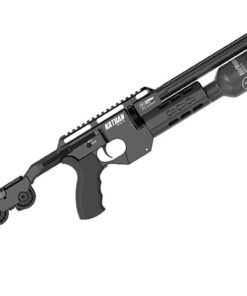
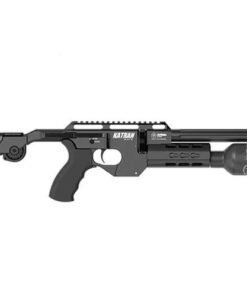
Air Rifles
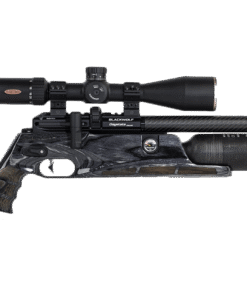
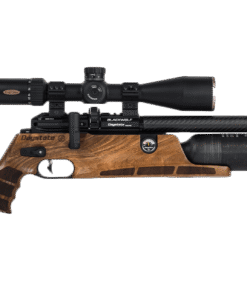
Air Rifles
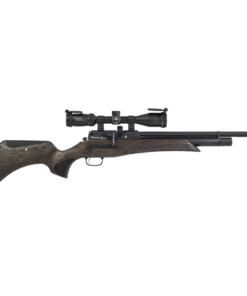
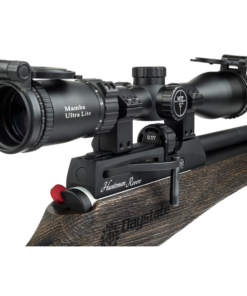
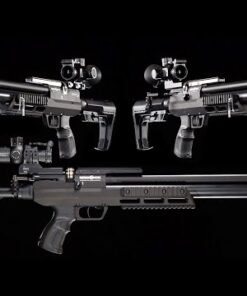
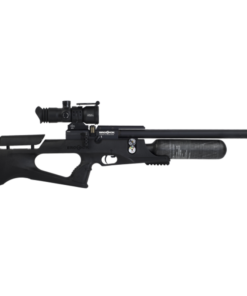
Air Rifles
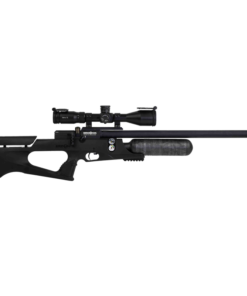
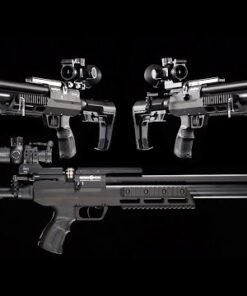
Air Rifles
Reviews
There are no reviews yet.